Global Soy Sauces Market Size is valued at $58.1 Billion in 2024 and is forecast to register a growth rate (CAGR) of 4.6% to reach $83.3 Billion by 2032.
The global Soy Sauces Market Comprehensive Study analyzes and forecasts the market size across 6 regions and 24 countries for diverse segments -By Type (Brewed, Blended), By Application (Household, Food Industry)
An Introduction to Soy Sauces Market
In 2024, the soy sauces market is expanding rapidly, driven by the increasing demand for authentic Asian flavors and versatile condiments. Soy sauce, a staple in many cuisines, is prized for its rich umami taste and diverse culinary applications. The market is characterized by a wide range of products, including traditional, low-sodium, and gluten-free varieties to cater to various dietary preferences. Innovations in fermentation techniques and natural brewing methods are enhancing the quality and flavor profiles of soy sauces. The rise of global food trends, along with the popularity of home cooking and international cuisines, is significantly boosting market growth. Major producers are focusing on sustainable production practices and eco-friendly packaging to appeal to environmentally conscious consumers.
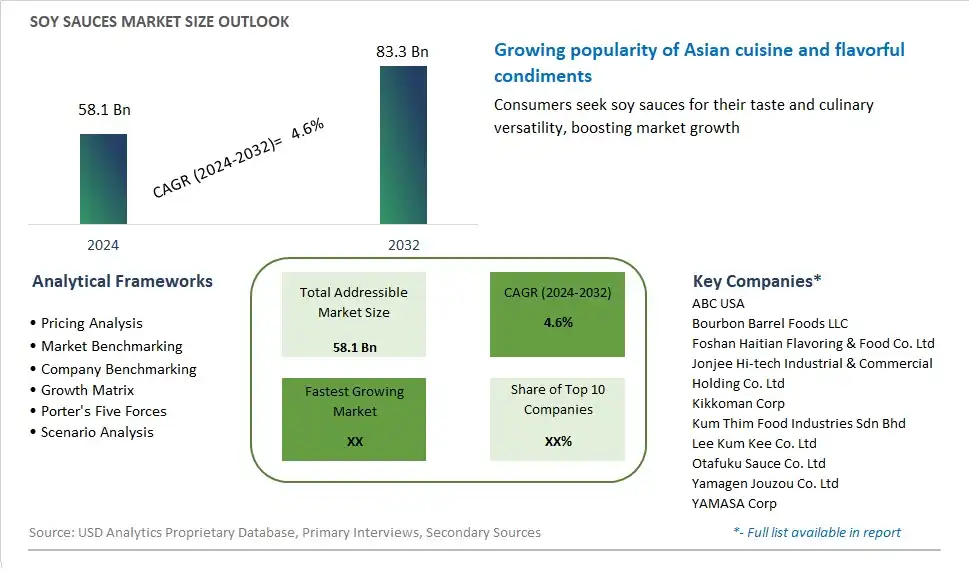
Soy Sauces Competitive Landscape
The market report analyses the leading companies in the industry including ABC USA, Bourbon Barrel Foods LLC, Foshan Haitian Flavoring & Food Co. Ltd, Jonjee Hi-tech Industrial & Commercial Holding Co. Ltd, Kikkoman Corp, Kum Thim Food Industries Sdn Bhd, Lee Kum Kee Co. Ltd, Otafuku Sauce Co. Ltd, Yamagen Jouzou Co. Ltd, YAMASA Corp, and Others.
Soy Sauces Market Dynamics
Soy Sauces Market Trend: Rising Demand for Authentic and Artisanal Soy Sauces
One prominent market trend in soy sauces is the rising demand for authentic and artisanal varieties. As consumers increasingly seek high-quality and flavorful condiments, there is a growing appreciation for traditional methods of soy sauce production, such as fermentation and aging. This trend is driven by a desire for authenticity, unique flavor profiles, and a connection to cultural heritage. Artisanal soy sauces crafted using time-honored techniques and premium ingredients are gaining popularity among discerning consumers who value quality and craftsmanship in their culinary experiences.
Market Driver: Increased Interest in Asian Cuisine and Cooking at Home
A key market driver for soy sauces is the increased interest in Asian cuisine and cooking at home. With the globalization of food culture and the popularity of cooking shows and social media platforms showcasing diverse culinary traditions, consumers are becoming more adventurous in their food choices and cooking practices. Soy sauce, as a staple ingredient in many Asian dishes, is experiencing heightened demand as consumers explore and experiment with Asian-inspired recipes in their own kitchens. The versatility and umami-rich flavor of soy sauce make it a essential pantry staple for home cooks seeking to recreate authentic flavors and elevate their culinary creations.
Market Opportunity: Diversification and Innovation in Product Offerings
The growing demand for soy sauces presents a significant opportunity for diversification and innovation in product offerings. Manufacturers can capitalize on this trend by expanding their product lines to include a variety of soy sauce options tailored to different consumer preferences and culinary applications. This includes low-sodium or gluten-free varieties to cater to health-conscious consumers, as well as flavored or infused soy sauces to add a creative twist to traditional dishes. Furthermore, there is potential for collaboration with chefs, restaurants, and foodservice providers to develop signature blends or limited-edition releases that appeal to culinary enthusiasts and food aficionados. By leveraging opportunities for diversification and innovation, stakeholders in the soy sauce market can differentiate themselves and capture market share in an increasingly competitive landscape. Market Trend: Increasing Adoption of Genetically Modified Soybean SeedsOne prominent market trend in soybean seeds is the increasing adoption of genetically modified (GM) varieties. As agricultural practices evolve to meet the growing global demand for soybeans, genetically modified seeds are gaining traction among farmers for their enhanced traits such as herbicide tolerance, pest resistance, and higher yields. This trend is driven by the desire to improve crop productivity, reduce production costs, and mitigate risks associated with pests and weeds. With advancements in biotechnology and genetic engineering, genetically modified soybean seeds are becoming increasingly prevalent in agricultural landscapes worldwide, shaping the future of soybean cultivation.
Market Driver: Growing Demand for Protein-Rich Animal Feed
A key market driver for soybean seeds is the growing demand for protein-rich animal feed. Soybeans are a valuable source of protein and essential nutrients used in livestock feed formulations for poultry, swine, cattle, and aquaculture industries. With increasing meat consumption and rising demand for animal protein globally, there is a corresponding need for high-quality feed ingredients to support animal growth, health, and production efficiency. Soybean seeds, with their high protein content and amino acid profile, are a preferred choice for formulating nutritious and balanced feed rations, driving demand for soybean cultivation and production.
Market Opportunity: Expansion in Emerging Markets and Sustainable Agriculture
The growing demand for soybean seeds presents a significant opportunity for expansion in emerging markets and sustainable agriculture initiatives. As population growth, urbanization, and changing dietary patterns drive demand for protein-rich foods, there is a need to expand soybean production to meet rising food and feed requirements. This includes opportunities for market penetration in regions with growing livestock industries and increasing adoption of soy-based products in human diets. Additionally, there is potential for promoting sustainable agricultural practices, such as conservation tillage, crop rotation, and precision farming techniques, to improve soil health, conserve natural resources, and enhance the environmental sustainability of soybean cultivation. By leveraging opportunities in emerging markets and embracing sustainable agriculture principles, stakeholders in the soybean seed market can contribute to food security, economic development, and environmental stewardship on a global scale.
Soy Sauces Market Share Analysis: Brewed Segment Leads held the dominant market share in 2024
In the Soy Sauces Market, the brewed segment is the largest, propelled by its traditional production methods, rich flavor profile, and widespread usage in culinary applications. Brewed soy sauce undergoes a fermentation process that enhances its depth of flavor and complexity, making it a staple condiment in Asian cuisines and beyond. Its distinctive umami taste adds depth and richness to a wide range of dishes, from stir-fries and marinades to dipping sauces and dressings. Further, brewed soy sauce is valued for its authenticity and purity, as it typically contains only soybeans, wheat, salt, and water. While blended soy sauces offer variations in flavor and consistency by combining brewed soy sauce with other ingredients, the brewed segment maintains its dominance due to its long-standing tradition, superior taste, and versatility in culinary applications. As consumers continue to seek authentic and high-quality ingredients for their cooking, the brewed segment of the soy sauces market remains poised for sustained growth.
Soy Sauces Market Share Analysis: Driving the Fast Growth of the Soy Sauces market is poised to register the fastest growth rae over the forecast period to 2032
The household application segment within the soy sauces market has emerged as the fastest-growing sector, showcasing a robust upward trajectory primarily due to shifting consumer preferences and lifestyle changes. With an increasing focus on healthier eating habits and the rising popularity of Asian cuisines worldwide, more households are incorporating soy sauces into their everyday cooking routines. Further, the growing awareness regarding the nutritional benefits of soy-based products, such as their high protein content and potential health-promoting properties, has further fueled the demand for soy sauces among households. Additionally, the convenience offered by ready-to-use soy sauce products and the expanding availability of diverse flavor profiles cater to the evolving tastes of consumers, thereby stimulating market growth. As consumers continue to seek flavorful and nutritious alternatives, the household application segment is poised to sustain its rapid expansion, contributing significantly to the overall growth of the soy sauces market.
Soy Sauces Market Segmentation
By Type
Brewed
Blended
By Application
Household
Food Industry
Countries Analyzed
North America (US, Canada, Mexico)
Europe (Germany, UK, France, Spain, Italy, Russia, Rest of Europe)
Asia Pacific (China, India, Japan, South Korea, Australia, South East Asia, Rest of Asia)
South America (Brazil, Argentina, Rest of South America)
Middle East and Africa (Saudi Arabia, UAE, Rest of Middle East, South Africa, Egypt, Rest of Africa)
Soy Sauces Companies Profiled in the Study
ABC USA
Bourbon Barrel Foods LLC
Foshan Haitian Flavoring & Food Co. Ltd
Jonjee Hi-tech Industrial & Commercial Holding Co. Ltd
Kikkoman Corp
Kum Thim Food Industries Sdn Bhd
Lee Kum Kee Co. Ltd
Otafuku Sauce Co. Ltd
Yamagen Jouzou Co. Ltd
YAMASA Corp
*- List Not Exhaustive
Chapter 1. TABLE OF CONTENTS
Chapter 2. Introduction to Soy Sauces Market
2.1. Market Overview
2.2. Key Statistics and Report Highlights
2.3. Scope of the Comprehensive Study
2.3.1. Market Definition
2.3.2 Countries and Regions Covered
2.3.3 Research Objective
2.3.4 Units, Currency, and Conversions
2.3.5 Industry Value Chain
2.4. Key Market Segments
2.5. Key Companies
2.6. Study Period
Chapter 3. Strategic Analysis Review
3.1. Soy Sauces Pricing Analysis and Forecast
3.2. Porter’s Five Forces
3.3. Market Ecosystem
3.4. SWOT Analysis
3.5. Regulatory Scenario
3.3. Effects of Inflation, Russia-Ukraine War, moderating economic growth, and other macroeconomic factors
Chapter 4. Competitive Landscape
4.1. Market Share Analysis
4.1.1. Global Soy Sauces Market Share by Company, 2023
4.1.2. Product Offerings of Leading Soy Sauces Companies
4.2. Market Entropy
4.2.1. New Product Launches in the Industry
4.2.2. Mergers, Acquisitions, Joint ventures, and Partnerships
4.3. Key Strategies and Best Practices
Chapter 5. Global Market Projections: Best, Reference, and Low Case Scenarios
5.1. Growth Analysis- Case Scenario Definitions
5.2. Low Growth Case Scenario Forecasts
5.3. Reference Growth Case Scenario Forecasts
5.4. High Growth Case Scenario Forecasts
Chapter 6. Market Dynamics
6.1. Soy Sauces Market Drivers
6.2. Soy Sauces Market Challenges
6.6. Soy Sauces Market Opportunities
6.4. Soy Sauces Market Trends
Chapter 7. Global Soy Sauces Market Outlook Trends
7.1. Global Soy Sauces Revenue (USD Million) and CAGR (%) by Type (2021-2032)
7.2. Global Soy Sauces Revenue (USD Million) and CAGR (%) by Application (2021-2032)
7.3. Global Soy Sauces Revenue (USD Million) and CAGR (%) by Product (2021-2032)
By Type
Brewed
Blended
By Application
Household
Food Industry
Chapter 8. Global Soy Sauces Regional Analysis and Outlook
8.1. Global Soy Sauces Revenue (USD Million) By Regions (2021- 2032)
8.2. North America Soy Sauces Revenue (USD Million) by Country (2021-2032)
8.2.1. United States Soy Sauces Regional Analysis and Outlook
8.2.2. Canada Soy Sauces Regional Analysis and Outlook
8.2.3. Mexico Soy Sauces Regional Analysis and Outlook
8.3. Europe Soy Sauces Revenue (USD Million), by Country (2021-2032)
8.3.1. Germany Soy Sauces Regional Analysis and Outlook
8.3.2. France Soy Sauces Regional Analysis and Outlook
8.3.3. United Kingdom Soy Sauces Regional Analysis and Outlook
8.3.4. Spain Soy Sauces Regional Analysis and Outlook
8.3.5. Italy Soy Sauces Regional Analysis and Outlook
8.3.6. Russia Soy Sauces Regional Analysis and Outlook
8.3.7. Rest of Europe Soy Sauces Regional Analysis and Outlook
8.4. Asia Pacific Soy Sauces Revenue (USD Million) by Country (2021-2032)
8.4.1. China Soy Sauces Regional Analysis and Outlook
8.4.2. Japan Soy Sauces Regional Analysis and Outlook
8.4.3. India Soy Sauces Regional Analysis and Outlook
8.4.4. South Korea Soy Sauces Regional Analysis and Outlook
8.4.5. Australia Soy Sauces Regional Analysis and Outlook
8.4.6. South East Asia Soy Sauces Regional Analysis and Outlook
8.4.7. Rest of Asia Pacific Soy Sauces Regional Analysis and Outlook
8.5. South America Soy Sauces Revenue (USD Million), by Country (2021-2032)
8.5.1. Brazil Soy Sauces Regional Analysis and Outlook
8.5.2. Argentina Soy Sauces Regional Analysis and Outlook
8.5.3. Rest of South America Soy Sauces Regional Analysis and Outlook
8.6. Middle East and Africa Soy Sauces Revenue (USD Million) by Country (2021-2032)
8.6.1. Middle East Soy Sauces Regional Analysis and Outlook
8.6.2. Africa Soy Sauces Regional Analysis and Outlook
Chapter 9. North America Soy Sauces Analysis and Outlook
9.1. North America Soy Sauces Revenue (USD Million) by Segments (2021-2032)
9.1.1. North America Soy Sauces Revenue (USD Million) by Type (2021-2032)
9.1.2. North America Soy Sauces Revenue (USD Million) by Application (2021-2032)
9.1.3. North America Soy Sauces Revenue (USD Million) by Product (2021-2032)
By Type
Brewed
Blended
By Application
Household
Food Industry
Chapter 10. Europe Soy Sauces Analysis and Outlook
10.1. Europe Soy Sauces Revenue (USD Million), by Segments (USD Million) (2021-2032)
10.1.1. Europe Soy Sauces Revenue (USD Million) by Type (2021-2032)
10.1.2. Europe Soy Sauces Revenue (USD Million) by Application (2021-2032)
10.1.3. Europe Soy Sauces Revenue (USD Million) by Product (2021-2032)
By Type
Brewed
Blended
By Application
Household
Food Industry
Chapter 11. Asia Pacific Soy Sauces Analysis and Outlook
11.1. Asia Pacific Soy Sauces Revenue (USD Million), and Revenue (USD Million) by Segments (2021-2032)
11.1.1. Asia Pacific Soy Sauces Revenue (USD Million) by Type (2021-2032)
11.1.2. Asia Pacific Soy Sauces Revenue (USD Million) by Application (2021-2032)
11.1.3. Asia Pacific Soy Sauces Revenue (USD Million) by Product (2021-2032)
By Type
Brewed
Blended
By Application
Household
Food Industry
Chapter 12. South America Soy Sauces Analysis and Outlook
12.1. South America Soy Sauces Revenue (USD Million), by Segments (2021-2032)
12.1.1. South America Soy Sauces Revenue (USD Million) by Type (2021-2032)
12.1.2. South America Soy Sauces Revenue (USD Million) by Application (2021-2032)
12.1.3. South America Soy Sauces Revenue (USD Million) by Product (2021-2032)
By Type
Brewed
Blended
By Application
Household
Food Industry
Chapter 13. Middle East and Africa Soy Sauces Analysis and Outlook
13.1. Middle East and Africa Soy Sauces Revenue (USD Million), by Segments (2021-2032)
13.1.1. Middle East and Africa Soy Sauces Revenue (USD Million) by Type (2021-2032)
13.1.2. Middle East and Africa Soy Sauces Revenue (USD Million) by Application (2021-2032)
13.1.3. Middle East and Africa Soy Sauces Revenue (USD Million) by Product (2021-2032)
By Type
Brewed
Blended
By Application
Household
Food Industry
Chapter 14. Soy Sauces Company Profiles
14.1 Business Overview
14.2 Product Profiles
14.3 SWOT Profiles
14.5 Recent Developments
14.6 Financial Profile
List of Companies
ABC USA
Bourbon Barrel Foods LLC
Foshan Haitian Flavoring & Food Co. Ltd
Jonjee Hi-tech Industrial & Commercial Holding Co. Ltd
Kikkoman Corp
Kum Thim Food Industries Sdn Bhd
Lee Kum Kee Co. Ltd
Otafuku Sauce Co. Ltd
Yamagen Jouzou Co. Ltd
YAMASA Corp
15. Methodology and Data Sources
15.1 Customization Offerings
15.2 Subscription Services
15.3 Related Reports
15.4 Publisher Expertise
LIST OF TABLES
Table 1 Market Segmentation Analysis
Table 2 Global Soy Sauces Market Share of Leading Companies, 2023
Table 3 Product Offerings of Leading Companies
Table 4 Low Growth Scenario Forecasts
Table 5 Reference Case Growth Scenario
Table 6 High Growth Case Scenario
Table 7 Global Soy Sauces Revenue (USD Million) And CAGR (%) By Type (2021-2032)
Table 8 Global Soy Sauces Revenue (USD Million) And CAGR (%) By Application (2021-2032)
Table 9 Global Soy Sauces Revenue (USD Million) And CAGR (%) By Product (2021-2032)
Table 10 Global Soy Sauces Market Revenue (USD Million) By Regions (2021-2032)
Table 11 Global Soy Sauces Market Share (%) By Regions (2021-2032)
Table 12 North America Soy Sauces Revenue (USD Million) By Country (2021-2032)
Table 13 Europe Soy Sauces Revenue (USD Million) By Country (2021-2032)
Table 14 Asia Pacific Soy Sauces Revenue (USD Million) By Country (2021-2032)
Table 15 South America Soy Sauces Revenue (USD Million) By Country (2021-2032)
Table 16 Middle East and Africa Soy Sauces Revenue (USD Million) By Region (2021-2032)
Table 17 North America Soy Sauces Revenue (USD Million) By Type (2021-2032)
Table 18 North America Soy Sauces Revenue (USD Million) By Application (2021-2032)
Table 19 North America Soy Sauces Revenue (USD Million) By Product (2021-2032)
Table 20 Europe Soy Sauces Revenue (USD Million) By Type (2021-2032)
Table 21 Europe Soy Sauces Revenue (USD Million) By Application (2021-2032)
Table 22 Europe Soy Sauces Revenue (USD Million) By Product (2021-2032)
Table 23 Asia Pacific Soy Sauces Revenue (USD Million) By Type (2021-2032)
Table 24 Asia Pacific Soy Sauces Revenue (USD Million) By Application (2021-2032)
Table 25 Asia Pacific Soy Sauces Revenue (USD Million) By Product (2021-2032)
Table 26 South America Soy Sauces Revenue (USD Million) By Type (2021-2032)
Table 27 South America Soy Sauces Revenue (USD Million) By Application (2021-2032)
Table 28 South America Soy Sauces Revenue (USD Million) By Product (2021-2032)
Table 29 Middle East and Africa Soy Sauces Revenue (USD Million) By Type (2021-2032)
Table 30 Middle East and Africa Soy Sauces Revenue (USD Million) By Application (2021-2032)
Table 31 Middle East and Africa Soy Sauces Revenue (USD Million) By Product (2021-2032)
LIST OF FIGURES
Figure 1. Market Scope
Figure 2. Pricing Forecasts Per Unit, 2023- 2032
Figure 3. Porter’s Five Forces
Figure 4. Global Soy Sauces Market Revenue (USD Million) By Regions (2021-2032)
Figure 5. Global Soy Sauces Market Share (%) By Regions (2023)
Figure 6. North America Soy Sauces Revenue (USD Million) By Country (2021-2032)
Figure 7. United States Soy Sauces Revenue (USD Million) By Country (2021-2032)
Figure 8. Canada Soy Sauces Revenue (USD Million) By Country (2021-2032)
Figure 9. Mexico Soy Sauces Revenue (USD Million) By Country (2021-2032)
Figure 10. Europe Soy Sauces Revenue (USD Million) By Country (2021-2032)
Figure 11. Germany Soy Sauces Revenue (USD Million) By Country (2021-2032)
Figure 12. France Soy Sauces Revenue (USD Million) By Country (2021-2032)
Figure 13. United Kingdom Soy Sauces Revenue (USD Million) By Country (2021-2032)
Figure 14. Spain Soy Sauces Revenue (USD Million) By Country (2021-2032)
Figure 15. Italy Soy Sauces Revenue (USD Million) By Country (2021-2032)
Figure 16. Russia Soy Sauces Revenue (USD Million) By Country (2021-2032)
Figure 17. Rest of Europe Soy Sauces Revenue (USD Million) By Country (2021-2032)
Figure 11. Asia Pacific Soy Sauces Revenue (USD Million) By Country (2021-2032)
Figure 12. China Soy Sauces Revenue (USD Million) By Country (2021-2032)
Figure 13. Japan Soy Sauces Revenue (USD Million) By Country (2021-2032)
Figure 14. India Soy Sauces Revenue (USD Million) By Country (2021-2032)
Figure 15. South Korea Soy Sauces Revenue (USD Million) By Country (2021-2032)
Figure 16. Australia Soy Sauces Revenue (USD Million) By Country (2021-2032)
Figure 17. South East Asia Soy Sauces Revenue (USD Million) By Country (2021-2032)
Figure 18. South America Soy Sauces Revenue (USD Million) By Country (2021-2032)
Figure 19. Brazil Soy Sauces Revenue (USD Million) By Country (2021-2032)
Figure 20. Argentina Soy Sauces Revenue (USD Million) By Country (2021-2032)
Figure 21. Rest of Asia Pacific Soy Sauces Revenue (USD Million) By Country (2021-2032)
Figure 22. Middle East and Africa Soy Sauces Revenue (USD Million) By Region (2021-2032)
Figure 23. Saudi Arabia Soy Sauces Revenue (USD Million) By Region (2021-2032)
Figure 24. The UAE Soy Sauces Revenue (USD Million) By Region (2021-2032)
Figure 25. Rest of Middle East Soy Sauces Revenue (USD Million) By Region (2021-2032)
Figure 26. South Africa Soy Sauces Revenue (USD Million) By Region (2021-2032)
Figure 27. Africa Soy Sauces Revenue (USD Million) By Region (2021-2032)
Figure 28. North America Soy Sauces Revenue (USD Million) By Type (2021-2032)
Figure 29. North America Soy Sauces Revenue (USD Million) By Application (2021-2032)
Figure 30. North America Soy Sauces Revenue (USD Million) By Product (2021-2032)
Figure 31. Europe Soy Sauces Revenue (USD Million) By Type (2021-2032)
Figure 32. Europe Soy Sauces Revenue (USD Million) By Application (2021-2032)
Figure 33. Europe Soy Sauces Revenue (USD Million) By Product (2021-2032)
Figure 34. Asia Pacific Soy Sauces Revenue (USD Million) By Type (2021-2032)
Figure 35. Asia Pacific Soy Sauces Revenue (USD Million) By Application (2021-2032)
Figure 36. Asia Pacific Soy Sauces Revenue (USD Million) By Product (2021-2032)
Figure 37. South America Soy Sauces Revenue (USD Million) By Type (2021-2032)
Figure 38. South America Soy Sauces Revenue (USD Million) By Application (2021-2032)
Figure 39. South America Soy Sauces Revenue (USD Million) By Product (2021-2032)
Figure 40. Middle East and Africa Soy Sauces Revenue (USD Million) By Type (2021-2032)
Figure 41. Middle East and Africa Soy Sauces Revenue (USD Million) By Application (2021-2032)
Figure 42. Middle East and Africa Soy Sauces Revenue (USD Million) By Product (2021-2032)
By Type
Brewed
Blended
By Application
Household
Food Industry
Countries Analyzed
North America (US, Canada, Mexico)
Europe (Germany, UK, France, Spain, Italy, Russia, Rest of Europe)
Asia Pacific (China, India, Japan, South Korea, Australia, South East Asia, Rest of Asia)
South America (Brazil, Argentina, Rest of South America)
Middle East and Africa (Saudi Arabia, UAE, Rest of Middle East, South Africa, Egypt, Rest of Africa)
