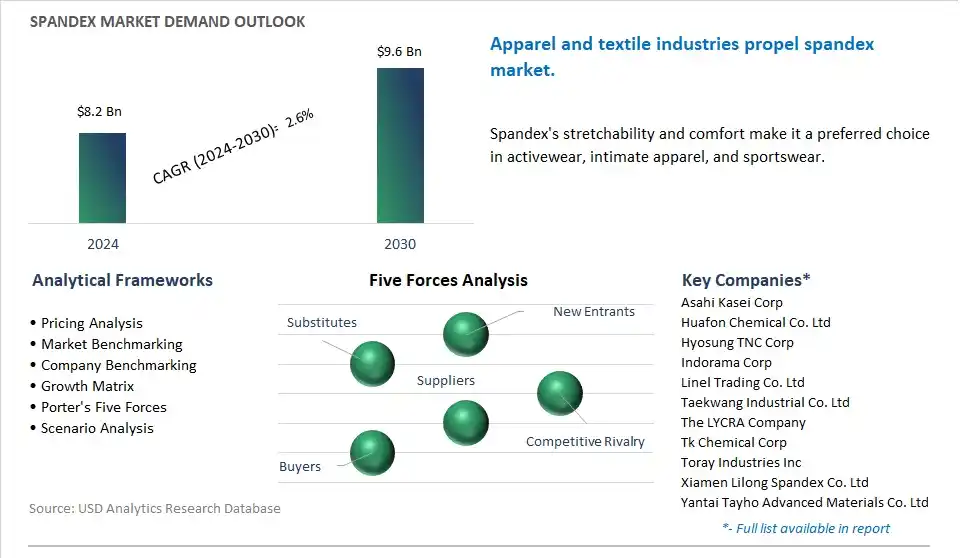
The global Spandex Market is poised to register a 2.6% CAGR from $8.2 Billion in 2024 to $9.6 Billion in 2030.
The global Spandex Market Study analyzes and forecasts the market size across 6 regions and 24 countries for diverse segments -By Production Method (Solution Dry Spinning, Solution Wet Spinning, Others), By Application (Apparels, Medical, Others).
An Introduction to Global Spandex Market in 2024
The future of spandex is influenced by trends in apparel, sportswear, and technical textiles, driven by the demand for stretchable, comfortable, and performance-enhancing materials in diverse applications. Spandex, also known as elastane or Lycra, is a synthetic fiber renowned for its exceptional elasticity, resilience, and form-fitting properties, making it a popular choice for stretch fabrics used in garments, activewear, swimwear, lingerie, and medical textiles. With the increasing emphasis on athleisure, fitness, and wellness lifestyles, spandex plays a crucial role in providing comfort, freedom of movement, and moisture management in sportswear and activewear, enabling athletes and consumers to perform at their best while staying dry and comfortable. Moreover, as fashion trends evolve towards body-conscious silhouettes, seamless constructions, and functional clothing, spandex blends with natural and synthetic fibers offer designers and manufacturers versatility, drape, and stretch recovery for creating innovative and stylish apparel collections. Additionally, advancements in spandex production technology, fiber engineering, and finishing treatments enable the development of performance-enhanced spandex fibers with features such as UV protection, antimicrobial properties, and moisture wicking, meeting the stringent requirements of technical textiles for medical, aerospace, automotive, and industrial applications. Furthermore, as sustainability concerns and circular economy initiatives drive demand for eco-friendly and recyclable materials in the textile industry, spandex manufacturers are exploring bio-based alternatives, recycling technologies, and closed-loop systems to reduce environmental impact and improve resource efficiency throughout the spandex value chain. As consumers continue to prioritize comfort, performance, and sustainability in their clothing choices, spandex will remain a key ingredient in the fabrics of the future, driving innovation and market growth in the global textile and apparel industry.
Spandex Market Competitive Landscape
The market report analyses the leading companies in the industry including Asahi Kasei Corp, Huafon Chemical Co. Ltd, Hyosung TNC Corp, Indorama Corp, Linel Trading Co. Ltd, Taekwang Industrial Co. Ltd, The LYCRA Company, Tk Chemical Corp, Toray Industries Inc, Xiamen Lilong Spandex Co. Ltd, Yantai Tayho Advanced Materials Co. Ltd.
Spandex Market Dynamics
Spandex Market Trend: Growing Demand for Comfortable and Stretchable Apparel
A prominent trend in the spandex market is the growing demand for comfortable and stretchable apparel. Spandex, also known as elastane or Lycra, is widely used in the textile industry to add elasticity and stretch to various types of clothing, including activewear, swimwear, lingerie, and athleisure. As consumers prioritize comfort, mobility, and performance in their clothing choices, the demand for garments with stretch and recovery properties provided by spandex continues to rise. This is driven by the popularity of athleisure fashion, fitness activities, and lifestyle trends emphasizing comfort and versatility. As the athleisure market expands and consumers seek clothing that seamlessly transitions from the gym to everyday wear, the demand for spandex-infused apparel is expected to grow.
Spandex Market Driver: Advancements in Textile Technology and Fabric Innovation
The primary driver behind the spandex market's growth is advancements in textile technology and fabric innovation. Manufacturers are continuously developing new spandex fibers and blends with improved stretch, recovery, and comfort characteristics to meet evolving consumer preferences and performance requirements. Innovations such as microfiber spandex, moisture-wicking blends, and eco-friendly spandex alternatives are driving product differentiation and market competitiveness. Additionally, advancements in textile manufacturing processes, including knitting, weaving, and dyeing, enable the production of high-quality spandex fabrics with enhanced properties and aesthetics. This driver is significant as it enables textile producers and apparel brands to offer innovative and differentiated products that meet the demands of modern consumers.
Spandex Market Opportunity: Expansion into New Application Areas and Product Segments
An attractive opportunity within the spandex market lies in the expansion into new application areas and product segments. While spandex is traditionally associated with apparel, there are opportunities to explore new applications and markets where stretchable and elastic materials are in demand. For example, spandex fibers and blends can be used in medical compression garments, orthopedic braces, and prosthetic devices to provide support, flexibility, and comfort. Similarly, there's potential for spandex in automotive interiors, upholstery, and furniture fabrics, where stretch and durability are needd. By diversifying their product portfolios and targeting new application areas beyond traditional apparel, spandex manufacturers can unlock new revenue streams and capitalize on emerging market opportunities.
Spandex Market Share Analysis: solution dry spinning generated the highest revenue in 2024
The largest segment in the Spandex Market is the solution dry spinning method. solution dry spinning is one of the most widely used and established methods for producing spandex fibers. This method involves dissolving the spandex polymer in a solvent, then extruding the solution through spinnerets into a heated chamber, where the solvent evaporates, leaving behind continuous spandex filaments. Solution dry spinning offers potential advantages, including high production efficiency, consistent fiber quality, and the ability to produce a wide range of fiber deniers and elastic properties to meet various end-use requirements. Additionally, solution dry spinning allows for precise control over the spinning process parameters, such as temperature, humidity, and solvent concentration, ensuring uniform fiber morphology and mechanical properties. Further, solution dry spinning technology has undergone significant advancements and optimization over the years, leading to improved spinning performance, higher productivity, and lower production costs. Furthermore, solution dry spinning is compatible with a variety of spandex polymer compositions, including polyurethane-based and polyester-based formulations, further contributing to its dominance in the spandex market. Accordingly, the solution dry spinning method is the largest segment in the spandex market.
Spandex Market Share Analysis: medical application segment is poised to register the fastest growth rate (CAGR) over the forecast period to 2030
The fastest-growing segment in the Spandex Market is the medical application sector. There is an increasing demand for spandex fibers in medical applications due to their unique combination of stretchability, comfort, and durability. Spandex is used in various medical products and devices, including compression garments, surgical bandages, orthopedic supports, and wound dressings, to provide gentle compression, support, and flexibility while ensuring patient comfort and mobility. Additionally, advancements in medical textile technology and manufacturing processes have led to the development of innovative spandex-based medical textiles with enhanced performance characteristics, such as antimicrobial properties, moisture management, and breathability, further expanding the application potential of spandex in the medical field. Further, the growing prevalence of chronic diseases, sports injuries, and surgical procedures worldwide drives the demand for medical garments and devices made from spandex fibers, supporting market growth. Furthermore, the COVID-19 pandemic has further accelerated the demand for medical textiles, including spandex-based protective apparel such as surgical gowns, masks, and gloves, as well as compression garments for managing lymphedema and venous disorders, contributing to the rapid growth of the medical application segment in the spandex market. Accordingly, the medical application sector is the fastest-growing segment in the spandex market.
Spandex Market Report Segmentation
By Production Method
Solution Dry Spinning
Solution Wet Spinning
Others
By Application
Apparels
Medical
Others
Regions Included
North America (US, Canada, Mexico)
Europe (Germany, UK, France, Spain, Italy, Russia, Rest of Europe)
Asia Pacific (China, India, Japan, South Korea, Australia, South East Asia, Rest of Asia)
South America (Brazil, Argentina, Rest of South America)
Middle East and Africa (Saudi Arabia, UAE, Rest of Middle East, South Africa, Egypt, Rest of Africa)
Spandex Companies Profiled in the Market Study
Asahi Kasei Corp
Huafon Chemical Co. Ltd
Hyosung TNC Corp
Indorama Corp
Linel Trading Co. Ltd
Taekwang Industrial Co. Ltd
The LYCRA Company
Tk Chemical Corp
Toray Industries Inc
Xiamen Lilong Spandex Co. Ltd
Yantai Tayho Advanced Materials Co. Ltd
*- List Not Exhaustive
TABLE OF CONTENTS
1 Introduction to 2024 Spandex Market
1.1 Market Overview
1.2 Quick Facts
1.3 Scope/Objective of the Study
1.4 Market Definition
1.5 Countries and Regions Covered
1.6 Units, Currency, and Conversions
1.7 Industry Value Chain
2 Research Methodology
2.1 Market Size Estimation
2.2 Sources and Research Methodology
2.3 Data Triangulation
2.4 Assumptions and Limitations
3 Executive Summary
3.1 Global Spandex Market Size Outlook, $ Million, 2021 to 2030
3.2 Spandex Market Outlook by Type, $ Million, 2021 to 2030
3.3 Spandex Market Outlook by Product, $ Million, 2021 to 2030
3.4 Spandex Market Outlook by Application, $ Million, 2021 to 2030
3.5 Spandex Market Outlook by Key Countries, $ Million, 2021 to 2030
4 Market Dynamics
4.1 Key Driving Forces of Spandex Industry
4.2 Key Market Trends in Spandex Industry
4.3 Potential Opportunities in Spandex Industry
4.4 Key Challenges in Spandex Industry
5 Market Factor Analysis
5.1 Value Chain Analysis
5.2 Competitive Landscape
5.2.1 Global Spandex Market Share by Company (%), 2023
5.2.2 Product Offerings by Company
5.3 Porter’s Five Forces Analysis
5.4 Pricing Analysis and Outlook
6 Growth Outlook Across Scenarios
6.1 Growth Analysis-Case Scenario Definitions
6.2 Low Growth Scenario Forecasts
6.3 Reference Growth Scenario Forecasts
6.4 High Growth Scenario Forecasts
7 Global Spandex Market Outlook by Segments
7.1 Spandex Market Outlook by Segments, $ Million, 2021- 2030
By Production Method
Solution Dry Spinning
Solution Wet Spinning
Others
By Application
Apparels
Medical
Others
8 North America Spandex Market Analysis and Outlook To 2030
8.1 Introduction to North America Spandex Markets in 2024
8.2 North America Spandex Market Size Outlook by Country, 2021-2030
8.2.1 United States
8.2.2 Canada
8.2.3 Mexico
8.3 North America Spandex Market size Outlook by Segments, 2021-2030
By Production Method
Solution Dry Spinning
Solution Wet Spinning
Others
By Application
Apparels
Medical
Others
9 Europe Spandex Market Analysis and Outlook To 2030
9.1 Introduction to Europe Spandex Markets in 2024
9.2 Europe Spandex Market Size Outlook by Country, 2021-2030
9.2.1 Germany
9.2.2 France
9.2.3 Spain
9.2.4 United Kingdom
9.2.4 Italy
9.2.5 Russia
9.2.6 Norway
9.2.7 Rest of Europe
9.3 Europe Spandex Market Size Outlook by Segments, 2021-2030
By Production Method
Solution Dry Spinning
Solution Wet Spinning
Others
By Application
Apparels
Medical
Others
10 Asia Pacific Spandex Market Analysis and Outlook To 2030
10.1 Introduction to Asia Pacific Spandex Markets in 2024
10.2 Asia Pacific Spandex Market Size Outlook by Country, 2021-2030
10.2.1 China
10.2.2 India
10.2.3 Japan
10.2.4 South Korea
10.2.5 Indonesia
10.2.6 Malaysia
10.2.7 Australia
10.2.8 Rest of Asia Pacific
10.3 Asia Pacific Spandex Market size Outlook by Segments, 2021-2030
By Production Method
Solution Dry Spinning
Solution Wet Spinning
Others
By Application
Apparels
Medical
Others
11 South America Spandex Market Analysis and Outlook To 2030
11.1 Introduction to South America Spandex Markets in 2024
11.2 South America Spandex Market Size Outlook by Country, 2021-2030
11.2.1 Brazil
11.2.2 Argentina
11.2.3 Rest of South America
11.3 South America Spandex Market size Outlook by Segments, 2021-2030
By Production Method
Solution Dry Spinning
Solution Wet Spinning
Others
By Application
Apparels
Medical
Others
12 Middle East and Africa Spandex Market Analysis and Outlook To 2030
12.1 Introduction to Middle East and Africa Spandex Markets in 2024
12.2 Middle East and Africa Spandex Market Size Outlook by Country, 2021-2030
12.2.1 Saudi Arabia
12.2.2 UAE
12.2.3 Oman
12.2.4 Rest of Middle East
12.2.5 Egypt
12.2.6 Nigeria
12.2.7 South Africa
12.2.8 Rest of Africa
12.3 Middle East and Africa Spandex Market size Outlook by Segments, 2021-2030
By Production Method
Solution Dry Spinning
Solution Wet Spinning
Others
By Application
Apparels
Medical
Others
13 Company Profiles
13.1 Company Snapshot
13.2 SWOT Profiles
13.3 Products and Services
13.4 Recent Developments
13.5 Financial Profile
Asahi Kasei Corp
Huafon Chemical Co. Ltd
Hyosung TNC Corp
Indorama Corp
Linel Trading Co. Ltd
Taekwang Industrial Co. Ltd
The LYCRA Company
Tk Chemical Corp
Toray Industries Inc
Xiamen Lilong Spandex Co. Ltd
Yantai Tayho Advanced Materials Co. Ltd
14 Appendix
14.1 Customization Offerings
14.2 Subscription Services
14.3 Related Reports
14.4 Publisher Expertise
By Production Method
Solution Dry Spinning
Solution Wet Spinning
Others
By Application
Apparels
Medical
Others
Countries Analyzed
North America (US, Canada, Mexico)
Europe (Germany, UK, France, Spain, Italy, Russia, Rest of Europe)
Asia Pacific (China, India, Japan, South Korea, Australia, South East Asia, Rest of Asia)
South America (Brazil, Argentina, Rest of South America)
Middle East and Africa (Saudi Arabia, UAE, Rest of Middle East, South Africa, Egypt, Rest of Africa)
