Market Overview: Sustainability, Tangible Value, and E-Commerce Transforming Growth
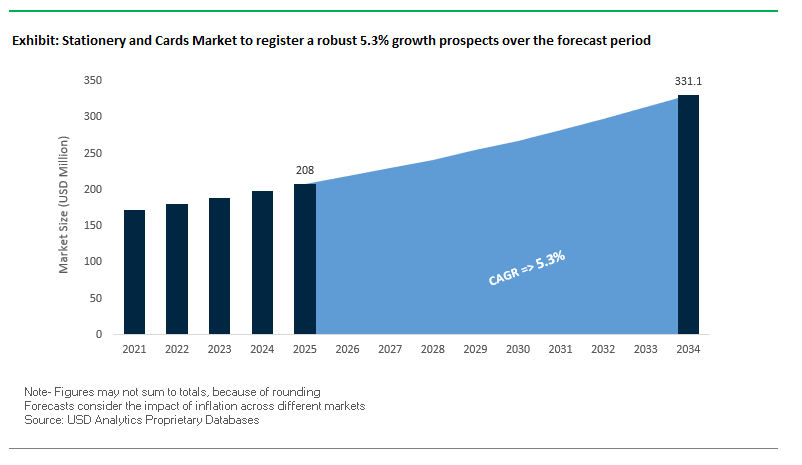
The global stationery and cards market is projected to reach USD 208 million in 2025 and expand to USD 331.1 million by 2034, reflecting a steady CAGR of 5.3%. This growth is supported by a balance of traditional consumer preferences for physical stationery and greeting cards alongside digital transformation and eco-friendly innovations.
A key driver is the rising demand for sustainable stationery, as over 65% of manufacturers integrate recycled materials and biodegradable pens report 30% YoY production growth, showing clear momentum toward greener products. Despite digital alternatives, physical stationery maintains strong relevance, with 15 billion notebooks sold annually and over 1 billion greeting cards exchanged each year in the U.S. alone. The sector is also shifting toward customized, personalized offerings, such as custom-printed greeting cards and modular planners.
The e-commerce channel continues to surge, fueled by consumer preferences for convenience, diverse product offerings, and competitive pricing. Subscription models and digital-first retail strategies are expanding reach, particularly among younger demographics. This intersection of eco-friendly production, tangible communication, and online distribution makes the stationery and cards market resilient and adaptive.
Key Insights for Industry Professionals:
Eco-friendly stationery is becoming mainstream, with biodegradable pens growing 30% YoY.
Tangible communication remains vital, with billions of notebooks and cards still in demand.
Customization drives value, from tailored planners to personalized cards.
E-commerce is the fastest-growing distribution channel, reshaping the retail landscape.
Market Analysis: Recent Developments Reshaping Stationery and Cards
The stationery and cards market is evolving rapidly, with recent developments underscoring a dual focus on digital innovation and sustainable product strategies.
In August 2025, American Greetings introduced a digital advent calendar in partnership with Peanuts Worldwide, a move that blends nostalgic traditions with modern digital engagement. Around the same time, Faber-Castell launched sustainable stationery products with a conservation group, highlighting the industry’s strong pivot toward eco-friendly solutions. In June 2025, Moleskine unveiled smart notebooks that sync handwritten notes with cloud platforms, addressing the hybrid work and study needs of modern consumers.
Strategic retail expansion also continues, with Pilot Corporation partnering with a global retailer in April 2025 to introduce an exclusive erasable pen line, strengthening its presence in international markets. In February 2025, Hallmark Cards acquired a boutique stationery brand specializing in custom wedding invitations, reinforcing its leadership in premium, personalized cards.
Earlier, in December 2024, American Greetings leveraged nostalgia by launching a digital card collection featuring Bing Crosby, while in October 2024, Hallmark and Crayola expanded their Rainbow Brite collaboration, boosting stationery and coloring book sales. The diversification trend was further highlighted in September 2024, when Hallmark expanded its partnership with Accedo to develop Hallmark+ streaming, blending physical stationery with entertainment content.
Transformative Trends and Emerging Opportunities in the Stationery and Cards Market
Premiumization and Artisanal Revival Driven by the “Analog Renaissance”
The Stationery and Cards Market is experiencing a powerful revival rooted in the Analog Renaissance, where consumers increasingly seek tactile, artisanal, and high-quality products as a counterbalance to digitalization. Unlike generic stationery, this movement emphasizes craftsmanship, sensory engagement, and authenticity, appealing to a new class of buyers who value personal expression and intentional experiences.
Consumer preference is shifting toward stationery that stimulates the senses. Premium brands are employing soft-touch coatings, embossed finishes, and textured varnishes to create products that stand out through feel as much as appearance. This tactile emphasis is tied to consumer psychology: research on analog hobbies like film photography and vinyl records underscores how individuals find satisfaction in slower, deliberate processes. Handwriting, for instance, offers not only a visual output but also a deeper emotional connection and mindfulness, qualities that digital note-taking cannot replicate.
Furthermore, stationery is increasingly positioned as a luxury lifestyle accessory, elevating products from functional tools to status symbols. Limited production runs, handcrafted elements, and bespoke customization are fueling willingness among consumers to pay premiums for uniqueness and exclusivity. This premiumization trend is driving innovation in both product design and marketing, redefining stationery as a category where authenticity, craftsmanship, and storytelling outweigh utility.
Integration of Technology for Hybrid Physical-Digital Experiences
Parallel to the artisanal revival, the Stationery and Cards Market is witnessing the emergence of hybrid physical-digital solutions that merge analog writing with digital convenience. The integration of smart technologies such as smart pens, digitized notebooks, and AR-enabled cards is enabling new consumer experiences that balance creativity, productivity, and connectivity.
Smart stationery systems allow handwritten notes and sketches to be instantly digitized and stored in the cloud, enhancing workflow efficiency. A study on smart tools found these innovations reduce task completion times by up to 25% and improve accuracy by 15%, particularly in creative and professional contexts. Beyond digitization, augmented reality (AR) is transforming greeting cards and notebooks into interactive platforms, offering animations and multimedia content when viewed through a smartphone.
This hybridization is strongly aligned with the rise of remote and hybrid work models, where users need seamless transitions between brainstorming on paper and collaborating digitally. Many professionals favor notebooks for ideation while leveraging cloud tools for project execution. By addressing this balance, stationery brands are carving out relevance in modern workflows, reinforcing the convergence of analog creativity with digital efficiency.
Expansion into the Adult “Creative Wellness” and Mindfulness Segment
One of the most promising opportunities lies in the expansion of stationery into the adult creative wellness and mindfulness sector, where writing, journaling, and art supplies are embraced as tools for emotional well-being. Unlike traditional stationery markets focused on education or office use, this segment taps into an affluent demographic prioritizing mental health, self-expression, and mindful practices.
Research from the University of Rochester Medical Center and other academic institutions confirms that journaling helps reduce stress, anxiety, and depression by providing a safe outlet for processing emotions. This positions stationery not just as a utility product, but as a therapeutic tool. Practices such as mindful writing emphasize the tactile experience the feel of pen on paper, the sound of pages turning offering a grounding alternative to screen fatigue.
A growing professional segment is also turning to creative stationery for personal expression and workplace inspiration, reinforcing its role in wellness-driven consumption. By strategically marketing journals, sketchbooks, and premium pens as tools for self-discovery, stress relief, and creativity, brands can expand their reach into the high-value lifestyle and wellness market, further elevating stationery as a meaningful purchase beyond its practical role.
Direct-to-Consumer (DTC) and Hyper-Personalization through On-Demand Manufacturing
The rise of e-commerce, digital printing, and variable data printing (VDP) is unlocking massive potential for direct-to-consumer (DTC) models and hyper-personalized stationery. This opportunity is reshaping traditional supply chains, reducing waste, and creating stronger customer relationships through personalization and interactivity.
Print-on-demand models enable stationery and greeting card producers to manufacture only after orders are placed, minimizing inventory costs and reducing paper waste from unsold products. Meanwhile, VDP technologies allow every card, notebook, or invitation to be uniquely customized with consumer-selected text, images, or artwork without raising production costs. This infinite personalization capability resonates with the growing demand for unique, one-of-a-kind products in both personal and corporate gifting markets.
Furthermore, the DTC model bypasses traditional retail intermediaries, giving brands direct access to consumer data, preferences, and purchasing behavior. This creates opportunities for personalized product recommendations, exclusive product launches, and loyalty-building campaigns. As consumers increasingly seek stationery that reflects individuality and emotional connection, DTC personalization strategies combined with sustainable, on-demand manufacturing are poised to redefine competitive dynamics in the stationery and cards industry.
Competitive Landscape: Leading Players in Global Stationery and Cards Market
The global stationery and cards market is shaped by established companies with strong brand equity, global distribution, and innovation capabilities. Players are expanding into digital ecosystems while maintaining physical product relevance.
Hallmark Cards, Inc.: Expanding Beyond Traditional Cards with Digital Entertainment
Hallmark remains one of the world’s largest greeting card manufacturers, with brands like Shoebox and Hoops&Yoyo. In September 2024, it deepened its partnership with Accedo for Hallmark+ streaming, signaling a shift into digital entertainment. Hallmark leverages a network of over 1,200 retail stores and strong licensing agreements with Disney and Marvel. By investing in digital design platforms such as Hallmark Card Studio, it bridges the gap between personalized e-cards and physical stationery.
American Greetings Corporation: Driving Digital Innovation in Social Expression
American Greetings is a global leader in both traditional greeting cards and digital offerings. In August 2025, it launched its first digital advent calendar with Peanuts Worldwide, followed by expanding its SmashUp™ video e-cards portfolio in February 2025. With a robust distribution network and significant progress in sustainability through its Actively Green 2025 goals, American Greetings continues to modernize social expression by combining physical, digital, and eco-friendly cards.
Faber-Castell AG: Sustainable Innovation in Premium Stationery
Faber-Castell, one of the oldest stationery brands (since 1761), produces premium pens, pencils, and art supplies. In July 2025, it launched a sustainable stationery line with a global conservation group, aligning with consumer demand for eco-conscious products. Operating 14 factories and 20 sales units across 120 countries, it manufactures over 200 million wood-cased pencils annually. Its strategic focus is on premium quality and eco-friendly innovation, appealing to professional artists, students, and environmentally conscious buyers.
Pilot Corporation: Growth Fueled by Erasable Pen Innovation
Pilot Corporation is a Japanese leader in writing instruments, known for its Frixion erasable pen line, which enables corrections without paper waste. In April 2025, Pilot expanded its retail footprint through a partnership with a global retailer, launching an exclusive erasable pen collection. Its strength lies in continuous innovation and writing technology leadership, while diversification into planners, notebooks, and accessories broadens its consumer appeal.
Moleskine S.r.l.: Bridging Analog and Digital Creativity
Moleskine is renowned for its luxury notebooks and planners, favored by professionals, creatives, and writers. In June 2025, it launched smart notebooks that sync notes to the cloud, creating a digital-to-paper ecosystem. Its minimalist, premium design combined with collaborations with Evernote and Livescribe has positioned it as a leader in tech-integrated stationery. By blending tradition with digital innovation, Moleskine attracts a modern, tech-savvy audience seeking creativity and connectivity.
Stationery and Cards Market Share Insights
Paper-Based Stationery Retains Lead in Stationery and Cards Market Share by Product Type
Paper-based stationery continues to dominate the global stationery and cards market with a projected 35% share in 2025, sustained by diversification into premium notebooks, bullet journals, and personalized planners. Writing instruments follow closely at 30%, driven not only by everyday utility but also by premiumization trends in fountain and rollerball pens, alongside the rising popularity of artist-grade markers and brush pens. Cards and envelopes hold a resilient position, underscored by emotional and cultural value in greetings and professional correspondence, while craft and art supplies emerge as the fastest-growing category, fueled by the DIY movement and creative hobbyists. Other stationery items, including desk accessories and decorative products like washi tape, serve as profitable add-ons in this evolving retail mix. Paper-based stationery’s ability to adapt through premiumization and personalization reinforces its position as the anchor product type, while the surrounding categories expand the market’s creative and experiential appeal.
Educational Institutions Anchor Stationery and Cards Market Share by Application
Educational institutions remain the largest application segment, accounting for 35% of stationery and cards demand in 2025, driven by consistent bulk purchases of notebooks, pens, pencils, and art supplies. Despite digital tools, physical stationery continues to play a critical role in classrooms worldwide, ensuring steady volume demand. Home use and hobbyists, however, are emerging as the fastest-growing application, representing nearly 30% of the market as hybrid work models, journaling, and crafting culture accelerate consumer adoption. Corporate offices, contributing around 25%, emphasize value through curated premium stationery, branded merchandise, and luxury writing instruments used for both utility and image. Commercial and retail applications hold a smaller but stable share, reflecting niche business use cases and impulse purchases of greeting cards and specialty stationery in retail channels. This segmentation demonstrates how the education sector anchors volume, while lifestyle-driven hobbyist demand and premiumization in corporate markets fuel incremental growth opportunities.
United States: Personalized and Eco-Friendly Stationery Fuel Market Growth
The U.S. stationery and cards market is witnessing robust expansion driven by resurgent consumer demand for physical, premium, and eco-friendly products. Consumers are increasingly valuing tangible communication, fueling demand for products such as biodegradable notebooks, recycled paper journals, and artisanal greeting cards. The rise in personalized stationery including monogrammed notebooks and custom planners offers a significant growth opportunity for brands aiming to capture niche, premium segments.
Technological advancements are reshaping the market, with smart notebooks and digitizable pens bridging the gap between physical and digital solutions, catering to tech-savvy professionals and students. Additionally, the rise of e-commerce and direct-to-consumer (D2C) models has expanded reach and engagement, allowing brands to quickly respond to market trends. Strategic product launches and collaborations, including limited-edition collections in U.S. retail stores, are further strengthening market presence while highlighting innovation in custom and sustainable stationery products.
Germany: Circular Economy and Sustainable Printing Drive Market Leadership
Germany’s stationery and cards sector operates under a stringent regulatory framework, including the EU Packaging and Packaging Waste Regulation (PPWR), which promotes the adoption of eco-friendly and highly recyclable materials. Sustainability is a key driver, with consumers demonstrating strong preferences for reusable and low-impact products, creating heightened demand for environmentally responsible stationery.
The market is embracing sustainable printing innovations, such as energy-efficient processes, low-VOC inks, and waterless printing technologies, reducing environmental impact and operational costs. Germany’s focus on a circular economy encourages manufacturers and end-users to collaborate on recycled content and resource optimization, positioning the country as a hub for high-quality, sustainable stationery solutions.
China: Industrial Growth and Digital Integration Transform Stationery Market
China’s stationery and cards market benefits from its large manufacturing base, expanding education sector, and growing middle-class population, which drive demand for school and office supplies. Government initiatives aligned with the dual carbon goals are accelerating the adoption of eco-friendly, reusable, and reduced-impact materials across the stationery industry, while subsidies for traditional paper products are decreasing.
Technological advancements, including automation, AI, and 5G-powered industrial internet, are enhancing production efficiency and flexibility. The rapid expansion of e-commerce platforms in Tier 2 and 3 cities is increasing accessibility to a wide variety of stationery products, from basic writing tools to creative supplies, fostering a strong digital-physical market integration and enabling faster response to consumer preferences.
India: Government Initiatives and Smart Stationery Propel Market Growth
India’s stationery and cards market is witnessing accelerated growth driven by government schemes such as GST reforms and PLI incentives. The recent move to 0% GST on essential educational stationery reduces costs for students and parents, boosting consumption. The technical and printed stationery sectors are benefiting from investment in mega textile and stationery parks with plug-and-play facilities, enhancing manufacturing quality and efficiency.
Technological advancements are also pivotal, with digital stationery, e-writing tablets, and intelligent pens gaining traction due to hybrid work and remote learning trends. Sustainability is a strong driver, exemplified by the launch of world’s first 100% biodegradable pen in Delhi and eco-friendly rebranding of flagship products. E-commerce and D2C channels are further expanding market reach, enabling Indian stationery brands to access both domestic and international consumers effectively.
Brazil: Sustainability and Automation Transform the Stationery Industry
Brazil’s stationery and cards market is shaped by the National Solid Waste Policy, which emphasizes a circular economy and encourages the adoption of reusable and durable alternatives. Companies are investing in automation and AI technologies, enhancing efficiency in operations such as sorting, quality inspection, and defect detection, which improves productivity and consistency.
The market is also shifting toward innovative, sustainable solutions, with brands like Kaywin focusing on efficient production systems and R&D for practical stationery innovations. Strategic partnerships and increased patent filings for adhesive and stationery innovations demonstrate a growing commitment to technology-driven, eco-conscious growth. These trends position Brazil as a key hub for sustainable, high-performance stationery products.
Japan: Bio-Based Materials and Research-Driven Innovation Lead Market Advancement
Japan’s stationery and cards market benefits from one of the world’s most advanced recycling systems, supported by the Plastic Resource Circulation Act, enabling circular production practices. The adoption of bio-based materials, such as Spiber’s Brewed Protein™, demonstrates a strong move toward sustainable production.
Innovation in functionality is another key driver, with companies utilizing recovered ocean plastics and fishing nets to produce pens and pouches. Academic research, such as the development of UV-densified printable films at Yamagata University, further advances the market by creating materials that are high-performing, sustainable, and adaptable for multiple applications. These developments reinforce Japan’s position as a global leader in eco-friendly and technologically advanced stationery solutions.
Stationery and Cards Market Report Scope
Stationery and Cards Market
Parameter
Details
Market Size (2025)
$208 Million
Market Size (2034)
$331.1 Million
Market Growth Rate
5.3%
Segments
By Product Type (Paper-based Stationery, Writing Instruments, Craft & Art Supplies, Cards & Envelopes, Other Stationery), By Application (Educational Institutions, Corporate Offices, Home Use & Hobbyists, Commercial & Retail), By Distribution Channel (Online Retail, Offline Retail, Supermarkets & Hypermarkets, Departmental Stores, Specialty Stores)
Study Period
2019- 2024 and 2025-2034
Units
Revenue (USD)
Qualitative Analysis
Porter’s Five Forces, SWOT Profile, Market Share, Scenario Forecasts, Market Ecosystem, Company Ranking, Market Dynamics, Industry Benchmarking
Companies
ACCO Brands Corporation, Beifa Group, Deli Group Co., Ltd., Faber-Castell AG, Hallmark Cards, Inc., Kokuyo Co., Ltd., Mitsubishi Pencil Co., Ltd., Navneet Education Limited, Newell Brands Inc., Pilot Corporation, Société BIC SA, Stabilo International GmbH, Staedtler Mars GmbH & Co. KG, The ODP Corporation, ZEBRA Pen Corporation
Countries
US, Canada, Mexico, Germany, France, Spain, Italy, UK, Russia, China, India, Japan, South Korea, Australia, South East Asia, Brazil, Argentina, Middle East, Africa
Stationery and Cards Market Segmentation
By Product Type
Paper-based Stationery
Writing Instruments
Craft & Art Supplies
Cards & Envelopes
Other Stationery
By Application
Educational Institutions
Corporate Offices
Home Use & Hobbyists
Commercial & Retail
By Distribution Channel
Online Retail
Offline Retail
Supermarkets & Hypermarkets
Departmental Stores
Specialty Stores
Countries Analyzed
North America (US, Canada, Mexico)
Europe (Germany, UK, France, Spain, Italy, Russia, Rest of Europe)
Asia Pacific (China, India, Japan, South Korea, Australia, South East Asia, Rest of Asia)
South America (Brazil, Argentina, Rest of South America)
Middle East and Africa (Saudi Arabia, UAE, Rest of Middle East, South Africa, Egypt, Rest of Africa)
Top Companies in Stationery and Cards Market
ACCO Brands Corporation
Beifa Group
Deli Group Co., Ltd.
Faber-Castell AG
Hallmark Cards, Inc.
Kokuyo Co., Ltd.
Mitsubishi Pencil Co., Ltd.
Navneet Education Limited
Newell Brands Inc.
Pilot Corporation
Société BIC SA
Stabilo International GmbH
Staedtler Mars GmbH & Co. KG
The ODP Corporation
ZEBRA Pen Corporation
*List not Exhaustive
Research Coverage
This report by USDAnalytics investigates the global stationery and cards market, capturing breakthroughs in sustainable materials, smart stationery, e-commerce adoption, and artisanal product innovation that are transforming both traditional and digital consumer experiences. The analysis reviews the resurgence of premium and tactile stationery driven by the Analog Renaissance, hybrid physical-digital solutions such as smart notebooks and AR-enabled cards, and the growing integration of on-demand and DTC models that facilitate hyper-personalization. It highlights emerging trends in creative wellness, mindful journaling, and eco-conscious product development, illustrating how manufacturers and retailers are leveraging technology, sustainability, and design to meet evolving consumer expectations. This report is an essential resource for industry professionals, investors, and retailers seeking actionable insights into market dynamics, competitive strategies, regional growth patterns, and innovation trajectories. By synthesizing historical data, recent developments, and forecasts, the report provides a comprehensive view of product types, applications, and distribution channels, ensuring stakeholders can identify strategic opportunities and optimize decision-making in this evolving market.
Scope Highlights:
Segmentation: By Product Type (Paper-based Stationery, Writing Instruments, Craft & Art Supplies, Cards & Envelopes, Other Stationery), By Application (Educational Institutions, Corporate Offices, Home Use & Hobbyists, Commercial & Retail), By Distribution Channel (Online Retail, Offline Retail, Supermarkets & Hypermarkets, Departmental Stores, Specialty Stores)
Geographic Scope: Analysis spans 25+ countries across North America, Europe, Asia Pacific, Latin America, the Middle East & Africa
Timeframe: Historic data from 2021 to 2024 and forecast data from 2025 to 2034
Companies: Analysis and profiles of 15+ leading companies, including Hallmark Cards, American Greetings, Faber-Castell, Pilot Corporation, Moleskine, ACCO Brands, and Staedtler Mars
Methodology
USDAnalytics employed a structured research methodology combining primary and secondary sources to deliver a precise overview of the stationery and cards market. Primary research included interviews with manufacturers, distributors, retailers, and end-users to assess trends in product design, sustainability, hybrid analog-digital offerings, and consumer preferences across diverse applications such as educational, corporate, and creative wellness segments. Secondary research encompassed company reports, regulatory publications, trade associations, patent filings, and academic studies to validate market size, growth drivers, and technological innovations. Quantitative analyses evaluated market share, sales volume, and distribution channels, while qualitative insights focused on premiumization, customization, and DTC strategies. By triangulating these data points, the methodology ensures accurate forecasting, competitive benchmarking, and actionable insights for strategic decision-making in the rapidly evolving stationery and cards landscape.
Deliverables:
Comprehensive Market Research Report (PDF and Excel) with detailed tables, charts, and interactive visualizations.
Country-Specific Forecasts & Analysis.
Segment-Wise Revenue Forecasts (2025–2034).
Competitive Analysis, Benchmarking, and SWOT Profiles.
Recent Developments & Innovation Tracker.
Executive Summary & Analyst Commentary.
Post-Purchase Analyst Support for Client-Specific Questions and Custom Data Requirements.
2. Stationery and Cards Market Landscape & Outlook (2025–2034)
2.1. Introduction to Stationery and Cards Market
2.2. Market Valuation and Growth Projections (2025–2034)
2.3. Impact of Sustainability and Eco-Friendly Materials
2.4. Role of E-Commerce and Direct-to-Consumer Models
2.5. Market Drivers, Challenges, and Emerging Opportunities
3. Innovations Reshaping the Stationery and Cards Market
3.1. Trend: Premiumization and Artisanal Revival Driven by the Analog Renaissance
3.2. Trend: Integration of Technology for Hybrid Physical-Digital Experiences
3.3. Opportunity: Expansion into Adult Creative Wellness and Mindfulness Segment
3.4. Opportunity: Direct-to-Consumer (DTC) and Hyper-Personalization through On-Demand Manufacturing
4. Competitive Landscape and Strategic Initiatives
4.1. Mergers, Acquisitions and Strategic Alliances
4.2. R&D and Material Innovation
4.3. Sustainability and Strategies
4.4. Market Expansion and Regional Focus
5. Market Share and Segmentation Insights: Stationery and Cards Market
5.1. By Product Type
5.1.1. Paper-Based Stationery
5.1.2. Writing Instruments
5.1.3. Craft & Art Supplies
5.1.4. Cards & Envelopes
5.1.5. Other Stationery
5.2. By Application
5.2.1. Educational Institutions
5.2.2. Corporate Offices
5.2.3. Home Use & Hobbyists
5.2.4. Commercial & Retail
5.3. By Distribution Channel
5.3.1. Online Retail
5.3.2. Offline Retail
5.3.3. Supermarkets & Hypermarkets
5.3.4. Departmental Stores
5.3.5. Specialty Stores
6. Country Analysis and Outlook of Stationery and Cards Market
6.1. United States
6.2. Canada
6.3. Mexico
6.4. Germany
6.5. France
6.6. Spain
6.7. Italy
6.8. UK
6.9. Russia
6.10. China
6.11. India
6.12. Japan
6.13. South Korea
6.14. Australia
6.15. South East Asia
6.16. Brazil
6.17. Argentina
6.18. Middle East
6.19. Africa
7. Stationery and Cards Market Size Outlook by Region (2025–2034)
7.1. North America Stationery and Cards Market Size Outlook to 2034
7.1.1. By Product Type
7.1.2. By Application
7.1.3. By Distribution Channel
7.2. Europe Stationery and Cards Market Size Outlook to 2034
7.2.1. By Product Type
7.2.2. By Application
7.2.3. By Distribution Channel
7.3. Asia Pacific Stationery and Cards Market Size Outlook to 2034
7.3.1. By Product Type
7.3.2. By Application
7.3.3. By Distribution Channel
7.4. South America Stationery and Cards Market Size Outlook to 2034
7.4.1. By Product Type
7.4.2. By Application
7.4.3. By Distribution Channel
7.5. Middle East and Africa Stationery and Cards Market Size Outlook to 2034
7.5.1. By Product Type
7.5.2. By Application
7.5.3. By Distribution Channel
8. Company Profiles: Leading Players in the Stationery and Cards Market
8.1. ACCO Brands Corporation
8.2. Beifa Group
8.3. Deli Group Co., Ltd.
8.4. Faber-Castell AG
8.5. Hallmark Cards, Inc.
8.6. Kokuyo Co., Ltd.
8.7. Mitsubishi Pencil Co., Ltd.
8.8. Navneet Education Limited
8.9. Newell Brands Inc.
8.10. Pilot Corporation
8.11. Société BIC SA
8.12. Stabilo International GmbH
8.13. Staedtler Mars GmbH & Co. KG
8.14. The ODP Corporation
8.15. ZEBRA Pen Corporation
9. Methodology
9.1. Research Scope
9.2. Market Research Approach
9.3. Market Sizing and Forecasting Model
9.4. Research Coverage
9.5. Data Horizon
9.6. Deliverables
10. Appendix
10.1. Acronyms and Abbreviations
10.2. List of Tables
10.3. List of Figures
Stationery and Cards Market Segmentation
By Product Type
Paper-based Stationery
Writing Instruments
Craft & Art Supplies
Cards & Envelopes
Other Stationery
By Application
Educational Institutions
Corporate Offices
Home Use & Hobbyists
Commercial & Retail
By Distribution Channel
Online Retail
Offline Retail
Supermarkets & Hypermarkets
Departmental Stores
Specialty Stores
Countries Analyzed
North America (US, Canada, Mexico)
Europe (Germany, UK, France, Spain, Italy, Russia, Rest of Europe)
Asia Pacific (China, India, Japan, South Korea, Australia, South East Asia, Rest of Asia)
South America (Brazil, Argentina, Rest of South America)
Middle East and Africa (Saudi Arabia, UAE, Rest of Middle East, South Africa, Egypt, Rest of Africa)
Growth is driven by the resurgence of premium, artisanal stationery, the adoption of sustainable materials, and integration of smart technologies. Additionally, on-demand manufacturing, e-commerce expansion, and personalized products are reshaping consumer experiences globally.
Paper-based stationery holds the largest share, supported by notebooks, planners, and journals. Writing instruments follow closely, while craft and art supplies are emerging rapidly due to DIY and creative wellness trends, with cards and envelopes maintaining cultural and emotional significance.
Eco-friendly materials, biodegradable pens, recycled paper, and low-impact inks are becoming mainstream. Regulatory frameworks and consumer demand are encouraging circular economy practices, energy-efficient production, and resource optimization across global markets.
Educational institutions remain the largest segment due to bulk purchases, while home use, hobbyists, and corporate premium stationery are growing rapidly. Hybrid work, creative wellness, and personalized gifting further expand high-value demand across multiple applications.
Key players include Hallmark Cards, American Greetings, Faber-Castell, Pilot Corporation, Moleskine, ACCO Brands, and Staedtler Mars. These companies excel in sustainability, digital integration, premiumization, and global distribution, driving innovation and market growth.
More Equipment, Services and End-use Products Reports