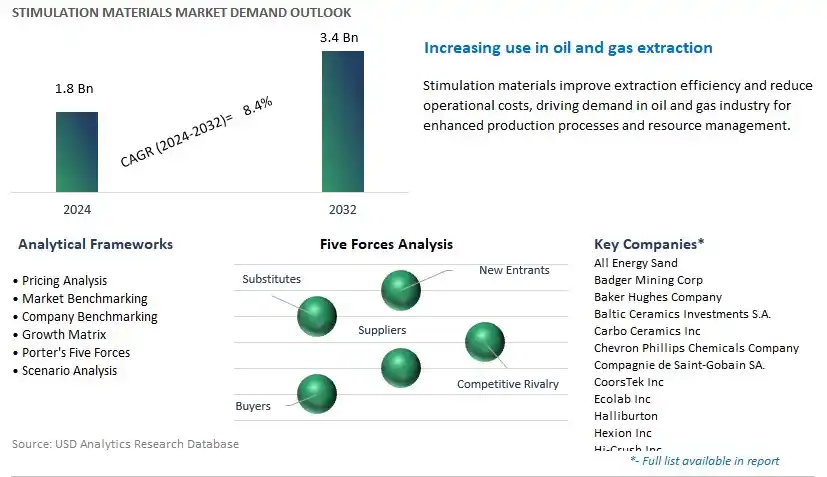
Global Stimulation Materials Market Size is valued at $1.8 Billion in 2024 and is forecast to register a growth rate (CAGR) of 8.4% to reach $3.4 Billion by 2032.
The global Stimulation Materials Market Study analyzes and forecasts the market size across 6 regions and 24 countries for diverse segments -By Proppants Material (Frac Sand, Resin Coated, Ceramic), By Chemical Material (Surfactants, Gelling Agents, Friction Reducers, Breakers, Crosslinking Agents, Corrosion and Scale Inhibitors, Biocides, Others).
An Introduction to Stimulation Materials Market in 2024
Stimulation materials are substances used in oil and gas well stimulation treatments to enhance hydrocarbon production from reservoir formations. In 2024, the market for stimulation materials is vital to the global oil and gas industry, driven by the need to optimize well productivity, recoverable reserves, and operational efficiency in both conventional and unconventional reservoirs. Stimulation treatments, such as hydraulic fracturing (fracking) and acidizing, involve injecting fluids and proppants into the formation under high pressure to create or enhance fractures, increase permeability, and improve fluid flow pathways within the reservoir. Stimulation materials include proppants such as sand, ceramic beads, and resin-coated sands, as well as chemical additives such as friction reducers, biocides, and scale inhibitors, each designed to improve the effectiveness and longevity of stimulation treatments. With advancements in hydraulic fracturing technology, reservoir modeling, and chemical formulations, oilfield service companies are developing customized stimulation solutions tailored to specific reservoir conditions and production goals. Further, the growing exploration and production activities in unconventional shale plays, deepwater fields, and mature reservoirs are driving demand for stimulation materials, supporting the global energy supply and economic growth. As oil and gas operators to pursue efficient and sustainable production strategies, the market for stimulation materials is poised for d innovation and growth, offering solutions for maximizing hydrocarbon recovery and optimizing well performance in diverse geological environments and operational conditions.
Stimulation Materials Market Competitive Landscape
The market report analyses the leading companies in the industry including All Energy Sand, Badger Mining Corp, Baker Hughes Company, Baltic Ceramics Investments S.A., Carbo Ceramics Inc, Chevron Phillips Chemicals Company, Compagnie de Saint-Gobain SA., CoorsTek Inc, Ecolab Inc, Halliburton, Hexion Inc, Hi-Crush Inc, Imerys SA, Mineracao Curimbaba Ltda, Royal Dutch Shell plc, Schlumberger Ltd, Solvay SA, Unimin Corp, Weatherford International Plc, and others.
Stimulation Materials Market Dynamics
Market Trend: Growing Focus on Enhanced Oil and Gas Recovery Techniques
A significant trend in the stimulation materials market is the growing focus on enhanced oil and gas recovery techniques. Stimulation materials, including proppants, fluids, and chemicals, play a crucial role in hydraulic fracturing (fracking) and other stimulation techniques used to extract oil and gas from unconventional reservoirs such as shale formations. With the decline in conventional oil and gas reserves, there is increasing exploration and production activity in unconventional resources, driving the demand for stimulation materials. Moreover, advancements in drilling technologies and reservoir engineering have led to the development of more efficient and cost-effective stimulation techniques, further boosting the market for stimulation materials. This trend is expected to continue as the energy industry seeks to maximize recovery rates and optimize production from unconventional reservoirs, driving the adoption of advanced stimulation materials and techniques.
Market Driver: Growth in Unconventional Oil and Gas Exploration
The primary driver behind the growth of the stimulation materials market is the growth in unconventional oil and gas exploration. As conventional reserves become depleted and global energy demand continues to rise, there is a growing need to explore and develop unconventional resources such as tight oil and shale gas. Stimulation materials are essential components of hydraulic fracturing operations, where they help create and maintain fractures in the reservoir rock, allowing oil and gas to flow more freely to the wellbore. The demand for stimulation materials is driven by the expansion of hydraulic fracturing activities in regions rich in unconventional resources, such as the Permian Basin in the United States, the Bakken Formation in North Dakota, and the Montney Formation in Canada. As companies continue to invest in unconventional oil and gas projects worldwide, the demand for stimulation materials is expected to increase, providing opportunities for manufacturers and suppliers in the market.
Market Opportunity: Development of Environmentally Friendly and Sustainable Stimulation Materials
An opportunity for the stimulation materials market lies in the development of environmentally friendly and sustainable stimulation materials. With increasing concerns about environmental impact and regulatory scrutiny surrounding hydraulic fracturing operations, there is a growing demand for stimulation materials that minimize water usage, reduce chemical additives, and mitigate environmental risks. Manufacturers have the opportunity to innovate and develop stimulation materials that are biodegradable, non-toxic, and environmentally sustainable, aligning with industry efforts to promote responsible resource development and reduce the carbon footprint of oil and gas production. Additionally, there is an opportunity to offer recycled or reclaimed stimulation materials, such as recycled proppants or treated wastewater for fracking operations, as a way to reduce costs and environmental impact. By focusing on sustainability and environmental stewardship, stimulation material suppliers can differentiate their products, meet regulatory requirements, and capture market share in the growing market for environmentally conscious oil and gas production technologies. Expanding into environmentally friendly and sustainable stimulation materials presents an opportunity for the market to address industry challenges, meet evolving customer demands, and drive growth in the oil and gas sector.
Stimulation Materials Market Share Analysis: Frac Sand segment generated the highest revenue in 2024
Within the stimulation materials market, the Frac Sand segment is the largest. Frac sand, also known as silica sand or industrial sand, is a naturally occurring granular material composed of high-purity quartz grains. It is widely used as a proppant in hydraulic fracturing operations to enhance oil and gas production from unconventional reservoirs such as shale formations. Frac sand serves as a prop to hold open the fractures created in the rock formation during hydraulic fracturing, allowing hydrocarbons to flow to the wellbore. The abundance, accessibility, and cost-effectiveness of frac sand make it a preferred proppant material for hydraulic fracturing operations. Additionally, frac sand offers favorable characteristics such as high crush strength, roundness, and sphericity, which are essential for creating and maintaining fracture conductivity in the reservoir. Moreover, the continuous growth of hydraulic fracturing activities in the oil and gas industry, particularly in regions with vast shale reserves such as the Permian Basin and the Eagle Ford Shale, drives the demand for frac sand as a key component of stimulation materials. As a result, the Frac Sand segment maintains its position as the largest within the stimulation materials market, supported by its widespread use and indispensable role in hydraulic fracturing operations for oil and gas production.
Stimulation Materials Market Share Analysis: Surfactants is poised to register the fastest CAGR over the forecast period
Within the stimulation materials market, the Surfactants segment is the fastest-growing. Surfactants, also known as surface-active agents, play a crucial role in hydraulic fracturing operations by modifying the surface tension and interfacial properties of fluids, facilitating the efficient movement of fluids within the wellbore and reservoir. Surfactants are used to enhance the effectiveness of fracturing fluids, improve fluid compatibility with reservoir conditions, and mitigate issues such as water retention, emulsification, and formation damage. Additionally, surfactants act as wetting agents, dispersants, and foamers, enhancing the performance of other stimulation materials and additives used in hydraulic fracturing treatments. Moreover, the increasing complexity and depth of hydraulic fracturing operations, coupled with the growing demand for unconventional oil and gas resources, drive the need for advanced surfactant formulations tailored to specific reservoir conditions and production challenges. Furthermore, stringent environmental regulations and the emphasis on sustainable fracturing practices contribute to the adoption of environmentally friendly surfactants with reduced toxicity and biodegradability. As a result of these factors, the Surfactants segment experiences rapid growth within the stimulation materials market, propelled by the increasing demand for surfactant-based solutions to optimize hydraulic fracturing operations and maximize oil and gas recovery.
Stimulation Materials Market
By Proppants Material
Frac Sand
Resin Coated
Ceramic
By Chemical Material
Surfactants
Gelling Agents
Friction Reducers
Breakers
Crosslinking Agents
Corrosion and Scale Inhibitors
Biocides
Others
Countries Analyzed
North America (US, Canada, Mexico)
Europe (Germany, UK, France, Spain, Italy, Russia, Rest of Europe)
Asia Pacific (China, India, Japan, South Korea, Australia, South East Asia, Rest of Asia)
South America (Brazil, Argentina, Rest of South America)
Middle East and Africa (Saudi Arabia, UAE, Rest of Middle East, South Africa, Egypt, Rest of Africa)
Stimulation Materials Companies Profiled in the Study
All Energy Sand
Badger Mining Corp
Baker Hughes Company
Baltic Ceramics Investments S.A.
Carbo Ceramics Inc
Chevron Phillips Chemicals Company
Compagnie de Saint-Gobain SA.
CoorsTek Inc
Ecolab Inc
Halliburton
Hexion Inc
Hi-Crush Inc
Imerys SA
Mineracao Curimbaba Ltda
Royal Dutch Shell plc
Schlumberger Ltd
Solvay SA
Unimin Corp
Weatherford International Plc
*- List Not Exhaustive
TABLE OF CONTENTS
1 Introduction to 2024 Stimulation Materials Market
1.1 Market Overview
1.2 Quick Facts
1.3 Scope/Objective of the Study
1.4 Market Definition
1.5 Countries and Regions Covered
1.6 Units, Currency, and Conversions
1.7 Industry Value Chain
2 Research Methodology
2.1 Market Size Estimation
2.2 Sources and Research Methodology
2.3 Data Triangulation
2.4 Assumptions and Limitations
3 Executive Summary
3.1 Global Stimulation Materials Market Size Outlook, $ Million, 2021 to 2032
3.2 Stimulation Materials Market Outlook by Type, $ Million, 2021 to 2032
3.3 Stimulation Materials Market Outlook by Product, $ Million, 2021 to 2032
3.4 Stimulation Materials Market Outlook by Application, $ Million, 2021 to 2032
3.5 Stimulation Materials Market Outlook by Key Countries, $ Million, 2021 to 2032
4 Market Dynamics
4.1 Key Driving Forces of Stimulation Materials Industry
4.2 Key Market Trends in Stimulation Materials Industry
4.3 Potential Opportunities in Stimulation Materials Industry
4.4 Key Challenges in Stimulation Materials Industry
5 Market Factor Analysis
5.1 Value Chain Analysis
5.2 Competitive Landscape
5.2.1 Global Stimulation Materials Market Share by Company (%), 2023
5.2.2 Product Offerings by Company
5.3 Porter’s Five Forces Analysis
5.4 Pricing Analysis and Outlook
6 Growth Outlook Across Scenarios
6.1 Growth Analysis-Case Scenario Definitions
6.2 Low Growth Scenario Forecasts
6.3 Reference Growth Scenario Forecasts
6.4 High Growth Scenario Forecasts
7 Global Stimulation Materials Market Outlook by Segments
7.1 Stimulation Materials Market Outlook by Segments, $ Million, 2021- 2032
By Proppants Material
Frac Sand
Resin Coated
Ceramic
By Chemical Material
Surfactants
Gelling Agents
Friction Reducers
Breakers
Crosslinking Agents
Corrosion and Scale Inhibitors
Biocides
Others
8 North America Stimulation Materials Market Analysis and Outlook To 2032
8.1 Introduction to North America Stimulation Materials Markets in 2024
8.2 North America Stimulation Materials Market Size Outlook by Country, 2021-2032
8.2.1 United States
8.2.2 Canada
8.2.3 Mexico
8.3 North America Stimulation Materials Market size Outlook by Segments, 2021-2032
By Proppants Material
Frac Sand
Resin Coated
Ceramic
By Chemical Material
Surfactants
Gelling Agents
Friction Reducers
Breakers
Crosslinking Agents
Corrosion and Scale Inhibitors
Biocides
Others
9 Europe Stimulation Materials Market Analysis and Outlook To 2032
9.1 Introduction to Europe Stimulation Materials Markets in 2024
9.2 Europe Stimulation Materials Market Size Outlook by Country, 2021-2032
9.2.1 Germany
9.2.2 France
9.2.3 Spain
9.2.4 United Kingdom
9.2.4 Italy
9.2.5 Russia
9.2.6 Norway
9.2.7 Rest of Europe
9.3 Europe Stimulation Materials Market Size Outlook by Segments, 2021-2032
By Proppants Material
Frac Sand
Resin Coated
Ceramic
By Chemical Material
Surfactants
Gelling Agents
Friction Reducers
Breakers
Crosslinking Agents
Corrosion and Scale Inhibitors
Biocides
Others
10 Asia Pacific Stimulation Materials Market Analysis and Outlook To 2032
10.1 Introduction to Asia Pacific Stimulation Materials Markets in 2024
10.2 Asia Pacific Stimulation Materials Market Size Outlook by Country, 2021-2032
10.2.1 China
10.2.2 India
10.2.3 Japan
10.2.4 South Korea
10.2.5 Indonesia
10.2.6 Malaysia
10.2.7 Australia
10.2.8 Rest of Asia Pacific
10.3 Asia Pacific Stimulation Materials Market size Outlook by Segments, 2021-2032
By Proppants Material
Frac Sand
Resin Coated
Ceramic
By Chemical Material
Surfactants
Gelling Agents
Friction Reducers
Breakers
Crosslinking Agents
Corrosion and Scale Inhibitors
Biocides
Others
11 South America Stimulation Materials Market Analysis and Outlook To 2032
11.1 Introduction to South America Stimulation Materials Markets in 2024
11.2 South America Stimulation Materials Market Size Outlook by Country, 2021-2032
11.2.1 Brazil
11.2.2 Argentina
11.2.3 Rest of South America
11.3 South America Stimulation Materials Market size Outlook by Segments, 2021-2032
By Proppants Material
Frac Sand
Resin Coated
Ceramic
By Chemical Material
Surfactants
Gelling Agents
Friction Reducers
Breakers
Crosslinking Agents
Corrosion and Scale Inhibitors
Biocides
Others
12 Middle East and Africa Stimulation Materials Market Analysis and Outlook To 2032
12.1 Introduction to Middle East and Africa Stimulation Materials Markets in 2024
12.2 Middle East and Africa Stimulation Materials Market Size Outlook by Country, 2021-2032
12.2.1 Saudi Arabia
12.2.2 UAE
12.2.3 Oman
12.2.4 Rest of Middle East
12.2.5 Egypt
12.2.6 Nigeria
12.2.7 South Africa
12.2.8 Rest of Africa
12.3 Middle East and Africa Stimulation Materials Market size Outlook by Segments, 2021-2032
By Proppants Material
Frac Sand
Resin Coated
Ceramic
By Chemical Material
Surfactants
Gelling Agents
Friction Reducers
Breakers
Crosslinking Agents
Corrosion and Scale Inhibitors
Biocides
Others
13 Company Profiles
13.1 Company Snapshot
13.2 SWOT Profiles
13.3 Products and Services
13.4 Recent Developments
13.5 Financial Profile
All Energy Sand
Badger Mining Corp
Baker Hughes Company
Baltic Ceramics Investments S.A.
Carbo Ceramics Inc
Chevron Phillips Chemicals Company
Compagnie de Saint-Gobain SA.
CoorsTek Inc
Ecolab Inc
Halliburton
Hexion Inc
Hi-Crush Inc
Imerys SA
Mineracao Curimbaba Ltda
Royal Dutch Shell plc
Schlumberger Ltd
Solvay SA
Unimin Corp
Weatherford International Plc
14 Appendix
14.1 Customization Offerings
14.2 Subscription Services
14.3 Related Reports
14.4 Publisher Expertise
By Proppants Material
Frac Sand
Resin Coated
Ceramic
By Chemical Material
Surfactants
Gelling Agents
Friction Reducers
Breakers
Crosslinking Agents
Corrosion and Scale Inhibitors
Biocides
Others
Countries Analyzed
North America (US, Canada, Mexico)
Europe (Germany, UK, France, Spain, Italy, Russia, Rest of Europe)
Asia Pacific (China, India, Japan, South Korea, Australia, South East Asia, Rest of Asia)
South America (Brazil, Argentina, Rest of South America)
Middle East and Africa (Saudi Arabia, UAE, Rest of Middle East, South Africa, Egypt, Rest of Africa)
