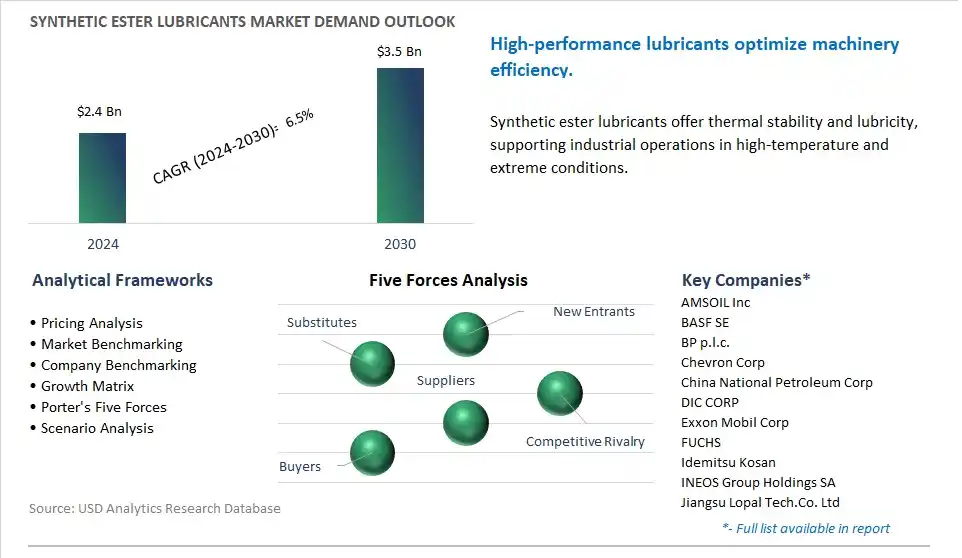
The global Synthetic Ester Lubricants Market is poised to register a 6.5% CAGR from $2.4 Billion in 2024 to $3.5 Billion in 2030.
The global Synthetic Ester Lubricants Market Study analyzes and forecasts the market size across 6 regions and 24 countries for diverse segments -By Type (Polyalkylene Glycol (PAG), Polyalpha Olefins (PAO), Esters, Group III), By Application (Compressor Oils, Hydraulic Oils, Metal Working Fluids, Diesel and Engine Oils, Gear Oils, Turbine Oils).
An Introduction to Global Synthetic Ester Lubricants Market in 2024
Synthetic ester lubricants are high-performance lubricating oils formulated from synthetic ester base stocks, offering superior thermal stability, oxidative resistance, and lubricity compared to conventional mineral oils. The future of synthetic ester lubricants is shaped by several key trends, including advancements in lubricant technology, environmental regulations, and industrial applications. One significant trend is the increasing demand for synthetic ester lubricants in industries such as automotive, aerospace, marine, and industrial machinery, where high temperatures, heavy loads, and harsh operating conditions require superior lubrication performance and reliability. Lubricant manufacturers are investing in research and development to develop new synthetic ester formulations with improved viscosity-temperature behavior, shear stability, and wear protection properties, meeting the stringent requirements of modern machinery and equipment. Additionally, the integration of synthetic ester lubricants into sustainable manufacturing practices and energy-efficient technologies is driving innovations in equipment design, maintenance strategies, and lubricant management programs, optimizing operational efficiency and reducing environmental impact. Moreover, the emphasis on environmental sustainability and regulatory compliance is driving initiatives to develop biodegradable and environmentally friendly ester lubricants that minimize ecological footprint and contamination risks in sensitive environments such as marine ecosystems and food processing facilities. Furthermore, collaborations between lubricant producers, equipment manufacturers, and end-users are driving innovation and market growth by delivering customized solutions that meet the specific performance, regulatory, and sustainability requirements of diverse industries and applications, ensuring continued reliability and efficiency in lubrication systems.
Synthetic Ester Lubricants Market Competitive Landscape
The market report analyses the leading companies in the industry including AMSOIL Inc, BASF SE, BP p.l.c., Chevron Corp, China National Petroleum Corp, DIC CORP, Exxon Mobil Corp, FUCHS, Idemitsu Kosan, INEOS Group Holdings SA, Jiangsu Lopal Tech.Co. Ltd, Kendall Group, LANXESS, Lubrication Engineers, Motul, Petroliam Nasional Berhad, Shell Global, TotalEnergies, Valvoline.
Synthetic Ester Lubricants Market Dynamics
Synthetic Ester Lubricants Market Trend: Shift Towards Environmentally-Friendly and High-Performance Lubricants
A prominent market trend in the synthetic ester lubricants industry is the increasing demand for environmentally friendly lubricants that offer high performance and superior protection. Synthetic ester lubricants, derived from ester compounds synthesized from organic acids and alcohols, are gaining popularity as alternatives to conventional mineral-based lubricants due to their excellent thermal stability, oxidative resistance, and biodegradability. With growing concerns about environmental sustainability and regulatory requirements, there is a shift towards lubricants that minimize environmental impact while providing optimal lubrication and equipment protection. This trend is driven by industry initiatives to reduce carbon footprint, improve energy efficiency, and enhance equipment reliability across various applications including automotive, aerospace, industrial machinery, and marine.
Synthetic Ester Lubricants Market Driver: Stringent Regulations and Industry Standards for Environmental Protection
A key driver behind the growth of the synthetic ester lubricants market is the implementation of stringent regulations and industry standards aimed at reducing environmental pollution and promoting sustainable practices. Governments worldwide are enacting laws and regulations to limit emissions of harmful pollutants, including volatile organic compounds (VOCs) and hazardous chemicals, from industrial activities such as lubricant use. Additionally, industry associations and organizations are developing standards and certifications for environmentally-friendly lubricants, driving the adoption of synthetic ester lubricants that meet or exceed these requirements. The need for compliance with environmental regulations and the desire to minimize ecological impact on ecosystems and human health are driving the demand for synthetic ester lubricants as environmentally-responsible lubrication solutions.
Synthetic Ester Lubricants Market Opportunity: Expansion into Niche Applications and Specialized Industries
An opportunity exists for synthetic ester lubricant manufacturers to expand into niche applications and specialized industries where performance requirements and environmental considerations are paramount. Synthetic ester lubricants offer unique properties such as high thermal stability, low volatility, and resistance to oxidation and corrosion, making them ideal for demanding applications such as aviation, defense, power generation, and food processing. By targeting these specialized industries and developing tailored lubrication solutions that meet specific performance and regulatory requirements, manufacturers can capitalize on growing market segments and differentiate themselves from competitors. Additionally, there is opportunity to innovate in formulation technology and develop customized lubricants for emerging applications such as electric vehicles, renewable energy systems, and advanced manufacturing processes, where lubrication plays a critical role in optimizing performance and sustainability.
Synthetic Ester Lubricants Market Share Analysis: Polyalpha Olefins (PAO) generated the highest revenue in 2024
Polyalpha Olefins (PAO) emerge as the largest segment in the Synthetic Ester Lubricants Market, driven by Diverse factors. PAO-based lubricants are renowned for their exceptional thermal stability, oxidation resistance, and high viscosity index, making them ideal for a wide range of applications across various industries, including automotive, industrial machinery, and aerospace. Their ability to perform under extreme temperatures and harsh operating conditions has propelled their adoption in critical applications where conventional mineral oils fall short. Additionally, the stringent environmental regulations aimed at reducing carbon emissions have led to a shift towards synthetic lubricants like PAO, which offer improved fuel efficiency and reduced greenhouse gas emissions compared to traditional lubricants. Furthermore, the continuous advancements in PAO technology, including the development of high-performance formulations tailored to specific industrial applications, further contribute to the dominance of PAO-based lubricants in the Synthetic Ester Lubricants Market.
Synthetic Ester Lubricants Market Share Analysis: Metal Working Fluids segment is poised to register the fastest growth rate (CAGR) over the forecast period to 2030
Among the segments in the Synthetic Ester Lubricants Market, Metal Working Fluids stand out as the fastest growing. Metal working fluids play a critical role in machining and metal forming processes by providing lubrication, cooling, and corrosion protection to ensure efficient and high-quality manufacturing operations. With the growing emphasis on precision engineering and the increasing adoption of advanced machining techniques such as high-speed machining and CNC machining, the demand for high-performance metal working fluids has surged. Synthetic ester-based metal working fluids offer superior lubricity, thermal stability, and compatibility with a wide range of metals, enabling enhanced machining efficiency, extended tool life, and improved surface finish. Additionally, stringent environmental regulations aimed at reducing emissions of volatile organic compounds (VOCs) and hazardous substances have accelerated the transition from traditional mineral oil-based metal working fluids to synthetic ester-based formulations, further driving the growth of this segment in the Synthetic Ester Lubricants Market. As industries continue to prioritize productivity, quality, and environmental sustainability in metalworking operations, the demand for advanced synthetic ester-based metal working fluids is expected to continue its rapid growth trajectory.
Synthetic Ester Lubricants Market Report Segmentation
By Type
Polyalkylene Glycol (PAG)
Polyalpha Olefins (PAO)
Esters
Group III
By Application
Compressor Oils
Hydraulic Oils
Metal Working Fluids
Diesel and Engine Oils
Gear Oils
Turbine Oils
Regions Included
North America (US, Canada, Mexico)
Europe (Germany, UK, France, Spain, Italy, Russia, Rest of Europe)
Asia Pacific (China, India, Japan, South Korea, Australia, South East Asia, Rest of Asia)
South America (Brazil, Argentina, Rest of South America)
Middle East and Africa (Saudi Arabia, UAE, Rest of Middle East, South Africa, Egypt, Rest of Africa)
Synthetic Ester Lubricants Companies Profiled in the Market Study
AMSOIL Inc
BASF SE
BP p.l.c.
Chevron Corp
China National Petroleum Corp
DIC CORP
Exxon Mobil Corp
FUCHS
Idemitsu Kosan
INEOS Group Holdings SA
Jiangsu Lopal Tech.Co. Ltd
Kendall Group
LANXESS
Lubrication Engineers
Motul
Petroliam Nasional Berhad
Shell Global
TotalEnergies
Valvoline
*- List Not Exhaustive
TABLE OF CONTENTS
1 Introduction to 2024 Synthetic Ester Lubricants Market
1.1 Market Overview
1.2 Quick Facts
1.3 Scope/Objective of the Study
1.4 Market Definition
1.5 Countries and Regions Covered
1.6 Units, Currency, and Conversions
1.7 Industry Value Chain
2 Research Methodology
2.1 Market Size Estimation
2.2 Sources and Research Methodology
2.3 Data Triangulation
2.4 Assumptions and Limitations
3 Executive Summary
3.1 Global Synthetic Ester Lubricants Market Size Outlook, $ Million, 2021 to 2030
3.2 Synthetic Ester Lubricants Market Outlook by Type, $ Million, 2021 to 2030
3.3 Synthetic Ester Lubricants Market Outlook by Product, $ Million, 2021 to 2030
3.4 Synthetic Ester Lubricants Market Outlook by Application, $ Million, 2021 to 2030
3.5 Synthetic Ester Lubricants Market Outlook by Key Countries, $ Million, 2021 to 2030
4 Market Dynamics
4.1 Key Driving Forces of Synthetic Ester Lubricants Industry
4.2 Key Market Trends in Synthetic Ester Lubricants Industry
4.3 Potential Opportunities in Synthetic Ester Lubricants Industry
4.4 Key Challenges in Synthetic Ester Lubricants Industry
5 Market Factor Analysis
5.1 Value Chain Analysis
5.2 Competitive Landscape
5.2.1 Global Synthetic Ester Lubricants Market Share by Company (%), 2023
5.2.2 Product Offerings by Company
5.3 Porter’s Five Forces Analysis
5.4 Pricing Analysis and Outlook
6 Growth Outlook Across Scenarios
6.1 Growth Analysis-Case Scenario Definitions
6.2 Low Growth Scenario Forecasts
6.3 Reference Growth Scenario Forecasts
6.4 High Growth Scenario Forecasts
7 Global Synthetic Ester Lubricants Market Outlook by Segments
7.1 Synthetic Ester Lubricants Market Outlook by Segments, $ Million, 2021- 2030
By Type
Polyalkylene Glycol (PAG)
Polyalpha Olefins (PAO)
Esters
Group III
By Application
Compressor Oils
Hydraulic Oils
Metal Working Fluids
Diesel and Engine Oils
Gear Oils
Turbine Oils
8 North America Synthetic Ester Lubricants Market Analysis and Outlook To 2030
8.1 Introduction to North America Synthetic Ester Lubricants Markets in 2024
8.2 North America Synthetic Ester Lubricants Market Size Outlook by Country, 2021-2030
8.2.1 United States
8.2.2 Canada
8.2.3 Mexico
8.3 North America Synthetic Ester Lubricants Market size Outlook by Segments, 2021-2030
By Type
Polyalkylene Glycol (PAG)
Polyalpha Olefins (PAO)
Esters
Group III
By Application
Compressor Oils
Hydraulic Oils
Metal Working Fluids
Diesel and Engine Oils
Gear Oils
Turbine Oils
9 Europe Synthetic Ester Lubricants Market Analysis and Outlook To 2030
9.1 Introduction to Europe Synthetic Ester Lubricants Markets in 2024
9.2 Europe Synthetic Ester Lubricants Market Size Outlook by Country, 2021-2030
9.2.1 Germany
9.2.2 France
9.2.3 Spain
9.2.4 United Kingdom
9.2.4 Italy
9.2.5 Russia
9.2.6 Norway
9.2.7 Rest of Europe
9.3 Europe Synthetic Ester Lubricants Market Size Outlook by Segments, 2021-2030
By Type
Polyalkylene Glycol (PAG)
Polyalpha Olefins (PAO)
Esters
Group III
By Application
Compressor Oils
Hydraulic Oils
Metal Working Fluids
Diesel and Engine Oils
Gear Oils
Turbine Oils
10 Asia Pacific Synthetic Ester Lubricants Market Analysis and Outlook To 2030
10.1 Introduction to Asia Pacific Synthetic Ester Lubricants Markets in 2024
10.2 Asia Pacific Synthetic Ester Lubricants Market Size Outlook by Country, 2021-2030
10.2.1 China
10.2.2 India
10.2.3 Japan
10.2.4 South Korea
10.2.5 Indonesia
10.2.6 Malaysia
10.2.7 Australia
10.2.8 Rest of Asia Pacific
10.3 Asia Pacific Synthetic Ester Lubricants Market size Outlook by Segments, 2021-2030
By Type
Polyalkylene Glycol (PAG)
Polyalpha Olefins (PAO)
Esters
Group III
By Application
Compressor Oils
Hydraulic Oils
Metal Working Fluids
Diesel and Engine Oils
Gear Oils
Turbine Oils
11 South America Synthetic Ester Lubricants Market Analysis and Outlook To 2030
11.1 Introduction to South America Synthetic Ester Lubricants Markets in 2024
11.2 South America Synthetic Ester Lubricants Market Size Outlook by Country, 2021-2030
11.2.1 Brazil
11.2.2 Argentina
11.2.3 Rest of South America
11.3 South America Synthetic Ester Lubricants Market size Outlook by Segments, 2021-2030
By Type
Polyalkylene Glycol (PAG)
Polyalpha Olefins (PAO)
Esters
Group III
By Application
Compressor Oils
Hydraulic Oils
Metal Working Fluids
Diesel and Engine Oils
Gear Oils
Turbine Oils
12 Middle East and Africa Synthetic Ester Lubricants Market Analysis and Outlook To 2030
12.1 Introduction to Middle East and Africa Synthetic Ester Lubricants Markets in 2024
12.2 Middle East and Africa Synthetic Ester Lubricants Market Size Outlook by Country, 2021-2030
12.2.1 Saudi Arabia
12.2.2 UAE
12.2.3 Oman
12.2.4 Rest of Middle East
12.2.5 Egypt
12.2.6 Nigeria
12.2.7 South Africa
12.2.8 Rest of Africa
12.3 Middle East and Africa Synthetic Ester Lubricants Market size Outlook by Segments, 2021-2030
By Type
Polyalkylene Glycol (PAG)
Polyalpha Olefins (PAO)
Esters
Group III
By Application
Compressor Oils
Hydraulic Oils
Metal Working Fluids
Diesel and Engine Oils
Gear Oils
Turbine Oils
13 Company Profiles
13.1 Company Snapshot
13.2 SWOT Profiles
13.3 Products and Services
13.4 Recent Developments
13.5 Financial Profile
AMSOIL Inc
BASF SE
BP p.l.c.
Chevron Corp
China National Petroleum Corp
DIC CORP
Exxon Mobil Corp
FUCHS
Idemitsu Kosan
INEOS Group Holdings SA
Jiangsu Lopal Tech.Co. Ltd
Kendall Group
LANXESS
Lubrication Engineers
Motul
Petroliam Nasional Berhad
Shell Global
TotalEnergies
Valvoline
14 Appendix
14.1 Customization Offerings
14.2 Subscription Services
14.3 Related Reports
14.4 Publisher Expertise
By Type
Polyalkylene Glycol (PAG)
Polyalpha Olefins (PAO)
Esters
Group III
By Application
Compressor Oils
Hydraulic Oils
Metal Working Fluids
Diesel and Engine Oils
Gear Oils
Turbine Oils
Countries Analyzed
North America (US, Canada, Mexico)
Europe (Germany, UK, France, Spain, Italy, Russia, Rest of Europe)
Asia Pacific (China, India, Japan, South Korea, Australia, South East Asia, Rest of Asia)
South America (Brazil, Argentina, Rest of South America)
Middle East and Africa (Saudi Arabia, UAE, Rest of Middle East, South Africa, Egypt, Rest of Africa)
