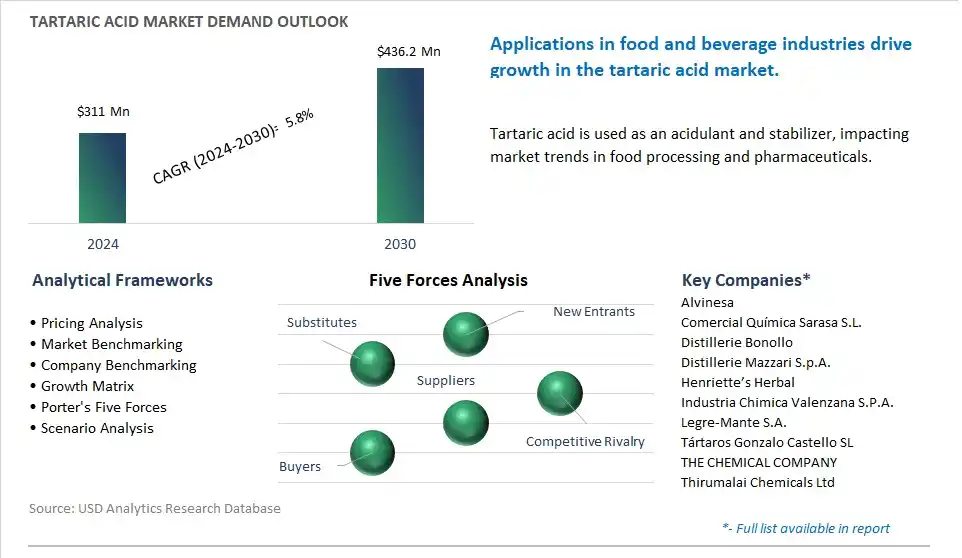
The global Tartaric Acid Market is poised to register a 5.8% CAGR from $311 Million in 2024 to $436.2 Million in 2030.
The global Tartaric Acid Market Study analyzes and forecasts the market size across 6 regions and 24 countries for diverse segments -By Source (Grapes & sun-dried raisins, Maleic Anhydride, Others), By Application (Food, Beverages, Pharmaceuticals, Cosmetics & Personal Care, Animal Feed, Construction, Metal Cleaning, Others).
An Introduction to Global Tartaric Acid Market in 2024
The tartaric acid market is experiencing growth driven by its diverse applications in food and beverage, pharmaceutical, cosmetics, and industrial sectors. Key trends shaping the future of the industry include advancements in tartaric acid production technologies, purification methods, and derivatives synthesis to meet quality standards, regulatory requirements, and customer specifications. Innovations such as biotechnological fermentation processes, green extraction techniques, and sustainable sourcing practices contribute to the development of high-purity tartaric acid products with minimal environmental impact and production costs. Moreover, the increasing demand for natural and clean label ingredients in food and beverage formulations drives the adoption of tartaric acid as a food additive, acidity regulator, and flavor enhancer in products such as wine, soft drinks, confectionery, and baked goods. Additionally, tartaric acid finds applications in pharmaceuticals as a chelating agent, buffer, and excipient, as well as in cosmetics for its skin exfoliating and pH adjustment properties. As manufacturers invest in R&D to expand tartaric acid applications, improve process efficiency, and explore new market opportunities, the market is poised for sustained growth as a versatile and indispensable ingredient in various industries.
Tartaric Acid Market Competitive Landscape
The market report analyses the leading companies in the industry including Alvinesa, Comercial Química Sarasa S.L., Distillerie Bonollo, Distillerie Mazzari S.p.A., Henriette’s Herbal, Industria Chimica Valenzana S.P.A., Legre-Mante S.A., Tártaros Gonzalo Castello SL, THE CHEMICAL COMPANY, Thirumalai Chemicals Ltd.
Tartaric Acid Market Dynamics
Tartaric Acid Market Trend: Increased Demand for Natural and Clean Label Ingredients
A prominent trend in the tartaric acid market is the increased demand for natural and clean label ingredients. As consumers become more health-conscious and scrutinize product labels, there is a growing preference for food and beverage products formulated with natural ingredients. Tartaric acid, a naturally occurring organic acid found in fruits such as grapes, offers a clean label solution for acidity regulation and flavor enhancement in various food and beverage applications. This trend towards natural ingredients aligns with consumer preferences for clean label products free from artificial additives and preservatives, driving the demand for tartaric acid as a natural acidulant and flavor enhancer.
Tartaric Acid Market Driver: Growth in Wine Production and Wine Industry
A key driver for the tartaric acid market is the growth in wine production and the wine industry. Tartaric acid is a key component in winemaking, where it plays a crucial role in controlling acidity, pH levels, and flavor profile during fermentation and aging processes. With the increasing popularity of wine consumption worldwide, particularly in emerging markets, there is a rising demand for tartaric acid as a natural acidulant and stabilizer in winemaking. Additionally, the expansion of the wine industry, driven by changing consumer preferences, rising disposable incomes, and growing wine tourism, fuels the demand for tartaric acid as a vital ingredient in wine production.
Tartaric Acid Market Opportunity: Diversification into Pharmaceutical and Cosmetic Applications
An opportunity within the tartaric acid market lies in diversification into pharmaceutical and cosmetic applications. While tartaric acid is primarily used in the food and beverage industry, there is potential to explore new applications in pharmaceuticals and cosmetics, leveraging its properties as an acidulant, chelating agent, and pH adjuster. In pharmaceuticals, tartaric acid can be used as an excipient in tablet formulations, as well as in effervescent salts and oral solutions. In cosmetics, tartaric acid can be utilized in skincare products as an alpha hydroxy acid (AHA) for exfoliation and skin brightening. By expanding into pharmaceutical and cosmetic markets, manufacturers of tartaric acid can diversify their customer base and capture additional revenue streams in high-growth industries.
Tartaric Acid Market Share Analysis: Grapes & Sun-Dried Raisins segment generated the highest revenue in the industry
The grapes & sun-dried raisins segment is the largest segment in the Tartaric Acid Market due to its natural abundance and superior quality compared to other sources. Tartaric acid, a dicarboxylic acid, is primarily extracted from grapes and sun-dried raisins during the winemaking process. Grapes contain relatively high concentrations of tartaric acid, which crystallizes as potassium bitartrate (cream of tartar) during fermentation and maturation. This potassium bitartrate is then further processed to obtain tartaric acid. Sun-dried raisins, which are dried grapes, also contain significant levels of tartaric acid, making them a viable source for tartaric acid production. The grapes & sun-dried raisins segment offers diverse advantages, including natural sourcing, consistent quality, and sustainability. Additionally, tartaric acid derived from grapes and sun-dried raisins is widely recognized for its purity, food-grade status, and safety for human consumption, making it suitable for various applications in the food and beverage industry, including as a flavoring agent, acidulant, pH regulator, and stabilizer. In addition, the winemaking industry, which relies heavily on grapes as a raw material, generates substantial quantities of grape pomace, a byproduct rich in tartaric acid. The utilization of grape pomace for tartaric acid extraction further enhances the sustainability and cost-effectiveness of the grapes & sun-dried raisins segment. As the demand for tartaric acid in the food and beverage industry continues to grow, driven by factors such as population growth, urbanization, and changing consumer preferences for natural ingredients, the grapes & sun-dried raisins segment maintains its dominance in the Tartaric Acid Market.
Tartaric Acid Market Share Analysis: Pharmaceuticals Segment is poised to register the fastest growth rate (CAGR) over the forecast period to 2030
The pharmaceuticals segment is the fastest-growing segment in the Tartaric Acid Market due to increasing demand for tartaric acid in pharmaceutical formulations and drug manufacturing processes. Tartaric acid finds wide applications in the pharmaceutical industry as an excipient, acidulant, chelating agent, and buffering agent in various oral and parenteral medications. It is used in tablet formulations to improve the solubility, stability, and bioavailability of active pharmaceutical ingredients (APIs). Additionally, tartaric acid is utilized in effervescent formulations to generate carbon dioxide gas, providing a pleasant fizziness and aiding in the dissolution and absorption of drugs. In addition, tartaric acid is employed as a complexing agent in liquid formulations, suspensions, and injections to enhance the stability and efficacy of certain drugs. Further, tartaric acid derivatives such as potassium tartrate and sodium tartrate are used in intravenous solutions as electrolyte replenishers and pH adjusters. The pharmaceuticals segment experiences rapid growth due to factors such as increasing prevalence of chronic diseases, rising demand for generic and specialty medications, and growing investments in research and development (R&D) by pharmaceutical companies. As pharmaceutical manufacturers strive to develop innovative drug formulations with improved efficacy, safety, and patient compliance, the demand for tartaric acid as a pharmaceutical excipient and ingredient is expected to surge, positioning the pharmaceuticals segment as the fastest-growing segment in the Tartaric Acid Market.
Tartaric Acid Market Report Segmentation
By Source
Grapes & sun-dried raisins
Maleic Anhydride
Others
By Application
Food
Beverages
Pharmaceuticals
Cosmetics & Personal Care
Animal Feed
Construction
Metal Cleaning
Others
Regions Included
North America (US, Canada, Mexico)
Europe (Germany, UK, France, Spain, Italy, Russia, Rest of Europe)
Asia Pacific (China, India, Japan, South Korea, Australia, South East Asia, Rest of Asia)
South America (Brazil, Argentina, Rest of South America)
Middle East and Africa (Saudi Arabia, UAE, Rest of Middle East, South Africa, Egypt, Rest of Africa)
Tartaric Acid Companies Profiled in the Market Study
Alvinesa
Comercial Química Sarasa S.L.
Distillerie Bonollo
Distillerie Mazzari S.p.A.
Henriette’s Herbal
Industria Chimica Valenzana S.P.A.
Legre-Mante S.A.
Tártaros Gonzalo Castello SL
THE CHEMICAL COMPANY
Thirumalai Chemicals Ltd
*- List Not Exhaustive
TABLE OF CONTENTS
1 Introduction to 2024 Tartaric Acid Market
1.1 Market Overview
1.2 Quick Facts
1.3 Scope/Objective of the Study
1.4 Market Definition
1.5 Countries and Regions Covered
1.6 Units, Currency, and Conversions
1.7 Industry Value Chain
2 Research Methodology
2.1 Market Size Estimation
2.2 Sources and Research Methodology
2.3 Data Triangulation
2.4 Assumptions and Limitations
3 Executive Summary
3.1 Global Tartaric Acid Market Size Outlook, $ Million, 2021 to 2030
3.2 Tartaric Acid Market Outlook by Type, $ Million, 2021 to 2030
3.3 Tartaric Acid Market Outlook by Product, $ Million, 2021 to 2030
3.4 Tartaric Acid Market Outlook by Application, $ Million, 2021 to 2030
3.5 Tartaric Acid Market Outlook by Key Countries, $ Million, 2021 to 2030
4 Market Dynamics
4.1 Key Driving Forces of Tartaric Acid Industry
4.2 Key Market Trends in Tartaric Acid Industry
4.3 Potential Opportunities in Tartaric Acid Industry
4.4 Key Challenges in Tartaric Acid Industry
5 Market Factor Analysis
5.1 Value Chain Analysis
5.2 Competitive Landscape
5.2.1 Global Tartaric Acid Market Share by Company (%), 2023
5.2.2 Product Offerings by Company
5.3 Porter’s Five Forces Analysis
5.4 Pricing Analysis and Outlook
6 Growth Outlook Across Scenarios
6.1 Growth Analysis-Case Scenario Definitions
6.2 Low Growth Scenario Forecasts
6.3 Reference Growth Scenario Forecasts
6.4 High Growth Scenario Forecasts
7 Global Tartaric Acid Market Outlook by Segments
7.1 Tartaric Acid Market Outlook by Segments, $ Million, 2021- 2030
By Source
Grapes & sun-dried raisins
Maleic Anhydride
Others
By Application
Food
Beverages
Pharmaceuticals
Cosmetics & Personal Care
Animal Feed
Construction
Metal Cleaning
Others
8 North America Tartaric Acid Market Analysis and Outlook To 2030
8.1 Introduction to North America Tartaric Acid Markets in 2024
8.2 North America Tartaric Acid Market Size Outlook by Country, 2021-2030
8.2.1 United States
8.2.2 Canada
8.2.3 Mexico
8.3 North America Tartaric Acid Market size Outlook by Segments, 2021-2030
By Source
Grapes & sun-dried raisins
Maleic Anhydride
Others
By Application
Food
Beverages
Pharmaceuticals
Cosmetics & Personal Care
Animal Feed
Construction
Metal Cleaning
Others
9 Europe Tartaric Acid Market Analysis and Outlook To 2030
9.1 Introduction to Europe Tartaric Acid Markets in 2024
9.2 Europe Tartaric Acid Market Size Outlook by Country, 2021-2030
9.2.1 Germany
9.2.2 France
9.2.3 Spain
9.2.4 United Kingdom
9.2.4 Italy
9.2.5 Russia
9.2.6 Norway
9.2.7 Rest of Europe
9.3 Europe Tartaric Acid Market Size Outlook by Segments, 2021-2030
By Source
Grapes & sun-dried raisins
Maleic Anhydride
Others
By Application
Food
Beverages
Pharmaceuticals
Cosmetics & Personal Care
Animal Feed
Construction
Metal Cleaning
Others
10 Asia Pacific Tartaric Acid Market Analysis and Outlook To 2030
10.1 Introduction to Asia Pacific Tartaric Acid Markets in 2024
10.2 Asia Pacific Tartaric Acid Market Size Outlook by Country, 2021-2030
10.2.1 China
10.2.2 India
10.2.3 Japan
10.2.4 South Korea
10.2.5 Indonesia
10.2.6 Malaysia
10.2.7 Australia
10.2.8 Rest of Asia Pacific
10.3 Asia Pacific Tartaric Acid Market size Outlook by Segments, 2021-2030
By Source
Grapes & sun-dried raisins
Maleic Anhydride
Others
By Application
Food
Beverages
Pharmaceuticals
Cosmetics & Personal Care
Animal Feed
Construction
Metal Cleaning
Others
11 South America Tartaric Acid Market Analysis and Outlook To 2030
11.1 Introduction to South America Tartaric Acid Markets in 2024
11.2 South America Tartaric Acid Market Size Outlook by Country, 2021-2030
11.2.1 Brazil
11.2.2 Argentina
11.2.3 Rest of South America
11.3 South America Tartaric Acid Market size Outlook by Segments, 2021-2030
By Source
Grapes & sun-dried raisins
Maleic Anhydride
Others
By Application
Food
Beverages
Pharmaceuticals
Cosmetics & Personal Care
Animal Feed
Construction
Metal Cleaning
Others
12 Middle East and Africa Tartaric Acid Market Analysis and Outlook To 2030
12.1 Introduction to Middle East and Africa Tartaric Acid Markets in 2024
12.2 Middle East and Africa Tartaric Acid Market Size Outlook by Country, 2021-2030
12.2.1 Saudi Arabia
12.2.2 UAE
12.2.3 Oman
12.2.4 Rest of Middle East
12.2.5 Egypt
12.2.6 Nigeria
12.2.7 South Africa
12.2.8 Rest of Africa
12.3 Middle East and Africa Tartaric Acid Market size Outlook by Segments, 2021-2030
By Source
Grapes & sun-dried raisins
Maleic Anhydride
Others
By Application
Food
Beverages
Pharmaceuticals
Cosmetics & Personal Care
Animal Feed
Construction
Metal Cleaning
Others
13 Company Profiles
13.1 Company Snapshot
13.2 SWOT Profiles
13.3 Products and Services
13.4 Recent Developments
13.5 Financial Profile
Alvinesa
Comercial Química Sarasa S.L.
Distillerie Bonollo
Distillerie Mazzari S.p.A.
Henriette’s Herbal
Industria Chimica Valenzana S.P.A.
Legre-Mante S.A.
Tártaros Gonzalo Castello SL
THE CHEMICAL COMPANY
Thirumalai Chemicals Ltd
14 Appendix
14.1 Customization Offerings
14.2 Subscription Services
14.3 Related Reports
14.4 Publisher Expertise
By Source
Grapes & sun-dried raisins
Maleic Anhydride
Others
By Application
Food
Beverages
Pharmaceuticals
Cosmetics & Personal Care
Animal Feed
Construction
Metal Cleaning
Others
Countries Analyzed
North America (US, Canada, Mexico)
Europe (Germany, UK, France, Spain, Italy, Russia, Rest of Europe)
Asia Pacific (China, India, Japan, South Korea, Australia, South East Asia, Rest of Asia)
South America (Brazil, Argentina, Rest of South America)
Middle East and Africa (Saudi Arabia, UAE, Rest of Middle East, South Africa, Egypt, Rest of Africa)
