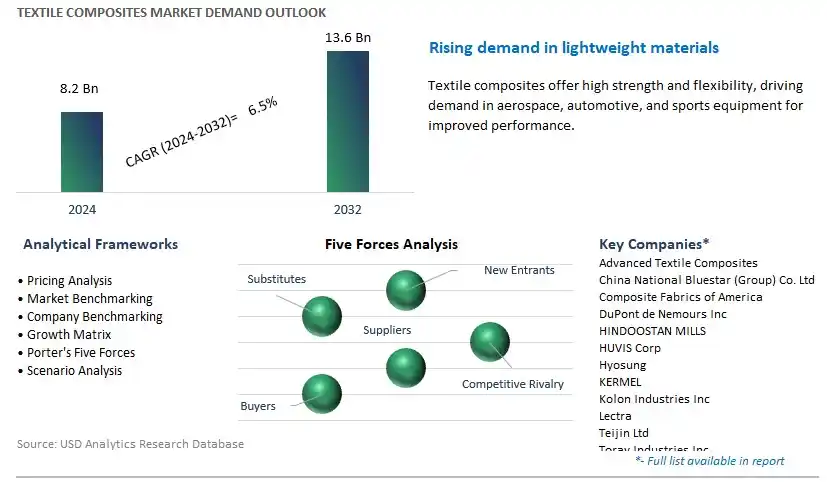
Global Textile Composites Market Size is valued at $8.2 Billion in 2024 and is forecast to register a growth rate (CAGR) of 6.5% to reach $13.6 Billion by 2032.
The global Textile Composites Market Study analyzes and forecasts the market size across 6 regions and 24 countries for diverse segments -By Type (Carbon fiber textile, Glass fiber textile, Aramid fiber textile), By Resin (Woven, Non-woven), By Application (Introduction, Electrical & Electronics, Wind Energy, Sporting Goods, Marine, Construction, Others).
An Introduction to Textile Composites Market in 2024
Textile composites, comprised of woven or non-woven textile fabrics combined with polymer resins or other reinforcing materials, to gain prominence in various industries in 2024. These composites offer a unique combination of properties such as lightweight, strength, flexibility, and design versatility, making them ideal for applications ranging from aerospace and automotive to sports equipment and infrastructure. In aerospace, textile composites are used for aircraft components such as fuselage panels, interior panels, and engine nacelles, where weight reduction and performance optimization are critical. Similarly, in automotive manufacturing, textile composites find applications in components such as interior trim, seat structures, and body panels, contributing to vehicle lightweighting and fuel efficiency. With advancements in textile engineering, resin formulations, and composite manufacturing processes, textile composites to offer innovative solutions for lightweighting, structural integrity, and sustainability in various industries.
Textile Composites Market Competitive Landscape
The market report analyses the leading companies in the industry including Advanced Textile Composites, China National Bluestar (Group) Co. Ltd, Composite Fabrics of America, DuPont de Nemours Inc, HINDOOSTAN MILLS, HUVIS Corp, Hyosung, KERMEL, Kolon Industries Inc, Lectra, Teijin Ltd, Toray Industries Inc, Yantai Tayho Advanced Materials Co. Ltd, and others.
Textile Composites Market Dynamics
Market Trend: Adoption of Lightweight and High-Performance Materials in Textile Composites
A significant trend in the textile composites market is the adoption of lightweight and high-performance materials. Textile composites, which combine textiles with other materials such as resins, fibers, and coatings, are increasingly favored across industries for their lightweight properties, high strength-to-weight ratio, and flexibility. This trend is driven by the need for materials that offer superior performance while reducing overall weight, especially in industries such as aerospace, automotive, sports equipment, and construction. With advancements in textile manufacturing processes, material science, and composite technologies, there is a growing interest in utilizing textile composites to replace traditional materials like metals and plastics in various applications. As industries seek to enhance product performance, fuel efficiency, and sustainability, the adoption of lightweight and high-performance materials in textile composites is expected to continue growing, driven by the demand for materials that offer strength, durability, and versatility.
Market Driver: Demand for Lightweight and Fuel-Efficient Solutions
The primary driver for the textile composites market is the demand for lightweight and fuel-efficient solutions across industries. Lightweight materials play a crucial role in industries such as aerospace, automotive, and transportation, where reducing weight translates to improved fuel efficiency, performance, and environmental sustainability. Textile composites offer significant weight savings compared to traditional materials while maintaining or even improving mechanical properties such as strength, stiffness, and impact resistance. This drives their adoption in applications such as aircraft structures, automotive components, wind turbine blades, and sporting goods, where lightweighting is a critical factor. Additionally, regulatory standards for emissions and fuel economy further incentivize the use of lightweight materials, spurring demand for textile composites as a key enabler of lightweight and fuel-efficient solutions. As industries seek to meet regulatory requirements, enhance product performance, and reduce environmental impact, the demand for lightweight materials in textile composites is expected to grow, driven by the need for materials that offer efficiency, sustainability, and cost-effectiveness.
Market Opportunity: Development of Advanced Manufacturing Processes and Design Techniques
A significant opportunity for the textile composites market lies in the development of advanced manufacturing processes and design techniques. With the advent of technologies such as additive manufacturing, automated fiber placement, and 3D weaving, there is an opportunity to innovate and optimize the production of textile composites for various applications. Advanced manufacturing processes enable the precise placement of fibers, resins, and reinforcements, allowing for the customization of material properties and the creation of complex geometries with minimal waste. Additionally, advanced design techniques such as topology optimization, finite element analysis, and computer-aided design (CAD) software facilitate the optimization of structural performance, weight distribution, and cost efficiency in textile composite components. By leveraging these technologies and techniques, manufacturers can develop tailor-made solutions that meet specific performance requirements, reduce material consumption, and optimize manufacturing processes. As industries embrace digitalization, automation, and advanced materials, the demand for innovative manufacturing processes and design techniques in textile composites presents opportunities for differentiation, efficiency gains, and market growth in the textile composites market.
Textile Composites Market Share Analysis: Glass Fiber Textile segment generated the highest revenue in 2024
Within the textile composites market, the Glass Fiber Textile segment is the largest and most dominant player. Glass fiber textiles are widely used in composite materials due to their exceptional properties such as high tensile strength, durability, corrosion resistance, and relatively low cost compared to other fiber types. Glass fiber textiles find extensive applications in industries such as aerospace, automotive, construction, and sports and leisure, where lightweight and high-performance materials are essential. Moreover, glass fiber textiles offer versatility in manufacturing processes such as filament winding, pultrusion, and weaving, allowing for the production of complex shapes and structures with superior mechanical properties. Additionally, advancements in glass fiber technology have led to the development of enhanced fiber compositions and surface treatments, further improving the performance and applicability of glass fiber textiles in demanding environments. With their proven performance, versatility, and widespread use across diverse industries, the Glass Fiber Textile segment maintains its dominance in the textile composites market and is poised to witness continued growth in the future.
Textile Composites Market Share Analysis: Woven segment is poised to register the fastest CAGR over the forecast period
Among the segments in the textile composites market, the Woven segment is the fastest-growing player. Woven textile composites are experiencing increased demand across various industries due to their superior mechanical properties, such as high tensile strength, stiffness, and impact resistance. Woven textiles offer precise fiber alignment and uniform distribution of reinforcing fibers, resulting in enhanced structural integrity and performance in composite materials. Moreover, the versatility of woven textiles allows for the creation of complex shapes and intricate designs, making them suitable for a wide range of applications in aerospace, automotive, marine, and sports equipment. Additionally, advancements in weaving technologies and resin formulations have led to the development of high-performance woven composites with improved durability, fatigue resistance, and cost-effectiveness. Furthermore, the growing emphasis on lightweight and sustainable materials in manufacturing processes further drives the adoption of woven textile composites as they offer a lightweight alternative to traditional materials while maintaining strength and durability. With their versatile applications and superior performance characteristics, the Woven segment is poised to witness sustained growth and expand its market share in the textile composites industry.
Textile Composites Market Share Analysis: Wind Energy segment generated the highest revenue in 2024
Among the applications in the textile composites market, the Wind Energy segment is the largest and most dominant player. Textile composites play a crucial role in the wind energy sector, where they are extensively used in the manufacturing of wind turbine blades. Wind turbine blades require materials with exceptional strength-to-weight ratios, durability, and fatigue resistance to withstand harsh environmental conditions and dynamic loads during operation. Textile composites, particularly carbon fiber and glass fiber reinforced composites, offer superior mechanical properties and lightweight characteristics, making them ideal materials for wind turbine blade construction. Moreover, the increasing global demand for renewable energy sources, coupled with government initiatives and incentives to promote wind power generation, drives the growth of the wind energy sector and consequently the demand for textile composites. Additionally, advancements in composite manufacturing processes and design optimization techniques enable the production of longer, more efficient, and higher-performing wind turbine blades, further fuelling the adoption of textile composites in the wind energy industry. With their critical role in improving wind turbine efficiency and reducing overall energy costs, the Wind Energy segment maintains its dominance in the textile composites market and is poised to witness continued growth in the future.
Textile Composites Market
By Type
Carbon fiber textile
Glass fiber textile
Aramid fiber textile
By Resin
Woven
Non-woven
By Application
Introduction
Electrical & Electronics
Wind Energy
Sporting Goods
Marine
Construction
Others
Countries Analyzed
North America (US, Canada, Mexico)
Europe (Germany, UK, France, Spain, Italy, Russia, Rest of Europe)
Asia Pacific (China, India, Japan, South Korea, Australia, South East Asia, Rest of Asia)
South America (Brazil, Argentina, Rest of South America)
Middle East and Africa (Saudi Arabia, UAE, Rest of Middle East, South Africa, Egypt, Rest of Africa)
Textile Composites Companies Profiled in the Study
Advanced Textile Composites
China National Bluestar (Group) Co. Ltd
Composite Fabrics of America
DuPont de Nemours Inc
HINDOOSTAN MILLS
HUVIS Corp
Hyosung
KERMEL
Kolon Industries Inc
Lectra
Teijin Ltd
Toray Industries Inc
Yantai Tayho Advanced Materials Co. Ltd
*- List Not Exhaustive
TABLE OF CONTENTS
1 Introduction to 2024 Textile Composites Market
1.1 Market Overview
1.2 Quick Facts
1.3 Scope/Objective of the Study
1.4 Market Definition
1.5 Countries and Regions Covered
1.6 Units, Currency, and Conversions
1.7 Industry Value Chain
2 Research Methodology
2.1 Market Size Estimation
2.2 Sources and Research Methodology
2.3 Data Triangulation
2.4 Assumptions and Limitations
3 Executive Summary
3.1 Global Textile Composites Market Size Outlook, $ Million, 2021 to 2032
3.2 Textile Composites Market Outlook by Type, $ Million, 2021 to 2032
3.3 Textile Composites Market Outlook by Product, $ Million, 2021 to 2032
3.4 Textile Composites Market Outlook by Application, $ Million, 2021 to 2032
3.5 Textile Composites Market Outlook by Key Countries, $ Million, 2021 to 2032
4 Market Dynamics
4.1 Key Driving Forces of Textile Composites Industry
4.2 Key Market Trends in Textile Composites Industry
4.3 Potential Opportunities in Textile Composites Industry
4.4 Key Challenges in Textile Composites Industry
5 Market Factor Analysis
5.1 Value Chain Analysis
5.2 Competitive Landscape
5.2.1 Global Textile Composites Market Share by Company (%), 2023
5.2.2 Product Offerings by Company
5.3 Porter’s Five Forces Analysis
5.4 Pricing Analysis and Outlook
6 Growth Outlook Across Scenarios
6.1 Growth Analysis-Case Scenario Definitions
6.2 Low Growth Scenario Forecasts
6.3 Reference Growth Scenario Forecasts
6.4 High Growth Scenario Forecasts
7 Global Textile Composites Market Outlook by Segments
7.1 Textile Composites Market Outlook by Segments, $ Million, 2021- 2032
By Type
Carbon fiber textile
Glass fiber textile
Aramid fiber textile
By Resin
Woven
Non-woven
By Application
Introduction
Electrical & Electronics
Wind Energy
Sporting Goods
Marine
Construction
Others
8 North America Textile Composites Market Analysis and Outlook To 2032
8.1 Introduction to North America Textile Composites Markets in 2024
8.2 North America Textile Composites Market Size Outlook by Country, 2021-2032
8.2.1 United States
8.2.2 Canada
8.2.3 Mexico
8.3 North America Textile Composites Market size Outlook by Segments, 2021-2032
By Type
Carbon fiber textile
Glass fiber textile
Aramid fiber textile
By Resin
Woven
Non-woven
By Application
Introduction
Electrical & Electronics
Wind Energy
Sporting Goods
Marine
Construction
Others
9 Europe Textile Composites Market Analysis and Outlook To 2032
9.1 Introduction to Europe Textile Composites Markets in 2024
9.2 Europe Textile Composites Market Size Outlook by Country, 2021-2032
9.2.1 Germany
9.2.2 France
9.2.3 Spain
9.2.4 United Kingdom
9.2.4 Italy
9.2.5 Russia
9.2.6 Norway
9.2.7 Rest of Europe
9.3 Europe Textile Composites Market Size Outlook by Segments, 2021-2032
By Type
Carbon fiber textile
Glass fiber textile
Aramid fiber textile
By Resin
Woven
Non-woven
By Application
Introduction
Electrical & Electronics
Wind Energy
Sporting Goods
Marine
Construction
Others
10 Asia Pacific Textile Composites Market Analysis and Outlook To 2032
10.1 Introduction to Asia Pacific Textile Composites Markets in 2024
10.2 Asia Pacific Textile Composites Market Size Outlook by Country, 2021-2032
10.2.1 China
10.2.2 India
10.2.3 Japan
10.2.4 South Korea
10.2.5 Indonesia
10.2.6 Malaysia
10.2.7 Australia
10.2.8 Rest of Asia Pacific
10.3 Asia Pacific Textile Composites Market size Outlook by Segments, 2021-2032
By Type
Carbon fiber textile
Glass fiber textile
Aramid fiber textile
By Resin
Woven
Non-woven
By Application
Introduction
Electrical & Electronics
Wind Energy
Sporting Goods
Marine
Construction
Others
11 South America Textile Composites Market Analysis and Outlook To 2032
11.1 Introduction to South America Textile Composites Markets in 2024
11.2 South America Textile Composites Market Size Outlook by Country, 2021-2032
11.2.1 Brazil
11.2.2 Argentina
11.2.3 Rest of South America
11.3 South America Textile Composites Market size Outlook by Segments, 2021-2032
By Type
Carbon fiber textile
Glass fiber textile
Aramid fiber textile
By Resin
Woven
Non-woven
By Application
Introduction
Electrical & Electronics
Wind Energy
Sporting Goods
Marine
Construction
Others
12 Middle East and Africa Textile Composites Market Analysis and Outlook To 2032
12.1 Introduction to Middle East and Africa Textile Composites Markets in 2024
12.2 Middle East and Africa Textile Composites Market Size Outlook by Country, 2021-2032
12.2.1 Saudi Arabia
12.2.2 UAE
12.2.3 Oman
12.2.4 Rest of Middle East
12.2.5 Egypt
12.2.6 Nigeria
12.2.7 South Africa
12.2.8 Rest of Africa
12.3 Middle East and Africa Textile Composites Market size Outlook by Segments, 2021-2032
By Type
Carbon fiber textile
Glass fiber textile
Aramid fiber textile
By Resin
Woven
Non-woven
By Application
Introduction
Electrical & Electronics
Wind Energy
Sporting Goods
Marine
Construction
Others
13 Company Profiles
13.1 Company Snapshot
13.2 SWOT Profiles
13.3 Products and Services
13.4 Recent Developments
13.5 Financial Profile
Advanced Textile Composites
China National Bluestar (Group) Co. Ltd
Composite Fabrics of America
DuPont de Nemours Inc
HINDOOSTAN MILLS
HUVIS Corp
Hyosung
KERMEL
Kolon Industries Inc
Lectra
Teijin Ltd
Toray Industries Inc
Yantai Tayho Advanced Materials Co. Ltd
14 Appendix
14.1 Customization Offerings
14.2 Subscription Services
14.3 Related Reports
14.4 Publisher Expertise
By Type
Carbon fiber textile
Glass fiber textile
Aramid fiber textile
By Resin
Woven
Non-woven
By Application
Introduction
Electrical & Electronics
Wind Energy
Sporting Goods
Marine
Construction
Others
Countries Analyzed
North America (US, Canada, Mexico)
Europe (Germany, UK, France, Spain, Italy, Russia, Rest of Europe)
Asia Pacific (China, India, Japan, South Korea, Australia, South East Asia, Rest of Asia)
South America (Brazil, Argentina, Rest of South America)
Middle East and Africa (Saudi Arabia, UAE, Rest of Middle East, South Africa, Egypt, Rest of Africa)
