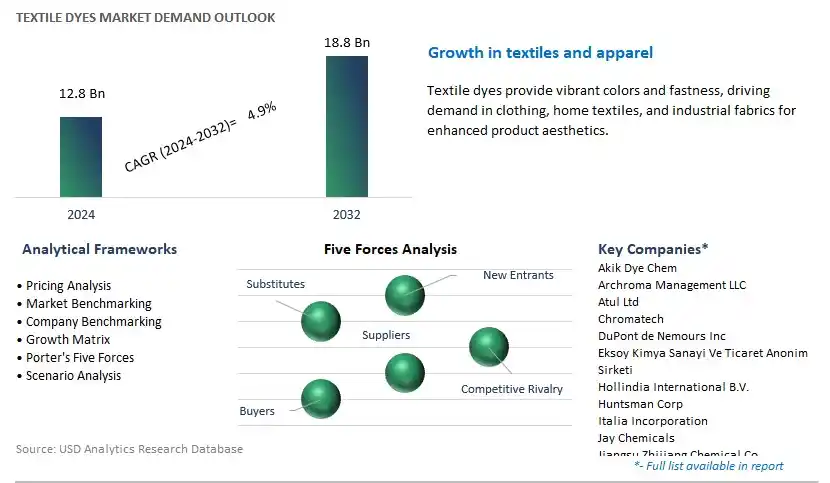
Global Textile Dyes Market Size is valued at $12.8 Billion in 2024 and is forecast to register a growth rate (CAGR) of 4.9% to reach $18.8 Billion by 2032.
The global Textile Dyes Market Study analyzes and forecasts the market size across 6 regions and 24 countries for diverse segments -By Fiber (Wool, Nylon, Cotton, Viscose, Polyester, Acrylic, Others), By Dye (Direct, Reactive, VAT, Basic, Acid, Disperse, Others).
An Introduction to Textile Dyes Market in 2024
Textile dyes play a vital role in the vibrant colors and designs of fabrics and garments in 2024. These dyes are used to impart color to textiles through immersion, padding, or printing processes, offering an extensive range of shades and effects. In the textile industry, dyes are categorized into various types, including reactive dyes, disperse dyes, acid dyes, and pigment dyes, each suitable for specific fiber types and application methods. With advancements in dye chemistry and formulation, textile dyes offer improved colorfastness, eco-friendliness, and compatibility with sustainable manufacturing practices. Further, innovations such as digital printing technologies enable precise and efficient application of dyes, reducing water and chemical consumption while providing customizable designs. With the growing demand for eco-friendly and high-quality textiles, the market for textile dyes s to evolve, driven by trends in fashion, sustainability, and consumer preferences.
Textile Dyes Market Competitive Landscape
The market report analyses the leading companies in the industry including Akik Dye Chem, Archroma Management LLC, Atul Ltd, Chromatech, DuPont de Nemours Inc, Eksoy Kimya Sanayi Ve Ticaret Anonim Sirketi, Hollindia International B.V., Huntsman Corp, Italia Incorporation, Jay Chemicals, Jiangsu Zhijiang Chemical Co., Kiri Industries, Lanxess AG, Organic Dyes and Pigments LLC, Pentachem Industries, Shandong Qing Shun Chemical Co. Ltd, Shanghai Anoky Group Co. Ltd, Synthesia A.S, Yabang Dyestuff, Zhejiang Jihua Group, Zhejiang Longsheng Group Co. Ltd, Zhejiang Runtu Co. Ltd, and others.
Textile Dyes Market Dynamics
Market Trend: Increasing Demand for Sustainable and Eco-Friendly Textile Dyes
A significant trend in the textile dyes market is the increasing demand for sustainable and eco-friendly dyes. With growing awareness of environmental issues and concerns about the impact of textile dyeing processes on ecosystems and human health, there is a rising preference for dyes that are produced using sustainable manufacturing methods, have minimal environmental footprint, and are safe for use in textiles. This trend is driving the development and adoption of eco-friendly dyeing technologies such as natural dyes derived from plant sources, bio-based dyes produced from renewable feedstocks, and low-impact synthetic dyes that minimize water and energy consumption, reduce chemical usage, and facilitate wastewater treatment and recycling. As consumers and regulatory agencies push for more sustainable practices in the textile industry, the demand for eco-friendly textile dyes is expected to continue growing, driven by the need for dyes that offer colorfastness, performance, and environmental responsibility.
Market Driver: Regulatory Compliance and Consumer Preferences for Safe and Non-Toxic Dyes
The primary driver for the textile dyes market is regulatory compliance and consumer preferences for safe and non-toxic dyes. Governments and regulatory agencies worldwide are imposing stricter regulations and standards on the use of chemicals in textile manufacturing to ensure product safety, environmental protection, and worker health. This has led to the phasing out or restriction of certain hazardous chemicals and dyes, prompting manufacturers to seek alternative solutions that comply with regulations and meet consumer demands for non-toxic and sustainable products. Additionally, consumers are becoming more conscious of the chemicals used in the production of textiles and are actively seeking products that are free from harmful substances such as azo dyes, heavy metals, and carcinogenic compounds. As a result, textile manufacturers are under pressure to adopt safer and environmentally friendly dyeing practices, driving the demand for non-toxic and eco-friendly dyes that offer color vibrancy, durability, and safety for end-users.
Market Opportunity: Development of Innovative Dyeing Technologies and Formulations
A significant opportunity for the textile dyes market lies in the development of innovative dyeing technologies and formulations. As the demand for sustainable and eco-friendly dyes continues to grow, there is an opportunity for manufacturers to invest in research and development to create new dyeing technologies that offer improved performance, efficiency, and environmental sustainability. This includes the development of dyeing processes that minimize water and energy consumption, reduce waste generation, and enable dye fixation without the need for toxic chemicals or mordants. Additionally, there is an opportunity to innovate in dye formulations to enhance color stability, lightfastness, and wash fastness, while minimizing the environmental impact of dyeing processes. By collaborating with academia, research institutions, and technology partners, manufacturers can explore new dyeing techniques such as digital printing, enzymatic dyeing, and nanoparticle-based formulations to address market needs and differentiate their products. As industries seek to meet sustainability goals, comply with regulations, and satisfy consumer preferences, the demand for innovative dyeing technologies and formulations presents opportunities for growth, differentiation, and market leadership in the textile dyes market.
Textile Dyes Market Share Analysis: Polyester segment generated the highest revenue in 2024
Within the textile dyes market, the Polyester segment is the largest and most dominant player. Polyester is one of the most commonly used fibers in the textile industry due to its versatile properties, including durability, wrinkle resistance, and ease of care. These characteristics make polyester fabrics popular in a wide range of applications, from clothing and home textiles to industrial uses. Additionally, polyester fabrics offer excellent dyeing properties, allowing for vibrant and long-lasting colors that resist fading and bleeding. Moreover, the growing demand for synthetic fibers, including polyester, in emerging economies due to urbanization, rising disposable incomes, and changing fashion trends, further drives the growth of the Polyester segment in the textile dyes market. Furthermore, advancements in dyeing technologies and eco-friendly dye formulations contribute to the continued dominance of polyester in the textile industry. With its widespread use, favorable properties, and increasing demand, the Polyester segment maintains its leadership position in the textile dyes market and is expected to continue its growth trajectory in the future.
Textile Dyes Market Share Analysis: Reactive Dye is poised to register the fastest CAGR over the forecast period
Among the dye types in the textile dyes market, the Reactive Dye segment is the fastest-growing player. Reactive dyes are highly versatile and widely used for dyeing natural fibers such as cotton, wool, and silk. These dyes form a covalent bond with the fibers, resulting in excellent color fastness and durability. Additionally, reactive dyes offer a wide range of vibrant and colorfast shades, making them popular choices for textile manufacturers and designers. Moreover, the increasing consumer demand for sustainably produced textiles drives the adoption of reactive dyes, as they can be used in eco-friendly dyeing processes with minimal environmental impact. Furthermore, technological advancements in reactive dye formulations and dyeing techniques, such as cold pad batch and continuous dyeing, enhance efficiency and reduce water and energy consumption, further fuelling the growth of the Reactive Dye segment. With their superior dyeing properties, eco-friendliness, and increasing demand for sustainable textiles, the Reactive Dye segment is poised to witness sustained growth and expand its market share in the textile dyes industry.
Textile Dyes Market
By Fiber
Wool
Nylon
Cotton
Viscose
Polyester
Acrylic
Others
By Dye
Direct
Reactive
VAT
Basic
Acid
Disperse
Others
Countries Analyzed
North America (US, Canada, Mexico)
Europe (Germany, UK, France, Spain, Italy, Russia, Rest of Europe)
Asia Pacific (China, India, Japan, South Korea, Australia, South East Asia, Rest of Asia)
South America (Brazil, Argentina, Rest of South America)
Middle East and Africa (Saudi Arabia, UAE, Rest of Middle East, South Africa, Egypt, Rest of Africa)
Textile Dyes Companies Profiled in the Study
Akik Dye Chem
Archroma Management LLC
Atul Ltd
Chromatech
DuPont de Nemours Inc
Eksoy Kimya Sanayi Ve Ticaret Anonim Sirketi
Hollindia International B.V.
Huntsman Corp
Italia Incorporation
Jay Chemicals
Jiangsu Zhijiang Chemical Co.
Kiri Industries
Lanxess AG
Organic Dyes and Pigments LLC
Pentachem Industries
Shandong Qing Shun Chemical Co. Ltd
Shanghai Anoky Group Co. Ltd
Synthesia A.S
Yabang Dyestuff
Zhejiang Jihua Group
Zhejiang Longsheng Group Co. Ltd
Zhejiang Runtu Co. Ltd
*- List Not Exhaustive
TABLE OF CONTENTS
1 Introduction to 2024 Textile Dyes Market
1.1 Market Overview
1.2 Quick Facts
1.3 Scope/Objective of the Study
1.4 Market Definition
1.5 Countries and Regions Covered
1.6 Units, Currency, and Conversions
1.7 Industry Value Chain
2 Research Methodology
2.1 Market Size Estimation
2.2 Sources and Research Methodology
2.3 Data Triangulation
2.4 Assumptions and Limitations
3 Executive Summary
3.1 Global Textile Dyes Market Size Outlook, $ Million, 2021 to 2032
3.2 Textile Dyes Market Outlook by Type, $ Million, 2021 to 2032
3.3 Textile Dyes Market Outlook by Product, $ Million, 2021 to 2032
3.4 Textile Dyes Market Outlook by Application, $ Million, 2021 to 2032
3.5 Textile Dyes Market Outlook by Key Countries, $ Million, 2021 to 2032
4 Market Dynamics
4.1 Key Driving Forces of Textile Dyes Industry
4.2 Key Market Trends in Textile Dyes Industry
4.3 Potential Opportunities in Textile Dyes Industry
4.4 Key Challenges in Textile Dyes Industry
5 Market Factor Analysis
5.1 Value Chain Analysis
5.2 Competitive Landscape
5.2.1 Global Textile Dyes Market Share by Company (%), 2023
5.2.2 Product Offerings by Company
5.3 Porter’s Five Forces Analysis
5.4 Pricing Analysis and Outlook
6 Growth Outlook Across Scenarios
6.1 Growth Analysis-Case Scenario Definitions
6.2 Low Growth Scenario Forecasts
6.3 Reference Growth Scenario Forecasts
6.4 High Growth Scenario Forecasts
7 Global Textile Dyes Market Outlook by Segments
7.1 Textile Dyes Market Outlook by Segments, $ Million, 2021- 2032
By Fiber
Wool
Nylon
Cotton
Viscose
Polyester
Acrylic
Others
By Dye
Direct
Reactive
VAT
Basic
Acid
Disperse
Others
8 North America Textile Dyes Market Analysis and Outlook To 2032
8.1 Introduction to North America Textile Dyes Markets in 2024
8.2 North America Textile Dyes Market Size Outlook by Country, 2021-2032
8.2.1 United States
8.2.2 Canada
8.2.3 Mexico
8.3 North America Textile Dyes Market size Outlook by Segments, 2021-2032
By Fiber
Wool
Nylon
Cotton
Viscose
Polyester
Acrylic
Others
By Dye
Direct
Reactive
VAT
Basic
Acid
Disperse
Others
9 Europe Textile Dyes Market Analysis and Outlook To 2032
9.1 Introduction to Europe Textile Dyes Markets in 2024
9.2 Europe Textile Dyes Market Size Outlook by Country, 2021-2032
9.2.1 Germany
9.2.2 France
9.2.3 Spain
9.2.4 United Kingdom
9.2.4 Italy
9.2.5 Russia
9.2.6 Norway
9.2.7 Rest of Europe
9.3 Europe Textile Dyes Market Size Outlook by Segments, 2021-2032
By Fiber
Wool
Nylon
Cotton
Viscose
Polyester
Acrylic
Others
By Dye
Direct
Reactive
VAT
Basic
Acid
Disperse
Others
10 Asia Pacific Textile Dyes Market Analysis and Outlook To 2032
10.1 Introduction to Asia Pacific Textile Dyes Markets in 2024
10.2 Asia Pacific Textile Dyes Market Size Outlook by Country, 2021-2032
10.2.1 China
10.2.2 India
10.2.3 Japan
10.2.4 South Korea
10.2.5 Indonesia
10.2.6 Malaysia
10.2.7 Australia
10.2.8 Rest of Asia Pacific
10.3 Asia Pacific Textile Dyes Market size Outlook by Segments, 2021-2032
By Fiber
Wool
Nylon
Cotton
Viscose
Polyester
Acrylic
Others
By Dye
Direct
Reactive
VAT
Basic
Acid
Disperse
Others
11 South America Textile Dyes Market Analysis and Outlook To 2032
11.1 Introduction to South America Textile Dyes Markets in 2024
11.2 South America Textile Dyes Market Size Outlook by Country, 2021-2032
11.2.1 Brazil
11.2.2 Argentina
11.2.3 Rest of South America
11.3 South America Textile Dyes Market size Outlook by Segments, 2021-2032
By Fiber
Wool
Nylon
Cotton
Viscose
Polyester
Acrylic
Others
By Dye
Direct
Reactive
VAT
Basic
Acid
Disperse
Others
12 Middle East and Africa Textile Dyes Market Analysis and Outlook To 2032
12.1 Introduction to Middle East and Africa Textile Dyes Markets in 2024
12.2 Middle East and Africa Textile Dyes Market Size Outlook by Country, 2021-2032
12.2.1 Saudi Arabia
12.2.2 UAE
12.2.3 Oman
12.2.4 Rest of Middle East
12.2.5 Egypt
12.2.6 Nigeria
12.2.7 South Africa
12.2.8 Rest of Africa
12.3 Middle East and Africa Textile Dyes Market size Outlook by Segments, 2021-2032
By Fiber
Wool
Nylon
Cotton
Viscose
Polyester
Acrylic
Others
By Dye
Direct
Reactive
VAT
Basic
Acid
Disperse
Others
13 Company Profiles
13.1 Company Snapshot
13.2 SWOT Profiles
13.3 Products and Services
13.4 Recent Developments
13.5 Financial Profile
Akik Dye Chem
Archroma Management LLC
Atul Ltd
Chromatech
DuPont de Nemours Inc
Eksoy Kimya Sanayi Ve Ticaret Anonim Sirketi
Hollindia International B.V.
Huntsman Corp
Italia Incorporation
Jay Chemicals
Jiangsu Zhijiang Chemical Co.
Kiri Industries
Lanxess AG
Organic Dyes and Pigments LLC
Pentachem Industries
Shandong Qing Shun Chemical Co. Ltd
Shanghai Anoky Group Co. Ltd
Synthesia A.S
Yabang Dyestuff
Zhejiang Jihua Group
Zhejiang Longsheng Group Co. Ltd
Zhejiang Runtu Co. Ltd
14 Appendix
14.1 Customization Offerings
14.2 Subscription Services
14.3 Related Reports
14.4 Publisher Expertise
By Fiber
Wool
Nylon
Cotton
Viscose
Polyester
Acrylic
Others
By Dye
Direct
Reactive
VAT
Basic
Acid
Disperse
Others
Countries Analyzed
North America (US, Canada, Mexico)
Europe (Germany, UK, France, Spain, Italy, Russia, Rest of Europe)
Asia Pacific (China, India, Japan, South Korea, Australia, South East Asia, Rest of Asia)
South America (Brazil, Argentina, Rest of South America)
Middle East and Africa (Saudi Arabia, UAE, Rest of Middle East, South Africa, Egypt, Rest of Africa)
