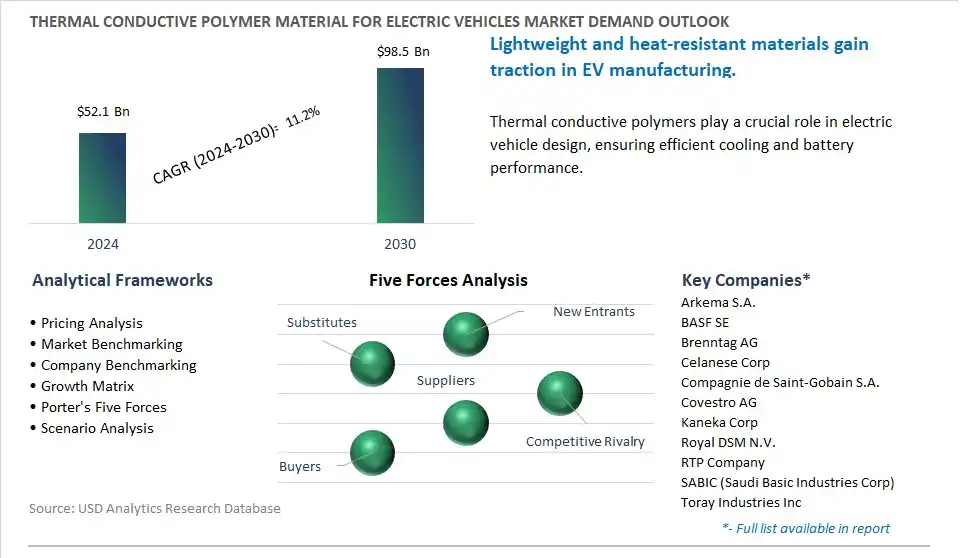
The global Thermal Conductive Polymer Material For Electric Vehicles Market is poised to register a 11.2% CAGR from $52.1 Billion in 2024 to $98.5 Billion in 2030.
The global Thermal Conductive Polymer Material For Electric Vehicles Market Study analyzes and forecasts the market size across 6 regions and 24 countries for diverse segments -By Product (Thermally Conductive Plastics, Thermal Adhesive, Thermally Conductive Coating, Thermally Conductive Elastomer, Others).
An Introduction to Global Thermal Conductive Polymer Material For Electric Vehicles Market in 2024
Thermal conductive polymer materials for electric vehicles play a crucial role in managing heat generated by power electronics, battery packs, and electric motors, ensuring efficient operation and prolonged lifespan of vehicle components. The future of thermal conductive polymer materials for electric vehicles is shaped by several key trends, including advancements in material science, automotive electrification, and sustainability initiatives. One significant trend is the development of polymer-based composites and nanocomposites with enhanced thermal conductivity, mechanical strength, and flame retardancy, meeting the demanding requirements of thermal management systems in electric vehicles. Material manufacturers are investing in research and development to engineer new polymer formulations, filler materials, and processing techniques that improve heat dissipation, thermal stability, and compatibility with electric vehicle components, enabling efficient cooling and temperature control in battery packs, power electronics modules, and electric drivetrains. Additionally, the integration of thermal conductive polymers into lightweight structural components and thermal interface materials is driving innovations in vehicle design, weight reduction, and energy efficiency, contributing to the performance and range of electric vehicles. Moreover, the increasing demand for electric vehicles and the transition towards sustainable transportation solutions are driving the adoption of thermal conductive polymer materials that offer environmental benefits such as reduced energy consumption, lower greenhouse gas emissions, and improved recyclability compared to traditional metal-based heat sinks and thermal management solutions. Furthermore, collaborations between polymer manufacturers, automotive OEMs, and thermal management experts are driving innovation and market growth by delivering customized solutions that meet the specific thermal conductivity, durability, and safety requirements of electric vehicle applications, ensuring continued advancement and adoption of thermal conductive polymer materials in the automotive industry.
Thermal Conductive Polymer Material For Electric Vehicles Market Competitive Landscape
The market report analyses the leading companies in the industry including Arkema S.A., BASF SE, Brenntag AG, Celanese Corp, Compagnie de Saint-Gobain S.A., Covestro AG, Kaneka Corp, Royal DSM N.V., RTP Company, SABIC (Saudi Basic Industries Corp), Toray Industries Inc.
Thermal Conductive Polymer Material For Electric Vehicles Market Dynamics
Thermal Conductive Polymer Material For Electric Vehicles Market Trend: Increasing Adoption of Thermal Conductive Polymer Materials for Electric Vehicle Battery Systems
A prominent market trend in the thermal conductive polymer material for the electric vehicles industry is the increasing adoption of thermal conductive polymer materials in electric vehicle (EV) battery systems. As the electric vehicle market continues to expand rapidly, there is a growing need for effective thermal management solutions to maintain battery performance, longevity, and safety. Thermal conductive polymer materials, engineered to efficiently dissipate heat generated during battery operation, play a crucial role in ensuring optimal thermal conditions within EV battery packs. This trend is driven by advancements in battery technology, increasing energy density, and the need to address thermal challenges associated with fast charging, high-power operation, and temperature fluctuations in electric vehicle batteries.
Thermal Conductive Polymer Material For Electric Vehicles Market Driver: Demand for Improved Battery Performance and Reliability in Electric Vehicles
A key driver behind the growth of the thermal conductive polymer material for the electric vehicles market is the demand for improved battery performance and reliability in electric vehicles. As consumers and automotive manufacturers prioritize the range, efficiency, and durability of electric vehicles, there is a heightened focus on battery thermal management to enhance overall vehicle performance and safety. Thermal conductive polymer materials offer advantages such as lightweight, flexibility, and thermal conductivity, making them ideal for integrating into battery pack designs to enhance heat dissipation and temperature regulation. The need to mitigate thermal issues such as overheating, thermal runaway, and battery degradation drives market demand for thermal conductive polymer materials as essential components of advanced thermal management systems in electric vehicles.
Thermal Conductive Polymer Material For Electric Vehicles Market Opportunity: Development of Next-Generation Thermal Conductive Polymer Composites
An opportunity exists for manufacturers of thermal conductive polymer materials to develop next-generation thermal conductive polymer composites that meet the evolving requirements of electric vehicle battery systems. With the increasing demand for higher energy density, faster charging, and longer battery life in electric vehicles, there is potential to innovate in polymer formulations, filler materials, and manufacturing processes to create polymer composites with enhanced thermal conductivity, mechanical strength, and compatibility with battery pack architectures. Manufacturers can explore opportunities to collaborate with automotive OEMs, battery manufacturers, and research institutions to develop customized polymer materials tailored to specific electric vehicle platforms, battery chemistries, and thermal management strategies. Additionally, there is opportunity to integrate advanced functionalities such as flame retardancy, electrical insulation, and chemical resistance into thermal conductive polymer materials, expanding their utility in electric vehicle applications and addressing emerging market needs for high-performance thermal management solutions. By focusing on innovation and collaboration, thermal conductive polymer material manufacturers can position themselves as key enablers of the electric vehicle revolution and capture significant opportunities for growth and market leadership in the automotive industry.
Thermal Conductive Polymer Material For Electric Vehicles Market Share Analysis: Thermally Conductive Plastics generated the highest revenue in 2024
The largest segment in the Thermal Conductive Polymer Material for Electric Vehicles Market is the Thermally Conductive Plastics category. This is because thermally conductive plastics offer potential advantages for electric vehicle (EV) applications. Thermally conductive plastics can be molded into complex shapes and integrated into various components of electric vehicles, including battery housings, motor enclosures, power electronics, and thermal management systems. This versatility allows for efficient heat dissipation and thermal management in EVs, crucial for maintaining optimal operating temperatures and ensuring the reliability and performance of sensitive electronic components. Additionally, thermally conductive plastics combine the mechanical properties of plastics with enhanced thermal conductivity, providing lightweight and cost-effective solutions for EV manufacturers. Furthermore, advancements in polymer science and additive technologies have led to the development of thermally conductive plastics with improved thermal performance, processing characteristics, and sustainability, further driving their adoption in the electric vehicle industry. Over the forecast period, the widespread use and versatility of thermally conductive plastics contribute to their dominance as the largest segment in the Thermal Conductive Polymer Material for Electric Vehicles Market.
Thermal Conductive Polymer Material For Electric Vehicles Market Report Segmentation
By Product
Thermally Conductive Plastics
Thermal Adhesive
Thermally Conductive Coating
Thermally Conductive Elastomer
Others
Regions Included
North America (US, Canada, Mexico)
Europe (Germany, UK, France, Spain, Italy, Russia, Rest of Europe)
Asia Pacific (China, India, Japan, South Korea, Australia, South East Asia, Rest of Asia)
South America (Brazil, Argentina, Rest of South America)
Middle East and Africa (Saudi Arabia, UAE, Rest of Middle East, South Africa, Egypt, Rest of Africa)
Thermal Conductive Polymer Material For Electric Vehicles Companies Profiled in the Market Study
Arkema S.A.
BASF SE
Brenntag AG
Celanese Corp
Compagnie de Saint-Gobain S.A.
Covestro AG
Kaneka Corp
Royal DSM N.V.
RTP Company
SABIC (Saudi Basic Industries Corp)
Toray Industries Inc
*- List Not Exhaustive
TABLE OF CONTENTS
1 Introduction to 2024 Thermal Conductive Polymer Material For Electric Vehicles Market
1.1 Market Overview
1.2 Quick Facts
1.3 Scope/Objective of the Study
1.4 Market Definition
1.5 Countries and Regions Covered
1.6 Units, Currency, and Conversions
1.7 Industry Value Chain
2 Research Methodology
2.1 Market Size Estimation
2.2 Sources and Research Methodology
2.3 Data Triangulation
2.4 Assumptions and Limitations
3 Executive Summary
3.1 Global Thermal Conductive Polymer Material For Electric Vehicles Market Size Outlook, $ Million, 2021 to 2030
3.2 Thermal Conductive Polymer Material For Electric Vehicles Market Outlook by Type, $ Million, 2021 to 2030
3.3 Thermal Conductive Polymer Material For Electric Vehicles Market Outlook by Product, $ Million, 2021 to 2030
3.4 Thermal Conductive Polymer Material For Electric Vehicles Market Outlook by Application, $ Million, 2021 to 2030
3.5 Thermal Conductive Polymer Material For Electric Vehicles Market Outlook by Key Countries, $ Million, 2021 to 2030
4 Market Dynamics
4.1 Key Driving Forces of Thermal Conductive Polymer Material For Electric Vehicles Industry
4.2 Key Market Trends in Thermal Conductive Polymer Material For Electric Vehicles Industry
4.3 Potential Opportunities in Thermal Conductive Polymer Material For Electric Vehicles Industry
4.4 Key Challenges in Thermal Conductive Polymer Material For Electric Vehicles Industry
5 Market Factor Analysis
5.1 Value Chain Analysis
5.2 Competitive Landscape
5.2.1 Global Thermal Conductive Polymer Material For Electric Vehicles Market Share by Company (%), 2023
5.2.2 Product Offerings by Company
5.3 Porter’s Five Forces Analysis
5.4 Pricing Analysis and Outlook
6 Growth Outlook Across Scenarios
6.1 Growth Analysis-Case Scenario Definitions
6.2 Low Growth Scenario Forecasts
6.3 Reference Growth Scenario Forecasts
6.4 High Growth Scenario Forecasts
7 Global Thermal Conductive Polymer Material For Electric Vehicles Market Outlook by Segments
7.1 Thermal Conductive Polymer Material For Electric Vehicles Market Outlook by Segments, $ Million, 2021- 2030
By Product
Thermally Conductive Plastics
Thermal Adhesive
Thermally Conductive Coating
Thermally Conductive Elastomer
Others
8 North America Thermal Conductive Polymer Material For Electric Vehicles Market Analysis and Outlook To 2030
8.1 Introduction to North America Thermal Conductive Polymer Material For Electric Vehicles Markets in 2024
8.2 North America Thermal Conductive Polymer Material For Electric Vehicles Market Size Outlook by Country, 2021-2030
8.2.1 United States
8.2.2 Canada
8.2.3 Mexico
8.3 North America Thermal Conductive Polymer Material For Electric Vehicles Market size Outlook by Segments, 2021-2030
By Product
Thermally Conductive Plastics
Thermal Adhesive
Thermally Conductive Coating
Thermally Conductive Elastomer
Others
9 Europe Thermal Conductive Polymer Material For Electric Vehicles Market Analysis and Outlook To 2030
9.1 Introduction to Europe Thermal Conductive Polymer Material For Electric Vehicles Markets in 2024
9.2 Europe Thermal Conductive Polymer Material For Electric Vehicles Market Size Outlook by Country, 2021-2030
9.2.1 Germany
9.2.2 France
9.2.3 Spain
9.2.4 United Kingdom
9.2.4 Italy
9.2.5 Russia
9.2.6 Norway
9.2.7 Rest of Europe
9.3 Europe Thermal Conductive Polymer Material For Electric Vehicles Market Size Outlook by Segments, 2021-2030
By Product
Thermally Conductive Plastics
Thermal Adhesive
Thermally Conductive Coating
Thermally Conductive Elastomer
Others
10 Asia Pacific Thermal Conductive Polymer Material For Electric Vehicles Market Analysis and Outlook To 2030
10.1 Introduction to Asia Pacific Thermal Conductive Polymer Material For Electric Vehicles Markets in 2024
10.2 Asia Pacific Thermal Conductive Polymer Material For Electric Vehicles Market Size Outlook by Country, 2021-2030
10.2.1 China
10.2.2 India
10.2.3 Japan
10.2.4 South Korea
10.2.5 Indonesia
10.2.6 Malaysia
10.2.7 Australia
10.2.8 Rest of Asia Pacific
10.3 Asia Pacific Thermal Conductive Polymer Material For Electric Vehicles Market size Outlook by Segments, 2021-2030
By Product
Thermally Conductive Plastics
Thermal Adhesive
Thermally Conductive Coating
Thermally Conductive Elastomer
Others
11 South America Thermal Conductive Polymer Material For Electric Vehicles Market Analysis and Outlook To 2030
11.1 Introduction to South America Thermal Conductive Polymer Material For Electric Vehicles Markets in 2024
11.2 South America Thermal Conductive Polymer Material For Electric Vehicles Market Size Outlook by Country, 2021-2030
11.2.1 Brazil
11.2.2 Argentina
11.2.3 Rest of South America
11.3 South America Thermal Conductive Polymer Material For Electric Vehicles Market size Outlook by Segments, 2021-2030
By Product
Thermally Conductive Plastics
Thermal Adhesive
Thermally Conductive Coating
Thermally Conductive Elastomer
Others
12 Middle East and Africa Thermal Conductive Polymer Material For Electric Vehicles Market Analysis and Outlook To 2030
12.1 Introduction to Middle East and Africa Thermal Conductive Polymer Material For Electric Vehicles Markets in 2024
12.2 Middle East and Africa Thermal Conductive Polymer Material For Electric Vehicles Market Size Outlook by Country, 2021-2030
12.2.1 Saudi Arabia
12.2.2 UAE
12.2.3 Oman
12.2.4 Rest of Middle East
12.2.5 Egypt
12.2.6 Nigeria
12.2.7 South Africa
12.2.8 Rest of Africa
12.3 Middle East and Africa Thermal Conductive Polymer Material For Electric Vehicles Market size Outlook by Segments, 2021-2030
By Product
Thermally Conductive Plastics
Thermal Adhesive
Thermally Conductive Coating
Thermally Conductive Elastomer
Others
13 Company Profiles
13.1 Company Snapshot
13.2 SWOT Profiles
13.3 Products and Services
13.4 Recent Developments
13.5 Financial Profile
Arkema S.A.
BASF SE
Brenntag AG
Celanese Corp
Compagnie de Saint-Gobain S.A.
Covestro AG
Kaneka Corp
Royal DSM N.V.
RTP Company
SABIC (Saudi Basic Industries Corp)
Toray Industries Inc
14 Appendix
14.1 Customization Offerings
14.2 Subscription Services
14.3 Related Reports
14.4 Publisher Expertise
By Product
Thermally Conductive Plastics
Thermal Adhesive
Thermally Conductive Coating
Thermally Conductive Elastomer
Others
Countries Analyzed
North America (US, Canada, Mexico)
Europe (Germany, UK, France, Spain, Italy, Russia, Rest of Europe)
Asia Pacific (China, India, Japan, South Korea, Australia, South East Asia, Rest of Asia)
South America (Brazil, Argentina, Rest of South America)
Middle East and Africa (Saudi Arabia, UAE, Rest of Middle East, South Africa, Egypt, Rest of Africa)
