
The Thermodilution Catheter Market study analyzes and forecasts the market size across 6 regions and 24 countries for diverse segments- By Material (Polyurethane, Nylon, Others), By End-User (Hospitals, Ambulatory Surgical Centers, Others).
In 2024, the market for thermodilution catheters continues to be integral in hemodynamic monitoring and management of critically ill patients in intensive care units, cardiac catheterization labs, and operating rooms. Thermodilution catheters are specialized vascular access devices equipped with temperature sensors used to measure cardiac output and other hemodynamic parameters by injecting cold saline into the bloodstream and monitoring the resulting changes in blood temperature. With advancements in catheter design, sensor technology, and data analysis software, thermodilution catheters offer accurate and real-time assessment of cardiac function, fluid status, and tissue perfusion, guiding clinical decision-making and optimizing patient care. Moreover, the market is influenced by trends such as the integration of thermodilution technology into multi-parameter monitoring systems, the development of miniaturized catheters for minimally invasive procedures, and the customization of catheter configurations for specific patient populations and clinical scenarios. Additionally, ongoing research focuses on refining measurement algorithms, enhancing catheter biocompatibility and safety profiles, and exploring novel applications such as thermodilution-based drug delivery and targeted temperature management, reflecting the continuous innovation and improvement in thermodilution catheter technology to meet the evolving needs of critical care medicine and cardiovascular health.
One prominent market trend in the thermodilution catheter industry is the increasing preference for minimally invasive hemodynamic monitoring techniques. Traditional methods of hemodynamic monitoring often involve invasive procedures such as pulmonary artery catheterization, which carry risks of complications such as infection, bleeding, and thrombosis. However, thermodilution catheters offer a less invasive alternative for assessing cardiac function and hemodynamic parameters. These catheters are inserted into central veins and use the thermodilution technique to measure cardiac output and other hemodynamic variables, providing valuable insights into a patient's cardiovascular status without the need for more invasive procedures. The trend towards minimally invasive hemodynamic monitoring reflects a desire to minimize patient discomfort, reduce procedural risks, and optimize clinical outcomes in critical care settings.
A significant market driver for thermodilution catheters is the growing demand for accurate hemodynamic monitoring in critical care settings. Hemodynamic instability is a common feature of critically ill patients, including those with sepsis, acute respiratory distress syndrome (ARDS), and heart failure, among other conditions. Timely and accurate assessment of cardiac function and fluid status is essential for guiding hemodynamic management strategies, optimizing tissue perfusion, and preventing organ dysfunction. Thermodilution catheters enable continuous or intermittent monitoring of key hemodynamic parameters such as cardiac output, stroke volume, and systemic vascular resistance, providing clinicians with valuable information to guide hemodynamic optimization and therapeutic interventions. The increasing recognition of the importance of hemodynamic monitoring in critical care drives the demand for thermodilution catheters as indispensable tools for managing complex and critically ill patients.
One potential opportunity in the thermodilution catheter market lies in the expansion into interventional cardiology and electrophysiology procedures. While thermodilution catheters are traditionally used for hemodynamic monitoring in critical care and perioperative settings, there's an opportunity to leverage their capabilities for guiding interventional procedures in cardiology and electrophysiology. For example, thermodilution catheters can be used to assess cardiac output and measure intracardiac pressures during cardiac catheterization procedures, facilitating the diagnosis and treatment of conditions such as valvular heart disease, coronary artery disease, and congenital heart defects. Additionally, thermodilution catheters may be employed for monitoring cardiac output and guiding fluid management strategies during electrophysiology studies and ablation procedures for arrhythmias. By expanding into interventional cardiology and electrophysiology applications, manufacturers of thermodilution catheters can diversify their product offerings and tap into new market segments, catering to the evolving needs of cardiovascular healthcare providers and improving patient care outcomes.
In the Thermodilution Catheter Market, the catheter material segment of Polyurethane is experiencing rapid growth. Polyurethane catheters offer several advantages over other materials, including excellent biocompatibility, flexibility, durability, and resistance to kinking and deformation. These catheters are widely used in various medical procedures, including hemodynamic monitoring and cardiac output measurements, where accurate and reliable catheter performance is essential. Hospitals, ambulatory surgical centers, and other healthcare facilities are the primary end-users adopting polyurethane catheters for clinical applications, reflecting their versatility and effectiveness in diverse healthcare settings. As the demand for advanced hemodynamic monitoring and minimally invasive procedures continues to rise, driven by factors such as aging populations and the increasing prevalence of cardiovascular diseases, the market for polyurethane catheters in the thermodilution catheter segment is expected to continue its rapid growth trajectory. Additionally, ongoing advancements in catheter design, manufacturing processes, and patient safety features further contribute to market expansion in this segment.
The market research study provides in-depth insights into leading companies including the SWOT analyses, product profile, financial details, and recent developments acrossAdvanced Lifesciences Pvt. Ltd, Alpha Medical Instruments LLC, B. Braun Melsungen AG, DeRoyal Industries Inc, Edwards Lifesciences Corp, ICU Medical Inc, Merit Medical Systems Inc, Nolato AB, Teleflex Inc
By Material
Polyurethane
Nylon
Others
By End-User
Hospitals
Ambulatory Surgical Centers
Others
Geographical Analysis
North America (United States, Canada, Mexico)
Europe (Germany, France, United Kingdom, Spain, Italy, Rest of Europe)
Asia Pacific (China, India, Japan, South Korea, Rest of Asia Pacific)
South America (Brazil, Argentina, Rest of South America)
Middle East and Africa (Saudi Arabia, UAE, Rest of Middle East, South Africa, Egypt, Rest of Africa)
Advanced Lifesciences Pvt. Ltd
Alpha Medical Instruments LLC
B. Braun Melsungen AG
DeRoyal Industries Inc
Edwards Lifesciences Corp
ICU Medical Inc
Merit Medical Systems Inc
Nolato AB
Teleflex Inc
• Deepen your industry insights and navigate uncertainties for strategy formulation, CAPEX, and Operational decisions
• Gain access to detailed insights on the Thermodilution Catheter Market, encompassing current market size, growth trends, and forecasts till 2030.
• Access detailed competitor analysis, enabling competitive advantage through a thorough understanding of market players, strategies, and potential differentiation opportunities
• Stay ahead of the curve with insights on technological advancements, innovations, and upcoming trends
• Identify lucrative investment avenues and expansion opportunities within the Thermodilution Catheter Market industry, guided by robust, data-backed analysis.
• Understand regional and global markets through country-wise analysis, regional market potential, regulatory nuances, and dynamics
• Execute strategies with confidence and speed through information, analytics, and insights on the industry value chain
• Corporate leaders, strategists, financial experts, shareholders, asset managers, and governmental representatives can make long-term planning scenarios and build an integrated and timely understanding of market dynamics
• Benefit from tailored solutions and expert consultation based on report insights, providing personalized strategies aligned with specific business needs.
TABLE OF CONTENTS
1 Introduction to 2024 Thermodilution Catheter Market
1.1 Market Overview
1.2 Quick Facts
1.3 Scope/Objective of the Study
1.4 Market Definition
1.5 Countries and Regions Covered
1.6 Units, Currency, and Conversions
1.7 Industry Value Chain
2 Research Methodology
2.1 Market Size Estimation
2.2 Sources and Research Methodology
2.3 Data Triangulation
2.4 Assumptions and Limitations
3 Executive Summary
3.1 Global Thermodilution Catheter Market Size Outlook, $ Million, 2021 to 2030
3.2 Thermodilution Catheter Market Outlook by Type, $ Million, 2021 to 2030
3.3 Thermodilution Catheter Market Outlook by Product, $ Million, 2021 to 2030
3.4 Thermodilution Catheter Market Outlook by Application, $ Million, 2021 to 2030
3.5 Thermodilution Catheter Market Outlook by Key Countries, $ Million, 2021 to 2030
4 Market Dynamics
4.1 Key Driving Forces of Thermodilution Catheter Industry
4.2 Key Market Trends in Thermodilution Catheter Industry
4.3 Potential Opportunities in Thermodilution Catheter Industry
4.4 Key Challenges in Thermodilution Catheter Industry
5 Market Factor Analysis
5.1 Value Chain Analysis
5.2 Competitive Landscape
5.2.1 Global Thermodilution Catheter Market Share by Company (%), 2023
5.2.2 Product Offerings by Company
5.3 Porter’s Five Forces Analysis
5.4 Pricing Analysis and Outlook
6 Growth Outlook Across Scenarios
6.1 Growth Analysis-Case Scenario Definitions
6.2 Low Growth Scenario Forecasts
6.3 Reference Growth Scenario Forecasts
6.4 High Growth Scenario Forecasts
7 Global Thermodilution Catheter Market Outlook by Segments
7.1 Thermodilution Catheter Market Outlook by Segments, $ Million, 2021- 2030
By Material
Polyurethane
Nylon
Others
By End-User
Hospitals
Ambulatory Surgical Centers
Others
8 North America Thermodilution Catheter Market Analysis and Outlook To 2030
8.1 Introduction to North America Thermodilution Catheter Markets in 2024
8.2 North America Thermodilution Catheter Market Size Outlook by Country, 2021-2030
8.2.1 United States
8.2.2 Canada
8.2.3 Mexico
8.3 North America Thermodilution Catheter Market size Outlook by Segments, 2021-2030
By Material
Polyurethane
Nylon
Others
By End-User
Hospitals
Ambulatory Surgical Centers
Others
9 Europe Thermodilution Catheter Market Analysis and Outlook To 2030
9.1 Introduction to Europe Thermodilution Catheter Markets in 2024
9.2 Europe Thermodilution Catheter Market Size Outlook by Country, 2021-2030
9.2.1 Germany
9.2.2 France
9.2.3 Spain
9.2.4 United Kingdom
9.2.4 Italy
9.2.5 Russia
9.2.6 Norway
9.2.7 Rest of Europe
9.3 Europe Thermodilution Catheter Market Size Outlook by Segments, 2021-2030
By Material
Polyurethane
Nylon
Others
By End-User
Hospitals
Ambulatory Surgical Centers
Others
10 Asia Pacific Thermodilution Catheter Market Analysis and Outlook To 2030
10.1 Introduction to Asia Pacific Thermodilution Catheter Markets in 2024
10.2 Asia Pacific Thermodilution Catheter Market Size Outlook by Country, 2021-2030
10.2.1 China
10.2.2 India
10.2.3 Japan
10.2.4 South Korea
10.2.5 Indonesia
10.2.6 Malaysia
10.2.7 Australia
10.2.8 Rest of Asia Pacific
10.3 Asia Pacific Thermodilution Catheter Market size Outlook by Segments, 2021-2030
By Material
Polyurethane
Nylon
Others
By End-User
Hospitals
Ambulatory Surgical Centers
Others
11 South America Thermodilution Catheter Market Analysis and Outlook To 2030
11.1 Introduction to South America Thermodilution Catheter Markets in 2024
11.2 South America Thermodilution Catheter Market Size Outlook by Country, 2021-2030
11.2.1 Brazil
11.2.2 Argentina
11.2.3 Rest of South America
11.3 South America Thermodilution Catheter Market size Outlook by Segments, 2021-2030
By Material
Polyurethane
Nylon
Others
By End-User
Hospitals
Ambulatory Surgical Centers
Others
12 Middle East and Africa Thermodilution Catheter Market Analysis and Outlook To 2030
12.1 Introduction to Middle East and Africa Thermodilution Catheter Markets in 2024
12.2 Middle East and Africa Thermodilution Catheter Market Size Outlook by Country, 2021-2030
12.2.1 Saudi Arabia
12.2.2 UAE
12.2.3 Oman
12.2.4 Rest of Middle East
12.2.5 Egypt
12.2.6 Nigeria
12.2.7 South Africa
12.2.8 Rest of Africa
12.3 Middle East and Africa Thermodilution Catheter Market size Outlook by Segments, 2021-2030
By Material
Polyurethane
Nylon
Others
By End-User
Hospitals
Ambulatory Surgical Centers
Others
13 Company Profiles
13.1 Company Snapshot
13.2 SWOT Profiles
13.3 Products and Services
13.4 Recent Developments
13.5 Financial Profile
List of Companies
Advanced Lifesciences Pvt. Ltd
Alpha Medical Instruments LLC
B. Braun Melsungen AG
DeRoyal Industries Inc
Edwards Lifesciences Corp
ICU Medical Inc
Merit Medical Systems Inc
Nolato AB
Teleflex Inc
14 Appendix
14.1 Customization Offerings
14.2 Subscription Services
14.3 Related Reports
14.4 Publisher Expertise
By Material
Polyurethane
Nylon
Others
By End-User
Hospitals
Ambulatory Surgical Centers
Others
Countries Analyzed
North America (United States, Canada, Mexico)
Europe (Germany, France, United Kingdom, Spain, Italy, Rest of Europe)
Asia Pacific (China, India, Japan, South Korea, Rest of Asia Pacific)
South America (Brazil, Argentina, Rest of South America)
Middle East and Africa (Saudi Arabia, UAE, Rest of Middle East, South Africa, Egypt, Rest of Africa)
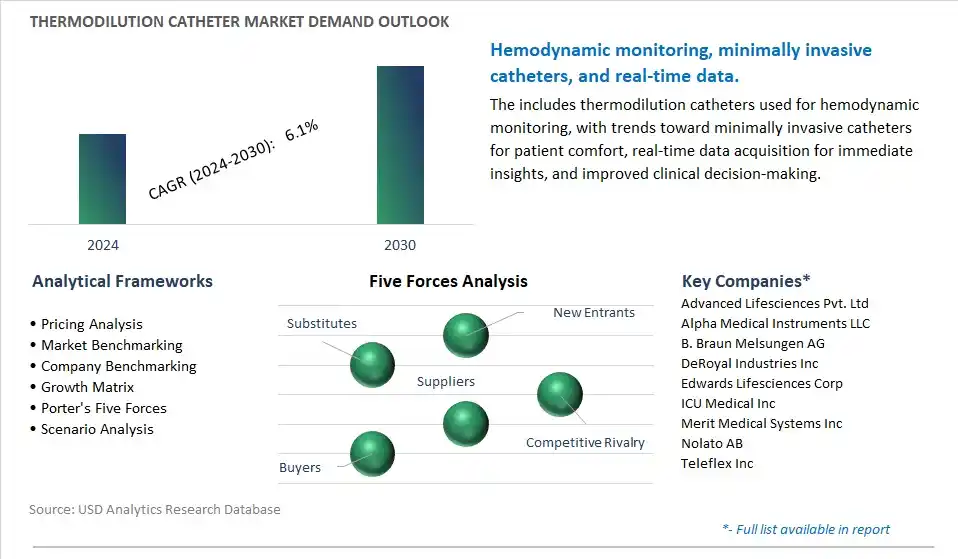
The global Thermodilution Catheter Market is one of the lucrative growth markets, poised to register a 6.1% growth (CAGR) between 2024 and 2030.
Emerging Markets across Asia Pacific, Europe, and Americas present robust growth prospects.
Advanced Lifesciences Pvt. Ltd, Alpha Medical Instruments LLC, B. Braun Melsungen AG, DeRoyal Industries Inc, Edwards Lifesciences Corp, ICU Medical Inc, Merit Medical Systems Inc, Nolato AB, Teleflex Inc
Base Year- 2023; Estimated Year- 2024; Historic Period- 2018-2023; Forecast period- 2024 to 2030; Currency: USD; Volume