
The global Thermoplastic Polyester Engineering Resins Market Study analyzes and forecasts the market size across 6 regions and 24 countries for diverse segments -By Product (Polybutylene Terephthalate, Polyethylene Terephthalate, Polycyclohexylene Dimethylene Terephthalate), By Application (Automotive, Electrical Appliances, Food & Beverage, Industrial Equipment, Others).
Thermoplastic polyester engineering resins are high-performance polymers with excellent mechanical, thermal, and chemical properties, widely used in automotive, electrical, and industrial applications. The future of thermoplastic polyester engineering resins is shaped by several key trends, including advancements in polymer chemistry, additive manufacturing, and sustainability initiatives. One significant trend is the development of novel polyester resins such as polyethylene terephthalate (PET), polybutylene terephthalate (PBT), and polyethylene naphthalate (PEN) with enhanced properties such as heat resistance, flame retardancy, and chemical resistance, meeting the demanding requirements of automotive under-the-hood components, electrical connectors, and structural parts in industrial machinery. Manufacturers are investing in research and development to engineer new resin formulations, reinforcement fibers, and compounding technologies that improve mechanical strength, dimensional stability, and processing characteristics of thermoplastic polyester resins, enabling lightweighting, part consolidation, and cost reduction in diverse applications. Additionally, the integration of recycled and bio-based feedstocks into polyester resin production is driving innovations in sustainable materials that reduce environmental impact, energy consumption, and greenhouse gas emissions throughout the product lifecycle, contributing to circular economy principles and carbon neutrality goals in the plastics industry. Moreover, the increasing demand for high-performance materials in electrified vehicles, renewable energy systems, and 5G telecommunications is driving the adoption of thermoplastic polyester engineering resins that offer excellent dielectric properties, thermal stability, and reliability in harsh operating environments, enabling the development of lightweight, durable, and energy-efficient components for next-generation technologies. Furthermore, collaborations between resin manufacturers, compounders, and end-users are driving innovation and market growth by delivering customized solutions that meet the specific performance, processing, and sustainability requirements of diverse industries and applications, ensuring continued adoption and advancement of thermoplastic polyester engineering resins in the global marketplace.
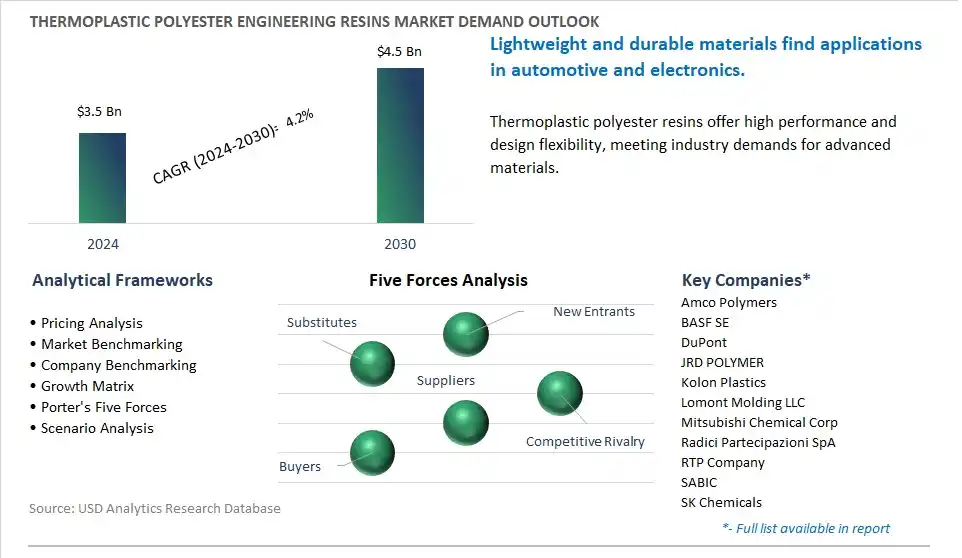
The market report analyses the leading companies in the industry including Amco Polymers, BASF SE, DuPont, JRD POLYMER, Kolon Plastics, Lomont Molding LLC, Mitsubishi Chemical Corp, Radici Partecipazioni SpA, RTP Company, SABIC, SK Chemicals, Teijin Ltd, Toray Industries Inc, Toyobo U.S.A. Inc.
A prominent market trend in the thermoplastic polyester engineering resins industry is the growing demand for lightweight and high-performance materials in automotive and aerospace applications. Thermoplastic polyester engineering resins, such as polybutylene terephthalate (PBT) and polyethylene terephthalate (PET), offer a combination of excellent mechanical properties, chemical resistance, and thermal stability, making them ideal for use in structural components, interior parts, and under-the-hood applications in vehicles and aircraft. With increasing pressure to reduce vehicle weight, improve fuel efficiency, and enhance performance, there is a rising need for thermoplastic polyester resins that offer superior strength-to-weight ratio, dimensional stability, and design flexibility. This trend is driven by advancements in material science, manufacturing processes, and design optimization techniques, enabling the development of innovative lightweight solutions for automotive and aerospace industries.
A key driver behind the growth of the thermoplastic polyester engineering resins market is the demand for sustainable and recyclable materials in manufacturing. Thermoplastic polyester resins are known for their recyclability, chemical resistance, and ability to be processed using various molding techniques such as injection molding, extrusion, and blow molding. With increasing awareness of environmental issues and regulatory pressures to reduce carbon footprint, there is a growing preference for materials that offer sustainability advantages and can be recycled or reused at the end of their life cycle. Thermoplastic polyester engineering resins provide manufacturers with an eco-friendly alternative to traditional materials such as metals and thermoset plastics, driving market demand for their adoption in automotive, aerospace, consumer goods, and other industries seeking to improve sustainability and reduce environmental impact.
An opportunity exists for manufacturers of thermoplastic polyester engineering resins to develop bio-based and biodegradable formulations that meet the increasing demand for sustainable materials. With the shift towards circular economy principles and the desire to reduce dependence on fossil fuels, there is potential to innovate in resin formulations by incorporating renewable feedstocks such as bio-based monomers derived from biomass sources like corn, sugarcane, or bio-waste. Additionally, there is an opportunity to develop biodegradable polyester resins that offer similar performance characteristics as conventional thermoplastic polyester resins but degrade naturally in the environment, reducing pollution and waste accumulation. By investing in research and development of bio-based and biodegradable polyester resins, manufacturers can address market demand for sustainable materials, differentiate their product offerings, and capture opportunities in industries seeking eco-friendly solutions for their products and applications.
The largest segment in the Thermoplastic Polyester Engineering Resins Market is the Polybutylene Terephthalate (PBT) category. PBT offers a combination of excellent mechanical properties, chemical resistance, and dimensional stability, making it suitable for a wide range of engineering applications. PBT resins exhibit high strength, stiffness, and toughness, along with good resistance to abrasion, impact, and fatigue, making them ideal for applications requiring durable and reliable materials. Additionally, PBT has excellent electrical insulating properties, low moisture absorption, and good resistance to heat and chemicals, further expanding its applicability in various industries such as automotive, electrical and electronics, consumer goods, and industrial machinery. Further, PBT resins can be easily processed using injection molding, extrusion, and other manufacturing techniques, allowing for the production of complex shapes and parts with tight tolerances. Furthermore, the versatility and cost-effectiveness of PBT make it a preferred choice for manufacturers seeking high-performance materials that offer design flexibility, processing ease, and long-term performance. Over the forecast period, the combination of excellent properties, wide-ranging applications, and processing advantages makes Polybutylene Terephthalate (PBT) the largest segment in the Thermoplastic Polyester Engineering Resins Market.
The fastest growing segment in the Thermoplastic Polyester Engineering Resins Market is the Automotive category. There is a growing demand for lightweight materials in the automotive industry to improve fuel efficiency, reduce emissions, and enhance performance. Thermoplastic polyester engineering resins offer a combination of lightweight properties, high strength, and durability, making them suitable for various automotive applications such as interior components, exterior trims, under-the-hood parts, and structural components. Additionally, thermoplastic polyester resins provide design flexibility, allowing for the production of complex shapes and parts with reduced weight compared to traditional materials such as metal and glass-reinforced plastics. Furthermore, advancements in material formulations and processing technologies have led to the development of specialized grades of thermoplastic polyester resins tailored to meet the stringent requirements of the automotive industry, including heat resistance, chemical resistance, and dimensional stability. Further, the shift towards electric and hybrid vehicles drives the demand for thermoplastic polyester resins in battery enclosures, charging components, and thermal management systems, further contributing to their growth in the automotive sector. Over the forecast period, the combination of lightweight properties, design flexibility, and performance characteristics makes thermoplastic polyester engineering resins a preferred choice for automotive manufacturers, leading to their rapid growth in the Automotive segment of the market.
By Product
Polybutylene Terephthalate
Polyethylene Terephthalate
Polycyclohexylene Dimethylene Terephthalate
By Application
Automotive
Electrical Appliances
Food & Beverage
Industrial Equipment
Others
Regions Included
North America (US, Canada, Mexico)
Europe (Germany, UK, France, Spain, Italy, Russia, Rest of Europe)
Asia Pacific (China, India, Japan, South Korea, Australia, South East Asia, Rest of Asia)
South America (Brazil, Argentina, Rest of South America)
Middle East and Africa (Saudi Arabia, UAE, Rest of Middle East, South Africa, Egypt, Rest of Africa)
Amco Polymers
BASF SE
DuPont
JRD POLYMER
Kolon Plastics
Lomont Molding LLC
Mitsubishi Chemical Corp
Radici Partecipazioni SpA
RTP Company
SABIC
SK Chemicals
Teijin Ltd
Toray Industries Inc
Toyobo U.S.A. Inc
*- List Not Exhaustive
TABLE OF CONTENTS
1 Introduction to 2024 Thermoplastic Polyester Engineering Resins Market
1.1 Market Overview
1.2 Quick Facts
1.3 Scope/Objective of the Study
1.4 Market Definition
1.5 Countries and Regions Covered
1.6 Units, Currency, and Conversions
1.7 Industry Value Chain
2 Research Methodology
2.1 Market Size Estimation
2.2 Sources and Research Methodology
2.3 Data Triangulation
2.4 Assumptions and Limitations
3 Executive Summary
3.1 Global Thermoplastic Polyester Engineering Resins Market Size Outlook, $ Million, 2021 to 2030
3.2 Thermoplastic Polyester Engineering Resins Market Outlook by Type, $ Million, 2021 to 2030
3.3 Thermoplastic Polyester Engineering Resins Market Outlook by Product, $ Million, 2021 to 2030
3.4 Thermoplastic Polyester Engineering Resins Market Outlook by Application, $ Million, 2021 to 2030
3.5 Thermoplastic Polyester Engineering Resins Market Outlook by Key Countries, $ Million, 2021 to 2030
4 Market Dynamics
4.1 Key Driving Forces of Thermoplastic Polyester Engineering Resins Industry
4.2 Key Market Trends in Thermoplastic Polyester Engineering Resins Industry
4.3 Potential Opportunities in Thermoplastic Polyester Engineering Resins Industry
4.4 Key Challenges in Thermoplastic Polyester Engineering Resins Industry
5 Market Factor Analysis
5.1 Value Chain Analysis
5.2 Competitive Landscape
5.2.1 Global Thermoplastic Polyester Engineering Resins Market Share by Company (%), 2023
5.2.2 Product Offerings by Company
5.3 Porter’s Five Forces Analysis
5.4 Pricing Analysis and Outlook
6 Growth Outlook Across Scenarios
6.1 Growth Analysis-Case Scenario Definitions
6.2 Low Growth Scenario Forecasts
6.3 Reference Growth Scenario Forecasts
6.4 High Growth Scenario Forecasts
7 Global Thermoplastic Polyester Engineering Resins Market Outlook by Segments
7.1 Thermoplastic Polyester Engineering Resins Market Outlook by Segments, $ Million, 2021- 2030
By Product
Polybutylene Terephthalate
Polyethylene Terephthalate
Polycyclohexylene Dimethylene Terephthalate
By Application
Automotive
Electrical Appliances
Food & Beverage
Industrial Equipment
Others
8 North America Thermoplastic Polyester Engineering Resins Market Analysis and Outlook To 2030
8.1 Introduction to North America Thermoplastic Polyester Engineering Resins Markets in 2024
8.2 North America Thermoplastic Polyester Engineering Resins Market Size Outlook by Country, 2021-2030
8.2.1 United States
8.2.2 Canada
8.2.3 Mexico
8.3 North America Thermoplastic Polyester Engineering Resins Market size Outlook by Segments, 2021-2030
By Product
Polybutylene Terephthalate
Polyethylene Terephthalate
Polycyclohexylene Dimethylene Terephthalate
By Application
Automotive
Electrical Appliances
Food & Beverage
Industrial Equipment
Others
9 Europe Thermoplastic Polyester Engineering Resins Market Analysis and Outlook To 2030
9.1 Introduction to Europe Thermoplastic Polyester Engineering Resins Markets in 2024
9.2 Europe Thermoplastic Polyester Engineering Resins Market Size Outlook by Country, 2021-2030
9.2.1 Germany
9.2.2 France
9.2.3 Spain
9.2.4 United Kingdom
9.2.4 Italy
9.2.5 Russia
9.2.6 Norway
9.2.7 Rest of Europe
9.3 Europe Thermoplastic Polyester Engineering Resins Market Size Outlook by Segments, 2021-2030
By Product
Polybutylene Terephthalate
Polyethylene Terephthalate
Polycyclohexylene Dimethylene Terephthalate
By Application
Automotive
Electrical Appliances
Food & Beverage
Industrial Equipment
Others
10 Asia Pacific Thermoplastic Polyester Engineering Resins Market Analysis and Outlook To 2030
10.1 Introduction to Asia Pacific Thermoplastic Polyester Engineering Resins Markets in 2024
10.2 Asia Pacific Thermoplastic Polyester Engineering Resins Market Size Outlook by Country, 2021-2030
10.2.1 China
10.2.2 India
10.2.3 Japan
10.2.4 South Korea
10.2.5 Indonesia
10.2.6 Malaysia
10.2.7 Australia
10.2.8 Rest of Asia Pacific
10.3 Asia Pacific Thermoplastic Polyester Engineering Resins Market size Outlook by Segments, 2021-2030
By Product
Polybutylene Terephthalate
Polyethylene Terephthalate
Polycyclohexylene Dimethylene Terephthalate
By Application
Automotive
Electrical Appliances
Food & Beverage
Industrial Equipment
Others
11 South America Thermoplastic Polyester Engineering Resins Market Analysis and Outlook To 2030
11.1 Introduction to South America Thermoplastic Polyester Engineering Resins Markets in 2024
11.2 South America Thermoplastic Polyester Engineering Resins Market Size Outlook by Country, 2021-2030
11.2.1 Brazil
11.2.2 Argentina
11.2.3 Rest of South America
11.3 South America Thermoplastic Polyester Engineering Resins Market size Outlook by Segments, 2021-2030
By Product
Polybutylene Terephthalate
Polyethylene Terephthalate
Polycyclohexylene Dimethylene Terephthalate
By Application
Automotive
Electrical Appliances
Food & Beverage
Industrial Equipment
Others
12 Middle East and Africa Thermoplastic Polyester Engineering Resins Market Analysis and Outlook To 2030
12.1 Introduction to Middle East and Africa Thermoplastic Polyester Engineering Resins Markets in 2024
12.2 Middle East and Africa Thermoplastic Polyester Engineering Resins Market Size Outlook by Country, 2021-2030
12.2.1 Saudi Arabia
12.2.2 UAE
12.2.3 Oman
12.2.4 Rest of Middle East
12.2.5 Egypt
12.2.6 Nigeria
12.2.7 South Africa
12.2.8 Rest of Africa
12.3 Middle East and Africa Thermoplastic Polyester Engineering Resins Market size Outlook by Segments, 2021-2030
By Product
Polybutylene Terephthalate
Polyethylene Terephthalate
Polycyclohexylene Dimethylene Terephthalate
By Application
Automotive
Electrical Appliances
Food & Beverage
Industrial Equipment
Others
13 Company Profiles
13.1 Company Snapshot
13.2 SWOT Profiles
13.3 Products and Services
13.4 Recent Developments
13.5 Financial Profile
Amco Polymers
BASF SE
DuPont
JRD POLYMER
Kolon Plastics
Lomont Molding LLC
Mitsubishi Chemical Corp
Radici Partecipazioni SpA
RTP Company
SABIC
SK Chemicals
Teijin Ltd
Toray Industries Inc
Toyobo U.S.A. Inc
14 Appendix
14.1 Customization Offerings
14.2 Subscription Services
14.3 Related Reports
14.4 Publisher Expertise
By Product
Polybutylene Terephthalate
Polyethylene Terephthalate
Polycyclohexylene Dimethylene Terephthalate
By Application
Automotive
Electrical Appliances
Food & Beverage
Industrial Equipment
Others
Countries Analyzed
North America (US, Canada, Mexico)
Europe (Germany, UK, France, Spain, Italy, Russia, Rest of Europe)
Asia Pacific (China, India, Japan, South Korea, Australia, South East Asia, Rest of Asia)
South America (Brazil, Argentina, Rest of South America)
Middle East and Africa (Saudi Arabia, UAE, Rest of Middle East, South Africa, Egypt, Rest of Africa)
Global Thermoplastic Polyester Engineering Resins is forecast to reach $4.5 Billion in 2030 from $3.5 Billion in 2024, registering a CAGR of 4.2%
Emerging Markets across Asia Pacific, Europe, and Americas present robust growth prospects.
Amco Polymers, BASF SE, DuPont, JRD POLYMER, Kolon Plastics, Lomont Molding LLC, Mitsubishi Chemical Corp, Radici Partecipazioni SpA, RTP Company, SABIC, SK Chemicals, Teijin Ltd, Toray Industries Inc, Toyobo U.S.A. Inc
Base Year- 2023; Estimated Year- 2024; Historic Period- 2018-2023; Forecast period- 2024 to 2030; Currency: Revenue (USD); Volume