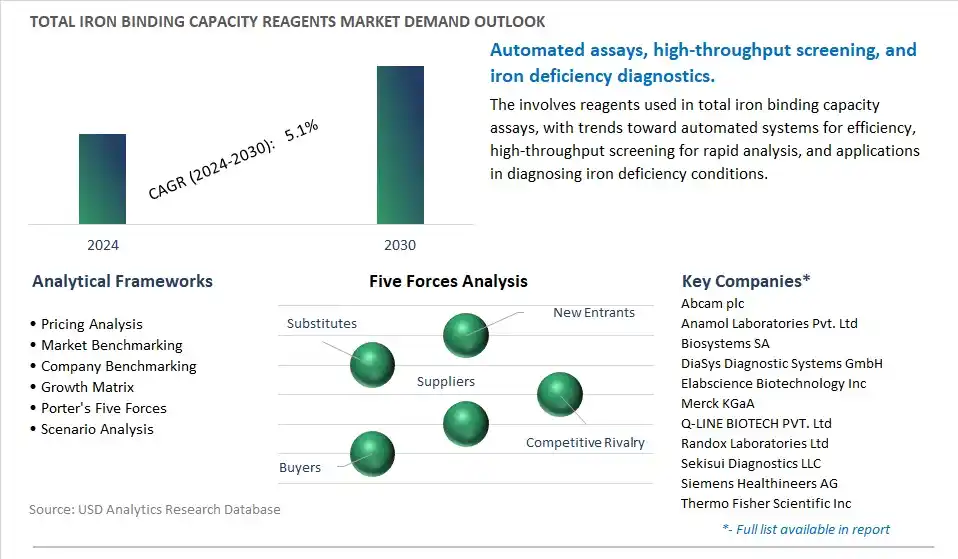
Total Iron Binding Capacity Reagents Market is estimated to increase at a Compounded Annual Growth Rate of 5.1% CAGR over the forecast period from 2024 to 2030
The Total Iron Binding Capacity Reagents Market study analyzes and forecasts the market size across 6 regions and 24 countries for diverse segments- By Disease (Iron Deficiency Anemia, Iron Deficiency in Late Pregnancy, Others), By End-User (Hospitals, Clinics, Others).
An Introduction to Total Iron Binding Capacity Reagents Market in 2024
In 2024, the market for total iron binding capacity (TIBC) reagents continues to be crucial in the diagnosis and monitoring of iron metabolism disorders, including iron deficiency anemia and iron overload conditions such as hemochromatosis. TIBC reagents are used in laboratory assays to measure the capacity of transferrin, the primary iron transport protein in the blood, to bind and transport iron molecules. By assessing TIBC levels along with serum iron and transferrin saturation, healthcare providers can evaluate the body's ability to transport and utilize iron effectively. With advancements in assay methodologies, automation technology, and quality control measures, TIBC reagents offer accurate and reliable results for clinicians to assess iron status and guide patient management decisions. Moreover, the market is influenced by trends such as the development of multiplexed assays for comprehensive iron panel testing, the adoption of high-throughput platforms for increased laboratory efficiency, and the customization of reagent formulations for compatibility with various analytical instruments and sample types. Additionally, ongoing research focuses on elucidating the role of TIBC in iron homeostasis, refining assay performance characteristics, and exploring novel biomarkers and diagnostic algorithms for improved assessment of iron status and related disorders, reflecting the continuous innovation and advancement in TIBC reagent technology to support optimal patient care.
Market Trend: Increasing Demand for Iron Deficiency Anemia Screening
One prominent market trend in total iron binding capacity (TIBC) reagents is the increasing demand for iron deficiency anemia screening. Iron deficiency anemia is a common hematological disorder characterized by low levels of iron in the body, leading to reduced production of red blood cells and impaired oxygen transport. As awareness of the prevalence and consequences of iron deficiency anemia grows, there is a rising demand for diagnostic tests that can accurately assess iron status and facilitate early detection and management of the condition. TIBC reagents play a crucial role in laboratory testing for iron deficiency anemia by measuring the capacity of transferrin, the main iron transport protein, to bind iron ions. The trend towards increased iron deficiency anemia screening reflects efforts to improve public health outcomes by identifying and addressing nutritional deficiencies and underlying health conditions that contribute to iron deficiency anemia.
Market Driver: Growing Prevalence of Iron Deficiency Anemia Worldwide
A significant market driver for TIBC reagents is the growing prevalence of iron deficiency anemia worldwide. Iron deficiency anemia affects individuals of all ages and demographic groups and is particularly common in populations with inadequate dietary iron intake, malabsorption disorders, chronic diseases, or increased iron requirements such as pregnancy and infancy. Factors such as poor nutrition, gastrointestinal bleeding, menstrual blood loss, and parasitic infections contribute to the high prevalence of iron deficiency anemia in both developed and developing countries. As healthcare providers and policymakers prioritize the prevention and management of iron deficiency anemia, there is an increasing need for reliable and accurate diagnostic tools such as TIBC reagents to support clinical decision-making and optimize patient care.
Market Opportunity: Development of High-Sensitivity and High-Throughput Assays
One potential opportunity in the TIBC reagents market lies in the development of high-sensitivity and high-throughput assays. While traditional TIBC assays provide valuable information about iron status, there is an opportunity to enhance assay sensitivity and efficiency to meet the evolving needs of clinical laboratories and healthcare providers. Developing assays with improved sensitivity can enable the detection of subtle changes in iron status, allowing for earlier detection of iron deficiency and more precise monitoring of therapeutic interventions. Additionally, increasing assay throughput can streamline laboratory workflows, reduce turnaround times, and accommodate the growing demand for iron deficiency screening in various healthcare settings. By investing in research and development efforts to develop next-generation TIBC reagents with enhanced performance characteristics, manufacturers can capitalize on this opportunity to advance iron deficiency anemia diagnosis and management, improve patient outcomes, and address unmet needs in the global healthcare market.
Total Iron Binding Capacity Reagents Market Share Analysis: Iron Deficiency Anemia
In the Total Iron Binding Capacity (TIBC) Reagents Market, the disease segment of Iron Deficiency Anemia is experiencing rapid growth. Iron deficiency anemia is a common condition characterized by a decrease in the number of red blood cells due to insufficient iron levels in the body. TIBC reagents are used in laboratory tests to measure the total iron-binding capacity of transferrin, a protein that transports iron in the blood, which aids in the diagnosis and monitoring of iron deficiency anemia. As the prevalence of iron deficiency anemia continues to rise globally, driven by factors such as poor dietary intake, gastrointestinal disorders, and chronic diseases, there has been a significant surge in demand for TIBC reagents for diagnostic purposes. Hospitals, clinics, and other healthcare facilities are the primary end-users adopting TIBC reagents for the diagnosis and management of iron deficiency anemia, reflecting the widespread use of these tests in clinical practice. Additionally, with advancements in laboratory technology and the availability of automated testing platforms, the market for TIBC reagents is expected to continue its rapid growth trajectory. Early diagnosis and intervention for iron deficiency anemia are crucial for improving patient outcomes and reducing the burden of this condition on healthcare systems worldwide.
Total Iron Binding Capacity Reagents Competitive Analysis
The market research study provides in-depth insights into leading companies including the SWOT analyses, product profile, financial details, and recent developments acrossAbcam plc, Anamol Laboratories Pvt. Ltd, Biosystems SA, DiaSys Diagnostic Systems GmbH, Elabscience Biotechnology Inc, Merck KGaA, Q-LINE BIOTECH PVT. Ltd, Randox Laboratories Ltd, Sekisui Diagnostics LLC, Siemens Healthineers AG, Thermo Fisher Scientific Inc
Total Iron Binding Capacity Reagents Market Segmentation
By Disease
Iron Deficiency Anemia
Iron Deficiency in Late Pregnancy
Others
By End-User
Hospitals
Clinics
Others
Geographical Analysis
North America (United States, Canada, Mexico)
Europe (Germany, France, United Kingdom, Spain, Italy, Rest of Europe)
Asia Pacific (China, India, Japan, South Korea, Rest of Asia Pacific)
South America (Brazil, Argentina, Rest of South America)
Middle East and Africa (Saudi Arabia, UAE, Rest of Middle East, South Africa, Egypt, Rest of Africa)
Total Iron Binding Capacity Reagents Market Companies
Abcam plc
Anamol Laboratories Pvt. Ltd
Biosystems SA
DiaSys Diagnostic Systems GmbH
Elabscience Biotechnology Inc
Merck KGaA
Q-LINE BIOTECH PVT. Ltd
Randox Laboratories Ltd
Sekisui Diagnostics LLC
Siemens Healthineers AG
Thermo Fisher Scientific Inc
Reasons to Buy the Total Iron Binding Capacity Reagents Market Study
• Deepen your industry insights and navigate uncertainties for strategy formulation, CAPEX, and Operational decisions
• Gain access to detailed insights on the Total Iron Binding Capacity Reagents Market, encompassing current market size, growth trends, and forecasts till 2030.
• Access detailed competitor analysis, enabling competitive advantage through a thorough understanding of market players, strategies, and potential differentiation opportunities
• Stay ahead of the curve with insights on technological advancements, innovations, and upcoming trends
• Identify lucrative investment avenues and expansion opportunities within the Total Iron Binding Capacity Reagents Market industry, guided by robust, data-backed analysis.
• Understand regional and global markets through country-wise analysis, regional market potential, regulatory nuances, and dynamics
• Execute strategies with confidence and speed through information, analytics, and insights on the industry value chain
• Corporate leaders, strategists, financial experts, shareholders, asset managers, and governmental representatives can make long-term planning scenarios and build an integrated and timely understanding of market dynamics
• Benefit from tailored solutions and expert consultation based on report insights, providing personalized strategies aligned with specific business needs.
TABLE OF CONTENTS
1 Introduction to 2024 Total Iron Binding Capacity Reagents Market
1.1 Market Overview
1.2 Quick Facts
1.3 Scope/Objective of the Study
1.4 Market Definition
1.5 Countries and Regions Covered
1.6 Units, Currency, and Conversions
1.7 Industry Value Chain
2 Research Methodology
2.1 Market Size Estimation
2.2 Sources and Research Methodology
2.3 Data Triangulation
2.4 Assumptions and Limitations
3 Executive Summary
3.1 Global Total Iron Binding Capacity Reagents Market Size Outlook, $ Million, 2021 to 2030
3.2 Total Iron Binding Capacity Reagents Market Outlook by Type, $ Million, 2021 to 2030
3.3 Total Iron Binding Capacity Reagents Market Outlook by Product, $ Million, 2021 to 2030
3.4 Total Iron Binding Capacity Reagents Market Outlook by Application, $ Million, 2021 to 2030
3.5 Total Iron Binding Capacity Reagents Market Outlook by Key Countries, $ Million, 2021 to 2030
4 Market Dynamics
4.1 Key Driving Forces of Total Iron Binding Capacity Reagents Industry
4.2 Key Market Trends in Total Iron Binding Capacity Reagents Industry
4.3 Potential Opportunities in Total Iron Binding Capacity Reagents Industry
4.4 Key Challenges in Total Iron Binding Capacity Reagents Industry
5 Market Factor Analysis
5.1 Value Chain Analysis
5.2 Competitive Landscape
5.2.1 Global Total Iron Binding Capacity Reagents Market Share by Company (%), 2023
5.2.2 Product Offerings by Company
5.3 Porter’s Five Forces Analysis
5.4 Pricing Analysis and Outlook
6 Growth Outlook Across Scenarios
6.1 Growth Analysis-Case Scenario Definitions
6.2 Low Growth Scenario Forecasts
6.3 Reference Growth Scenario Forecasts
6.4 High Growth Scenario Forecasts
7 Global Total Iron Binding Capacity Reagents Market Outlook by Segments
7.1 Total Iron Binding Capacity Reagents Market Outlook by Segments, $ Million, 2021- 2030
By Disease
Iron Deficiency Anemia
Iron Deficiency in Late Pregnancy
Others
By End-User
Hospitals
Clinics
Others
8 North America Total Iron Binding Capacity Reagents Market Analysis and Outlook To 2030
8.1 Introduction to North America Total Iron Binding Capacity Reagents Markets in 2024
8.2 North America Total Iron Binding Capacity Reagents Market Size Outlook by Country, 2021-2030
8.2.1 United States
8.2.2 Canada
8.2.3 Mexico
8.3 North America Total Iron Binding Capacity Reagents Market size Outlook by Segments, 2021-2030
By Disease
Iron Deficiency Anemia
Iron Deficiency in Late Pregnancy
Others
By End-User
Hospitals
Clinics
Others
9 Europe Total Iron Binding Capacity Reagents Market Analysis and Outlook To 2030
9.1 Introduction to Europe Total Iron Binding Capacity Reagents Markets in 2024
9.2 Europe Total Iron Binding Capacity Reagents Market Size Outlook by Country, 2021-2030
9.2.1 Germany
9.2.2 France
9.2.3 Spain
9.2.4 United Kingdom
9.2.4 Italy
9.2.5 Russia
9.2.6 Norway
9.2.7 Rest of Europe
9.3 Europe Total Iron Binding Capacity Reagents Market Size Outlook by Segments, 2021-2030
By Disease
Iron Deficiency Anemia
Iron Deficiency in Late Pregnancy
Others
By End-User
Hospitals
Clinics
Others
10 Asia Pacific Total Iron Binding Capacity Reagents Market Analysis and Outlook To 2030
10.1 Introduction to Asia Pacific Total Iron Binding Capacity Reagents Markets in 2024
10.2 Asia Pacific Total Iron Binding Capacity Reagents Market Size Outlook by Country, 2021-2030
10.2.1 China
10.2.2 India
10.2.3 Japan
10.2.4 South Korea
10.2.5 Indonesia
10.2.6 Malaysia
10.2.7 Australia
10.2.8 Rest of Asia Pacific
10.3 Asia Pacific Total Iron Binding Capacity Reagents Market size Outlook by Segments, 2021-2030
By Disease
Iron Deficiency Anemia
Iron Deficiency in Late Pregnancy
Others
By End-User
Hospitals
Clinics
Others
11 South America Total Iron Binding Capacity Reagents Market Analysis and Outlook To 2030
11.1 Introduction to South America Total Iron Binding Capacity Reagents Markets in 2024
11.2 South America Total Iron Binding Capacity Reagents Market Size Outlook by Country, 2021-2030
11.2.1 Brazil
11.2.2 Argentina
11.2.3 Rest of South America
11.3 South America Total Iron Binding Capacity Reagents Market size Outlook by Segments, 2021-2030
By Disease
Iron Deficiency Anemia
Iron Deficiency in Late Pregnancy
Others
By End-User
Hospitals
Clinics
Others
12 Middle East and Africa Total Iron Binding Capacity Reagents Market Analysis and Outlook To 2030
12.1 Introduction to Middle East and Africa Total Iron Binding Capacity Reagents Markets in 2024
12.2 Middle East and Africa Total Iron Binding Capacity Reagents Market Size Outlook by Country, 2021-2030
12.2.1 Saudi Arabia
12.2.2 UAE
12.2.3 Oman
12.2.4 Rest of Middle East
12.2.5 Egypt
12.2.6 Nigeria
12.2.7 South Africa
12.2.8 Rest of Africa
12.3 Middle East and Africa Total Iron Binding Capacity Reagents Market size Outlook by Segments, 2021-2030
By Disease
Iron Deficiency Anemia
Iron Deficiency in Late Pregnancy
Others
By End-User
Hospitals
Clinics
Others
13 Company Profiles
13.1 Company Snapshot
13.2 SWOT Profiles
13.3 Products and Services
13.4 Recent Developments
13.5 Financial Profile
List of Companies
Abcam plc
Anamol Laboratories Pvt. Ltd
Biosystems SA
DiaSys Diagnostic Systems GmbH
Elabscience Biotechnology Inc
Merck KGaA
Q-LINE BIOTECH PVT. Ltd
Randox Laboratories Ltd
Sekisui Diagnostics LLC
Siemens Healthineers AG
Thermo Fisher Scientific Inc
14 Appendix
14.1 Customization Offerings
14.2 Subscription Services
14.3 Related Reports
14.4 Publisher Expertise
By Disease
Iron Deficiency Anemia
Iron Deficiency in Late Pregnancy
Others
By End-User
Hospitals
Clinics
Others
Countries Analyzed
North America (United States, Canada, Mexico)
Europe (Germany, France, United Kingdom, Spain, Italy, Rest of Europe)
Asia Pacific (China, India, Japan, South Korea, Rest of Asia Pacific)
South America (Brazil, Argentina, Rest of South America)
Middle East and Africa (Saudi Arabia, UAE, Rest of Middle East, South Africa, Egypt, Rest of Africa)
