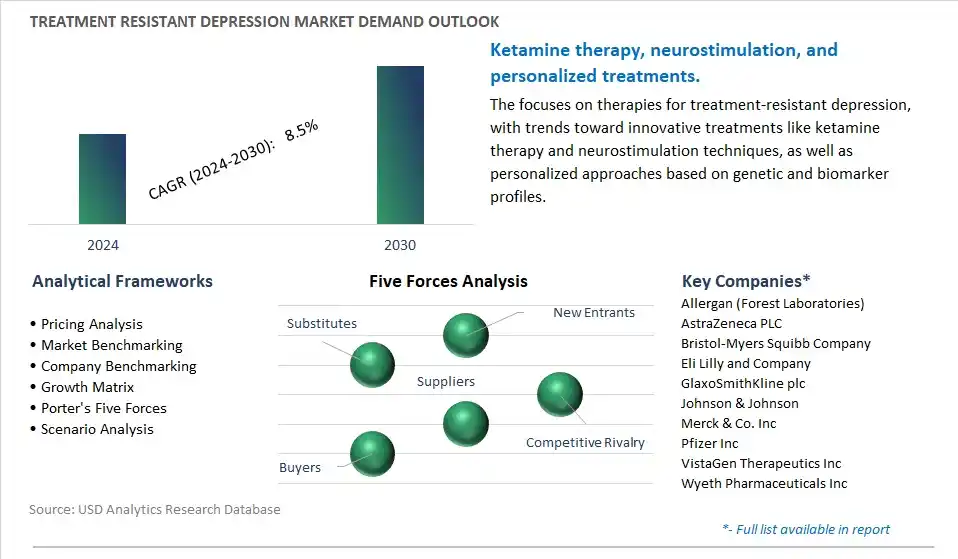
Treatment Resistant Depression Market is estimated to increase at a Compounded Annual Growth Rate of 8.5% CAGR over the forecast period from 2024 to 2030
The Treatment Resistant Depression Market study analyzes and forecasts the market size across 6 regions and 24 countries for diverse segments- By Drug Class (Selective Serotonin reuptake inhibitors, Monoamine Oxidase Inhibitors, Tricyclic Antidepressant Inhibitors, Others), By Distribution Channel (Hospital Pharmacies, Retail Pharmacies, Online Pharmacies).
An Introduction to Treatment Resistant Depression Market in 2024
In 2024, the market for treatment-resistant depression (TRD) continues to be a challenging area in mental health care, necessitating innovative approaches to address the unmet needs of patients who do not respond adequately to conventional antidepressant therapies. Treatment-resistant depression is defined as a failure to achieve remission or significant symptom reduction despite adequate trials of multiple antidepressant medications. With advancements in neuroscience, pharmacotherapy, and psychotherapy, TRD management encompasses a range of strategies including medication optimization, augmentation with adjunctive therapies such as psychotherapy or neuromodulation techniques, and exploration of novel treatment modalities targeting specific neurobiological pathways implicated in depression. Moreover, the market is influenced by trends such as the development of rapid-acting antidepressants with novel mechanisms of action, the integration of personalized medicine approaches based on biomarkers and genetic profiling, and the expansion of digital therapeutics and telemedicine platforms for remote monitoring and intervention. Additionally, ongoing research focuses on elucidating the neurobiological underpinnings of TRD, identifying predictive markers of treatment response, and conducting large-scale clinical trials to evaluate the efficacy and safety of emerging therapies, reflecting the continuous commitment to improving outcomes for individuals living with treatment-resistant depression and advancing the field of psychiatric care.
Market Trend: Growing Focus on Precision Medicine and Personalized Therapies
One prominent market trend in treatment-resistant depression is the growing focus on precision medicine and personalized therapies. With increasing recognition of the heterogeneity of depression and the variability in treatment response among patients, there is a shift towards tailoring treatment approaches to individual patient characteristics, including genetic factors, biomarkers, and psychosocial variables. This trend is driving the development of novel therapeutic interventions, such as pharmacogenomic testing, neurostimulation techniques, and psychedelic-assisted therapies, that aim to target specific biological mechanisms underlying treatment-resistant depression and optimize treatment outcomes for individual patients.
Market Driver: High Unmet Medical Need and Impact on Patient Quality of Life
A significant market driver for treatment-resistant depression is the high unmet medical need and its profound impact on patient quality of life. Despite the availability of various antidepressant medications and psychotherapeutic interventions, a substantial proportion of patients with depression do not achieve remission or significant symptom improvement with standard treatments. Treatment-resistant depression is associated with increased risk of suicide, functional impairment, comorbid medical conditions, and reduced quality of life, highlighting the urgent need for more effective and innovative treatment options. This driver underscores the importance of developing novel therapeutics and approaches that can address the complex and refractory nature of treatment-resistant depression and improve outcomes for affected individuals.
Market Opportunity: Exploration of Novel Treatment Modalities and Targeted Therapies
One potential opportunity in the treatment-resistant depression market lies in the exploration of novel treatment modalities and targeted therapies. Emerging research in neuroscience, neurobiology, and psychopharmacology has identified promising targets and pathways implicated in the pathophysiology of treatment-resistant depression, including glutamate neurotransmission, neuroinflammation, and neuroplasticity. Opportunities exist for the development of innovative pharmacological agents, such as glutamate receptor modulators, neuroinflammatory inhibitors, and neurotrophic factors, that can specifically target these biological mechanisms and provide new therapeutic options for patients with treatment-resistant depression. Additionally, exploring alternative treatment modalities such as ketamine infusion therapy, transcranial magnetic stimulation (TMS), and psychedelic-assisted therapies may offer novel approaches for managing treatment-resistant depression and addressing the diverse needs of patients who have not responded to conventional treatments. By capitalizing on these opportunities to advance research and innovation in treatment-resistant depression, pharmaceutical companies and healthcare providers can enhance patient care and contribute to improved outcomes in mental health treatment.
Treatment-Resistant Depression Market Share Analysis: Selective Serotonin Reuptake Inhibitors (SSRIs)
In the Treatment-Resistant Depression Market, the drug class of Selective Serotonin Reuptake Inhibitors (SSRIs) is experiencing rapid growth. SSRIs are a class of antidepressant medications commonly prescribed for the treatment of depression, including treatment-resistant depression (TRD). They work by increasing the levels of serotonin, a neurotransmitter associated with mood regulation, in the brain. Despite the availability of various antidepressant medications, a significant proportion of patients with depression do not respond adequately to initial treatment, leading to the classification of their condition as treatment-resistant depression. SSRIs are often considered as a first-line treatment option for TRD due to their favorable side-effect profile and efficacy in improving mood symptoms. As the prevalence of depression continues to rise globally, alongside awareness of treatment options for TRD, there has been a significant surge in demand for SSRIs in the TRD market segment. Hospital pharmacies, retail pharmacies, and online pharmacies play crucial roles in dispensing SSRIs to patients with TRD, ensuring access to essential medications for managing their condition. Additionally, with ongoing research and development efforts focused on novel formulations and adjunctive therapies to enhance the effectiveness of SSRIs in TRD, the market for SSRIs in this segment is expected to maintain its rapid growth trajectory. As healthcare providers strive to address the unmet needs of patients with TRD and improve treatment outcomes, the demand for SSRIs as a cornerstone of pharmacotherapy in TRD is poised for further expansion.
Treatment Resistant Depression Competitive Analysis
The market research study provides in-depth insights into leading companies including the SWOT analyses, product profile, financial details, and recent developments acrossAllergan (Forest Laboratories), AstraZeneca PLC, Bristol-Myers Squibb Company, Eli Lilly and Company, GlaxoSmithKline plc, Johnson & Johnson, Merck & Co. Inc, Pfizer Inc, VistaGen Therapeutics Inc, Wyeth Pharmaceuticals Inc
Treatment Resistant Depression Market Segmentation
By Drug Class
Selective Serotonin reuptake inhibitors
Monoamine Oxidase Inhibitors
Tricyclic Antidepressant Inhibitors
Others
By Distribution Channel
Hospital Pharmacies
Retail Pharmacies
Online Pharmacies
Geographical Analysis
North America (United States, Canada, Mexico)
Europe (Germany, France, United Kingdom, Spain, Italy, Rest of Europe)
Asia Pacific (China, India, Japan, South Korea, Rest of Asia Pacific)
South America (Brazil, Argentina, Rest of South America)
Middle East and Africa (Saudi Arabia, UAE, Rest of Middle East, South Africa, Egypt, Rest of Africa)
Treatment Resistant Depression Market Companies
Allergan (Forest Laboratories)
AstraZeneca PLC
Bristol-Myers Squibb Company
Eli Lilly and Company
GlaxoSmithKline plc
Johnson & Johnson
Merck & Co. Inc
Pfizer Inc
VistaGen Therapeutics Inc
Wyeth Pharmaceuticals Inc
Reasons to Buy the Treatment Resistant Depression Market Study
• Deepen your industry insights and navigate uncertainties for strategy formulation, CAPEX, and Operational decisions
• Gain access to detailed insights on the Treatment Resistant Depression Market, encompassing current market size, growth trends, and forecasts till 2030.
• Access detailed competitor analysis, enabling competitive advantage through a thorough understanding of market players, strategies, and potential differentiation opportunities
• Stay ahead of the curve with insights on technological advancements, innovations, and upcoming trends
• Identify lucrative investment avenues and expansion opportunities within the Treatment Resistant Depression Market industry, guided by robust, data-backed analysis.
• Understand regional and global markets through country-wise analysis, regional market potential, regulatory nuances, and dynamics
• Execute strategies with confidence and speed through information, analytics, and insights on the industry value chain
• Corporate leaders, strategists, financial experts, shareholders, asset managers, and governmental representatives can make long-term planning scenarios and build an integrated and timely understanding of market dynamics
• Benefit from tailored solutions and expert consultation based on report insights, providing personalized strategies aligned with specific business needs.
TABLE OF CONTENTS
1 Introduction to 2024 Treatment Resistant Depression Market
1.1 Market Overview
1.2 Quick Facts
1.3 Scope/Objective of the Study
1.4 Market Definition
1.5 Countries and Regions Covered
1.6 Units, Currency, and Conversions
1.7 Industry Value Chain
2 Research Methodology
2.1 Market Size Estimation
2.2 Sources and Research Methodology
2.3 Data Triangulation
2.4 Assumptions and Limitations
3 Executive Summary
3.1 Global Treatment Resistant Depression Market Size Outlook, $ Million, 2021 to 2030
3.2 Treatment Resistant Depression Market Outlook by Type, $ Million, 2021 to 2030
3.3 Treatment Resistant Depression Market Outlook by Product, $ Million, 2021 to 2030
3.4 Treatment Resistant Depression Market Outlook by Application, $ Million, 2021 to 2030
3.5 Treatment Resistant Depression Market Outlook by Key Countries, $ Million, 2021 to 2030
4 Market Dynamics
4.1 Key Driving Forces of Treatment Resistant Depression Industry
4.2 Key Market Trends in Treatment Resistant Depression Industry
4.3 Potential Opportunities in Treatment Resistant Depression Industry
4.4 Key Challenges in Treatment Resistant Depression Industry
5 Market Factor Analysis
5.1 Value Chain Analysis
5.2 Competitive Landscape
5.2.1 Global Treatment Resistant Depression Market Share by Company (%), 2023
5.2.2 Product Offerings by Company
5.3 Porter’s Five Forces Analysis
5.4 Pricing Analysis and Outlook
6 Growth Outlook Across Scenarios
6.1 Growth Analysis-Case Scenario Definitions
6.2 Low Growth Scenario Forecasts
6.3 Reference Growth Scenario Forecasts
6.4 High Growth Scenario Forecasts
7 Global Treatment Resistant Depression Market Outlook by Segments
7.1 Treatment Resistant Depression Market Outlook by Segments, $ Million, 2021- 2030
By Drug Class
Selective Serotonin reuptake inhibitors
Monoamine Oxidase Inhibitors
Tricyclic Antidepressant Inhibitors
Others
By Distribution Channel
Hospital Pharmacies
Retail Pharmacies
Online Pharmacies
8 North America Treatment Resistant Depression Market Analysis and Outlook To 2030
8.1 Introduction to North America Treatment Resistant Depression Markets in 2024
8.2 North America Treatment Resistant Depression Market Size Outlook by Country, 2021-2030
8.2.1 United States
8.2.2 Canada
8.2.3 Mexico
8.3 North America Treatment Resistant Depression Market size Outlook by Segments, 2021-2030
By Drug Class
Selective Serotonin reuptake inhibitors
Monoamine Oxidase Inhibitors
Tricyclic Antidepressant Inhibitors
Others
By Distribution Channel
Hospital Pharmacies
Retail Pharmacies
Online Pharmacies
9 Europe Treatment Resistant Depression Market Analysis and Outlook To 2030
9.1 Introduction to Europe Treatment Resistant Depression Markets in 2024
9.2 Europe Treatment Resistant Depression Market Size Outlook by Country, 2021-2030
9.2.1 Germany
9.2.2 France
9.2.3 Spain
9.2.4 United Kingdom
9.2.4 Italy
9.2.5 Russia
9.2.6 Norway
9.2.7 Rest of Europe
9.3 Europe Treatment Resistant Depression Market Size Outlook by Segments, 2021-2030
By Drug Class
Selective Serotonin reuptake inhibitors
Monoamine Oxidase Inhibitors
Tricyclic Antidepressant Inhibitors
Others
By Distribution Channel
Hospital Pharmacies
Retail Pharmacies
Online Pharmacies
10 Asia Pacific Treatment Resistant Depression Market Analysis and Outlook To 2030
10.1 Introduction to Asia Pacific Treatment Resistant Depression Markets in 2024
10.2 Asia Pacific Treatment Resistant Depression Market Size Outlook by Country, 2021-2030
10.2.1 China
10.2.2 India
10.2.3 Japan
10.2.4 South Korea
10.2.5 Indonesia
10.2.6 Malaysia
10.2.7 Australia
10.2.8 Rest of Asia Pacific
10.3 Asia Pacific Treatment Resistant Depression Market size Outlook by Segments, 2021-2030
By Drug Class
Selective Serotonin reuptake inhibitors
Monoamine Oxidase Inhibitors
Tricyclic Antidepressant Inhibitors
Others
By Distribution Channel
Hospital Pharmacies
Retail Pharmacies
Online Pharmacies
11 South America Treatment Resistant Depression Market Analysis and Outlook To 2030
11.1 Introduction to South America Treatment Resistant Depression Markets in 2024
11.2 South America Treatment Resistant Depression Market Size Outlook by Country, 2021-2030
11.2.1 Brazil
11.2.2 Argentina
11.2.3 Rest of South America
11.3 South America Treatment Resistant Depression Market size Outlook by Segments, 2021-2030
By Drug Class
Selective Serotonin reuptake inhibitors
Monoamine Oxidase Inhibitors
Tricyclic Antidepressant Inhibitors
Others
By Distribution Channel
Hospital Pharmacies
Retail Pharmacies
Online Pharmacies
12 Middle East and Africa Treatment Resistant Depression Market Analysis and Outlook To 2030
12.1 Introduction to Middle East and Africa Treatment Resistant Depression Markets in 2024
12.2 Middle East and Africa Treatment Resistant Depression Market Size Outlook by Country, 2021-2030
12.2.1 Saudi Arabia
12.2.2 UAE
12.2.3 Oman
12.2.4 Rest of Middle East
12.2.5 Egypt
12.2.6 Nigeria
12.2.7 South Africa
12.2.8 Rest of Africa
12.3 Middle East and Africa Treatment Resistant Depression Market size Outlook by Segments, 2021-2030
By Drug Class
Selective Serotonin reuptake inhibitors
Monoamine Oxidase Inhibitors
Tricyclic Antidepressant Inhibitors
Others
By Distribution Channel
Hospital Pharmacies
Retail Pharmacies
Online Pharmacies
13 Company Profiles
13.1 Company Snapshot
13.2 SWOT Profiles
13.3 Products and Services
13.4 Recent Developments
13.5 Financial Profile
List of Companies
Allergan (Forest Laboratories)
AstraZeneca PLC
Bristol-Myers Squibb Company
Eli Lilly and Company
GlaxoSmithKline plc
Johnson & Johnson
Merck & Co. Inc
Pfizer Inc
VistaGen Therapeutics Inc
Wyeth Pharmaceuticals Inc
14 Appendix
14.1 Customization Offerings
14.2 Subscription Services
14.3 Related Reports
14.4 Publisher Expertise
By Drug Class
Selective Serotonin reuptake inhibitors
Monoamine Oxidase Inhibitors
Tricyclic Antidepressant Inhibitors
Others
By Distribution Channel
Hospital Pharmacies
Retail Pharmacies
Online Pharmacies
Countries Analyzed
North America (United States, Canada, Mexico)
Europe (Germany, France, United Kingdom, Spain, Italy, Rest of Europe)
Asia Pacific (China, India, Japan, South Korea, Rest of Asia Pacific)
South America (Brazil, Argentina, Rest of South America)
Middle East and Africa (Saudi Arabia, UAE, Rest of Middle East, South Africa, Egypt, Rest of Africa)
