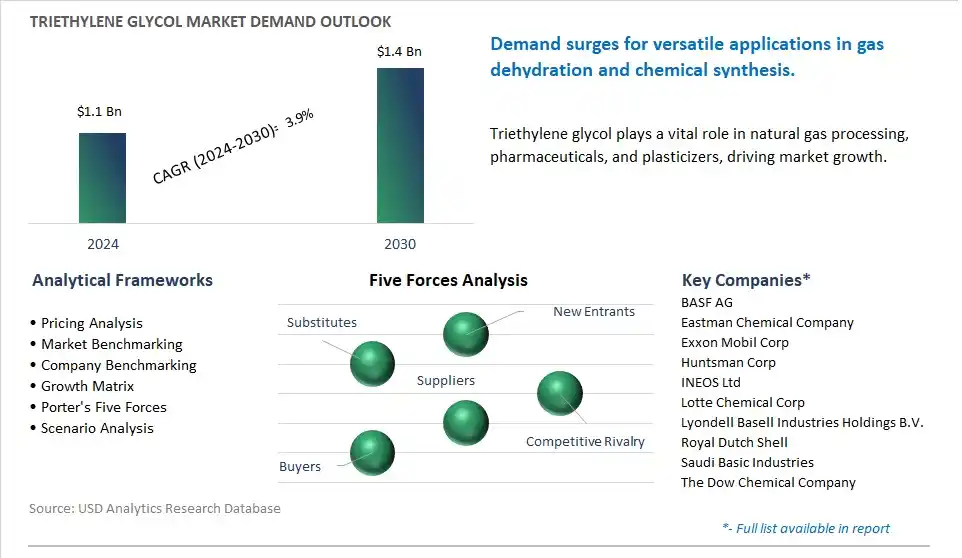
The global Triethylene Glycol Market is poised to register a 3.9% CAGR from $1.1 Billion in 2024 to $1.4 Billion in 2030.
The global Triethylene Glycol Market Study analyzes and forecasts the market size across 6 regions and 24 countries for diverse segments -By Purity (Purity 98.2%, Purity 98.5%, Purity 99.9% ), By Application (Plasticizer, Dehumidifying Agent, Dehydration of Natural Gas, Brake Fluids, Others), By End-User (Textile, Textile, Construction, Automotive, Others).
An Introduction to Global Triethylene Glycol Market in 2024
Triethylene glycol (TEG) is a colorless, odorless liquid commonly used as a solvent, humectant, and chemical intermediate in various industrial applications, including dehydration of natural gas, air conditioning systems, and manufacturing processes. The future of triethylene glycol is influenced by several key trends, including advancements in chemical processing, environmental regulations, and applications in diverse industries. One significant trend is the increasing demand for triethylene glycol as a desiccant and hydrate inhibitor in natural gas processing facilities, driven by the expansion of global natural gas production and infrastructure development. TEG is used in glycol dehydration units to remove water vapor from natural gas streams, preventing hydrate formation, corrosion, and equipment damage in pipelines, compressors, and storage facilities, ensuring safe and efficient gas transportation and processing operations. Additionally, the integration of triethylene glycol into air conditioning and refrigeration systems is driving innovations in energy-efficient cooling solutions that improve indoor air quality, humidity control, and thermal comfort in residential, commercial, and industrial buildings. TEG-based cooling systems offer advantages such as low toxicity, non-flammability, and compatibility with existing HVAC (Heating, Ventilation, and Air Conditioning) equipment, making them suitable for retrofitting and new construction projects in regions with high ambient temperatures and humidity levels. Moreover, the increasing focus on sustainability and environmental stewardship is driving the development of biodegradable and renewable sources of triethylene glycol, such as bio-based glycols derived from biomass feedstocks or waste streams, reducing dependence on fossil fuels and minimizing carbon footprint in glycol production processes. Furthermore, collaborations between chemical manufacturers, energy companies, and environmental regulators are driving innovation and market growth by delivering sustainable TEG solutions that meet the specific performance, regulatory, and sustainability requirements of diverse industrial applications and end-user needs, ensuring continued relevance and adoption of triethylene glycol in the global chemical industry.
Triethylene Glycol Market Competitive Landscape
The market report analyses the leading companies in the industry including BASF AG, Eastman Chemical Company, Exxon Mobil Corp, Huntsman Corp, INEOS Ltd, Lotte Chemical Corp, Lyondell Basell Industries Holdings B.V., Royal Dutch Shell, Saudi Basic Industries, The Dow Chemical Company.
Triethylene Glycol Market Dynamics
Triethylene Glycol Market Trend: Increasing Demand in Natural Gas Dehydration Processes
A prominent market trend in the triethylene glycol (TEG) industry is the increasing demand for its use in natural gas dehydration processes. TEG is widely utilized as a desiccant in the natural gas industry to remove water vapor from natural gas streams, preventing hydrate formation and corrosion in pipelines and processing equipment. With the growing production and consumption of natural gas globally, particularly in regions with abundant shale gas reserves, there is a corresponding rise in demand for TEG as a dehydration agent. This trend is driven by the expansion of natural gas exploration and production activities, as well as the need to meet stringent pipeline quality specifications and ensure the integrity of gas transmission infrastructure.
Triethylene Glycol Market Driver: Growth in Oil and Gas Exploration and Production Activities
A key driver behind the growth of the TEG market is the ongoing expansion of oil and gas exploration and production activities worldwide. TEG is a crucial component in the processing of natural gas and associated liquids, playing a vital role in removing moisture and impurities from hydrocarbon streams. As energy demand continues to rise and new reserves are discovered, there is an increasing need for efficient and reliable dehydration solutions to ensure the quality and purity of natural gas products. The growth of unconventional oil and gas production, including shale gas, tight gas, and coalbed methane, further drives market demand for TEG as a key ingredient in dehydration units and gas processing facilities.
Triethylene Glycol Market Opportunity: Development of Environmentally Friendly and Efficient TEG Formulations
An opportunity exists for TEG manufacturers to develop environmentally friendly and efficient formulations that address the evolving needs of the oil and gas industry. With increasing emphasis on sustainability and environmental stewardship, there is growing interest in alternative dehydration agents that offer higher efficiency, lower energy consumption, and reduced environmental impact compared to traditional TEG formulations. Manufacturers can invest in research and development to explore new chemistries, additives, and process enhancements that enhance the performance and sustainability of TEG-based dehydration systems. Additionally, there is opportunity to leverage advanced technologies such as membrane dehydration and hybrid systems to improve the efficiency and reliability of gas dehydration processes while minimizing TEG usage and emissions. By innovating in TEG formulations and dehydration technologies, manufacturers can position themselves to capture market share and meet the evolving needs of the oil and gas industry.
Triethylene Glycol Market Share Analysis: Purity 99. 9% generated the highest revenue in 2024
The largest segment in the Triethylene Glycol Market is Purity 99. 9%. This is because higher purity grades of triethylene glycol (TEG) command greater demand due to their superior quality and suitability for various applications. TEG with a purity of 99. 9% is the highest grade available, indicating minimal impurities and contaminants in the product. Industries such as pharmaceuticals, cosmetics, and personal care products often require TEG with high purity levels to ensure product safety, efficacy, and compliance with regulatory standards. Additionally, TEG with higher purity levels is preferred in industrial applications such as gas dehydration, where precise control over moisture levels is crucial for optimal performance. Therefore, the segment for TEG with a purity of 99. 9% is to be the largest in the market due to its broad applicability and stringent quality requirements.
Triethylene Glycol Market Share Analysis: Dehumidifying Agent segment is poised to register the fastest growth rate (CAGR) over the forecast period to 2030
The fastest-growing segment in the Triethylene Glycol (TEG) Market is the Dehumidifying Agent application. This is because TEG is commonly used as a desiccant or dehumidifying agent in various industrial and commercial applications. With increasing awareness about the importance of controlling moisture levels in processes and products to prevent corrosion, mold growth, and degradation, the demand for dehumidifying agents like TEG is on the rise. Industries such as pharmaceuticals, food processing, and electronics manufacturing require effective dehumidification solutions to maintain product quality, extend shelf life, and ensure operational efficiency. Additionally, TEG offers advantages such as high hygroscopicity, low volatility, and stability, making it well-suited for dehumidification applications. As industries continue to prioritize moisture control and adopt stringent quality standards, the demand for TEG as a dehumidifying agent is expected to experience rapid growth, driving the expansion of this segment in the TEG Market.
Triethylene Glycol Market Share Analysis: Segment: Automotive segment is poised to register the fastest growth rate (CAGR) over the forecast period to 2030
The Automotive segment is the fastest-growing segment in the Triethylene Glycol (TEG) Market. TEG finds extensive application in automotive manufacturing processes, particularly as a key component in the production of brake fluids. Brake fluids are critical for ensuring safe and efficient braking performance in vehicles by transferring hydraulic pressure from the brake pedal to the brake calipers or wheel cylinders. TEG serves as a vital ingredient in brake fluids due to its properties such as high boiling point, low viscosity, and compatibility with rubber seals and components. With the automotive industry witnessing rapid advancements in vehicle technology, including the development of electric and autonomous vehicles, there is a growing demand for high-performance brake fluids that can withstand the demanding operating conditions of modern vehicles. Additionally, stringent safety regulations and standards mandate the use of reliable brake fluids to ensure vehicle safety and compliance. As automotive manufacturers prioritize innovation and safety in vehicle design, the demand for TEG in brake fluid applications is expected to experience significant growth, driving the expansion of the Automotive segment in the TEG Market.
Triethylene Glycol Market Report Segmentation
By Purity
Purity 98.2%
Purity 98.5%
Purity 99.9%
By Application
Plasticizer
Dehumidifying Agent
Dehydration of Natural Gas
Brake Fluids
Others
By End-User
Textile
Textile
Construction
Automotive
Others
Regions Included
North America (US, Canada, Mexico)
Europe (Germany, UK, France, Spain, Italy, Russia, Rest of Europe)
Asia Pacific (China, India, Japan, South Korea, Australia, South East Asia, Rest of Asia)
South America (Brazil, Argentina, Rest of South America)
Middle East and Africa (Saudi Arabia, UAE, Rest of Middle East, South Africa, Egypt, Rest of Africa)
Triethylene Glycol Companies Profiled in the Market Study
BASF AG
Eastman Chemical Company
Exxon Mobil Corp
Huntsman Corp
INEOS Ltd
Lotte Chemical Corp
Lyondell Basell Industries Holdings B.V.
Royal Dutch Shell
Saudi Basic Industries
The Dow Chemical Company
*- List Not Exhaustive
TABLE OF CONTENTS
1 Introduction to 2024 Triethylene Glycol Market
1.1 Market Overview
1.2 Quick Facts
1.3 Scope/Objective of the Study
1.4 Market Definition
1.5 Countries and Regions Covered
1.6 Units, Currency, and Conversions
1.7 Industry Value Chain
2 Research Methodology
2.1 Market Size Estimation
2.2 Sources and Research Methodology
2.3 Data Triangulation
2.4 Assumptions and Limitations
3 Executive Summary
3.1 Global Triethylene Glycol Market Size Outlook, $ Million, 2021 to 2030
3.2 Triethylene Glycol Market Outlook by Type, $ Million, 2021 to 2030
3.3 Triethylene Glycol Market Outlook by Product, $ Million, 2021 to 2030
3.4 Triethylene Glycol Market Outlook by Application, $ Million, 2021 to 2030
3.5 Triethylene Glycol Market Outlook by Key Countries, $ Million, 2021 to 2030
4 Market Dynamics
4.1 Key Driving Forces of Triethylene Glycol Industry
4.2 Key Market Trends in Triethylene Glycol Industry
4.3 Potential Opportunities in Triethylene Glycol Industry
4.4 Key Challenges in Triethylene Glycol Industry
5 Market Factor Analysis
5.1 Value Chain Analysis
5.2 Competitive Landscape
5.2.1 Global Triethylene Glycol Market Share by Company (%), 2023
5.2.2 Product Offerings by Company
5.3 Porter’s Five Forces Analysis
5.4 Pricing Analysis and Outlook
6 Growth Outlook Across Scenarios
6.1 Growth Analysis-Case Scenario Definitions
6.2 Low Growth Scenario Forecasts
6.3 Reference Growth Scenario Forecasts
6.4 High Growth Scenario Forecasts
7 Global Triethylene Glycol Market Outlook by Segments
7.1 Triethylene Glycol Market Outlook by Segments, $ Million, 2021- 2030
By Purity
Purity 98.2%
Purity 98.5%
Purity 99.9%
By Application
Plasticizer
Dehumidifying Agent
Dehydration of Natural Gas
Brake Fluids
Others
By End-User
Textile
Textile
Construction
Automotive
Others
8 North America Triethylene Glycol Market Analysis and Outlook To 2030
8.1 Introduction to North America Triethylene Glycol Markets in 2024
8.2 North America Triethylene Glycol Market Size Outlook by Country, 2021-2030
8.2.1 United States
8.2.2 Canada
8.2.3 Mexico
8.3 North America Triethylene Glycol Market size Outlook by Segments, 2021-2030
By Purity
Purity 98.2%
Purity 98.5%
Purity 99.9%
By Application
Plasticizer
Dehumidifying Agent
Dehydration of Natural Gas
Brake Fluids
Others
By End-User
Textile
Textile
Construction
Automotive
Others
9 Europe Triethylene Glycol Market Analysis and Outlook To 2030
9.1 Introduction to Europe Triethylene Glycol Markets in 2024
9.2 Europe Triethylene Glycol Market Size Outlook by Country, 2021-2030
9.2.1 Germany
9.2.2 France
9.2.3 Spain
9.2.4 United Kingdom
9.2.4 Italy
9.2.5 Russia
9.2.6 Norway
9.2.7 Rest of Europe
9.3 Europe Triethylene Glycol Market Size Outlook by Segments, 2021-2030
By Purity
Purity 98.2%
Purity 98.5%
Purity 99.9%
By Application
Plasticizer
Dehumidifying Agent
Dehydration of Natural Gas
Brake Fluids
Others
By End-User
Textile
Textile
Construction
Automotive
Others
10 Asia Pacific Triethylene Glycol Market Analysis and Outlook To 2030
10.1 Introduction to Asia Pacific Triethylene Glycol Markets in 2024
10.2 Asia Pacific Triethylene Glycol Market Size Outlook by Country, 2021-2030
10.2.1 China
10.2.2 India
10.2.3 Japan
10.2.4 South Korea
10.2.5 Indonesia
10.2.6 Malaysia
10.2.7 Australia
10.2.8 Rest of Asia Pacific
10.3 Asia Pacific Triethylene Glycol Market size Outlook by Segments, 2021-2030
By Purity
Purity 98.2%
Purity 98.5%
Purity 99.9%
By Application
Plasticizer
Dehumidifying Agent
Dehydration of Natural Gas
Brake Fluids
Others
By End-User
Textile
Textile
Construction
Automotive
Others
11 South America Triethylene Glycol Market Analysis and Outlook To 2030
11.1 Introduction to South America Triethylene Glycol Markets in 2024
11.2 South America Triethylene Glycol Market Size Outlook by Country, 2021-2030
11.2.1 Brazil
11.2.2 Argentina
11.2.3 Rest of South America
11.3 South America Triethylene Glycol Market size Outlook by Segments, 2021-2030
By Purity
Purity 98.2%
Purity 98.5%
Purity 99.9%
By Application
Plasticizer
Dehumidifying Agent
Dehydration of Natural Gas
Brake Fluids
Others
By End-User
Textile
Textile
Construction
Automotive
Others
12 Middle East and Africa Triethylene Glycol Market Analysis and Outlook To 2030
12.1 Introduction to Middle East and Africa Triethylene Glycol Markets in 2024
12.2 Middle East and Africa Triethylene Glycol Market Size Outlook by Country, 2021-2030
12.2.1 Saudi Arabia
12.2.2 UAE
12.2.3 Oman
12.2.4 Rest of Middle East
12.2.5 Egypt
12.2.6 Nigeria
12.2.7 South Africa
12.2.8 Rest of Africa
12.3 Middle East and Africa Triethylene Glycol Market size Outlook by Segments, 2021-2030
By Purity
Purity 98.2%
Purity 98.5%
Purity 99.9%
By Application
Plasticizer
Dehumidifying Agent
Dehydration of Natural Gas
Brake Fluids
Others
By End-User
Textile
Textile
Construction
Automotive
Others
13 Company Profiles
13.1 Company Snapshot
13.2 SWOT Profiles
13.3 Products and Services
13.4 Recent Developments
13.5 Financial Profile
BASF AG
Eastman Chemical Company
Exxon Mobil Corp
Huntsman Corp
INEOS Ltd
Lotte Chemical Corp
Lyondell Basell Industries Holdings B.V.
Royal Dutch Shell
Saudi Basic Industries
The Dow Chemical Company
14 Appendix
14.1 Customization Offerings
14.2 Subscription Services
14.3 Related Reports
14.4 Publisher Expertise
By Purity
Purity 98.2%
Purity 98.5%
Purity 99.9%
By Application
Plasticizer
Dehumidifying Agent
Dehydration of Natural Gas
Brake Fluids
Others
By End-User
Textile
Textile
Construction
Automotive
Others
Countries Analyzed
North America (US, Canada, Mexico)
Europe (Germany, UK, France, Spain, Italy, Russia, Rest of Europe)
Asia Pacific (China, India, Japan, South Korea, Australia, South East Asia, Rest of Asia)
South America (Brazil, Argentina, Rest of South America)
Middle East and Africa (Saudi Arabia, UAE, Rest of Middle East, South Africa, Egypt, Rest of Africa)
