Vegan Collagen Market Overview 2025–2034: $398.6 Million to $4,783.8 Million at 31.8% CAGR Fueled by Precision Fermentation, Clinical Validation, and Ingestible Beauty Expansion
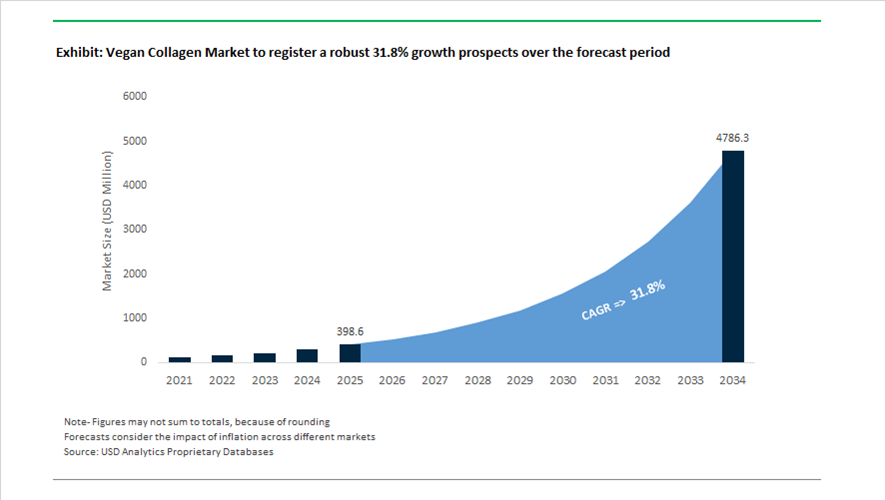
The global Vegan Collagen market is valued at $398.6 million in 2025 and is projected to reach $4,783.8 million by 2034, expanding at an exceptional CAGR of 31.8%. This rapid acceleration is driven by breakthroughs in precision fermentation collagen, recombinant human collagen, bio-designed polypeptides, plant-derived collagen analogs, edible vegan collagen, and clinically validated anti-aging actives. Unlike traditional marine or bovine collagen, next-generation vegan collagen leverages AI-guided protein engineering, microbial fermentation, and phytotechnology to produce bioidentical collagen fragments that replicate human amino acid sequences. Growth is concentrated across beauty-from-within supplements, medical-grade skincare, tissue engineering scaffolds, and pharmaceutical biomaterials, with regulatory validation and clinical benchmarking reshaping industry confidence.
Innovation momentum intensified between 2024 and 2025. In January 2024, INJA Wellness introduced India’s first “pure veg” collagen formulated to emulate the complete amino acid profile of animal collagen, marking a shift away from collagen boosters toward bioengineered structural proteins. In February 2024, Evonik entered a long-term strategic partnership with Jland Biotech to secure non-animal-derived collagen supply for global personal care applications. In April 2025, Evonik released in-vivo clinical results for Vecollage Fortify L, developed with Modern Meadow, demonstrating a 15% reduction in wrinkles and measurable elasticity improvement within four weeks. In September 2025, Evonik launched Vecollan®, a high-purity recombinant collagen designed for clinical trials in tissue engineering and wound healing. Regulatory validation significantly expanded commercial scope. In October 2025, Geltor received an FDA “no questions” letter confirming GRAS status for PrimaColl, enabling edible vegan collagen integration into U.S. food, beverage, and sports nutrition markets. In August 2025, Geltor secured expansion funding to scale its fermentation-based polypeptide manufacturing to meet rising global demand.
Consumer and aesthetic market penetration accelerated through premium product launches and AI-designed ingredients. In January 2025, Brenntag partnered with Cambrium to launch NovaColl in Europe, an AI-designed micro-molecular collagen produced via precision fermentation for enhanced dermal penetration. In May 2025, DR. Rashel introduced a 100% vegan bio-collagen facial mask combining plant-based alternatives and active acids for deep skin repair across India and the Middle East. In July 2025, Koru Pharma debuted Renoxome+ in South Korea, integrating hydrolyzed vegan collagen with plant-derived exosomes for regenerative aesthetic procedures. In September 2025, the U.S. brand Shed launched a multifunctional supplement combining vegan collagen, biotin, and hyaluronic acid, reflecting convergence in hair, skin, and joint wellness. In December 2025, Aveda introduced its Botanical Kinetics collection centered on Phytotech vegan collagen derived from vertically farmed plant leaves in Spain.
Trends and Opportunities in the Vegan Collagen Market
Precision Fermentation Scaling for Bioidentical Vegan Collagen Performance
The vegan collagen market is undergoing a decisive shift from indirect “collagen booster” supplements toward precision-fermented, bioidentical collagen proteins that replicate the human amino acid sequence. This transition is materially changing efficacy benchmarks, regulatory acceptance, and price realization across food, beverage, and personal care applications.
During late 2024 and throughout 2025, Geltor successfully transitioned from pilot to commercial-scale fermentation through its strategic manufacturing partnership with Arxada. This scale-up expanded fermentation capacity from tens of thousands to multi-million-liter volumes, enabling global rollout of PrimaColl™, the first bioidentical, animal-free collagen designed to match conventional poultry collagen functionality. The move signals that vegan collagen has crossed the threshold from niche innovation to industrial ingredient category.
Regulatory momentum is reinforcing this trend. On October 22, 2024, the U.S. Food and Drug Administration issued a “no questions” letter under GRN 1171 confirming the GRAS status of collagen polypeptides produced using E. coli. This clearance removed a critical commercialization barrier, allowing mainstream food, beverage, and nutraceutical brands to integrate bioidentical vegan collagen into mass-market SKUs in 2025. As a result, demand is increasingly anchored in performance parity rather than ethical positioning alone.
AI-Driven Formulation and Vertical Brand Integration
Beyond fermentation scale, competitive advantage in the vegan collagen market is shifting toward data-driven molecular design and vertical integration. Luxury beauty and wellness brands are investing directly in proprietary clinical datasets and AI-enabled protein engineering to differentiate efficacy claims and protect margins.
In January 2025, Brenntag partnered with Cambrium to commercialize NovaColl™, an AI-designed, micro-molecular vegan collagen optimized for enhanced skin penetration and bioavailability. This ingredient is being deployed across premium beauty markets in France, Italy, and the UK, where demand for science-validated vegan luxury products is accelerating. AI-led protein discovery shortens development cycles and enables targeted functionality, positioning vegan collagen closer to pharmaceutical-grade actives than traditional supplements.
At the consumer brand level, vertical integration is expanding into nutraceutical formats. In June 2025, Dabur launched its digital-first wellness brand Siens, targeting the “beauty-from-within” segment with vegan collagen gummies and effervescent tablets. This strategy reflects a broader market shift where FMCG players are internalizing formulation science and digital distribution to capture higher lifetime customer value in the active-aging demographic.
Clinical Dermatology and Ethical Nutricosmetics
One of the highest-value opportunities for vegan collagen lies in professional dermatology and ethical nutricosmetics, where clinical validation is becoming the primary purchase driver. Vegan collagen is increasingly positioned as a prescribable, evidence-backed alternative to marine and bovine sources, particularly for consumers with ethical, religious, or allergen concerns.
A September 2025 clinical study published in Collagen Science Update reported that eight weeks of supplementation with biomimetic vegan collagen resulted in measurable improvements in skin density and elasticity, including a 27.5% reduction in wrinkle depth versus placebo. These outcomes place precision-fermented vegan collagen on par with, and in some parameters ahead of, traditional fish collagen, fundamentally reshaping professional confidence in animal-free alternatives.
Further reinforcing this opportunity, late-2025 research supported by the U.S. National Institutes of Health demonstrated that specific vegan collagen amino acid profiles could reduce biological age markers by approximately 1.4 years within six months of supplementation. This longevity-linked narrative is driving adoption in aesthetic clinics and premium wellness programs, where consumers are willing to pay for clinically substantiated, ethical interventions.
Diversification into Joint Health and Sports Nutrition
While beauty and skin health remain the category’s revenue anchor, joint health and sports nutrition represent a structurally attractive expansion path for vegan collagen suppliers. Aging populations and physically active consumers are seeking connective tissue support without animal-derived inputs, creating white space beyond cosmetic benefits.
Industry data from 2025 underscores that endogenous collagen production declines by roughly 1% annually after age 40, contributing to joint stiffness and recovery challenges. Vegan collagen formulations are increasingly combined with hyaluronic acid, biotin, and plant-based proteins in sports powders and recovery blends, targeting the fast-growing active-aging segment that favors sustainable, plant-forward nutrition.
Product innovation is extending into topical and hybrid formats. In May 2025, Dr. Rashel introduced 100% vegan bio-collagen facial masks and recovery serums in India, signaling a move toward full-body collagen wellness. These launches illustrate how oral and topical vegan collagen solutions are converging to address skin, joint, and post-exercise recovery within a unified ethical and performance framework.
Vegan Collagen Market Share and Segmentation Insights
Source Market Share: Microbial Fermentation Leads with Scalable Recombinant Collagen Production
Microbial fermentation accounts for 48.60% of the vegan collagen market in 2025, driven by its ability to produce recombinant human collagen with high bioactivity and structural similarity to animal-derived collagen. Using engineered yeast and bacteria, this method offers scalable production, cost efficiency, and consistency across applications. Synthetic biology, genetically modified plants, and plant-based blends serve alternative production routes with varying performance profiles. A key market trend is precision fermentation scale-up, where advances in strain engineering and bioprocess optimization have improved yields and reduced production costs, enabling wider adoption of vegan collagen in cosmetics, nutraceuticals, and functional food applications.
Application Market Share: Cosmetics and Personal Care Leads with Biomimetic Skincare Innovation
Cosmetics and personal care hold a 48.60% share in the vegan collagen market in 2025, supported by strong demand for anti-aging, skin repair, and hair care formulations. Vegan collagen is increasingly integrated into serums, creams, and cosmetic products targeting hydration and elasticity improvement. Nutraceuticals, food and beverages, and medical applications contribute additional demand. A key growth driver is the biomimetic skincare trend, where recombinant collagen peptides are designed to interact with skin receptors and stimulate natural collagen synthesis. This aligns with the clean beauty movement, where consumers prioritize sustainable, animal-free, and science-backed ingredients with proven efficacy.
Vegan Collagen Market Competitive Landscape
The Vegan Collagen market in 2026 is defined by molecular mimicry, AI-driven protein engineering, and yeast-based fermentation systems producing skin-identical collagen for ingestible beauty, regenerative medicine, and advanced biomaterials, with precision fermentation and regulatory validation shaping competitive dynamics.
Geltor Leads Ingestible Vegan Collagen with FDA-Approved PrimaColl® Platform
Geltor, Inc. is pioneering the Vegan Collagen market through its PrimaColl® ingredient, the first biodesigned collagen polypeptide to achieve FDA GRAS status for food and beverage applications. Engineered to replicate Type 21 collagen, PrimaColl® stimulates endogenous collagen production, improving skin elasticity and reducing wrinkle depth. The company secured funding in 2025 to scale precision fermentation capabilities, supporting global expansion in ingestible beauty supplements. Its products are increasingly positioned as longevity-focused ingredients in premium nutraceutical formulations. Geltor’s platform delivers 100% animal-free, Halal, and Kosher-certified proteins with no contamination risks. This regulatory validation and functional efficacy strengthen its leadership in bioactive collagen alternatives.
Evonik Expands Recombinant Collagen Platforms for Medical and Premium Beauty Applications
Evonik Industries AG is positioning itself as a leader in the Vegan Collagen market through its VECOLLAN® and VECOLLAGE™ platforms targeting medical and cosmeceutical applications. VECOLLAN® provides clinical-grade recombinant collagen for tissue engineering and medical device development, supporting regenerative medicine advancements. VECOLLAGE™ Fortify L mimics human Type III collagen, enhancing skin structure and enabling prejuvenation-focused skincare. The company is expanding its Asia footprint with a new innovation center in Shanghai to capture demand in advanced beauty formulations. Its Cosmetic Drone® delivery system enhances targeted peptide delivery to fibroblasts, improving efficacy. This integration of biotechnology and delivery systems strengthens Evonik’s premium positioning.
Jland Biotech Scales Recombinant Human-Like Collagen for Mass-Premium Skincare
Jland Biotech is advancing the Vegan Collagen market through large-scale production of recombinant human-like collagen using high-density yeast fermentation. Its Biollagen™ portfolio offers high transdermal absorption, zero immunogenicity, and strong compatibility with aqueous formulations. Expansion into Europe and the UK enables access to certified vegan skincare markets and premium cosmetic brands. The company is innovating with freeze-dried collagen formats such as Biollagen™ FQ, preserving protein activity until application. Clinical validation demonstrates enhanced cell proliferation and improved solubility for advanced skincare formulations. This focus on scalable production and functional performance supports its mass-premium market penetration.
Cambrium Deploys AI-Designed Micro-Molecular Collagen for Deep Skin Penetration
Cambrium is differentiating itself in the Vegan Collagen market through AI-driven molecular design and next-generation protein engineering. Its NovaColl™ (sh-Polypeptide-47) features a micro-molecular structure enabling deep dermal penetration, outperforming traditional collagen formats. The partnership with Brenntag expands its distribution across key European markets, accelerating commercialization. Funding secured in 2024 is supporting expansion of its designer protein pipeline into broader biomaterials. Cambrium’s machine learning platform enables precise prediction of protein-skin interactions, optimizing efficacy at the molecular level. This innovation-driven approach positions the company at the forefront of computational biology in skincare.
Modern Meadow Expands Bio-Collagen Materials for Textiles and Advanced Skincare Applications
Modern Meadow is redefining the Vegan Collagen market through its INNOVERA™ platform, combining bio-based proteins and biopolymers for high-performance materials. The formation of INNOVERA™ Europe with HELLER-LEDER enables large-scale production for automotive and luxury fashion applications. Its materials achieve over 80% renewable carbon content, significantly reducing environmental impact compared to traditional leather. With production capacity exceeding 500,000 square meters annually, the company supports global supply chain scalability. The introduction of “Dry White” materials reduces water and chemical usage in downstream processing by over 50%. This expansion into material science and sustainability strengthens its cross-industry positioning.
United States Vegan Collagen Market Defined by Regulatory Breakthroughs and Biodesigned Scale-Up
The United States represents the regulatory and commercial inflection point for the global vegan collagen market, following a landmark safety determination in 2025. In October 2025, the U.S. Food and Drug Administration issued a no-questions letter for the GRAS notification covering Geltor’s PrimaColl. This decision established the first biodesigned vegan collagen polypeptide cleared for both ingestible food and beverage use and topical cosmetic applications. The ruling significantly reduces regulatory uncertainty for downstream formulators in sports nutrition, healthy aging, and nutricosmetics, accelerating product launches that were previously constrained to topical-only claims.
Technological maturity is reinforcing this regulatory momentum. Commercial-scale production of PrimaColl in 2025 successfully replicated the amino acid sequence of Type 21 avian collagen, delivering high-purity, animal-free alternatives with consistent molecular weight profiles. Federal emphasis on domestic biomanufacturing under CHIPS Act–linked initiatives has enabled firms such as Geltor and Bolt Threads to expand bioreactor capacity, materially reducing batch-to-batch variability versus animal extraction. Venture funding has followed suit, with biodesign startups raising a combined $120 million in August 2025 to scale polypeptide platforms targeting beauty-from-within formulations. Clinical validation further strengthens adoption. North American trials released in 2025 demonstrated statistically significant improvements in skin elasticity and hydration over a 12-week period, matching or outperforming bovine collagen benchmarks. Supply chain strategy is also evolving, as U.S. producers increasingly source domestic fermentation media to mitigate tariff-driven volatility in imported plant proteins.
China Vegan Collagen Market Driven by Recombinant Leadership and AI-Guided Precision
China has emerged as the global volume and technology leader in recombinant humanized collagen, particularly Type III variants used in advanced skincare and medical aesthetics. In 2025, Jiangsu Jland Biotech showcased Biollagen, a yeast-fermented collagen platform reported to deliver up to 200-fold functional performance versus conventional animal-derived collagen in skin repair applications. This leadership is underpinned by sophisticated fermentation infrastructure and aggressive investment in human-identical molecular design.
Artificial intelligence is a defining differentiator. Chinese producers are deploying AI-driven screening tools to isolate the most bioactive core segments of human Type III collagen, which are then expressed with high precision in Pichia pastoris yeast systems. Regulatory positioning supports export growth. In 2025, leading Chinese suppliers secured Vegan Society and Halal accreditation to access clean beauty markets across Southeast Asia and the Middle East. Scientific momentum is expanding into hair care. Research published in Frontiers in Bioengineering in late 2025 highlighted synergistic effects between recombinant collagen and nicotinamide, demonstrating enhanced hair follicle stabilization in laboratory models. However, regulatory friction is emerging. New draft food safety amendments in 2025 require imported vegan functional ingredients to carry certificates of compliance from exporting authorities, reshaping global trade flows for collagen intermediates and reinforcing China’s push toward finished-formulation exports.
Germany Vegan Collagen Market Anchored in Distribution Power and Skin-Identical Innovation
Germany functions as Europe’s commercialization and formulation gateway for vegan collagen, leveraging strong specialty distribution networks and advanced cosmetic science. In January 2025, Brenntag Specialties entered a long-term partnership with Cambrium to distribute NovaColl sh-Polypeptide-47 across Europe. Marketed as a 100% skin-identical, micro-molecular collagen, NovaColl represents the first recombinant collagen to achieve pan-European scale through Brenntag’s innovation centers, significantly lowering market entry barriers for cosmetic brands.
Strategic capital alignment is reinforcing this position. Evonik deepened its Nutrition and Care strategy in 2025 through a venture investment in Jland Biotech, targeting integration of recombinant collagen into advanced delivery systems and ceramide platforms. Innovation visibility remains high. At In-Cosmetics Global 2025 in Amsterdam, German innovators introduced Vecollage Fortify GP, a skin-identical polypeptide leveraging epigenetic signaling to address age-related collagen loss at ultra-low inclusion rates. On the manufacturing side, German producers are commissioning enzymatic and eco-efficient processes for emollients and collagen formulations, reporting up to a 60% reduction in climate footprint compared with traditional chemical synthesis routes.
India Vegan Collagen Market Shaped by Regulatory Tightening and Integrative Wellness
India’s vegan collagen market is transitioning from loosely regulated nutraceutical positioning toward pharmaceutical-grade scrutiny. In 2025, the government initiated steps to shift oversight of nutraceuticals to the Central Drugs Standard Control Organization, introducing stricter quality and substantiation requirements for vegan collagen boosters. This regulatory recalibration is expected to eliminate misleading claims while favoring clinically validated, biotech-derived collagen alternatives.
Capacity and cultural alignment are advancing in parallel. Nitta Gelatin India Ltd. announced a ₹200 crore expansion in mid-2025, including a dedicated Kerala facility for high-purity collagen peptides to serve India’s expanding vegetarian and flexitarian population. Beyond conventional nutrition, India is exploring integrative health models. The Ministry of Ayush is funding 2025–2026 research programs combining modern biotech vegan collagen with traditional Rasayana botanicals, positioning India as a testbed for hybrid wellness solutions that merge fermentation science with Ayurvedic rejuvenation concepts.
Israel Vegan Collagen Market Positioned at the Frontier of Regenerative Medicine
Israel occupies a distinct, high-value niche in the vegan collagen landscape through its leadership in plant-derived recombinant collagen for medical applications. In September 2025, CollPlant Biotechnologies announced positive results for a photocurable regenerative dermal filler based on recombinant human collagen produced in genetically engineered tobacco plants. This platform enables precise control over collagen structure and crosslinking, differentiating it from fermentation-based approaches.
Clinical focus is intensifying. CollPlant’s 2025 development roadmap centers on soft tissue repair, contouring precision, and tissue regeneration, with multiple programs advancing through late-stage clinical evaluation in medical aesthetics. Unlike markets oriented toward nutrition or cosmetics, Israel’s vegan collagen strategy is tightly aligned with regulated biomedical innovation, reinforcing its role as a technology incubator rather than a volume supplier.
Summary of Country-Level Vegan Collagen Market Dynamics
Skin-identical polypeptides, specialty delivery systems
European formulation hub
India
Regulatory tightening and integrative wellness
Nutraceutical reform, vegetarian demand
Emerging quality-driven market
Israel
Regenerative medicine leadership
Plant-derived rhCollagen, clinical aesthetics
Biomedical innovation frontier
Vegan Collagen Market Report Scope
Vegan Collagen Market
Parameter
Details
Market Size (2025)
$398.6 Million
Market Size (2034)
$4783.8 Million
Market Growth Rate
31.8%
Segments
By Source (Microbial Fermentation, Genetically Modified Plants, Plant-Based Blends, Synthetic Biology), By Product Type (Recombinant Human Collagen, Hydrolyzed Plant Protein Peptides, Hybrid Formulations), By Application (Cosmetics and Personal Care, Nutraceuticals and Dietary Supplements, Food and Beverages, Medical and Healthcare), By Distribution Channel (Direct-to-Consumer and E-commerce, Professional Channels, Retail)
Study Period
2019- 2025 and 2026-2034
Units
Revenue (USD)
Qualitative Analysis
Porter’s Five Forces, SWOT Profile, Market Share, Scenario Forecasts, Market Ecosystem, Company Ranking, Market Dynamics, Industry Benchmarking
Companies
Geltor Inc., Evonik Industries AG, CollPlant Biotechnologies Ltd., Jiangsu Jland Biotech Co. Ltd., Cambrium, Sederma, Brenntag Specialties, Vaneeghen, Hebeishunbang Biotech, AptarGroup Inc., Codif Technologie Naturelle, Bolt Threads Inc., Shiseido Company Limited, Nitta Gelatin India Limited, Gelita AG
Countries
US, Canada, Mexico, Germany, France, Spain, Italy, UK, Russia, China, India, Japan, South Korea, Australia, South East Asia, Brazil, Argentina, Middle East, Africa
Vegan Collagen Market Segmentation
By Source
Microbial Fermentation
Genetically Modified Plants
Plant-Based Blends
Synthetic Biology
By Product Type
Recombinant Human Collagen
Hydrolyzed Plant Protein Peptides
Hybrid Formulations
By Application
Cosmetics and Personal Care
Nutraceuticals and Dietary Supplements
Food and Beverages
Medical and Healthcare
By Distribution Channel
Direct-to-Consumer and E-commerce
Professional Channels
Retail
By Region
North America (United States, Canada, Mexico)
Europe (Germany, France, United Kingdom, Spain, Italy, Rest of Europe)
Asia Pacific (China, India, Japan, South Korea, Australia, Rest of APAC)
South and Central America (Brazil, Argentina, Rest of SCA)
Middle East and Africa (Saudi Arabia, UAE, South Africa, Rest of Middle East, Rest of Africa)
2. Vegan Collagen Market Landscape & Outlook (2025–2034)
2.1. Introduction to Vegan Collagen Market
2.2. Market Valuation and Growth Projections (2025–2034)
2.3. Precision Fermentation and Bioidentical Collagen Production
2.4. Clinical Validation and Regulatory Approvals (GRAS, FDA)
2.5. Expansion Across Beauty-from-Within, Medical, and Nutraceutical Applications
3. Innovations Reshaping the Vegan Collagen Market
3.1. Trend: Precision Fermentation Scaling for Bioidentical Collagen
3.2. Trend: AI-Driven Protein Engineering and Vertical Integration
3.3. Opportunity: Clinical Dermatology and Ethical Nutricosmetics
3.4. Opportunity: Joint Health and Sports Nutrition Applications
4. Competitive Landscape and Strategic Initiatives
4.1. Mergers and Acquisitions
4.2. R&D and Material Innovation
4.3. Sustainability and ESG Strategies
4.4. Market Expansion and Regional Focus
5. Market Share and Segmentation Insights: Vegan Collagen Market
5.1. By Source
5.1.1. Microbial Fermentation
5.1.2. Genetically Modified Plants
5.1.3. Plant-Based Blends
5.1.4. Synthetic Biology
5.2. By Product Type
5.2.1. Recombinant Human Collagen
5.2.2. Hydrolyzed Plant Protein Peptides
5.2.3. Hybrid Formulations
5.3. By Application
5.3.1. Cosmetics and Personal Care
5.3.2. Nutraceuticals and Dietary Supplements
5.3.3. Food and Beverages
5.3.4. Medical and Healthcare
5.4. By Distribution Channel
5.4.1. Direct-to-Consumer and E-commerce
5.4.2. Professional Channels
5.4.3. Retail
5.5. By Region
5.5.1. North America
5.5.2. Europe
5.5.3. Asia Pacific
5.5.4. South and Central America
5.5.5. Middle East and Africa
6. Country Analysis and Outlook of Vegan Collagen Market
6.1. United States
6.2. Canada
6.3. Mexico
6.4. Germany
6.5. France
6.6. Spain
6.7. Italy
6.8. UK
6.9. Russia
6.10. China
6.11. India
6.12. Japan
6.13. South Korea
6.14. Australia
6.15. South East Asia
6.16. Brazil
6.17. Argentina
6.18. Middle East
6.19. Africa
7. Vegan Collagen Market Size Outlook by Region (2025-2034)
7.1. North America Vegan Collagen Market Size Outlook to 2034
7.1.1. By Source
7.1.2. By Product Type
7.1.3. By Application
7.1.4. By Distribution Channel
7.1.5. By Region
7.2. Europe Vegan Collagen Market Size Outlook to 2034
7.2.1. By Source
7.2.2. By Product Type
7.2.3. By Application
7.2.4. By Distribution Channel
7.2.5. By Region
7.3. Asia Pacific Vegan Collagen Market Size Outlook to 2034
7.3.1. By Source
7.3.2. By Product Type
7.3.3. By Application
7.3.4. By Distribution Channel
7.3.5. By Region
7.4. South America Vegan Collagen Market Size Outlook to 2034
7.4.1. By Source
7.4.2. By Product Type
7.4.3. By Application
7.4.4. By Distribution Channel
7.4.5. By Region
7.5. Middle East and Africa Vegan Collagen Market Size Outlook to 2034
7.5.1. By Source
7.5.2. By Product Type
7.5.3. By Application
7.5.4. By Distribution Channel
7.5.5. By Region
8. Company Profiles: Leading Players in the Vegan Collagen Market
8.1. Geltor Inc.
8.2. Evonik Industries AG
8.3. CollPlant Biotechnologies Ltd.
8.4. Jiangsu Jland Biotech Co. Ltd.
8.5. Cambrium
8.6. Sederma
8.7. Brenntag Specialties
8.8. Vaneeghen
8.9. Hebeishunbang Biotech
8.10. AptarGroup Inc.
8.11. Codif Technologie Naturelle
8.12. Bolt Threads Inc.
8.13. Shiseido Company Limited
8.14. Nitta Gelatin India Limited
8.15. Gelita AG
9. Methodology
9.1. Research Scope
9.2. Market Research Approach
9.3. Market Sizing and Forecasting Model
9.4. Research Coverage
9.5. Data Horizon
9.6. Deliverables
10. Appendix
10.1. Acronyms and Abbreviations
10.2. List of Tables
10.3. List of Figures
Vegan Collagen Market Segmentation
By Source
Microbial Fermentation
Genetically Modified Plants
Plant-Based Blends
Synthetic Biology
By Product Type
Recombinant Human Collagen
Hydrolyzed Plant Protein Peptides
Hybrid Formulations
By Application
Cosmetics and Personal Care
Nutraceuticals and Dietary Supplements
Food and Beverages
Medical and Healthcare
By Distribution Channel
Direct-to-Consumer and E-commerce
Professional Channels
Retail
By Region
North America (United States, Canada, Mexico)
Europe (Germany, France, United Kingdom, Spain, Italy, Rest of Europe)
Asia Pacific (China, India, Japan, South Korea, Australia, Rest of APAC)
South and Central America (Brazil, Argentina, Rest of SCA)
Middle East and Africa (Saudi Arabia, UAE, South Africa, Rest of Middle East, Rest of Africa)
The vegan collagen market is valued at $398.6 million in 2025 and is projected to reach $4,783.8 million by 2034, growing at a CAGR of 31.8%. This exceptional growth is fueled by precision fermentation technologies and rising demand for bioidentical collagen. Expansion is strongest across nutraceuticals, cosmetics, and medical biomaterials.
Precision fermentation and recombinant protein engineering are transforming the market by enabling bioidentical collagen production. AI-driven molecular design is accelerating development of highly functional peptides with enhanced bioavailability. These technologies are shifting vegan collagen from “collagen boosters” to clinically validated structural proteins.
Cosmetics and personal care dominate with a 48.60% share, driven by anti-aging and skin repair solutions. However, nutraceuticals and ingestible beauty are the fastest-growing segments due to consumer demand for internal wellness. Medical applications such as tissue engineering and wound healing represent high-margin future opportunities.
The United States leads in regulatory validation and commercialization following FDA GRAS approvals. China dominates recombinant collagen production and AI-driven innovation. Europe, particularly Germany, acts as a formulation hub, while India is emerging with regulatory tightening and growing nutraceutical demand.
Major players include Geltor Inc., Evonik Industries AG, CollPlant Biotechnologies, Jland Biotech, and Cambrium. These companies are investing in fermentation scale-up, clinical validation, and AI-driven protein design. Strategic partnerships and regulatory approvals are central to gaining competitive advantage in this high-growth market.
More Nutraceutical and Functional Ingredients Reports