
The global Venous Thromboembolism Therapeutics Market Study analyzes and forecasts the market size across 6 regions and 24 countries for diverse segments including By Drug Class (Factor Xa inhibitors, Direct thrombin inhibitors, Heparin, Vitamin K antagonists), By End-User (Hospitals, Catheterisation Laboratories, Ambulatory Surgical Centres).
The Venous Thromboembolism (VTE) Therapeutics Market comprises anticoagulants, thrombolytics, venous stents, and VTE treatments used in hematology, cardiovascular medicine, and thromboembolism management for preventing and treating deep vein thrombosis (DVT), pulmonary embolism (PE), and venous thrombotic events. VTE therapeutics target blood clot formation, thrombus dissolution, and clot prevention, providing VTE prophylaxis, thromboembolism treatment, and cardiovascular risk reduction in patients with VTE risk factors or venous thrombotic disorders. Market dynamics include anticoagulant drugs, VTE treatment guidelines, novel thrombolytic therapies, and vascular intervention devices for VTE management and thromboembolism prevention strategies.
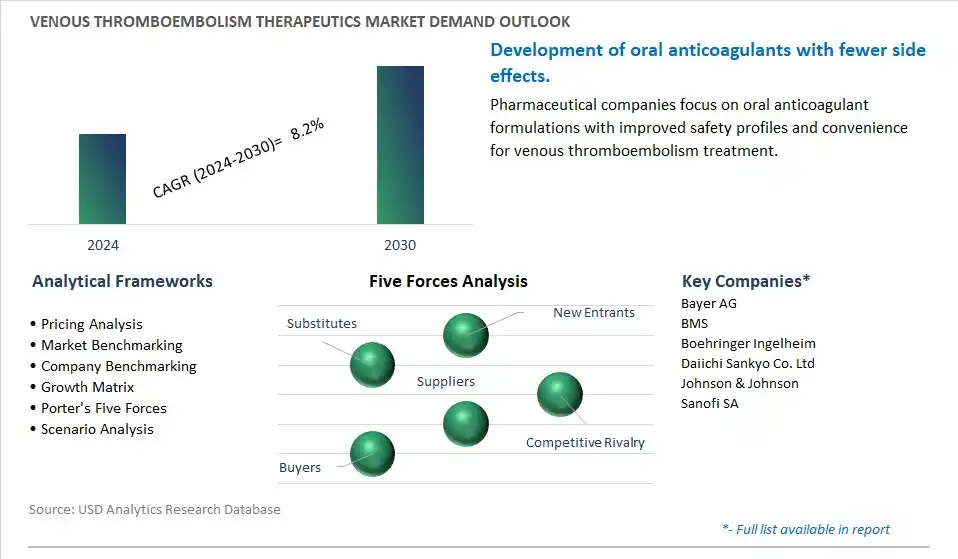
The global Venous Thromboembolism Therapeutics Industry is highly competitive with a large number of companies focusing on niche market segments. Amidst intense competitive conditions, Venous Thromboembolism Therapeutics Companies are investing in new product launches and strengthening distribution channels. Key companies operating in the Venous Thromboembolism Therapeutics Industry include- Bayer AG, BMS, Boehringer Ingelheim, Daiichi Sankyo Co. Ltd, Johnson & Johnson, Sanofi SA.
A significant trend in the market for Venous Thromboembolism Therapeutics is the continual advancements in anticoagulant therapy, including the development of novel oral anticoagulants (NOACs) and targeted anticoagulant agents, revolutionizing the management of venous thromboembolism (VTE) and providing more options for patients and healthcare providers. Anticoagulant therapy plays a central role in the prevention and treatment of VTE, encompassing deep vein thrombosis (DVT) and pulmonary embolism (PE), with the goal of preventing thrombus formation, propagation, and embolization. Traditional anticoagulants such as warfarin have long been the standard of care for VTE management, but their limitations, including narrow therapeutic windows, variable dosing requirements, and interactions with food and drugs, have spurred the development of NOACs with improved efficacy, safety, and convenience profiles. NOACs such as direct oral anticoagulants (DOACs) offer advantages such as rapid onset of action, predictable pharmacokinetics, and reduced need for routine monitoring compared to warfarin, driving their widespread adoption in clinical practice. Additionally, targeted anticoagulant agents such as factor Xa inhibitors and direct thrombin inhibitors provide alternative treatment options for patients with VTE, offering personalized approaches to anticoagulant therapy based on individual risk factors and preferences. As research and development efforts continue to advance the field of anticoagulant therapy, the market for VTE therapeutics is expected to witness further innovation and evolution, with the potential for improved outcomes and quality of life for patients with VTE.
A key driver for the market of Venous Thromboembolism Therapeutics is the growing burden of venous thromboembolism (VTE) worldwide, fueled by aging populations, rising prevalence of risk factors such as obesity and sedentary lifestyles, and increasing awareness and detection of VTE-related conditions. VTE represents a significant healthcare challenge, encompassing DVT and PE, with substantial morbidity, mortality, and economic costs associated with untreated or recurrent events. Risk factors for VTE include surgical procedures, prolonged immobility, trauma, cancer, pregnancy, hormonal therapy, and inherited or acquired thrombophilic disorders. As the global burden of chronic diseases such as cardiovascular disorders, cancer, and respiratory conditions continues to rise, there is a corresponding increase in the incidence and prevalence of VTE-related complications, driving the demand for effective prevention and treatment strategies. Additionally, efforts to improve VTE awareness, screening, and diagnosis contribute to the identification of at-risk individuals and the initiation of appropriate anticoagulant therapy, further driving market growth and adoption of VTE therapeutics. As healthcare systems strive to address the growing burden of VTE and its associated complications, there is a continued need for innovative and effective therapies to improve patient outcomes and reduce the societal impact of VTE-related morbidity and mortality.
An exciting opportunity for the market of Venous Thromboembolism Therapeutics lies in the expansion of the oral anticoagulant market, leveraging advancements in drug development, personalized medicine, and patient-centered care to address unmet clinical needs and improve treatment outcomes for patients with VTE. Oral anticoagulants, including NOACs and targeted anticoagulant agents, have transformed the landscape of VTE management, offering alternatives to traditional anticoagulants such as warfarin and heparin with improved efficacy, safety, and convenience profiles. The expansion of the oral anticoagulant market presents opportunities for pharmaceutical companies to innovate and differentiate their products through the development of next-generation anticoagulants with enhanced properties such as rapid onset of action, extended duration of effect, once-daily dosing regimens, and reduced risk of bleeding complications. Additionally, personalized approaches to anticoagulant therapy based on individual patient characteristics, including age, comorbidities, renal function, and genetic factors, offer opportunities for targeted therapy optimization and improved treatment outcomes. By investing in research and development initiatives focused on oral anticoagulant innovation and personalized medicine, pharmaceutical companies can capitalize on emerging market opportunities, address unmet clinical needs, and drive growth in the competitive landscape of VTE therapeutics.
Within the Venous Thromboembolism Therapeutics by Drug Class segmentation, Factor Xa inhibitors emerge as a fast-growing category. These medications offer a novel approach to preventing and treating venous thromboembolism by specifically targeting Factor Xa, a key enzyme involved in the blood clotting cascade. Factor Xa inhibitors, such as rivaroxaban and apixaban, have gained popularity due to their oral administration, predictable pharmacokinetics, and favorable safety profile compared to traditional anticoagulants like heparin and vitamin K antagonists. Additionally, Factor Xa inhibitors have demonstrated non-inferiority or superiority in clinical trials for both treatment and prevention of venous thromboembolism, leading to increased adoption in clinical practice. With ongoing research, expanding indications, and favorable guidelines recommending their use, Factor Xa inhibitors are expected to continue experiencing rapid growth, revolutionizing the landscape of venous thromboembolism management across various healthcare settings, including hospitals, catheterization laboratories, and ambulatory surgical centers.
By Drug Class
Factor Xa inhibitors
Direct thrombin inhibitors
Heparin
Vitamin K antagonists
By End-User
Hospitals
Catheterisation Laboratories
Ambulatory Surgical Centres
Geographical Analysis
North America (United States, Canada, Mexico)
Europe (Germany, France, United Kingdom, Spain, Italy, Rest of Europe)
Asia Pacific (China, India, Japan, South Korea, Rest of Asia Pacific)
South America (Brazil, Argentina, Rest of South America)
Middle East and Africa (Saudi Arabia, UAE, Rest of Middle East, South Africa, Egypt, Rest of Africa)
Bayer AG
BMS
Boehringer Ingelheim
Daiichi Sankyo Co. Ltd
Johnson & Johnson
Sanofi SA
* List not Exhaustive
• Deepen your industry insights and navigate uncertainties for strategy formulation, CAPEX, and Operational decisions
• Gain access to detailed insights on the Venous Thromboembolism Therapeutics Market, encompassing current market size, growth trends, and forecasts till 2030.
• Access detailed competitor analysis, enabling competitive advantage through a thorough understanding of market players, strategies, and potential differentiation opportunities
• Stay ahead of the curve with insights on technological advancements, innovations, and upcoming trends
• Identify lucrative investment avenues and expansion opportunities within the Venous Thromboembolism Therapeutics Industry, guided by robust, data-backed analysis.
• Understand regional and global markets through country-wise analysis, regional market potential, regulatory nuances, and dynamics
• Execute strategies with confidence and speed through information, analytics, and insights on the industry value chain
• Corporate leaders, strategists, financial experts, shareholders, asset managers, and governmental representatives can make long-term planning scenarios and build an integrated and timely understanding of market dynamics
• Benefit from tailored solutions and expert consultation based on report insights, providing personalized strategies aligned with specific business needs.
TABLE OF CONTENTS
1 Introduction to 2024 Venous Thromboembolism Therapeutics Market
1.1 Market Overview
1.2 Quick Facts
1.3 Scope/Objective of the Study
1.4 Market Definition
1.5 Countries and Regions Analyzed
1.6 Units, Currency, and Conversions
1.7 Industry Value Chain
2 Research Methodology
2.1 Market Size Estimation
2.2 Sources and Research Methodology
2.3 Data Triangulation
2.4 Assumptions and Limitations
3 Executive Summary
3.1 Global Venous Thromboembolism Therapeutics Market Size Outlook, $ Million, 2021 to 2030
3.2 Venous Thromboembolism Therapeutics Market Outlook by Type, $ Million, 2021 to 2030
3.3 Venous Thromboembolism Therapeutics Market Outlook by Product, $ Million, 2021 to 2030
3.4 Venous Thromboembolism Therapeutics Market Outlook by Application, $ Million, 2021 to 2030
3.5 Venous Thromboembolism Therapeutics Market Outlook by Key Countries, $ Million, 2021 to 2030
4 Market Dynamics
4.1 Key Driving Forces of Venous Thromboembolism Therapeutics Industry
4.2 Key Market Trends in Venous Thromboembolism Therapeutics Industry
4.3 Potential Opportunities in Venous Thromboembolism Therapeutics Industry
4.4 Key Challenges in Venous Thromboembolism Therapeutics Industry
5 Market Factor Analysis
5.1 Value Chain Analysis
5.2 Competitive Landscape
5.2.1 Global Venous Thromboembolism Therapeutics Market Share by Company (%), 2023
5.2.2 Product Offerings by Company
5.3 Porter’s Five Forces Analysis
5.4 Pricing Analysis and Outlook
6 Growth Outlook Across Scenarios
6.1 Growth Analysis-Case Scenario Definitions
6.2 Low Growth Scenario Forecasts
6.3 Reference Growth Scenario Forecasts
6.4 High Growth Scenario Forecasts
7 Global Venous Thromboembolism Therapeutics Market Outlook by Segments
7.1 Venous Thromboembolism Therapeutics Market Outlook by Segments, $ Million, 2021- 2030
By Drug Class
Factor Xa inhibitors
Direct thrombin inhibitors
Heparin
Vitamin K antagonists
By End-User
Hospitals
Catheterisation Laboratories
Ambulatory Surgical Centres
8 North America Venous Thromboembolism Therapeutics Market Analysis and Outlook To 2030
8.1 Introduction to North America Venous Thromboembolism Therapeutics Markets in 2024
8.2 North America Venous Thromboembolism Therapeutics Market Size Outlook by Country, 2021-2030
8.2.1 United States
8.2.2 Canada
8.2.3 Mexico
8.3 North America Venous Thromboembolism Therapeutics Market size Outlook by Segments, 2021-2030
By Drug Class
Factor Xa inhibitors
Direct thrombin inhibitors
Heparin
Vitamin K antagonists
By End-User
Hospitals
Catheterisation Laboratories
Ambulatory Surgical Centres
9 Europe Venous Thromboembolism Therapeutics Market Analysis and Outlook To 2030
9.1 Introduction to Europe Venous Thromboembolism Therapeutics Markets in 2024
9.2 Europe Venous Thromboembolism Therapeutics Market Size Outlook by Country, 2021-2030
9.2.1 Germany
9.2.2 France
9.2.3 Spain
9.2.4 United Kingdom
9.2.4 Italy
9.2.5 Russia
9.2.6 Norway
9.2.7 Rest of Europe
9.3 Europe Venous Thromboembolism Therapeutics Market Size Outlook by Segments, 2021-2030
By Drug Class
Factor Xa inhibitors
Direct thrombin inhibitors
Heparin
Vitamin K antagonists
By End-User
Hospitals
Catheterisation Laboratories
Ambulatory Surgical Centres
10 Asia Pacific Venous Thromboembolism Therapeutics Market Analysis and Outlook To 2030
10.1 Introduction to Asia Pacific Venous Thromboembolism Therapeutics Markets in 2024
10.2 Asia Pacific Venous Thromboembolism Therapeutics Market Size Outlook by Country, 2021-2030
10.2.1 China
10.2.2 India
10.2.3 Japan
10.2.4 South Korea
10.2.5 Indonesia
10.2.6 Malaysia
10.2.7 Australia
10.2.8 Rest of Asia Pacific
10.3 Asia Pacific Venous Thromboembolism Therapeutics Market size Outlook by Segments, 2021-2030
By Drug Class
Factor Xa inhibitors
Direct thrombin inhibitors
Heparin
Vitamin K antagonists
By End-User
Hospitals
Catheterisation Laboratories
Ambulatory Surgical Centres
11 South America Venous Thromboembolism Therapeutics Market Analysis and Outlook To 2030
11.1 Introduction to South America Venous Thromboembolism Therapeutics Markets in 2024
11.2 South America Venous Thromboembolism Therapeutics Market Size Outlook by Country, 2021-2030
11.2.1 Brazil
11.2.2 Argentina
11.2.3 Rest of South America
11.3 South America Venous Thromboembolism Therapeutics Market size Outlook by Segments, 2021-2030
By Drug Class
Factor Xa inhibitors
Direct thrombin inhibitors
Heparin
Vitamin K antagonists
By End-User
Hospitals
Catheterisation Laboratories
Ambulatory Surgical Centres
12 Middle East and Africa Venous Thromboembolism Therapeutics Market Analysis and Outlook To 2030
12.1 Introduction to Middle East and Africa Venous Thromboembolism Therapeutics Markets in 2024
12.2 Middle East and Africa Venous Thromboembolism Therapeutics Market Size Outlook by Country, 2021-2030
12.2.1 Saudi Arabia
12.2.2 UAE
12.2.3 Oman
12.2.4 Rest of Middle East
12.2.5 Egypt
12.2.6 Nigeria
12.2.7 South Africa
12.2.8 Rest of Africa
12.3 Middle East and Africa Venous Thromboembolism Therapeutics Market size Outlook by Segments, 2021-2030
By Drug Class
Factor Xa inhibitors
Direct thrombin inhibitors
Heparin
Vitamin K antagonists
By End-User
Hospitals
Catheterisation Laboratories
Ambulatory Surgical Centres
13 Company Profiles
13.1 Company Snapshot
13.2 SWOT Profiles
13.3 Products and Services
13.4 Recent Developments
13.5 Financial Profile
List of Companies
Bayer AG
BMS
Boehringer Ingelheim
Daiichi Sankyo Co. Ltd
Johnson & Johnson
Sanofi SA
14 Appendix
14.1 Customization Offerings
14.2 Subscription Services
14.3 Related Reports
14.4 Publisher Expertise
By Drug Class
Factor Xa inhibitors
Direct thrombin inhibitors
Heparin
Vitamin K antagonists
By End-User
Hospitals
Catheterisation Laboratories
Ambulatory Surgical Centres
The global Venous Thromboembolism Therapeutics Market is one of the lucrative growth markets, poised to register a 8.2% growth (CAGR) between 2024 and 2030.
Emerging Markets across Asia Pacific, Europe, and Americas present robust growth prospects.
Bayer AG, BMS, Boehringer Ingelheim, Daiichi Sankyo Co. Ltd, Johnson & Johnson, Sanofi SA
Base Year- 2023; Estimated Year- 2024; Historic Period- 2018-2023; Forecast period- 2024 to 2030; Currency: USD; Volume