Vials and Ampoules Market Size, Overview, and Growth Outlook (2025–2034)
Vials and Ampoules Market Poised to Surpass $24 Billion by 2034 Amid Rising Biologics and mRNA Therapy Demand
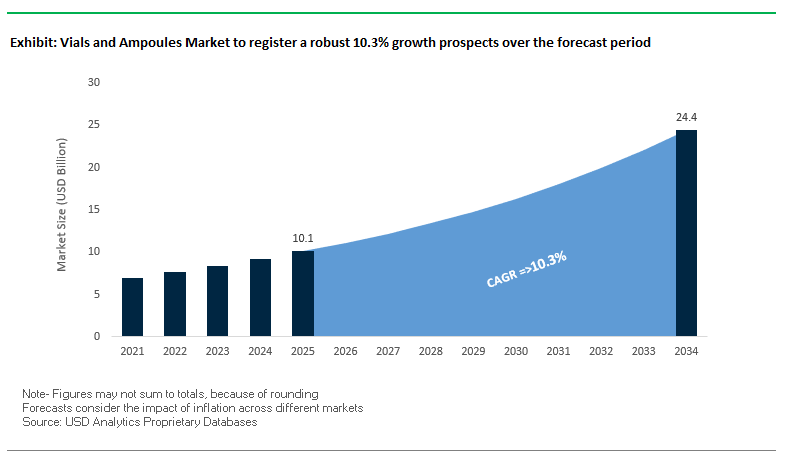
The global vials and ampoules market is projected to grow from $10.1 billion in 2025 to $24.4 billion by 2034, at a CAGR of 10.3%. This industry is the backbone of safe injectable drug delivery, ensuring sterility, integrity, and patient safety. High-quality glass and plastic containers provide tamper-evident, non-reactive solutions for vaccines, biologics, and diagnostic products. For pharmaceutical and biotech professionals, this market is critical for ensuring regulatory compliance and accelerating time-to-market for sensitive therapies.
Key Insights for industry professionals and buyers:
High-value packaging solutions are increasingly required for biologics, biosimilars, and mRNA therapies, demanding advanced materials and manufacturing precision.
Ready-to-use (RTU) and ready-to-fill (RTF) vials and ampoules streamline manufacturing, reduce contamination risk, and improve operational efficiency.
Traceability and anti-counterfeiting features, including serialized barcodes and tamper-evident seals, are essential to safeguard supply chains.
Sustainable and eco-friendly manufacturing is gaining prominence, with lightweight vials and post-consumer recycled (PCR) plastics reducing environmental impact.
Global demand growth is driven by the expansion of biologics, vaccines, and specialty drug markets.
Market Analysis: Strategic Investments and Innovative Materials Are Shaping the Future of Vials and Ampoules
The vials and ampoules industry is rapidly evolving, with strategic investments and technological innovations driving expansion and operational excellence. In August 2025, Gerresheimer secured €200 million in loans to support ongoing growth and acquisitions, reflecting strong market consolidation strategies. That same month, a study demonstrated the use of carrageenan-polyoxometalate antimicrobial films, offering excellent bactericidal activity and biodegradability—highlighting the intersection of safety and sustainability in packaging materials.
In July 2025, Alvotech expanded assembly and packaging capacity via the acquisition of Ivers-Lee in Switzerland, while Stevanato Group secured €200 million financing to fund capital expenditures in Italy and the U.S., reflecting rising demand for high-value syringes and advanced containment solutions. Earlier, May 2025 witnessed a strategic partnership between SCHOTT Pharma, the Serum Institute of India, and TPG, creating a joint venture to enhance global reach and production capabilities.
Earlier innovations include PCI Pharma Services’ acquisition of Ajinomoto Althea in April 2025, providing a first North American sterile fill-finish facility for prefilled syringes, and Nipro PharmaPackaging’s D2F glass vials launched in October 2024, offering ready-to-use EZ-fill technology. Notable collaborations, such as Nipro and Corning’s Velocity Coating Vials, illustrate ongoing investments in coating technologies and glass performance to meet stringent pharmaceutical standards.
Trends and Opportunities Driving Innovation in the Vials and Ampoules Market
Strategic Pivot to Ready-to-Use (RTU) Packaging Components
The vials and ampoules market is witnessing a major transformation with the adoption of ready-to-use (RTU) packaging formats. RTU vials and ampoules, which arrive pre-washed, depyrogenated, and sterilized, dramatically reduce contamination risks in aseptic filling operations. This shift is particularly critical for small-batch biologics and high-value pharmaceuticals, where a single contamination event can result in millions of dollars in losses and delay life-saving therapies.
In addition to safety, RTU components are simplifying supply chains by reducing the infrastructure burden on drug manufacturers. Suppliers now provide Certificates of Analysis (COAs) with each batch, enabling direct entry into fill-finish lines and cutting lead times for commercial launch. This is particularly valuable for contract development and manufacturing organizations (CDMOs) that manage multiple client projects under tight timelines.
Industry alliances are accelerating this transition. The September 2024 partnership between Stevanato Group, Gerresheimer, and SCHOTT Pharma under the “Alliance for RTU” demonstrates the sector’s push toward making RTU solutions the global industry standard, reinforcing reliability and efficiency across the value chain.
Mandated Adoption of Anti-Counterfeiting and Serialization Technologies
Serialization and authentication technologies are becoming non-negotiable in the vials and ampoules market, driven by regulatory mandates such as the U.S. Drug Supply Chain Security Act (DSCSA) and the EU Falsified Medicines Directive (FMD). These frameworks require unique identifiers, 2D matrix codes, and tamper-proof features on every saleable unit, creating full traceability from manufacturer to patient.
Manufacturers are also layering covert and overt anti-counterfeiting features. For instance, SCHOTT Pharma’s Ampoules AC use light-emitting inks that are invisible to the naked eye but detectable with specialized readers, making replication nearly impossible. This ensures intellectual property protection and strengthens patient confidence.
Meanwhile, consumer-enabled verification via QR codes and smartphone apps is enhancing transparency. Patients can instantly verify authenticity, dosage, and origin, positioning packaging as a frontline defense against counterfeit drugs while deepening consumer trust in pharmaceutical brands.
Development of Sustainable and Low-Carbon Footprint Primary Packaging
Sustainability is emerging as a key opportunity in the vials and ampoules market, with pharmaceutical companies under pressure to reduce environmental footprints. Innovative products like Corning’s Viridian™ Vials achieve up to 30% lower cradle-to-gate lifecycle emissions by cutting glass use by 20% while maintaining barrier strength. Such innovations reflect the industry’s pivot to low-carbon packaging solutions that align with corporate ESG goals.
Packaging design is also being reimagined to eliminate unnecessary materials. Initiatives like SCHOTT Pharma’s Alliance to Zero are developing syringe systems that eliminate thermoformed plastic blisters, shifting protection to labels, cartons, and the syringe itself. This not only cuts waste but also improves transport efficiency, helping manufacturers achieve their decarbonization targets without compromising product safety.
Expansion into High-Growth Biologics and Cell & Gene Therapy Applications
The booming biologics and cell & gene therapy (CGT) markets are creating demand for highly specialized vials and ampoules engineered for extreme conditions. Cryogenic-ready formats, such as BioLife Solutions’ cryogenic vials, can withstand temperatures down to -196°C in liquid nitrogen while preserving closure integrity, ensuring stability throughout global cold chain distribution.
To address drug–container interactions, manufacturers are adopting advanced polymer alternatives such as Cyclic Olefin Copolymer (COC). These materials provide a low leachables and extractables profile, reducing risks of protein aggregation and drug degradation—critical for biologics where stability is often a limiting factor.
Automation is also central to growth in this sector. Solutions from Röchling Medical leverage robotic, closed-system aseptic manufacturing under ISO 5 conditions, delivering vials with minimal particle content and unmatched sterility. This compatibility with automated fill-finish lines ensures scalability and regulatory compliance for next-generation biologics and CGTs.
Competitive Landscape: Leading Pharmaceutical Packaging Companies Are Driving Innovation in Sterile Vials and Ampoules
The vials and ampoules market is dominated by companies leveraging advanced materials, automation, and sustainable practices to provide high-performance packaging for biologics, vaccines, and specialty drugs.
Gerresheimer AG: Expanding Global Capacity to Support Biologics and Advanced Drug Delivery
Gerresheimer manufactures glass vials, ampoules, and ready-to-fill syringes for high-value applications. In August 2025, it secured €200 million in financing to fund growth projects and expand manufacturing in Mexico, North Macedonia, and Germany. Gerresheimer’s extensive network, expertise in pharmaceutical glass and plastics, and vertically integrated model ensure high-quality solutions across multiple regions.
SCHOTT Pharma: Pioneering Deep-Cold Storage and Strategic Biopharma Partnerships
SCHOTT Pharma specializes in high-quality glass vials, cartridges, and syringes. In May 2025, a joint venture with the Serum Institute of India welcomed TPG as a strategic partner, and in January 2024, SCHOTT introduced EVERIC freeze vials for deep-cold storage of mRNA vaccines and gene therapies. SCHOTT leverages brand recognition and integrated manufacturing to deliver advanced containment solutions globally.
Stevanato Group: Driving Growth Through Advanced EZ-Fill Technologies and Biopharma Solutions
Stevanato Group offers glass vials, cartridges, and syringes tailored for pharmaceutical and biotech industries. Its Biopharmaceutical and Diagnostic Solutions segment saw strong revenue growth in 2025, and the company secured €200 million financing to expand facilities in Italy and the U.S. Stevanato focuses on sustainable materials and vertically integrated manufacturing for high-value applications.
Becton, Dickinson and Company (BD): Enhancing Patient Experience and Prefilled Syringe Manufacturing
BD manufactures pre-filled syringes, vial systems, and other drug delivery devices. In August 2025, BD committed $35 million to expand prefilled flush syringe production in Nebraska. Recent innovations include the BD Vacutainer® UltraTouch™, improving patient experience during blood collection. BD emphasizes brand strength, material expertise, and integrated manufacturing across global markets.
Nipro PharmaPackaging: Providing Ready-to-Use Glass Vials with Advanced Coating Technologies
Nipro PharmaPackaging delivers glass vials, ampoules, and pre-filled syringes, including D2F EZ-fill vials launched in October 2024. The company also offers Vialex® vials, known for inner surface durability and quality. Nipro focuses on sustainable materials, vertically integrated operations, and high-quality pharmaceutical packaging solutions worldwide.
Vials and Ampoules Market Share Insights, 2025-2034
Vials Lead Market Share by Product Type in the Vials and Ampoules Industry
Vials hold a commanding 55% of the vials and ampoules industry, making them the unchallenged workhorse of pharmaceutical and biotechnology packaging. Traditionally manufactured from borosilicate glass and increasingly from advanced cyclic olefin copolymer (COC), vials are indispensable for liquid formulations, lyophilized drugs, and multi-dose products. Their enduring dominance is tied to superior chemical resistance, inertness, and compatibility with ultra-cold storage, which are critical for biologics, vaccines, and specialty injectables. Moreover, vials benefit from established global infrastructure for filling, sealing, and scaling to billions of units annually, making them the most reliable and cost-efficient solution for high-volume pharmaceutical applications. The continued expansion of biologics and vaccine production further consolidates vials as the backbone of this industry.
Pharmaceutical & Biotechnology Companies Dominate Market Share by End-Use in the Vials and Ampoules Industry
Pharmaceutical and biotechnology companies represent approximately 70% of the demand in the vials and ampoules industry, reflecting their central role as innovators and manufacturers of drugs and biologics. These companies drive technical specifications for packaging, dictating performance requirements such as barrier integrity, sterility assurance, and compatibility with sensitive formulations. The surge in demand for biologics, biosimilars, and specialty injectables has made vials, ampoules, and prefilled syringes indispensable, with pharmaceutical companies investing heavily in packaging technologies that support stability and compliance with FDA, EMA, and GMP standards. Their leadership position also extends to sustainability, as they push for recyclable glass and polymer alternatives to reduce environmental impact while maintaining safety. This overwhelming share underscores their strategic influence in shaping the direction of the entire vials and ampoules market.
United States: FDA Guidance, Personalized Medicine, and Major Investments Driving Growth
The United States vials and ampoules market is shaped by strict regulatory oversight and large-scale corporate investments. The U.S. Food and Drug Administration (FDA) issued a final guidance in July 2024 titled “Container Closure System and Component Changes: Glass Vials and Stoppers”. This directive provides clarity to pharmaceutical manufacturers on how to manage and report changes in vial and stopper systems, ensuring compliance while maintaining drug integrity. Regulatory stringency is boosting demand for tamper-evident, track-and-trace enabled packaging solutions. The trend toward personalized medicine and high-value biologics is further fueling innovation, requiring automated robotic systems that can deliver patient-specific, sterile dosing formats.
The investment landscape is also expanding rapidly. In March 2024, SCHOTT Pharma committed $371 million to a new facility in Wilson, North Carolina, focused on producing prefillable polymer and glass syringes suitable for vaccines and injectable biologics. Similarly, Stevanato Group announced a $512 million investment in Fishers, Indiana, aiming to expand pre-filled syringe production and hire over 500 employees by 2031. These moves position the U.S. as a hub for next-generation drug delivery systems, while demand continues to surge across hospital, long-term care, and home healthcare markets.
European Union: EMA Guidelines and Circular Economy Regulations Reshaping Packaging
The European Union vials and ampoules market is driven by a mix of regulatory reforms and sustainability mandates. The European Medicines Agency (EMA) issued a draft guideline in March 2025 on the quality aspects of mRNA vaccines, which specifies manufacturing and packaging requirements to preserve stability and sterility. At the same time, the Packaging and Packaging Waste Regulation (PPWR), effective February 2025, is accelerating the shift to recyclable and reusable materials, forcing companies to modernize their vial and ampoule production processes.
The EU also maintains strict Good Distribution Practice (GDP) guidelines, which place emphasis on validated cold chain management for biologics and vaccines. This creates demand for advanced vial systems that prevent temperature excursions. Notably, in October 2024, Nipro PharmaPackaging launched its Direct-to-Fill (D2F) glass vials, providing ready-to-use sterile solutions that meet stringent pharma standards. Additionally, the European Commission’s January 2025 update to its Manual of the Working Group on Cosmetic Products clarified regulatory boundaries for products packaged in vials and ampoules, ensuring compliance across pharmaceutical and cosmetic segments.
China: Tighter NMPA Standards and Expansion of Domestic Biologics Manufacturing
The China vials and ampoules market is undergoing significant regulatory tightening and industrial expansion. The National Medical Products Administration (NMPA) introduced YY 1001-2024 standards for all-glass syringes, which became effective in June 2025. This requires drug manufacturers to upgrade packaging lines with smart, automated systems capable of meeting new safety standards. Additionally, China’s vaccine lot release system mandates batch-level audits and inspections before distribution or import, making traceable and secure vial and ampoule packaging essential.
Government initiatives to achieve carbon neutrality are spurring adoption of biopolymer-based and recyclable packaging formats. At the same time, the rapid growth of the domestic generics and biologics sector is fueling demand for international-standard packaging solutions. Local companies such as SSY Group Limited and Forlong Medical are scaling up production capacities to reduce reliance on imports while meeting global quality benchmarks. This positions China as both a large consumer and an increasingly competitive producer of advanced vial and ampoule packaging.
India: eVIN Digitization and Regulatory Push for Sustainability
The India vials and ampoules market is benefiting from both digital innovation and regulatory reforms. The Electronic Vaccine Intelligence Network (eVIN) has digitized vaccine stock and temperature monitoring nationwide, ensuring real-time cold chain management and achieving vaccine availability rates above 99%. This system enhances the need for secure, trackable vial packaging to maintain safety in immunization programs.
On the sustainability side, the Plastic Waste Management (Amendment) Rules, 2024, effective April 2025, introduced Extended Producer Responsibility (EPR) for all plastic packaging, including pharmaceutical formats. This is pushing manufacturers to explore eco-friendly vial and ampoule materials. The Food Safety and Standards Authority of India (FSSAI) is also tightening standards, demanding hygienic and tamper-evident designs. With India’s large and fast-growing pharmaceutical export industry, vials and ampoules are becoming increasingly central to both domestic compliance and international trade competitiveness.
Japan: Circular Economy Laws and Innovations in Specialty Packaging
The Japan vials and ampoules market is advancing under the country’s Plastic Resource Circulation Strategy, which requires all plastic packaging to be recyclable or reusable by 2025. This initiative, reinforced by the Plastic Resource Circulation Promotion Law, is compelling pharmaceutical packaging producers to integrate compostable or paper-based alternatives where possible. Meanwhile, the Ministry of Health, Labor and Welfare (MHLW) introduced a positive list system for synthetic food contact packaging materials in June 2025, indirectly influencing pharmaceutical vial and ampoule safety standards.
Japan’s aging population and chronic disease prevalence are fueling demand for easy-to-use pharmaceutical packaging, particularly prefilled syringes, ampoules, and vials designed to improve medication adherence. Market leaders like Nipro Corporation are spearheading innovation in high-quality glass and polymer vials, catering to both domestic needs and international exports. With precision manufacturing and strong R&D investment, Japan continues to serve as a technological benchmark for sterile packaging.
Brazil: PNRS and Digital Packaging Leaflets Enhancing Transparency
The Brazil vials and ampoules market is shaped by the National Solid Waste Policy (PNRS), which emphasizes recycling, reuse, and waste reduction. This regulatory framework is encouraging pharmaceutical companies to adopt sustainable vial packaging solutions aligned with reverse logistics requirements. In July 2024, Anvisa (Brazil’s health regulatory agency) introduced RDC 885, a regulation permitting digital package leaflets with QR codes on vials and ampoules. This initiative enhances patient access to updated product information while reducing paper waste.
With Brazil’s extensive public health immunization programs, demand for reliable and scalable vial packaging solutions remains strong. These initiatives not only improve supply chain efficiency and transparency but also reinforce the role of vials and ampoules in supporting mass vaccination and pharmaceutical delivery across Latin America.
Vials and Ampoules Market Report Scope
Vials and Ampoules Market
Parameter
Details
Market Size (2025)
$10.1 Billion
Market Size (2034)
$24.4 Billion
Market Growth Rate
10.3%
Segments
By Product Type (Vials, Ampoules, Cartridges, Syringes), By Material (Glass, Plastics), By Application (Pharmaceuticals, Nutraceuticals, Cosmetics & Personal Care, Chemicals), By End-Use Industry (Pharmaceutical & Biotechnology, Hospitals & Clinics, Research & Development, Contract Manufacturing Organizations)
Study Period
2019- 2024 and 2025-2034
Units
Revenue (USD)
Qualitative Analysis
Porter’s Five Forces, SWOT Profile, Market Share, Scenario Forecasts, Market Ecosystem, Company Ranking, Market Dynamics, Industry Benchmarking
US, Canada, Mexico, Germany, France, Spain, Italy, UK, Russia, China, India, Japan, South Korea, Australia, South East Asia, Brazil, Argentina, Middle East, Africa
Vials and Ampoules Market Segmentation
By Product Type
Vials
Ampoules
Cartridges
Syringes
By Material
Glass
Plastics
By Application
Pharmaceuticals
Nutraceuticals
Cosmetics & Personal Care
Chemicals
By End-Use Industry
Pharmaceutical & Biotechnology
Hospitals & Clinics
Research & Development
Contract Manufacturing Organizations
Countries Analyzed
North America (US, Canada, Mexico)
Europe (Germany, UK, France, Spain, Italy, Russia, Rest of Europe)
Asia Pacific (China, India, Japan, South Korea, Australia, South East Asia, Rest of Asia)
South America (Brazil, Argentina, Rest of South America)
Middle East and Africa (Saudi Arabia, UAE, Rest of Middle East, South Africa, Egypt, Rest of Africa)
Top Companies in Vials and Ampoules Market
Gerresheimer AG
SCHOTT AG
Stevanato Group
Nipro Corporation
SGD Pharma
West Pharmaceutical Services, Inc.
Becton, Dickinson & Co.
Corning Incorporated
AptarGroup, Inc.
Amcor plc
SGD Pharma
DWK Life Sciences
Nelipak Healthcare Packaging
Datwyler Holding Inc.
Catalent Inc.
* List Not Exhaustive
Methodology
USDAnalytics employs a comprehensive research methodology to analyze the global vials and ampoules market, combining primary insights from leading pharmaceutical and biotech manufacturers, contract development organizations, and regulatory authorities with secondary data from corporate reports, scientific publications, and industry databases. Our approach evaluates key drivers such as biologics, mRNA therapy adoption, and prefilled syringe innovations, alongside technological trends including ready-to-use (RTU) and ready-to-fill (RTF) vials, advanced polymer and glass materials, anti-counterfeiting and serialization technologies, and sustainable, low-carbon packaging solutions. The study also examines regional dynamics across North America, Europe, Asia-Pacific, China, India, Japan, and Latin America, considering regulatory mandates, cold chain management, and ESG initiatives. USDAnalytics provides detailed segmentation by product type, material, application, and end-use industry, while assessing strategic investments, capacity expansions, and collaborations shaping market growth. This methodology ensures actionable insights for pharmaceutical professionals, packaging designers, and investors seeking opportunities in high-value, sterile, and traceable packaging solutions globally.
Deliverables:
Comprehensive Market Research Report (PDF and Excel) with detailed tables, charts, and interactive visualizations.
Country-Specific Forecasts & Analysis.
Segment-Wise Revenue Forecasts (2025–2034).
Competitive Analysis, Benchmarking, and SWOT Profiles.
Recent Developments & Innovation Tracker.
Executive Summary & Analyst Commentary.
Post-Purchase Analyst Support for Client-Specific Questions and Custom Data Requirements.
Table of Contents: Vials and Ampoules Market
1. Executive Summary
1.1. Market Highlights
1.2. Key Findings
1.3. Global Market Snapshot
2. Vials and Ampoules Market Landscape & Outlook (2025–2034)
2.1. Introduction to Vials and Ampoules Market
2.2. Market Valuation and Growth Projections (2025–2034)
2.3. Strategic Investments Driving Market Expansion
2.4. Technological Innovations in Packaging Materials
2.5. Market Consolidation and Global Production Capacity
3. Innovations Reshaping the Vials and Ampoules Market
3.1. Trend: Strategic Pivot to Ready-to-Use (RTU) Packaging Components
3.2. Trend: Mandated Adoption of Anti-Counterfeiting and Serialization Technologies
3.3. Opportunity: Development of Sustainable and Low-Carbon Footprint Primary Packaging
3.4. Opportunity: Expansion into High-Growth Biologics and Cell & Gene Therapy Applications
4. Competitive Landscape and Strategic Initiatives
4.1. Mergers, Acquisitions and Strategic Alliances
4.2. R&D and Material Innovation
4.3. Sustainability and Strategies
4.4. Market Expansion and Regional Focus
5. Market Share and Segmentation Insights: Vials and Ampoules Market
5.1. By Product Type
5.1.1. Vials
5.1.2. Ampoules
5.1.3. Cartridges
5.1.4. Syringes
5.2. By Material
5.2.1. Glass
5.2.2. Plastics
5.3. By Application
5.3.1. Pharmaceuticals
5.3.2. Nutraceuticals
5.3.3. Cosmetics & Personal Care
5.3.4. Chemicals
5.4. By End-Use Industry
5.4.1. Pharmaceutical & Biotechnology
5.4.2. Hospitals & Clinics
5.4.3. Research & Development
5.4.4. Contract Manufacturing Organizations
6. Country Analysis and Outlook of Vials and Ampoules Market
6.1. United States
6.2. Canada
6.3. Mexico
6.4. Germany
6.5. France
6.6. Spain
6.7. Italy
6.8. UK
6.9. Russia
6.10. China
6.11. India
6.12. Japan
6.13. South Korea
6.14. Australia
6.15. South East Asia
6.16. Brazil
6.17. Argentina
6.18. Middle East
6.19. Africa
7. Vials and Ampoules Market Size Outlook by Region (2025–2034)
7.1. North America Vials and Ampoules Market Size Outlook to 2034
7.1.1. By Product Type
7.1.2. By Material
7.1.3. By Application
7.1.4. By End-Use Industry
7.2. Europe Vials and Ampoules Market Size Outlook to 2034
7.2.1. By Product Type
7.2.2. By Material
7.2.3. By Application
7.2.4. By End-Use Industry
7.3. Asia Pacific Vials and Ampoules Market Size Outlook to 2034
7.3.1. By Product Type
7.3.2. By Material
7.3.3. By Application
7.3.4. By End-Use Industry
7.4. South America Vials and Ampoules Market Size Outlook to 2034
7.4.1. By Product Type
7.4.2. By Material
7.4.3. By Application
7.4.4. By End-Use Industry
7.5. Middle East and Africa Vials and Ampoules Market Size Outlook to 2034
7.5.1. By Product Type
7.5.2. By Material
7.5.3. By Application
7.5.4. By End-Use Industry
8. Company Profiles: Leading Players in the Vials and Ampoules Market
8.1. Gerresheimer AG
8.2. SCHOTT AG
8.3. Stevanato Group
8.4. Nipro Corporation
8.5. SGD Pharma
8.6. West Pharmaceutical Services, Inc.
8.7. Becton, Dickinson & Co.
8.8. Corning Incorporated
8.9. AptarGroup, Inc.
8.10. Amcor plc
8.11. DWK Life Sciences
8.12. Nelipak Healthcare Packaging
8.13. Datwyler Holding Inc.
8.14. Catalent Inc.
9. Methodology
9.1. Research Scope
9.2. Market Research Approach
9.3. Market Sizing and Forecasting Model
9.4. Research Coverage
9.5. Data Horizon
9.6. Deliverables
10. Appendix
10.1. Acronyms and Abbreviations
10.2. List of Tables
10.3. List of Figures
Vials and Ampoules Market Segmentation
By Product Type
Vials
Ampoules
Cartridges
Syringes
By Material
Glass
Plastics
By Application
Pharmaceuticals
Nutraceuticals
Cosmetics & Personal Care
Chemicals
By End-Use Industry
Pharmaceutical & Biotechnology
Hospitals & Clinics
Research & Development
Contract Manufacturing Organizations
Countries Analyzed
North America (US, Canada, Mexico)
Europe (Germany, UK, France, Spain, Italy, Russia, Rest of Europe)
Asia Pacific (China, India, Japan, South Korea, Australia, South East Asia, Rest of Asia)
South America (Brazil, Argentina, Rest of South America)
Middle East and Africa (Saudi Arabia, UAE, Rest of Middle East, South Africa, Egypt, Rest of Africa)
The global vials and ampoules market is expected to grow from USD 10.1 billion in 2025 to USD 24.4 billion by 2034, achieving a CAGR of 10.3%. Growth is driven by rising biologics, mRNA therapy demand, regulatory compliance requirements, and the adoption of ready-to-use and ready-to-fill sterile packaging formats.
Vials lead the market with a 55% share due to their chemical resistance, inertness, and compatibility with ultra-cold storage. They are essential for biologics, vaccines, lyophilized drugs, and multi-dose formulations, offering reliability and scalability for high-volume pharmaceutical applications.
RTU and RTF vials arrive pre-sterilized, depyrogenated, and validated for aseptic operations, reducing contamination risk and streamlining fill-finish processes. These formats improve operational efficiency, shorten time-to-market, and are particularly valuable for high-value biologics, vaccines, and contract manufacturing organizations (CMOs).
Sustainability is a growing priority, with companies adopting lightweight glass, post-consumer recycled plastics, and circular economy initiatives. Low-carbon footprint packaging, reduced material usage, and eco-friendly designs help pharmaceutical manufacturers meet ESG goals while maintaining sterility and compliance standards.
North America and Europe are expanding due to stringent regulatory oversight and adoption of automated, RTU packaging. Asia-Pacific, China, and India are experiencing rapid growth from domestic biologics manufacturing and eVIN digitization, while Brazil is advancing via PNRS regulations and digital packaging leaflets, supporting large-scale immunization programs.