Vitamin B Complex Ingredients Market Overview 2025–2034: $3.6 Billion to $5.2 Billion at 4.1% CAGR Amid Supply Realignment, Cosmetic Upgrading, and Delivery Format Innovation
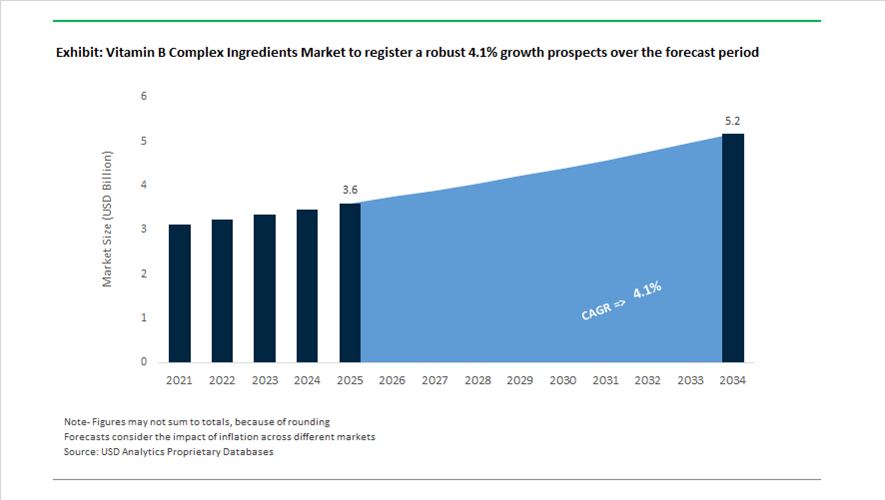
The global Vitamin B Complex Ingredients market is valued at $3.6 billion in 2025 and is projected to reach $5.2 billion by 2034, expanding at a CAGR of 4.1%. The market encompasses thiamine (Vitamin B1), riboflavin (B2), niacinamide (B3), pantothenic acid (B5), pyridoxine (B6), biotin (B7), folic acid (B9), and cyanocobalamin/methylcobalamin (B12) across dietary supplements, fortified foods, pharmaceuticals, animal nutrition, and cosmetic formulations. Growth is being shaped by portfolio divestitures among major producers, tightening and rebalancing supply chains, rising nutricosmetic demand, and innovation in consumer-friendly delivery formats such as gummies and effervescent tablets. Ingredient repositioning toward nerve health, cellular metabolism, and NAD+ pathways is elevating the functional value perception of B-complex formulations.
Industry restructuring between 2025 and early 2026 significantly reshaped competitive dynamics. In February 2025, dsm-firmenich divested its stake in the Feed Enzymes Alliance to Novonesis for €1.5 billion, narrowing its industrial exposure. In September 2025, BASF completed the sale of its Food and Health Performance Ingredients business to Louis Dreyfus Company, allowing BASF to refocus on core vitamin value chains. In January 2026, BASF lifted all remaining force majeure declarations related to prior production disruptions, restoring supply stability across key nutrition ingredients. In February 2026, dsm-firmenich agreed to divest its Animal Nutrition & Health business to CVC Capital Partners for €2.2 billion, including a substantial global B-vitamin portfolio. These moves signal a broader consolidation trend in vitamin ingredient manufacturing, with companies prioritizing high-margin human nutrition and beauty segments over commodity feed-grade supply.
Supply volatility and application diversification defined 2024–2025 market conditions. Throughout 2024 and early 2025, Vitamin B1 and B6 prices nearly doubled due to production restrictions in China, tightening global inventories before new entrants helped stabilize spot prices by late 2025. In contrast, the biotin segment experienced oversupply after a bio-fermentation-focused producer entered the market in late 2025, keeping Vitamin B7 prices under pressure into 2026. In 2025, Lonza optimized its Nansha facility to enhance yields of high-purity niacinamide for clean-label cosmetic and nutricosmetic applications, aligning with premium skincare demand. In August 2025, Bruhin Muller launched a luxury B3 NAD+ skincare collection, reinforcing the migration of niacinamide from commodity supplement to cellular rejuvenation active. Consumer marketing further stimulated demand. In February 2025, Neurobion Forte executed a large-scale awareness campaign in Asia-Pacific centered on nerve health benefits of high-dose B-complex formulations. In 2025, Bayer refreshed its multivitamin branding to emphasize targeted B-complex benefits, while Procter & Gamble’s VÖOST expanded B12 gummy offerings to address pill fatigue.
Trends and Opportunities in the Vitamin B Complex Ingredients Market
Precision Clinical Formulation Driving High-Dose Medical Nutrition Demand
The Vitamin B Complex Ingredients Market is undergoing a structural shift toward precision-driven clinical nutrition, as healthcare providers increasingly prescribe targeted B-vitamin interventions beyond standard Recommended Dietary Allowances. This transition is most visible in hospital-based medical foods and post-surgical nutrition, where high-dose Vitamin B9 and B12 formulations are being used to address metabolic disorders, anemia, and micronutrient malabsorption. In late 2024, U.S. Food and Drug Administration reinforced regulatory clarity around Medical Foods, accelerating innovation in therapeutic B-complex blends designed for disease-specific nutritional management. Clinical evidence now indicates that precision B-complex supplementation can reduce recovery times by up to 15% in patients with pre-existing deficiencies, strengthening physician confidence in these formulations.
At the ingredient level, suppliers are differentiating through bioavailability enhancement. At Vitafoods 2025, dsm-firmenich showcased medical-grade B-vitamin premixes incorporating lipid-based and encapsulated delivery systems that improve absorption efficiency by 30 to 40%. These advances are particularly critical for geriatric populations, where age-related declines in gastrointestinal absorption directly impact therapeutic outcomes. As a result, high-purity, clinically validated Vitamin B ingredients are increasingly positioned as essential components in regulated healthcare nutrition rather than commodity micronutrients.
Systematic Fortification of Plant-Based Proteins to Close the Nutritional Gap
The rapid mainstreaming of flexitarian and vegan diets has elevated Vitamin B Complex ingredients into strategic fortification tools for plant-based food systems. Vitamins B12, B2, and B3 are now considered parity nutrients, ensuring that alternative proteins deliver nutritional equivalence to animal-derived foods. A June 2024 study published in the Food and Nutrition Bulletin confirmed that Vitamin B12 deficiency remains a primary risk in plant-based diets, reinforcing fortification as the only reliable prevention strategy. This scientific consensus contributed to a 37% increase in B-complex inclusion across second-generation alternative proteins launched in 2025, particularly in plant-based meat and dairy analogues.
In parallel, sustainability-driven production innovations are reshaping supply dynamics. In December 2024, researchers at the Technical University of Denmark demonstrated a scalable fermentation method using food-approved lactic acid bacteria to biosynthesize Vitamin B2 directly within fermented foods. This approach enables yogurt and plant-based sourdough producers to naturally elevate riboflavin content by up to 60 times daily human requirements while maintaining clean-label positioning. Such bio-fortification strategies are strengthening demand for fermentation-compatible B-vitamin ingredients and reinforcing the role of Vitamin B Complex components as foundational inputs in climate-friendly protein systems.
Cognitive Health Nutrition Unlocking the Neurological Longevity Segment
A high-margin opportunity is emerging at the intersection of cognitive science and nutritional longevity, where Vitamin B6, B9, and B12 are gaining recognition as evidence-backed neuroprotective agents. Research published by the NIH in October 2025 established a statistically significant correlation between higher mid-life Vitamin B12 status and slower cognitive decline, with participants exhibiting up to 0.09 standard deviation less decline over a decade. These findings are catalyzing the integration of B-complex vitamins into brain health beverages, medical nutrition powders, and aging-focused functional foods.
This trend is converging with the broader nootropic and beauty-from-within movement, as brands combine cognitive performance claims with dermatological benefits. Vitamin B7 is increasingly paired with B6 and B12 to support skin integrity alongside mental clarity, appealing to consumers seeking holistic wellness solutions. Functional food manufacturers report a 38% year-on-year growth in cognitive-support product launches, with Vitamin B Complex ingredients positioned as essential metabolic co-factors that underpin credible neurological health claims.
Energy Metabolism Synergy Reshaping Sports Nutrition and Recovery Products
In sports nutrition, Vitamin B Complex ingredients are being repositioned from supportive micronutrients to central drivers of metabolic efficiency and recovery. Athletes and active consumers are increasingly favoring formulations that optimize cellular energy pathways rather than relying on stimulant-heavy products. This shift gained commercial validation in October 2024 when Keurig Dr Pepper acquired sports nutrition brand GHOST, underscoring market confidence in science-backed energy formulations. Leading brands are now embedding B-complex blends to support mitochondrial energy production without the crash associated with high caffeine intake.
Regulatory alignment further strengthens this opportunity. Under European Food Safety Authority guidelines updated for 2025, approved claims related to reduction of tiredness and fatigue continue to support the use of Vitamins B1, B2, and B5 in hydration supplements and pre-workout powders. As a result, clean-label sports nutrition products fortified with B-complex vitamins are capturing share within the rapidly expanding global performance nutrition market, positioning these ingredients as indispensable enablers of sustained energy and recovery.
Vitamin B Complex Ingredients Market Share and Segmentation Insights
Vitamin Type Market Share: Vitamin B3 Leads with Feed Fortification and Skincare Expansion
Vitamin B3 holds a 24.80% share in the vitamin B complex ingredients market in 2025, driven by its extensive use in animal feed additives, dietary supplements, and food fortification. Its critical role in energy metabolism and high inclusion rates in swine and poultry nutrition support large-scale consumption. Other vitamins such as B5, B12, B2, B6, B9, B1, and B7 contribute across diverse nutritional and pharmaceutical applications. A key market trend is the rising demand for niacinamide in personal care, where its skin-brightening, anti-aging, and barrier-enhancing properties are driving growth in cosmetic and pharmaceutical grade vitamin B3 across premium skincare formulations.
Application Market Share: Animal Feed Additives Lead with Global Livestock Production Demand
Animal feed additives account for 42.80% of the vitamin B complex ingredients market in 2025, supported by the essential role of B vitamins in animal growth, metabolism, and health. These micronutrients are widely used in poultry, swine, cattle, and aquaculture feeds to improve productivity and prevent deficiencies. Dietary supplements, functional foods and beverages, clinical nutrition, and cell culture media represent additional demand segments. A key growth driver is the shift toward antibiotic-free animal production, where optimized vitamin supplementation supports immune function and performance, increasing reliance on vitamin B complex ingredients in modern livestock nutrition systems.
Vitamin B Complex Ingredients Market Competitive Landscape
The Vitamin B Complex Ingredients market in 2026 is defined by solution-ready premix architectures, carbon footprint reduction, and circular feedstock integration, with leading players focusing on high-purity synthesis, traceable supply chains, and ESG-aligned vitamin production for food, pharma, and nutraceutical applications.
dsm-firmenich Expands High-Precision Premix Infrastructure and Traceable Vitamin Supply
dsm-firmenich is strengthening its leadership in the Vitamin B Complex Ingredients market through advanced premix infrastructure and vertically integrated supply chains. The $10 million upgrade of its Schenectady facility introduces 35 high-precision blenders and GMP-compliant zoning for pharmaceutical-grade vitamin premixes. Its European vitamin production strategy is capturing a supply security premium amid global logistics disruptions, particularly for B2, B6, and B12. The company is targeting 2–4% organic growth with ~20% EBITDA margins, supported by a €540 million share repurchase plan. Expansion into functional pet nutrition with fully traceable premix systems reflects cross-segment innovation. Its emphasis on transparency, traceability, and localized production strengthens its premium positioning.
Lonza Advances Green Niacin Synthesis and Strategic CDMO Realignment
Lonza is a key player in the Vitamin B Complex Ingredients market, particularly in high-purity Vitamin B3 (Niacin) production and delivery systems. The company reported CHF 6.5 billion in FY2025 revenue, with growth driven by premium nutraceutical demand. Its green catalytic process achieves 96% conversion efficiency and 91% yield while reducing waste and environmental impact. Lonza has already reduced greenhouse gas and waste intensity by over 50%, surpassing sustainability targets ahead of schedule. The planned carve-out of its Capsules & Health Ingredients division signals a strategic pivot toward high-margin CDMO operations. This transition could reshape global niacin supply dynamics while maintaining its technological leadership.
Jubilant Ingrevia Strengthens Bio-Based Vitamin B3 Supply with Integrated Molasses Value Chain
Jubilant Ingrevia is reinforcing its position in the Vitamin B Complex Ingredients market through bio-based feedstock integration and large-scale Vitamin B3 production. Its new human-grade niacin facility is ramping up capacity, targeting INR 2 billion in revenue with EBITDA margins exceeding 20% by FY2028. The use of bio-ethanol derived from sugarcane molasses reduces carbon emissions by approximately 4.3 tonnes per tonne of niacinamide, aligning with green supply chain mandates. As the global No. 2 player in Vitamin B3, its fully integrated production chain ensures cost stability and consistent quality. Strategic leadership restructuring and increased R&D investment are driving its transition toward solution-based offerings. This bio-based manufacturing model enhances its competitiveness in ESG-focused markets.
BASF SE Optimizes Vitamin B Production with Verbund Integration and Reduced Carbon Footprint Solutions
BASF SE is maintaining its influence in the Vitamin B Complex Ingredients market through large-scale integrated production and sustainability-driven portfolio optimization. The successful restart of vitamin production lines has stabilized supply for premix manufacturers. Its Zhanjiang Verbund site provides a cost-efficient base for producing nutritional intermediates in Asia-Pacific. BASF’s reduced Product Carbon Footprint offerings deliver 10–15% emissions reduction, supporting customer decarbonization goals. The divestment of certain downstream nutrition businesses allows greater focus on high-volume vitamin synthesis such as riboflavin. This integration of scale, cost efficiency, and sustainability reinforces BASF’s position in global vitamin supply chains.
Zhejiang NHU Advances Fermentation-Based Vitamin Production with Scalable Global Supply
Zhejiang NHU Co., Ltd. is expanding its presence in the Vitamin B Complex Ingredients market through green biomanufacturing and diversified vitamin production. Its fermentation-based process for Vitamin B5 reduces energy consumption and environmental impact, targeting premium nutrition segments. Recognition for innovation and inclusion in global enterprise rankings reflects its rapid expansion and R&D investment. NHU’s ability to bundle Vitamin B complex ingredients with fat-soluble vitamins provides a one-stop solution for premix manufacturers. Its scale and operational agility enable competitive pricing and global market penetration. This combination of fermentation technology and portfolio breadth strengthens its role as a major global supplier.
China Vitamin B Complex Ingredients Market Shaped by Export Controls and Green Manufacturing Transition
China remains the structural anchor of the global Vitamin B complex ingredients supply chain, with policy actions in 2025 materially influencing availability, pricing discipline, and production methods. As the world’s largest exporter of B vitamins, China implemented new dual-use item export controls in April 2025, tightening oversight on chemical intermediates essential for Vitamin B12 synthesis. This move has increased lead-time uncertainty for global buyers and prompted normalization of safety stock levels amid volatile freight conditions. In response, Chinese manufacturers prioritized cargo movement over inventory accumulation. This strategy contributed to a marginal local price correction for Vitamin B12 in May 2025, as suppliers opted to clear shipments rather than risk congestion during tariff-related disruptions.
Capacity expansion and environmental compliance are progressing in parallel. Lonza confirmed full-scale ramp-up of its Nansha facility in 2025, expanding Vitamin B3 nicotinate capacity by over 40% to serve fast-growing cosmetics and food applications. At the same time, major B-vitamin clusters in Zhejiang and Anhui are transitioning toward enzymatic production pathways under Green Manufacturing directives. These process shifts have reduced wastewater toxicity by an estimated 30% compared to 2023 benchmarks. Domestic demand remains structurally strong, as China’s compound feed output exceeds 200 million tons annually, sustaining high-volume consumption of Vitamin B3 and Vitamin B12 for livestock nutrition and productivity enhancement.
Switzerland Vitamin B Complex Ingredients Market Focused on Precision Fermentation and Portfolio Optimization
Switzerland’s Vitamin B complex ingredients market is increasingly defined by strategic repositioning toward high-margin human health and specialty nutrition segments. In its Q1 2025 update, DSM-Firmenich announced a Vitamin Transformation Program aimed at exiting low-margin bulk animal nutrition and reallocating resources toward dietary supplements and clinical nutrition. This shift reflects broader European demand for differentiated, science-backed micronutrient solutions rather than commodity-grade inputs.
Technology leadership underpins this transition. Swiss biotech clusters have achieved notable precision fermentation milestones in Vitamin B12 biosynthesis by applying CRISPR-Cas9 metabolic engineering. Reported gains include a 15% improvement in bioreactor efficiency in late 2025, enhancing yield consistency and cost control. Mergers and acquisitions are reinforcing formulation sophistication. Following the acquisition of Glycom, Swiss players are integrating Human Milk Oligosaccharides with Vitamin B complex systems to address early life nutrition and immunity-focused products. This convergence positions Switzerland as a formulation and intellectual property hub rather than a volume exporter.
India Vitamin B Complex Ingredients Market Driven by Fortification Policy and API Localization
India’s Vitamin B complex ingredients market is expanding rapidly due to mandatory food fortification and pharmaceutical-grade manufacturing initiatives. The Government of India extended the Fortified Rice Scheme through 2028 with a ₹17,082 crore allocation, mandating the inclusion of Vitamin B12 and folic acid in rice distributed under PM POSHAN and public distribution programs. This policy has created stable, institutional-scale demand for high-volume B-complex ingredients with consistent quality specifications.
Pharmaceutical and API-grade production is gaining momentum. Domestic manufacturers such as Camlin Fine Sciences reported a strategic pivot in 2025 toward higher-purity Vitamin B intermediates, leveraging the global China-plus-one sourcing strategy adopted by multinational buyers. Public health programs further reinforce demand. Under Anemia Mukt Bharat, the Ministry of Health allocated ₹805.91 crore in FY 2024–2025 for iron and folic acid supplementation, significantly increasing procurement volumes of Vitamin B9 inputs. Collectively, policy certainty and localization efforts are positioning India as both a consumption and manufacturing growth center for Vitamin B complex ingredients.
United States Vitamin B Complex Ingredients Market Influenced by Regulatory Clarity and Biotech Innovation
The United States Vitamin B complex ingredients market is shaped by regulatory signaling and advanced biotechnology investment. In 2025, the U.S. Food and Drug Administration clarified that certain Vitamin B derivatives, including nicotinamide mononucleotide, may remain on the market while undergoing review. This guidance stabilized the healthy aging and NAD-plus booster segment, allowing formulators to maintain continuity in product portfolios while awaiting final determinations.
Biotechnology investment is a key differentiator. U.S.-based life science companies such as Bio-Techne introduced AI-engineered designer proteins in early 2025 to optimize cell culture media formulations. Vitamin B complex components play a central role in these systems by supporting cellular metabolism and productivity. Trade and logistics dynamics provided temporary relief. In early 2025, U.S. import prices for Vitamin B12 declined due to excess shipping capacity on trans-Pacific routes, offering buyers a short-term procurement window before freight conditions normalized.
European Union Vitamin B Complex Ingredients Market Reshaped by EFSA Intake Revisions and Sustainable Chemistry
The European Union Vitamin B complex ingredients market is undergoing reformulation-driven change following updated safety guidance. In 2025, the European Food Safety Authority reduced the tolerable upper intake level for Vitamin B6 from 25 mg per day to 12 mg per day due to concerns over peripheral neuropathy. This decision triggered widespread reformulation of high-dose supplements across Germany and France, shifting demand toward lower-dose, bioavailable, and combination-based Vitamin B products.
Sustainability considerations are increasingly influencing sourcing strategies. Borregaard reported rising EU demand for wood-based intermediates used in high-purity Vitamin B synthesis. These lignin-derived inputs support natural-identical positioning and lower environmental impact, aligning with European regulatory and consumer expectations. As a result, the EU market is evolving toward precision dosing, sustainable chemistry, and compliance-led innovation rather than volume expansion.
Summary of Country-Level Vitamin B Complex Ingredients Market Dynamics
Vitamin B Complex Ingredients Market County Level Snapshot
Country / Region
Primary Policy or Strategy Driver
Key Application Focus
Strategic Market Role
China
Export controls and green manufacturing
Feed additives, food, cosmetics
Global supply anchor with tightening controls
Switzerland
Portfolio optimization and precision fermentation
Human health, early life nutrition
High-margin innovation and IP hub
India
Fortification mandates and API localization
Public nutrition, pharmaceuticals
Rapidly scaling production and consumption base
United States
FDA guidance and biotech investment
Healthy aging, cell culture media
Innovation-led demand market
European Union
EFSA intake revisions and sustainability
Dietary supplements, reformulated products
Regulation-driven reformulation leader
Vitamin B Complex Ingredients Market Report Scope
Vitamin B Complex Ingredients Market
Parameter
Details
Market Size (2025)
$3.6 Billion
Market Size (2034)
$5.2 Billion
Market Growth Rate
4.1%
Segments
By Vitamin Type (Vitamin B1, Vitamin B2, Vitamin B3, Vitamin B5, Vitamin B6, Vitamin B7, Vitamin B9, Vitamin B12), By Source (Synthetic, Natural, Fermentation-Based), By Grade (Pharmaceutical Grade, Food and Beverage Grade, Feed Grade, Cosmetic and Personal Care Grade), By Application (Dietary Supplements and Nutricosmetics, Functional Foods and Beverages, Animal Feed Additives, Clinical Nutrition and Infant Formula, Cell Culture Media)
Study Period
2019- 2025 and 2026-2034
Units
Revenue (USD)
Qualitative Analysis
Porter’s Five Forces, SWOT Profile, Market Share, Scenario Forecasts, Market Ecosystem, Company Ranking, Market Dynamics, Industry Benchmarking
US, Canada, Mexico, Germany, France, Spain, Italy, UK, Russia, China, India, Japan, South Korea, Australia, South East Asia, Brazil, Argentina, Middle East, Africa
Vitamin B Complex Ingredients Market Segmentation
By Vitamin Type
Vitamin B1
Vitamin B2
Vitamin B3
Vitamin B5
Vitamin B6
Vitamin B7
Vitamin B9
Vitamin B12
By Source
Synthetic
Natural
Fermentation-Based
By Grade
Pharmaceutical Grade
Food and Beverage Grade
Feed Grade
Cosmetic and Personal Care Grade
By Application
Dietary Supplements and Nutricosmetics
Functional Foods and Beverages
Animal Feed Additives
Clinical Nutrition and Infant Formula
Cell Culture Media
By Region
North America (United States, Canada, Mexico)
Europe (Germany, France, United Kingdom, Spain, Italy, Rest of Europe)
Asia Pacific (China, India, Japan, South Korea, Australia, Rest of APAC)
South and Central America (Brazil, Argentina, Rest of SCA)
Middle East and Africa (Saudi Arabia, UAE, South Africa, Rest of Middle East, Rest of Africa)
Top Companies in the Vitamin B Complex Ingredients Market
DSM-Firmenich
Lonza Group AG
BASF SE
Adisseo
Jiaxing Zhonghua Chemical Co. Ltd.
Brother Enterprises Holding Co. Ltd.
Zhejiang NHU Co. Ltd.
Northeast Pharmaceutical Group
Jubilant Life Sciences Limited
Merck KGaA
Thermo Fisher Scientific Inc.
Bio-Techne Corporation
Hebei Shengxue Dacheng Pharmaceutical
Hubei Guangji Pharmaceutical
*- List not Exhaustive
Table of Contents: Vitamin B Complex Ingredients Market
2. Vitamin B Complex Ingredients Market Landscape & Outlook (2025–2034)
2.1. Introduction to Vitamin B Complex Ingredients Market
2.2. Market Valuation and Growth Projections (2025–2034)
2.3. Supply Chain Realignment and Industry Restructuring
2.4. Nutricosmetics, Delivery Format Innovation, and Functional Positioning
2.5. Pricing Volatility, Production Shifts, and Application Diversification
3. Innovations Reshaping the Vitamin B Complex Ingredients Market
3.1. Trend: Precision Clinical Formulation and Medical Nutrition Demand
3.2. Trend: Fortification of Plant-Based Proteins and Bio-Fermentation Innovation
3.3. Opportunity: Cognitive Health and Neurological Longevity Nutrition
3.4. Opportunity: Energy Metabolism and Sports Nutrition Applications
4. Competitive Landscape and Strategic Initiatives
4.1. Mergers and Acquisitions
4.2. R&D and Material Innovation
4.3. Sustainability and ESG Strategies
4.4. Market Expansion and Regional Focus
5. Market Share and Segmentation Insights: Vitamin B Complex Ingredients Market
5.1. By Vitamin Type
5.1.1. Vitamin B1
5.1.2. Vitamin B2
5.1.3. Vitamin B3
5.1.4. Vitamin B5
5.1.5. Vitamin B6
5.1.6. Vitamin B7
5.1.7. Vitamin B9
5.1.8. Vitamin B12
5.2. By Source
5.2.1. Synthetic
5.2.2. Natural
5.2.3. Fermentation-Based
5.3. By Grade
5.3.1. Pharmaceutical Grade
5.3.2. Food and Beverage Grade
5.3.3. Feed Grade
5.3.4. Cosmetic and Personal Care Grade
5.4. By Application
5.4.1. Dietary Supplements and Nutricosmetics
5.4.2. Functional Foods and Beverages
5.4.3. Animal Feed Additives
5.4.4. Clinical Nutrition and Infant Formula
5.4.5. Cell Culture Media
5.5. By Region
5.5.1. North America
5.5.2. Europe
5.5.3. Asia Pacific
5.5.4. South and Central America
5.5.5. Middle East and Africa
6. Country Analysis and Outlook of Vitamin B Complex Ingredients Market
6.1. United States
6.2. Canada
6.3. Mexico
6.4. Germany
6.5. France
6.6. Spain
6.7. Italy
6.8. UK
6.9. Russia
6.10. China
6.11. India
6.12. Japan
6.13. South Korea
6.14. Australia
6.15. South East Asia
6.16. Brazil
6.17. Argentina
6.18. Middle East
6.19. Africa
7. Vitamin B Complex Ingredients Market Size Outlook by Region (2025-2034)
7.1. North America Vitamin B Complex Ingredients Market Size Outlook to 2034
7.1.1. By Vitamin Type
7.1.2. By Source
7.1.3. By Grade
7.1.4. By Application
7.1.5. By Region
7.2. Europe Vitamin B Complex Ingredients Market Size Outlook to 2034
7.2.1. By Vitamin Type
7.2.2. By Source
7.2.3. By Grade
7.2.4. By Application
7.2.5. By Region
7.3. Asia Pacific Vitamin B Complex Ingredients Market Size Outlook to 2034
7.3.1. By Vitamin Type
7.3.2. By Source
7.3.3. By Grade
7.3.4. By Application
7.3.5. By Region
7.4. South America Vitamin B Complex Ingredients Market Size Outlook to 2034
7.4.1. By Vitamin Type
7.4.2. By Source
7.4.3. By Grade
7.4.4. By Application
7.4.5. By Region
7.5. Middle East and Africa Vitamin B Complex Ingredients Market Size Outlook to 2034
7.5.1. By Vitamin Type
7.5.2. By Source
7.5.3. By Grade
7.5.4. By Application
7.5.5. By Region
8. Company Profiles: Leading Players in the Vitamin B Complex Ingredients Market
8.1. DSM-Firmenich
8.2. Lonza Group AG
8.3. BASF SE
8.4. Adisseo
8.5. Jiaxing Zhonghua Chemical Co. Ltd.
8.6. Brother Enterprises Holding Co. Ltd.
8.7. Zhejiang NHU Co. Ltd.
8.8. Northeast Pharmaceutical Group
8.9. Jubilant Life Sciences Limited
8.10. Merck KGaA
8.11. Thermo Fisher Scientific Inc.
8.12. Bio-Techne Corporation
8.13. Hebei Shengxue Dacheng Pharmaceutical
8.14. Hubei Guangji Pharmaceutical
9. Methodology
9.1. Research Scope
9.2. Market Research Approach
9.3. Market Sizing and Forecasting Model
9.4. Research Coverage
9.5. Data Horizon
9.6. Deliverables
10. Appendix
10.1. Acronyms and Abbreviations
10.2. List of Tables
10.3. List of Figures
Vitamin B Complex Ingredients Market Segmentation
By Vitamin Type
Vitamin B1
Vitamin B2
Vitamin B3
Vitamin B5
Vitamin B6
Vitamin B7
Vitamin B9
Vitamin B12
By Source
Synthetic
Natural
Fermentation-Based
By Grade
Pharmaceutical Grade
Food and Beverage Grade
Feed Grade
Cosmetic and Personal Care Grade
By Application
Dietary Supplements and Nutricosmetics
Functional Foods and Beverages
Animal Feed Additives
Clinical Nutrition and Infant Formula
Cell Culture Media
By Region
North America (United States, Canada, Mexico)
Europe (Germany, France, United Kingdom, Spain, Italy, Rest of Europe)
Asia Pacific (China, India, Japan, South Korea, Australia, Rest of APAC)
South and Central America (Brazil, Argentina, Rest of SCA)
Middle East and Africa (Saudi Arabia, UAE, South Africa, Rest of Middle East, Rest of Africa)
The vitamin B complex ingredients market is valued at $3.6 billion in 2025 and is projected to reach $5.2 billion by 2034, growing at a CAGR of 4.1%. Growth is supported by rising demand across dietary supplements, fortified foods, and pharmaceuticals. Increasing focus on metabolic health and NAD+ pathways is enhancing value perception.
The market is shifting toward high-value applications such as nutricosmetics, clinical nutrition, and personalized supplementation. Innovation in delivery formats like gummies and effervescent tablets is improving consumer compliance. Additionally, supply chain restructuring and price volatility in B1, B6, and biotin are influencing procurement strategies.
Vitamin B3 leads with a 24.80% share due to its widespread use in feed, supplements, and skincare. Animal feed dominates applications with 42.80% share, driven by global livestock production. Meanwhile, cosmetic-grade niacinamide and clinical nutrition formulations are emerging as high-margin growth segments.
China remains the global supply hub but is tightening export controls and shifting toward green manufacturing. India is emerging rapidly due to fortification mandates and API localization. The United States leads innovation in biotech applications, while Europe is driving reformulation under EFSA regulations.
Major players include DSM-Firmenich, BASF SE, Lonza Group AG, Zhejiang NHU, and Jubilant Ingrevia. These companies are focusing on high-purity production, fermentation technologies, and sustainable supply chains. Strategic divestitures and portfolio optimization are reshaping competitive positioning in the global market.
More Nutraceutical and Functional Ingredients Reports