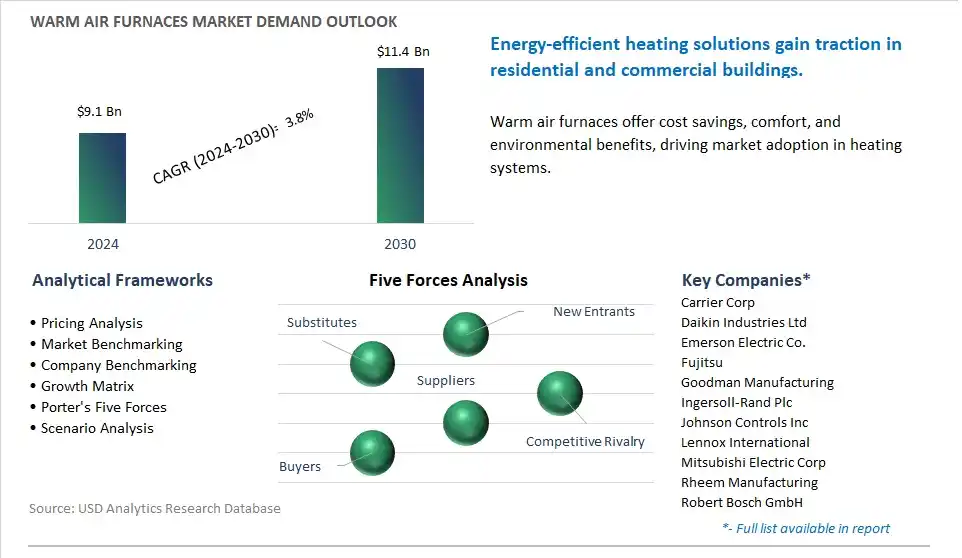
The global Warm Air Furnaces Market is poised to register a 3.8% CAGR from $9.1 Billion in 2024 to $11.4 Billion in 2030.
The global Warm Air Furnaces Market Study analyzes and forecasts the market size across 6 regions and 24 countries for diverse segments -By Type (Gas Warm Air Furnaces, Oil Warm Air Furnaces), By Application (Residential, Industrial, Commercial).
An Introduction to Global Warm Air Furnaces Market in 2024
The warm air furnaces market is undergoing significant evolution driven by key trends shaping the future of HVAC technology, energy efficiency, and indoor comfort. One notable trend is the increasing demand for high-efficiency furnaces that can reduce energy consumption, lower utility bills, and minimize environmental impact while providing consistent heating performance and indoor comfort. Manufacturers are developing advanced combustion technologies, such as condensing furnaces and modulating gas valves, to maximize fuel efficiency and optimize heat output based on real-time heating demand, ensuring precise temperature control and energy savings for homeowners and commercial building owners. Additionally, advancements in furnace design, materials, and insulation are driving innovations in heat exchanger technology, airflow management, and noise reduction, with manufacturers offering quieter, more compact furnace units that can be installed in tight spaces while delivering improved heating performance and air quality. Furthermore, the trend towards smart home automation and connectivity is driving the integration of Wi-Fi-enabled thermostats, mobile apps, and remote monitoring systems into warm air furnaces, enabling users to control heating settings, monitor energy usage, and receive maintenance alerts from their smartphones or tablets, enhancing convenience, comfort, and peace of mind for homeowners and property managers. Moreover, collaborations between furnace manufacturers, energy utilities, and government agencies are driving innovation and market growth by promoting energy efficiency incentives, rebates, and regulatory standards that encourage the adoption of high-efficiency warm air furnaces, ensuring continued advancement and adoption of energy-efficient heating solutions as essential components of sustainable building practices and climate action initiatives.
Warm Air Furnaces Market Competitive Landscape
The market report analyses the leading companies in the industry including Carrier Corp, Daikin Industries Ltd, Emerson Electric Co., Fujitsu, Goodman Manufacturing, Ingersoll-Rand Plc, Johnson Controls Inc, Lennox International, Mitsubishi Electric Corp, Rheem Manufacturing, Robert Bosch GmbH, Viessmann Group.
Warm Air Furnaces Market Dynamics
Warm Air Furnaces Market Trend: Increasing Adoption of Energy-Efficient and Smart Heating Systems
A prominent trend in the warm air furnaces market is the increasing adoption of energy-efficient and smart heating systems. As consumers and businesses seek to reduce energy consumption, lower utility bills, and minimize environmental impact, there is a growing demand for warm air furnaces that offer high efficiency ratings and advanced control features. Energy-efficient furnaces utilize technologies such as variable-speed blowers, modulating gas valves, and electronic ignition systems to optimize heating performance and reduce energy waste. Additionally, smart heating systems equipped with Wi-Fi connectivity, programmable thermostats, and remote monitoring capabilities allow users to control and monitor their heating systems remotely, optimizing comfort and energy usage. This trend is driven by regulatory incentives, consumer awareness of energy conservation, and the desire for greater convenience and control over home heating, driving the adoption of energy-efficient and smart warm air furnaces in residential and commercial buildings.
Warm Air Furnaces Market Driver: Replacement Demand and Renovation Activities in Residential and Commercial Sectors
The primary driver for the warm air furnaces market is replacement demand and renovation activities in residential and commercial sectors. As existing heating systems reach the end of their lifecycle or become obsolete, homeowners, property managers, and businesses are investing in the replacement and upgrade of their heating equipment. Replacement demand is fueled by factors such as equipment aging, technological obsolescence, and changes in energy efficiency standards, driving consumers to seek modern and efficient heating solutions. Additionally, renovation activities in residential and commercial buildings, including remodeling projects, retrofitting initiatives, and building expansions, create opportunities for the installation of new warm air furnaces that meet current energy codes and efficiency requirements. The need to improve comfort, reliability, and energy efficiency in indoor environments stimulates demand for warm air furnaces, supporting market growth and innovation in heating technologies and solutions.
Warm Air Furnaces Market Opportunity: Expansion into Renewable Energy and Hybrid Heating Systems
An opportunity for market expansion in the warm air furnaces segment lies in the expansion into renewable energy and hybrid heating systems. With increasing emphasis on sustainability, decarbonization, and renewable energy sources, there is a growing interest in integrating renewable energy technologies such as solar thermal, geothermal, and biomass heating with traditional heating systems. Hybrid heating systems combine warm air furnaces with renewable energy sources to provide efficient and environmentally friendly heating solutions that reduce reliance on fossil fuels and lower greenhouse gas emissions. By expanding their product offerings to include hybrid heating systems and renewable energy integration options, warm air furnace manufacturers can cater to the evolving needs of environmentally conscious consumers, businesses, and governments. Collaboration with renewable energy providers, HVAC contractors, and energy consultants can facilitate the development and adoption of hybrid heating solutions that leverage the benefits of both conventional and renewable heating technologies, unlocking new opportunities for growth in the warm air furnaces market.
Warm Air Furnaces Market Share Analysis: Gas Warm Air Furnaces generated the highest revenue in 2024
The largest segment in the Warm Air Furnaces Market is the Gas Warm Air Furnaces category. natural gas is a widely available and relatively inexpensive fuel source, making gas warm air furnaces a popular choice for residential and commercial heating systems. Additionally, gas furnaces are known for their energy efficiency and cost-effectiveness compared to oil furnaces, as natural gas burns cleaner and more efficiently, resulting in lower operating costs and reduced environmental impact. Furthermore, gas warm air furnaces are favored for their convenience and ease of use, as they require less maintenance and produce heat quickly and consistently. As a result of these advantages, the Gas Warm Air Furnaces segment maintains its position as the largest in the Warm Air Furnaces Market due to its widespread adoption and popularity among homeowners, businesses, and contractors.
Warm Air Furnaces Market Share Analysis: Residential segment is poised to register the fastest growth rate (CAGR) over the forecast period to 2030
The fastest-growing segment in the Warm Air Furnaces Market is the Residential application category. There is increasing demand for energy-efficient and environmentally friendly heating solutions in residential buildings, driven by factors such as rising energy costs, growing awareness of climate change, and government incentives for energy-efficient home upgrades. Accordingly, homeowners are increasingly investing in high-efficiency warm air furnaces to reduce their energy consumption and lower their utility bills. Additionally, the housing market is experiencing steady growth, with new construction and renovation projects driving the demand for heating systems in residential properties. Further, advancements in warm air furnace technology, such as condensing furnaces and modulating gas valves, are enhancing energy efficiency and comfort levels, further driving the adoption of residential warm air furnaces. Furthermore, the COVID-19 pandemic has led to changes in lifestyle and work patterns, with more people spending time at home and prioritizing indoor comfort and air quality. This trend has increased the demand for efficient heating systems that can provide consistent warmth and comfort throughout residential spaces. Over the forecast period, the Residential application segment is experiencing rapid growth in the Warm Air Furnaces Market due to increasing demand for energy-efficient heating solutions, growth in the housing market, and changing consumer preferences towards home comfort and sustainability.
Warm Air Furnaces Market Report Segmentation
By Type
Gas Warm Air Furnaces
Oil Warm Air Furnaces
By Application
Residential
Industrial
Commercial
Regions Included
North America (US, Canada, Mexico)
Europe (Germany, UK, France, Spain, Italy, Russia, Rest of Europe)
Asia Pacific (China, India, Japan, South Korea, Australia, South East Asia, Rest of Asia)
South America (Brazil, Argentina, Rest of South America)
Middle East and Africa (Saudi Arabia, UAE, Rest of Middle East, South Africa, Egypt, Rest of Africa)
Warm Air Furnaces Companies Profiled in the Market Study
Carrier Corp
Daikin Industries Ltd
Emerson Electric Co.
Fujitsu
Goodman Manufacturing
Ingersoll-Rand Plc
Johnson Controls Inc
Lennox International
Mitsubishi Electric Corp
Rheem Manufacturing
Robert Bosch GmbH
Viessmann Group
*- List Not Exhaustive
TABLE OF CONTENTS
1 Introduction to 2024 Warm Air Furnaces Market
1.1 Market Overview
1.2 Quick Facts
1.3 Scope/Objective of the Study
1.4 Market Definition
1.5 Countries and Regions Covered
1.6 Units, Currency, and Conversions
1.7 Industry Value Chain
2 Research Methodology
2.1 Market Size Estimation
2.2 Sources and Research Methodology
2.3 Data Triangulation
2.4 Assumptions and Limitations
3 Executive Summary
3.1 Global Warm Air Furnaces Market Size Outlook, $ Million, 2021 to 2030
3.2 Warm Air Furnaces Market Outlook by Type, $ Million, 2021 to 2030
3.3 Warm Air Furnaces Market Outlook by Product, $ Million, 2021 to 2030
3.4 Warm Air Furnaces Market Outlook by Application, $ Million, 2021 to 2030
3.5 Warm Air Furnaces Market Outlook by Key Countries, $ Million, 2021 to 2030
4 Market Dynamics
4.1 Key Driving Forces of Warm Air Furnaces Industry
4.2 Key Market Trends in Warm Air Furnaces Industry
4.3 Potential Opportunities in Warm Air Furnaces Industry
4.4 Key Challenges in Warm Air Furnaces Industry
5 Market Factor Analysis
5.1 Value Chain Analysis
5.2 Competitive Landscape
5.2.1 Global Warm Air Furnaces Market Share by Company (%), 2023
5.2.2 Product Offerings by Company
5.3 Porter’s Five Forces Analysis
5.4 Pricing Analysis and Outlook
6 Growth Outlook Across Scenarios
6.1 Growth Analysis-Case Scenario Definitions
6.2 Low Growth Scenario Forecasts
6.3 Reference Growth Scenario Forecasts
6.4 High Growth Scenario Forecasts
7 Global Warm Air Furnaces Market Outlook by Segments
7.1 Warm Air Furnaces Market Outlook by Segments, $ Million, 2021- 2030
By Type
Gas Warm Air Furnaces
Oil Warm Air Furnaces
By Application
Residential
Industrial
Commercial
8 North America Warm Air Furnaces Market Analysis and Outlook To 2030
8.1 Introduction to North America Warm Air Furnaces Markets in 2024
8.2 North America Warm Air Furnaces Market Size Outlook by Country, 2021-2030
8.2.1 United States
8.2.2 Canada
8.2.3 Mexico
8.3 North America Warm Air Furnaces Market size Outlook by Segments, 2021-2030
By Type
Gas Warm Air Furnaces
Oil Warm Air Furnaces
By Application
Residential
Industrial
Commercial
9 Europe Warm Air Furnaces Market Analysis and Outlook To 2030
9.1 Introduction to Europe Warm Air Furnaces Markets in 2024
9.2 Europe Warm Air Furnaces Market Size Outlook by Country, 2021-2030
9.2.1 Germany
9.2.2 France
9.2.3 Spain
9.2.4 United Kingdom
9.2.4 Italy
9.2.5 Russia
9.2.6 Norway
9.2.7 Rest of Europe
9.3 Europe Warm Air Furnaces Market Size Outlook by Segments, 2021-2030
By Type
Gas Warm Air Furnaces
Oil Warm Air Furnaces
By Application
Residential
Industrial
Commercial
10 Asia Pacific Warm Air Furnaces Market Analysis and Outlook To 2030
10.1 Introduction to Asia Pacific Warm Air Furnaces Markets in 2024
10.2 Asia Pacific Warm Air Furnaces Market Size Outlook by Country, 2021-2030
10.2.1 China
10.2.2 India
10.2.3 Japan
10.2.4 South Korea
10.2.5 Indonesia
10.2.6 Malaysia
10.2.7 Australia
10.2.8 Rest of Asia Pacific
10.3 Asia Pacific Warm Air Furnaces Market size Outlook by Segments, 2021-2030
By Type
Gas Warm Air Furnaces
Oil Warm Air Furnaces
By Application
Residential
Industrial
Commercial
11 South America Warm Air Furnaces Market Analysis and Outlook To 2030
11.1 Introduction to South America Warm Air Furnaces Markets in 2024
11.2 South America Warm Air Furnaces Market Size Outlook by Country, 2021-2030
11.2.1 Brazil
11.2.2 Argentina
11.2.3 Rest of South America
11.3 South America Warm Air Furnaces Market size Outlook by Segments, 2021-2030
By Type
Gas Warm Air Furnaces
Oil Warm Air Furnaces
By Application
Residential
Industrial
Commercial
12 Middle East and Africa Warm Air Furnaces Market Analysis and Outlook To 2030
12.1 Introduction to Middle East and Africa Warm Air Furnaces Markets in 2024
12.2 Middle East and Africa Warm Air Furnaces Market Size Outlook by Country, 2021-2030
12.2.1 Saudi Arabia
12.2.2 UAE
12.2.3 Oman
12.2.4 Rest of Middle East
12.2.5 Egypt
12.2.6 Nigeria
12.2.7 South Africa
12.2.8 Rest of Africa
12.3 Middle East and Africa Warm Air Furnaces Market size Outlook by Segments, 2021-2030
By Type
Gas Warm Air Furnaces
Oil Warm Air Furnaces
By Application
Residential
Industrial
Commercial
13 Company Profiles
13.1 Company Snapshot
13.2 SWOT Profiles
13.3 Products and Services
13.4 Recent Developments
13.5 Financial Profile
Carrier Corp
Daikin Industries Ltd
Emerson Electric Co.
Fujitsu
Goodman Manufacturing
Ingersoll-Rand Plc
Johnson Controls Inc
Lennox International
Mitsubishi Electric Corp
Rheem Manufacturing
Robert Bosch GmbH
Viessmann Group
14 Appendix
14.1 Customization Offerings
14.2 Subscription Services
14.3 Related Reports
14.4 Publisher Expertise
By Type
Gas Warm Air Furnaces
Oil Warm Air Furnaces
By Application
Residential
Industrial
Commercial
Countries Analyzed
North America (US, Canada, Mexico)
Europe (Germany, UK, France, Spain, Italy, Russia, Rest of Europe)
Asia Pacific (China, India, Japan, South Korea, Australia, South East Asia, Rest of Asia)
South America (Brazil, Argentina, Rest of South America)
Middle East and Africa (Saudi Arabia, UAE, Rest of Middle East, South Africa, Egypt, Rest of Africa)
