Washable Markers Market Overview 2025–2034: $984.7 Million to $1,413.7 Million at 4.1% CAGR Driven by AI-Enhanced Ink Science, Sustainability Mandates, and Digital-Hybrid Learning
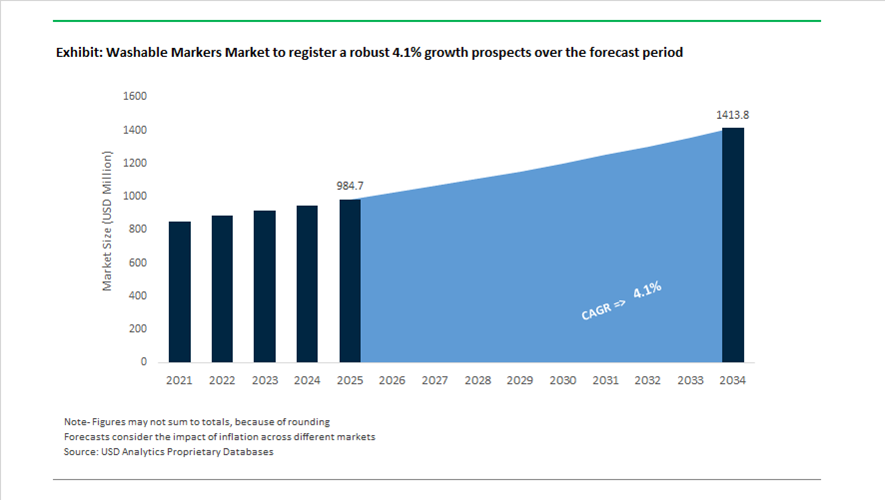
The global Washable Markers market is valued at $984.7 million in 2025 and is projected to reach $1,413.7 million by 2034, expanding at a CAGR of 4.1%. The category includes water-based marker inks, ultra-clean washable markers, non-toxic school markers, refillable art markers, dual-tip brush markers, and hybrid digital-analog systems targeted at children, students, educators, and adult hobbyists. Market expansion is supported by back-to-school demand cycles, growth in creative learning tools, tightening school procurement standards for non-toxic and ESG-compliant stationery, and crossover appeal into adult coloring and therapeutic art segments. Manufacturers are investing in advanced pigment dispersion systems, faster-drying washable inks, and enhanced tip durability to differentiate in a price-sensitive yet brand-driven category.
Innovation and vertical integration strengthened competitive positioning between 2024 and 2026. In February 2024, Crayola expanded its brand ecosystem through the launch of Crayola Crew in partnership with Moonbug Entertainment, reinforcing consumer engagement and supporting core Ultra-Clean Washable Marker sales. In November 2024, Faber-Castell acquired Robert E. Huber GmbH to vertically integrate precision mechanical component manufacturing, enhancing tip engineering quality across washable and dual-tip marker lines. In January 2025, Faber-Castell launched a refillable, non-toxic washable marker range utilizing recycled plastic casings to meet ESG-focused school procurement criteria in Europe and North America. In March 2025, STAEDTLER introduced Digital Hybrid markers combining traditional washable ink with real-time digitization capabilities, enabling classroom sketches to be transferred directly to digital platforms. In July 2025, Newell Brands launched InnoGEN, an AI-powered product development engine designed to accelerate formulation of advanced “super-washable” inks and optimize marker tip prototyping for Sharpie and Berol portfolios. During 2025, tariff measures in the United States prompted supply chain diversification, with major producers shifting certain component manufacturing to Southeast Asia to mitigate cost volatility.
Premiumization and cross-generational targeting gained momentum in 2026. In February 2026, Crayola debuted its All Grown Up professional range at the American International Toy Fair, introducing specialized washable inks tailored for adult hobbyists and creative wellness users. The same month, Crayola introduced the Story Creator device, integrating audio recording with drawings created using Ultra-Clean Washable Markers to promote multi-sensory educational experiences. In February 2026, Newell Brands reported resilience in its Learning & Development segment, highlighting sustained demand for premiumized, non-toxic marker formulations despite broader retail volatility. Earlier in 2024, Newell expanded its water-based innovation footprint through the Sharpie Creative Marker, featuring proprietary acrylic-style water-based ink capable of multi-surface application without bleed-through, intensifying competition within craft-adjacent washable categories.
Trends and Opportunities in the Washable Markers Market
Trends and Opportunities Shaping the Global Washable Markers Market
The washable markers market is transitioning from a low-involvement stationery category into a regulated, innovation-led segment influenced by public procurement rules, child safety legislation, sustainability mandates, and premium educational formats. Demand patterns in 2025 are increasingly shaped by institutional buyers such as school districts, retailers, and healthcare facilities rather than purely household consumption. This structural shift is forcing manufacturers to prioritize compliance-led reformulation, branded experiential value, and differentiated channel strategies to protect margins and secure long-term contracts.
Trend 1: Strategic Re-Formulation Driven by Eco-School Mandates and Child Safety Standards
Public education systems in Europe and North America are enforcing procurement policies that explicitly reference chemical safety, environmental impact, and lifecycle sustainability. A decisive regulatory inflection point occurred in February 2025 with the publication of EN 71-17:2025 by the European Committee for Standardization. This harmonized standard introduced specific concentration limits on isothiazolinone preservatives such as MIT, CIT, and BIT in aqueous toy materials, directly affecting washable marker inks.
As a result, multinational manufacturers including Newell Brands and BIC have undertaken large-scale reformulation programs to remove or drastically reduce these biocides while maintaining shelf stability and color vibrancy. For suppliers, compliance with EN 71-17 is no longer optional; it has become a gatekeeping requirement for access to EU school tenders and North American distributors that mirror European safety benchmarks. The shift has also raised barriers to entry for low-cost imports that lack formulation transparency or toxicological validation.
Parallel to chemical compliance, sustainability expectations are extending beyond ink chemistry into packaging. During 2024–2025, Newell Brands disclosed that 84% of its packaging transitioned to paper-based or recyclable formats. This move aligns with Science Based Targets initiative benchmarks and responds directly to “zero-waste classroom” policies now embedded in procurement frameworks across large U.S. and EU school districts. Washable marker suppliers that fail to demonstrate both clean chemistry and sustainable packaging risk exclusion from multi-year institutional contracts.
Trend 2: Premiumization Through Branded Play Systems and STEAM Integration
The washable markers market is experiencing premiumization through the repositioning of markers as components of integrated creative and educational systems rather than standalone consumables. Market leaders are bundling washable markers into branded play ecosystems that combine storytelling, tactile interaction, and learning outcomes, enabling substantial price-per-unit uplift.
Crayola’s Scribble Scrubbie™ and Magic Reveal™ systems exemplify this strategy. These kits integrate washable markers with figurines, surfaces, and reveal-based play mechanics, allowing the brand to compete in the experiential toy category rather than the commoditized stationery aisle. Licensed fashion-design kits and character-driven sets further strengthen this model by leveraging intellectual property to justify premium pricing and repeat purchases.
Simultaneously, the integration of washable markers into STEAM-focused educational kits is accelerating. In early 2025, school-driven demand for STEM and STEAM craft kits rose by approximately 33%, according to distributor and educator briefings. Washable markers are being used for circuit visualization, color-mixing experiments, and interactive problem-solving exercises, reinforcing their role as multi-sensory learning tools. This trend is particularly strong in primary education, where washable formats are essential to meet safety and classroom cleanliness requirements.
Opportunity 1: Expansion into Senior Memory Care and Occupational Therapy Applications
A high-growth, underpenetrated opportunity is emerging in senior care, memory care, and occupational therapy settings. Healthcare providers are increasingly adopting non-pharmacological interventions to support cognitive function, motor coordination, and emotional well-being in aging populations. Washable markers are becoming a preferred medium due to their water-based, non-toxic formulations and low-mess characteristics.
Clinical research published in late 2025 highlights that structured visual art therapy improves cognitive self-perception and visual-motor integration in seniors with mild to moderate cognitive decline. In memory care facilities, washable markers reduce risk associated with accidental ingestion, skin contact, and surface staining, making them suitable for supervised and semi-independent activities.
Product differentiation is emerging around ergonomics. Specialty brands are collaborating with occupational therapists to design markers with increased barrel diameter, textured grips, and optimized length to encourage pincer grasp development. These features directly support rehabilitation goals in adult daycare centers and physical therapy programs. This B2B healthcare channel offers higher margins, lower seasonality than back-to-school sales, and long-term supply agreements with institutional buyers.
Opportunity 2: Private-Label Growth in the High-Volume Value Multi-Pack Segment
While premium formats are expanding, inflation-driven consumer behavior is simultaneously accelerating private-label growth in the value segment. Major mass retailers are aggressively scaling their owned-brand washable marker portfolios to capture price-sensitive shoppers during peak back-to-school cycles.
Retailers such as Walmart and Target have expanded large-format offerings, including 60-count and 100-count washable marker mega-packs, priced significantly below national brands on a per-unit basis. These products are sourced through direct manufacturing partnerships, enabling retailers to maintain superior margin control while offering competitive pricing.
Importantly, private-label success is no longer based on cost alone. Consumer data from 2024–2025 indicates that over half of parents prioritize affordability but still demand verified child safety. Retailer brands are therefore securing AP non-toxic certifications and aligning with EN 71 standards to establish quality parity with incumbent leaders. This has allowed private labels to dominate shelf space in high-volume retail environments while reshaping competitive dynamics across the washable markers market.
Washable Markers Market Share and Segmentation Insights
Product Category Market Share: Basic Washable Markers Lead with High-Volume Consumer Adoption
Basic washable markers dominate the washable markers market with a 52.80% share in 2025, driven by their affordability, reliable washability, and widespread use among young children. These markers are designed for easy removal from skin, clothing, and surfaces, making them the preferred choice for parents and preschool environments. Super washable markers, washable window markers, and washable fabric markers serve niche and premium segments with specialized features. A key trend is the focus on washability performance, where advancements in dye chemistry enable brighter colors while maintaining easy removal in standard laundry cycles, enhancing product appeal in the competitive stationery and art supplies market.
End User Market Share: Early Childhood Segment Leads with Screen-Free Creative Activity Demand
Early childhood accounts for 42.80% of the washable markers market in 2025, supported by high usage frequency among children aged 2 to 5 in homes, preschools, and daycare settings. The segment benefits from continuous product replacement cycles and parental preference for safe, washable art tools that support skill development. School-aged children, educational institutions, and hobbyists contribute additional demand across broader use cases. A key growth driver is the increasing emphasis on screen-free activities, where coloring and drawing are promoted as essential for creativity and fine motor skill development, sustaining demand for washable markers despite the rise of digital entertainment alternatives.
Washable Markers Market Competitive Landscape
The Washable Markers market in 2026 is defined by brand-led ecosystem expansion, hybrid classroom adoption, and innovation in ink vibrancy, ghosting elimination, and non-porous surface performance, with sustainability and digital engagement shaping competitive differentiation across global stationery leaders.
Crayola Expands Global Reach and Content Ecosystem with Ultra-Clean Washable Innovation
Crayola LLC is reinforcing its dominance in the Washable Markers market through global expansion, sustainability leadership, and content-driven engagement strategies. Its 2026 partnership with Luxor Writing Instruments targets India’s 400 million children through localized manufacturing and distribution. The company produces over 700 million markers annually using 100% renewable energy from its Pennsylvania solar farm, while reducing plastic usage by over 2 million pounds. Its Ultra-Clean Washable™ markers feature advanced skin-release technology, ensuring easy removal from skin, textiles, and walls. The launch of "Crayola Crew" strengthens brand engagement by integrating markers into digital storytelling ecosystems. This multi-platform strategy enhances consumer retention and product demand.
Newell Brands Advances Ink Technology with AI-Driven Innovation and Glassboard Applications
Newell Brands is strengthening its position in the Washable Markers market through AI-powered R&D and advanced ink chemistry innovations. Its InnoGEN platform accelerates formulation development, enabling faster iteration of washable and dry-erase marker technologies. The reintroduction of EXPO® Yellow Dry Erase Marker using Vibrant Ink Technology resolves long-standing visibility challenges on whiteboards and glass surfaces. The company is targeting corporate environments with neon and high-contrast inks optimized for non-porous surfaces. The 50th anniversary relaunch of EXPO® reinforces brand legacy while driving product upgrades. This focus on technological precision enhances performance in hybrid classroom and office environments.
Faber-Castell Strengthens Premium Marker Positioning with Sustainable Manufacturing Integration
Faber-Castell AG is advancing its competitive position in the Washable Markers market through premiumization and global manufacturing optimization. The consolidation of production into its Peru facility enhances cost efficiency and operational synergies. The company maintains a carbon-neutral footprint supported by its 10,000-hectare sustainable forest in Brazil. Integration of high-precision components into marker tips improves durability and writing performance. Its Connector Marker range combines play-value with safe, water-based washable inks, targeting early childhood education. The shift toward a unified premium brand strategy strengthens its positioning in high-quality stationery segments.
BIC Group Expands Value-Oriented Washable Markers with E-Commerce and Recycled Materials
BIC Group is strengthening its presence in the Washable Markers market through value-added product strategies and digital retail expansion. Its e-commerce-focused classroom packs reduce packaging waste and optimize logistics for bulk purchases. The incorporation of at least 50% recycled plastics in marker barrels aligns with circular economy regulations and sustainability goals. The BIC Kids Visu-Clean series features pressure-resistant tips, improving usability for young children. The company leverages its global supply chain to provide private-label marker solutions for major retailers. This focus on affordability, sustainability, and scalability enhances its competitive reach.
STAEDTLER Enhances Educational Marker Performance with DRY SAFE and Super Washable Technologies
STAEDTLER SE is reinforcing its role in the Washable Markers market through innovation in ink durability and educational-focused product design. Its DRY SAFE technology allows markers to remain uncapped for extended periods without drying, addressing common classroom challenges. The Noris Junior range offers super washable inks that can be removed from textiles without harsh cleaning agents, ensuring child-safe usability. Celebrating 125 years of the Mars brand, STAEDTLER is leveraging heritage-driven marketing to strengthen premium positioning. The company’s focus on analogue-digital synergy aligns with evolving creative learning environments. Its long-term sustainability commitment supports consistent product innovation in educational markets.
United States Washable Markers Market Driven by Child Safety Regulation and Sustainable Manufacturing Scale
The United States washable markers market in 2025–2026 is being reshaped by a convergence of child safety regulation, large-scale manufacturing modernization, and education-sector demand. In December 2025, the Consumer Product Safety Commission issued its final rule under 16 CFR 1250 covering toys that contain liquid-absorbent polymers. While not directly targeting markers, the rule materially impacts creativity kits that bundle washable markers with expanding sensory materials such as water beads. As a result, U.S. manufacturers have tightened ink migration, cap ventilation, and bundling compliance protocols to ensure full conformity across mixed-product kits. In parallel, the transition to ASTM F963-23 has imposed stricter limits on heavy metal solubility in inks and marker substrates, reinforcing demand for high-purity, toddler-safe washable marker formulations.
Scale and sustainability remain defining competitive advantages. Crayola, under Newell Brands, reported annual production exceeding 500 million washable markers across 2024–2025, supported by a strategic pivot toward solar-powered manufacturing facilities aligned with 2026 ESG targets. Packaging innovation is also accelerating. Newell Brands announced a 2025 initiative to replace PVC blister packs with FSC-certified paperboard and recycled PET, targeting a 15% reduction in plastic waste per unit. Demand fundamentals are reinforced by education funding. Federal Title I grants supporting arts-integrated curricula have driven bulk procurement of low-odor washable markers with ventilated safety caps. At the product level, 2025 launches introduced washable inks optimized for augmented reality coloring applications, where high-contrast pigment performance enables reliable digital scanning without compromising washability.
European Union Washable Markers Market Defined by Digital Product Passports and Chemical Reformulation
The European Union washable markers market is entering a structurally different regulatory phase, with Germany and France acting as policy and innovation anchors. Effective January 1, 2026, the new EU Toy Safety Regulation mandates a Digital Product Passport for all children’s writing instruments. This requirement obliges manufacturers to embed QR codes on packaging that link directly to digital records of chemical safety assessments, traceability data, and compliance documentation. As a result, washable marker suppliers are investing in upstream data integration and reformulating legacy SKUs to withstand higher transparency scrutiny.
Chemical compliance is the most disruptive factor. The 2026 EU ban on PFAS and bisphenols in children’s products has forced a complete redesign of super-washable surfactant systems traditionally used to improve stain removal from fabrics. European producers are replacing fluorinated surfactants with biodegradable, soap-free alternatives that maintain wash performance while meeting the new regulatory thresholds. Strategic consolidation supports this transition. In October 2025, Faber-Castell accelerated its ONE Faber-Castell strategy, consolidating felt-tip and washable marker production into high-efficiency Centres of Excellence equipped with automated assembly lines. The company also reported a 35% increase in recycled plastic content across its marker ranges during 2025. In France, BIC expanded its BIC Kids portfolio with an ultra-washable ink formulation that remains stable for up to three months without a cap, while preserving soap-free removal from skin and most fabrics. Collectively, the EU market is shifting toward digitally traceable, chemically simplified, and circular-material marker systems.
China Washable Markers Market Shaped by Export Standards and Smart Manufacturing
China’s washable markers market is undergoing rapid quality normalization as export standards tighten and domestic manufacturing capabilities upgrade. In July 2025, the State Administration for Market Regulation released updated national standards under the Child Care and Green Development framework, imposing stricter volatile organic compound limits on export-grade stationery products. These limits are directly influencing ink solvent selection and drying profiles, particularly for washable markers destined for North American and European markets.
Manufacturing intelligence is emerging as a key differentiator. The Zhejiang stationery cluster has attracted significant 2025 investment in AI-driven quality control systems that detect ink leakage, nib deformation, and cap seal failure in real time. These systems are designed to address historically high rejection rates associated with low-cost imported markers, which previously reached up to 40% in some overseas markets. In parallel, Chinese producers are vertically integrating raw materials by localizing the production of synthetic fiber tips, reducing dependence on imported polyester nibs. This integration lowers landed costs for value-segment washable markers supplied to Southeast Asia while improving consistency in ink flow and wash performance. China’s market position is therefore shifting from volume-led exports toward compliance-driven, quality-assured supply.
India Washable Markers Market Supported by Safety Enforcement and Bio-Based Innovation
India’s washable markers market is expanding in tandem with stricter safety enforcement and rising student enrollment. The Bureau of Indian Standards has intensified enforcement of IS 9873 under the Safety of Toys framework, mandating compulsory testing of all washable markers for phthalates and heavy metals. This has raised entry barriers for low-quality imports and favored organized manufacturers capable of meeting laboratory certification and traceability requirements.
Demand growth is indirectly supported by education policy. Government-led expansion of school feeding and enrollment programs such as PM POSHAN has increased the number of children entering formal education, driving demand for affordable, washable markers in bulk school supply channels. On the innovation front, India is emerging as a testbed for sustainable inks. Under 2025 Green Innovation grants, domestic startups have commercialized vegetable-based, food-grade ink systems that are fully biodegradable and non-toxic. These bio-based washable markers align with parental safety concerns and position India as an innovation source for low-cost, environmentally benign marker formulations suitable for emerging markets.
Summary of Country-Level Washable Markers Market Dynamics
Washable Markers Market County Level Snapshot
Country / Region
Primary Regulatory or Market Driver
Key Product Focus
Strategic Market Role
United States
CPSC rules and ASTM safety standards
Toddler-safe, AR-compatible washable markers
Scale-driven innovation leader
European Union
Digital Product Passports and PFAS bans
Soap-free, traceable washable markers
Regulatory and circular design benchmark
China
VOC limits and smart manufacturing
Export-grade, value-segment markers
Quality-upgraded global supplier
India
BIS safety enforcement and green inks
Budget-friendly, bio-based markers
Emerging compliance and innovation hub
Washable Markers Market Report Scope
Washable Markers Market
Parameter
Details
Market Size (2025)
$984.7 Million
Market Size (2034)
$1413.7 Million
Market Growth Rate
4.1%
Segments
By Product Category (Basic Washable Markers, Super Washable Markers, Washable Window Markers, Washable Fabric Markers), By Tip Type (Fine Tip, Broad and Chisel Tip, Conical Tip, Brush Tip), By End User (Early Childhood, School-Aged Children, Educational Institutions, Hobbyists and Adults), By Distribution Channel (Online Retail, Hypermarkets and Supermarkets, Stationery and Craft Stores, Educational Supply Distributors)
Study Period
2019- 2025 and 2026-2034
Units
Revenue (USD)
Qualitative Analysis
Porter’s Five Forces, SWOT Profile, Market Share, Scenario Forecasts, Market Ecosystem, Company Ranking, Market Dynamics, Industry Benchmarking
Companies
Newell Brands, BIC Group, Faber-Castell AG, Société BIC, Staedtler Mars GmbH and Co. KG, Stabilo International GmbH, Dixon Ticonderoga Company, Pelikan Group GmbH, Liqui-Mark Corp., Dri Mark Products Inc., Sakura Color Products Corp., Pilot Corporation, Kokuyo Camlin Ltd., Beifa Group Co. Ltd., Hindustan Pencils Private Limited
Countries
US, Canada, Mexico, Germany, France, Spain, Italy, UK, Russia, China, India, Japan, South Korea, Australia, South East Asia, Brazil, Argentina, Middle East, Africa
Washable Markers Market Segmentation
By Product Category
Basic Washable Markers
Super Washable Markers
Washable Window Markers
Washable Fabric Markers
By Tip Type
Fine Tip
Broad and Chisel Tip
Conical Tip
Brush Tip
By End User
Early Childhood
School-Aged Children
Educational Institutions
Hobbyists and Adults
By Distribution Channel
Online Retail
Hypermarkets and Supermarkets
Stationery and Craft Stores
Educational Supply Distributors
By Region
North America (United States, Canada, Mexico)
Europe (Germany, France, United Kingdom, Spain, Italy, Rest of Europe)
Asia Pacific (China, India, Japan, South Korea, Australia, Rest of APAC)
South and Central America (Brazil, Argentina, Rest of SCA)
Middle East and Africa (Saudi Arabia, UAE, South Africa, Rest of Middle East, Rest of Africa)
2. Washable Markers Market Landscape & Outlook (2025–2034)
2.1. Introduction to Washable Markers Market
2.2. Market Valuation and Growth Projections (2025–2034)
2.3. AI-Enhanced Ink Science and Product Innovation
2.4. Sustainability Mandates and School Procurement Standards
2.5. Digital-Hybrid Learning and Cross-Generational Demand Expansion
3. Innovations Reshaping the Washable Markers Market
3.1. Trend: Eco-School Mandates and Child Safety Driven Reformulation
3.2. Trend: Premiumization Through Branded Play Systems and STEAM Integration
3.3. Opportunity: Expansion into Senior Memory Care and Occupational Therapy
3.4. Opportunity: Private-Label Growth in Value Multi-Pack Segment
4. Competitive Landscape and Strategic Initiatives
4.1. Mergers and Acquisitions
4.2. R&D and Material Innovation
4.3. Sustainability and ESG Strategies
4.4. Market Expansion and Regional Focus
5. Market Share and Segmentation Insights: Washable Markers Market
5.1. By Product Category
5.1.1. Basic Washable Markers
5.1.2. Super Washable Markers
5.1.3. Washable Window Markers
5.1.4. Washable Fabric Markers
5.2. By Tip Type
5.2.1. Fine Tip
5.2.2. Broad and Chisel Tip
5.2.3. Conical Tip
5.2.4. Brush Tip
5.3. By End User
5.3.1. Early Childhood
5.3.2. School-Aged Children
5.3.3. Educational Institutions
5.3.4. Hobbyists and Adults
5.4. By Distribution Channel
5.4.1. Online Retail
5.4.2. Hypermarkets and Supermarkets
5.4.3. Stationery and Craft Stores
5.4.4. Educational Supply Distributors
5.5. By Region
5.5.1. North America
5.5.2. Europe
5.5.3. Asia Pacific
5.5.4. South and Central America
5.5.5. Middle East and Africa
6. Country Analysis and Outlook of Washable Markers Market
6.1. United States
6.2. Canada
6.3. Mexico
6.4. Germany
6.5. France
6.6. Spain
6.7. Italy
6.8. UK
6.9. Russia
6.10. China
6.11. India
6.12. Japan
6.13. South Korea
6.14. Australia
6.15. South East Asia
6.16. Brazil
6.17. Argentina
6.18. Middle East
6.19. Africa
7. Washable Markers Market Size Outlook by Region (2025-2034)
7.1. North America Washable Markers Market Size Outlook to 2034
7.1.1. By Product Category
7.1.2. By Tip Type
7.1.3. By End User
7.1.4. By Distribution Channel
7.1.5. By Region
7.2. Europe Washable Markers Market Size Outlook to 2034
7.2.1. By Product Category
7.2.2. By Tip Type
7.2.3. By End User
7.2.4. By Distribution Channel
7.2.5. By Region
7.3. Asia Pacific Washable Markers Market Size Outlook to 2034
7.3.1. By Product Category
7.3.2. By Tip Type
7.3.3. By End User
7.3.4. By Distribution Channel
7.3.5. By Region
7.4. South America Washable Markers Market Size Outlook to 2034
7.4.1. By Product Category
7.4.2. By Tip Type
7.4.3. By End User
7.4.4. By Distribution Channel
7.4.5. By Region
7.5. Middle East and Africa Washable Markers Market Size Outlook to 2034
7.5.1. By Product Category
7.5.2. By Tip Type
7.5.3. By End User
7.5.4. By Distribution Channel
7.5.5. By Region
8. Company Profiles: Leading Players in the Washable Markers Market
8.1. Newell Brands
8.2. BIC Group
8.3. Faber-Castell AG
8.4. Société BIC
8.5. Staedtler Mars GmbH and Co. KG
8.6. Stabilo International GmbH
8.7. Dixon Ticonderoga Company
8.8. Pelikan Group GmbH
8.9. Liqui-Mark Corp.
8.10. Dri Mark Products Inc.
8.11. Sakura Color Products Corp.
8.12. Pilot Corporation
8.13. Kokuyo Camlin Ltd.
8.14. Beifa Group Co. Ltd.
8.15. Hindustan Pencils Private Limited
9. Methodology
9.1. Research Scope
9.2. Market Research Approach
9.3. Market Sizing and Forecasting Model
9.4. Research Coverage
9.5. Data Horizon
9.6. Deliverables
10. Appendix
10.1. Acronyms and Abbreviations
10.2. List of Tables
10.3. List of Figures
Washable Markers Market Segmentation
By Product Category
Basic Washable Markers
Super Washable Markers
Washable Window Markers
Washable Fabric Markers
By Tip Type
Fine Tip
Broad and Chisel Tip
Conical Tip
Brush Tip
By End User
Early Childhood
School-Aged Children
Educational Institutions
Hobbyists and Adults
By Distribution Channel
Online Retail
Hypermarkets and Supermarkets
Stationery and Craft Stores
Educational Supply Distributors
By Region
North America (United States, Canada, Mexico)
Europe (Germany, France, United Kingdom, Spain, Italy, Rest of Europe)
Asia Pacific (China, India, Japan, South Korea, Australia, Rest of APAC)
South and Central America (Brazil, Argentina, Rest of SCA)
Middle East and Africa (Saudi Arabia, UAE, South Africa, Rest of Middle East, Rest of Africa)
The washable markers market is valued at $984.7 million in 2025 and is projected to reach $1,413.7 million by 2034, growing at a CAGR of 4.1%. Growth is driven by rising school demand, non-toxic product requirements, and expanding use in creative learning. Institutional procurement is increasingly shaping volume trends.
Stringent regulations such as EN 71-17 in Europe and ASTM standards in the U.S. are forcing reformulation of inks to eliminate harmful preservatives and heavy metals. Compliance has become a prerequisite for school procurement contracts. This shift is increasing R&D costs while raising barriers for low-quality imports.
Manufacturers are investing in AI-driven ink formulation, improved pigment dispersion, and enhanced tip durability. Digital-hybrid markers that enable real-time digitization are gaining traction in classrooms. Sustainability innovations such as recyclable packaging and bio-based inks are also becoming competitive differentiators.
Early childhood remains the dominant segment due to high usage frequency and safety requirements. However, growth is accelerating in adult coloring, therapeutic art, and educational STEAM kits. Institutional buyers such as schools and healthcare facilities are increasingly driving bulk procurement and long-term contracts.
Key players include Newell Brands, BIC Group, Faber-Castell, STAEDTLER, and Crayola. These companies focus on sustainability, AI-enabled product development, and premium branded ecosystems. Strategic moves include vertical integration, digital innovation, and expansion into hybrid learning and creative wellness segments.