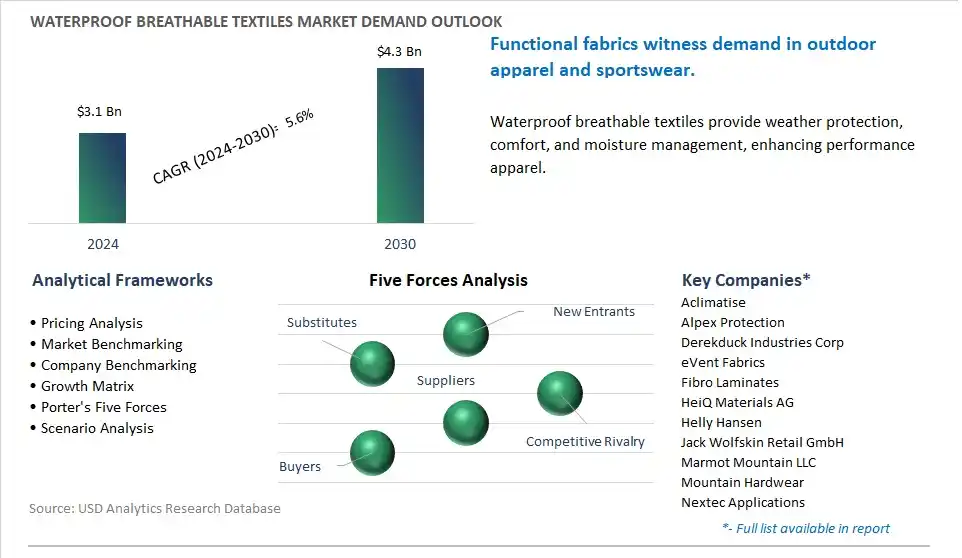
The global Waterproof Breathable Textiles Market is poised to register a 5.6% CAGR from $3.1 Billion in 2024 to $4.3 Billion in 2030.
The global Waterproof Breathable Textiles Market Study analyzes and forecasts the market size across 6 regions and 24 countries for diverse segments -By Raw Material (ePTFE, Polyurethane, Polyester, Others), By Fabric (Densely Woven, Membrane, Coated), By Application (General Clothing & Accessories, Sports Goods, Protective Clothing, Others).
An Introduction to Global Waterproof Breathable Textiles Market in 2024
The market for waterproof breathable textiles is witnessing significant growth and innovation driven by key trends shaping the future of outdoor apparel, sportswear, and performance textiles. One notable trend is the increasing demand for high-performance fabrics that offer protection against water penetration while allowing moisture vapor to escape, ensuring comfort, breathability, and durability in a wide range of outdoor and active wear applications. Waterproof breathable textiles, often constructed using advanced membrane technologies such as ePTFE (expanded polytetrafluoroethylene) or polyurethane, are designed to repel water droplets while allowing sweat vapor to pass through, preventing moisture buildup and maintaining a dry and comfortable microclimate next to the skin. Additionally, advancements in textile engineering, surface treatments, and laminating techniques are driving innovations in waterproof breathable fabric constructions, enabling improved waterproofness, breathability, and flexibility without compromising on performance or durability. Manufacturers are developing sustainable and eco-friendly alternatives using recycled materials, bio-based polymers, and environmentally friendly finishes to meet the growing demand for eco-conscious outdoor apparel and sportswear. Furthermore, the trend towards athleisure and outdoor recreation is driving the adoption of waterproof breathable textiles in a variety of apparel categories, including jackets, pants, footwear, and accessories, catering to the needs of active consumers seeking functional and stylish performance wear for outdoor activities, sports, and leisure pursuits. Moreover, collaborations between textile manufacturers, apparel brands, and material suppliers are driving innovation and market growth by delivering advanced waterproof breathable solutions that meet the specific performance, comfort, and sustainability requirements of diverse end-users and applications, ensuring continued advancement and adoption of waterproof breathable textiles as essential components of modern outdoor and performance apparel.
Waterproof Breathable Textiles Market Competitive Landscape
The market report analyses the leading companies in the industry including Aclimatise, Alpex Protection, Derekduck Industries Corp , eVent Fabrics, Fibro Laminates, HeiQ Materials AG, Helly Hansen, Jack Wolfskin Retail GmbH, Marmot Mountain LLC, Mountain Hardwear, Nextec Applications, Polartec LLC, Rudolf GmbH, schoeller Switzerland, Schweitzer-Mauduit International Inc, SympaTex Technologies GmbH, Taiwan Dyeing & Fabric Co. Ltd, Tanatex Chemicals B.V., The North Face, Toray Industries Inc, W. L. Gore & Associates Inc.
Waterproof Breathable Textiles Market Dynamics
Waterproof Breathable Textiles Market Trend: Growing Demand for Performance Outdoor Apparel
A prominent trend in the waterproof breathable textiles market is the growing demand for performance outdoor apparel. As outdoor recreational activities such as hiking, camping, and skiing gain popularity, there is an increasing need for textiles that offer both waterproofing and breathability to enhance comfort and protection in various weather conditions. Waterproof breathable textiles provide a solution for outdoor enthusiasts by offering protection from rain, snow, and wind while allowing moisture vapor to escape, preventing overheating and sweat buildup. This trend is driven by consumer preferences for high-performance clothing that enables freedom of movement, durability, and weather resistance during outdoor adventures, stimulating innovation and adoption of waterproof breathable textiles in the apparel industry.
Waterproof Breathable Textiles Market Driver: Advancements in Textile Technology and Fabric Innovation
The primary driver for the waterproof breathable textiles market is advancements in textile technology and fabric innovation. Manufacturers are continuously developing new materials, coatings, and laminates to improve the performance and functionality of waterproof breathable textiles, enhancing their waterproofing, breathability, durability, and comfort properties. Innovations such as microporous membranes, hydrophobic coatings, and moisture-wicking fabrics enable the production of lightweight, flexible, and highly breathable textiles that offer superior weather protection and comfort in outdoor environments. Additionally, advancements in manufacturing processes, sustainability initiatives, and eco-friendly materials drive the adoption of waterproof breathable textiles as a preferred choice for outdoor apparel, sports gear, and protective clothing.
Waterproof Breathable Textiles Market Opportunity: Expansion into Diverse Application Markets
An opportunity for market expansion in the waterproof breathable textiles segment lies in the expansion into diverse application markets beyond outdoor apparel. While waterproof breathable textiles are commonly used in outdoor clothing, footwear, and gear, there is potential to penetrate new markets such as medical textiles, protective clothing, and industrial applications. By offering customized solutions tailored to the specific requirements and performance criteria of diverse applications, textile manufacturers can capitalize on opportunities for market diversification and growth. For example, waterproof breathable textiles can be used in medical garments for patient care, surgical gowns, and wound dressings to provide protection against fluids and contaminants while maintaining comfort and breathability. Collaboration with industry partners, research institutions, and end-users can facilitate the development and customization of waterproof breathable textiles for various application markets, unlocking new opportunities for revenue growth and market expansion in the textile industry.
Waterproof Breathable Textiles Market Share Analysis: Polyurethane raw material generated the highest revenue in 2024
The largest segment in the Waterproof Breathable Textiles Market is the Polyurethane raw material category. polyurethane (PU) coatings and membranes are widely used in waterproof breathable textiles due to their excellent waterproofing properties, breathability, and versatility. PU coatings are applied to the surface of textiles through various methods such as lamination, spraying, or brushing, forming a protective barrier that repels water while allowing moisture vapor to escape, thus providing waterproofness and breathability simultaneously. Additionally, PU membranes are often used as laminate layers in waterproof breathable textiles, sandwiched between fabric layers to enhance waterproofing and breathability without compromising comfort or flexibility. Further, PU coatings and membranes offer cost-effective solutions for waterproof breathable textiles, making them accessible to a wide range of consumers across different market segments. PU coatings are relatively easy to apply and can be used on various fabric substrates, including nylon, polyester, and cotton, allowing manufacturers to produce waterproof breathable garments, footwear, and accessories at different price points to cater to diverse consumer preferences and budget considerations. Furthermore, advancements in PU technology, such as the development of eco-friendly and solvent-free PU formulations, have further increased the popularity and adoption of PU-based waterproof breathable textiles in the market. Eco-conscious consumers and regulatory pressures for sustainable manufacturing practices drive the demand for environmentally friendly alternatives, making eco-friendly PU coatings an attractive option for brands and manufacturers seeking to meet sustainability goals and market demands. Over the forecast period, the Polyurethane raw material category maintains its position as the largest in the Waterproof Breathable Textiles Market due to the excellent waterproofing, breathability, versatility, cost-effectiveness, and technological advancements of PU coatings and membranes in waterproof breathable textile applications across various industries and consumer segments.
Waterproof Breathable Textiles Market Share Analysis: Membrane fabric segment is poised to register the fastest growth rate (CAGR) over the forecast period to 2030
The fastest-growing segment in the Waterproof Breathable Textiles Market is the Membrane fabric category. membrane fabrics utilize advanced waterproof breathable technologies that offer superior performance in terms of waterproofing, breathability, and comfort. Membrane fabrics feature a microporous membrane layer that acts as a barrier to water while allowing moisture vapor to pass through, thus keeping the wearer dry and comfortable even during intense physical activity or adverse weather conditions. This superior performance makes membrane fabrics highly desirable for outdoor and active wear applications, such as hiking, skiing, mountaineering, and cycling, where protection from the elements and comfort are paramount. Additionally, membrane fabrics are known for their durability, abrasion resistance, and versatility, making them suitable for a wide range of outdoor and performance-oriented garments, footwear, and accessories. Further, advancements in membrane technology, such as the development of new membrane materials, laminates, and construction techniques, have further enhanced the performance and functionality of membrane fabrics in waterproof breathable textiles. Manufacturers continue to innovate and invest in research and development to improve membrane properties such as waterproofness, breathability, stretchability, and sustainability, meeting the evolving needs and preferences of consumers and market demands. Furthermore, the growing popularity of outdoor activities, sports, and recreational pursuits drives the demand for high-performance waterproof breathable textiles, particularly membrane fabrics that offer reliable protection and comfort in challenging outdoor environments. As consumers become more health-conscious and environmentally aware, there is a growing demand for sustainable and eco-friendly membrane fabrics made from recycled materials or bio-based polymers, further fueling the growth of this segment. Over the forecast period, the Membrane fabric category is experiencing rapid growth in the Waterproof Breathable Textiles Market due to its superior performance, durability, versatility, and technological advancements in membrane technology, making it the fabric of choice for outdoor and performance-oriented apparel and gear.
Waterproof Breathable Textiles Market Share Analysis: Protective Clothing application segment is poised to register the fastest growth rate (CAGR) over the forecast period to 2030
The fastest-growing segment in the Waterproof Breathable Textiles Market is the Protective Clothing application category. There is an increasing awareness of workplace safety and regulations, driving the demand for high-performance protective clothing that offers both waterproofing and breathability. Industries such as construction, manufacturing, oil and gas, and healthcare require protective clothing to shield workers from hazardous environments, chemicals, and inclement weather conditions while ensuring comfort and mobility. Waterproof breathable textiles provide an ideal solution for protective clothing by offering reliable protection against water, chemicals, and other contaminants, while allowing moisture vapor to escape, thus preventing heat buildup and moisture accumulation inside the garment. Additionally, the COVID-19 pandemic has further highlighted the importance of protective clothing in healthcare settings, leading to increased demand for waterproof breathable fabrics for medical gowns, coveralls, and personal protective equipment (PPE) to protect frontline workers from exposure to infectious agents and contaminants. Further, advancements in textile technology, such as the development of specialized membrane materials, coatings, and construction techniques, have improved the performance and functionality of waterproof breathable textiles in protective clothing applications. Manufacturers are incorporating innovative features such as flame resistance, anti-static properties, chemical resistance, and antimicrobial treatments into protective clothing made from waterproof breathable fabrics, meeting industry standards and regulatory requirements for workplace safety and personal protective equipment (PPE). Furthermore, the growing adoption of waterproof breathable textiles in protective clothing is driven by trends such as urbanization, infrastructure development, and industrialization, which increase the demand for high-performance protective gear in hazardous work environments and critical infrastructure projects. As workplace safety regulations become more stringent and industries prioritize employee well-being, the demand for waterproof breathable textiles in protective clothing applications is expected to continue growing rapidly. Over the forecast period, the Protective Clothing application category is experiencing rapid growth in the Waterproof Breathable Textiles Market due to increasing workplace safety regulations, the COVID-19 pandemic's impact on healthcare protective clothing demand, advancements in textile technology, and the growing adoption of waterproof breathable textiles in industrial and healthcare settings to ensure worker safety and comfort.
Waterproof Breathable Textiles Market Report Segmentation
By Raw Material
ePTFE
Polyurethane
Polyester
Others
By Fabric
Densely Woven
Membrane
Coated
By Application
General Clothing & Accessories
Sports Goods
Protective Clothing
Others
Regions Included
North America (US, Canada, Mexico)
Europe (Germany, UK, France, Spain, Italy, Russia, Rest of Europe)
Asia Pacific (China, India, Japan, South Korea, Australia, South East Asia, Rest of Asia)
South America (Brazil, Argentina, Rest of South America)
Middle East and Africa (Saudi Arabia, UAE, Rest of Middle East, South Africa, Egypt, Rest of Africa)
Waterproof Breathable Textiles Companies Profiled in the Market Study
Aclimatise
Alpex Protection
Derekduck Industries Corp
eVent Fabrics
Fibro Laminates
HeiQ Materials AG
Helly Hansen
Jack Wolfskin Retail GmbH
Marmot Mountain LLC
Mountain Hardwear
Nextec Applications
Polartec LLC
Rudolf GmbH
schoeller Switzerland
Schweitzer-Mauduit International Inc
SympaTex Technologies GmbH
Taiwan Dyeing & Fabric Co. Ltd
Tanatex Chemicals B.V.
The North Face
Toray Industries Inc
W. L. Gore & Associates Inc
*- List Not Exhaustive
TABLE OF CONTENTS
1 Introduction to 2024 Waterproof Breathable Textiles Market
1.1 Market Overview
1.2 Quick Facts
1.3 Scope/Objective of the Study
1.4 Market Definition
1.5 Countries and Regions Covered
1.6 Units, Currency, and Conversions
1.7 Industry Value Chain
2 Research Methodology
2.1 Market Size Estimation
2.2 Sources and Research Methodology
2.3 Data Triangulation
2.4 Assumptions and Limitations
3 Executive Summary
3.1 Global Waterproof Breathable Textiles Market Size Outlook, $ Million, 2021 to 2030
3.2 Waterproof Breathable Textiles Market Outlook by Type, $ Million, 2021 to 2030
3.3 Waterproof Breathable Textiles Market Outlook by Product, $ Million, 2021 to 2030
3.4 Waterproof Breathable Textiles Market Outlook by Application, $ Million, 2021 to 2030
3.5 Waterproof Breathable Textiles Market Outlook by Key Countries, $ Million, 2021 to 2030
4 Market Dynamics
4.1 Key Driving Forces of Waterproof Breathable Textiles Industry
4.2 Key Market Trends in Waterproof Breathable Textiles Industry
4.3 Potential Opportunities in Waterproof Breathable Textiles Industry
4.4 Key Challenges in Waterproof Breathable Textiles Industry
5 Market Factor Analysis
5.1 Value Chain Analysis
5.2 Competitive Landscape
5.2.1 Global Waterproof Breathable Textiles Market Share by Company (%), 2023
5.2.2 Product Offerings by Company
5.3 Porter’s Five Forces Analysis
5.4 Pricing Analysis and Outlook
6 Growth Outlook Across Scenarios
6.1 Growth Analysis-Case Scenario Definitions
6.2 Low Growth Scenario Forecasts
6.3 Reference Growth Scenario Forecasts
6.4 High Growth Scenario Forecasts
7 Global Waterproof Breathable Textiles Market Outlook by Segments
7.1 Waterproof Breathable Textiles Market Outlook by Segments, $ Million, 2021- 2030
By Raw Material
ePTFE
Polyurethane
Polyester
Others
By Fabric
Densely Woven
Membrane
Coated
By Application
General Clothing & Accessories
Sports Goods
Protective Clothing
Others
8 North America Waterproof Breathable Textiles Market Analysis and Outlook To 2030
8.1 Introduction to North America Waterproof Breathable Textiles Markets in 2024
8.2 North America Waterproof Breathable Textiles Market Size Outlook by Country, 2021-2030
8.2.1 United States
8.2.2 Canada
8.2.3 Mexico
8.3 North America Waterproof Breathable Textiles Market size Outlook by Segments, 2021-2030
By Raw Material
ePTFE
Polyurethane
Polyester
Others
By Fabric
Densely Woven
Membrane
Coated
By Application
General Clothing & Accessories
Sports Goods
Protective Clothing
Others
9 Europe Waterproof Breathable Textiles Market Analysis and Outlook To 2030
9.1 Introduction to Europe Waterproof Breathable Textiles Markets in 2024
9.2 Europe Waterproof Breathable Textiles Market Size Outlook by Country, 2021-2030
9.2.1 Germany
9.2.2 France
9.2.3 Spain
9.2.4 United Kingdom
9.2.4 Italy
9.2.5 Russia
9.2.6 Norway
9.2.7 Rest of Europe
9.3 Europe Waterproof Breathable Textiles Market Size Outlook by Segments, 2021-2030
By Raw Material
ePTFE
Polyurethane
Polyester
Others
By Fabric
Densely Woven
Membrane
Coated
By Application
General Clothing & Accessories
Sports Goods
Protective Clothing
Others
10 Asia Pacific Waterproof Breathable Textiles Market Analysis and Outlook To 2030
10.1 Introduction to Asia Pacific Waterproof Breathable Textiles Markets in 2024
10.2 Asia Pacific Waterproof Breathable Textiles Market Size Outlook by Country, 2021-2030
10.2.1 China
10.2.2 India
10.2.3 Japan
10.2.4 South Korea
10.2.5 Indonesia
10.2.6 Malaysia
10.2.7 Australia
10.2.8 Rest of Asia Pacific
10.3 Asia Pacific Waterproof Breathable Textiles Market size Outlook by Segments, 2021-2030
By Raw Material
ePTFE
Polyurethane
Polyester
Others
By Fabric
Densely Woven
Membrane
Coated
By Application
General Clothing & Accessories
Sports Goods
Protective Clothing
Others
11 South America Waterproof Breathable Textiles Market Analysis and Outlook To 2030
11.1 Introduction to South America Waterproof Breathable Textiles Markets in 2024
11.2 South America Waterproof Breathable Textiles Market Size Outlook by Country, 2021-2030
11.2.1 Brazil
11.2.2 Argentina
11.2.3 Rest of South America
11.3 South America Waterproof Breathable Textiles Market size Outlook by Segments, 2021-2030
By Raw Material
ePTFE
Polyurethane
Polyester
Others
By Fabric
Densely Woven
Membrane
Coated
By Application
General Clothing & Accessories
Sports Goods
Protective Clothing
Others
12 Middle East and Africa Waterproof Breathable Textiles Market Analysis and Outlook To 2030
12.1 Introduction to Middle East and Africa Waterproof Breathable Textiles Markets in 2024
12.2 Middle East and Africa Waterproof Breathable Textiles Market Size Outlook by Country, 2021-2030
12.2.1 Saudi Arabia
12.2.2 UAE
12.2.3 Oman
12.2.4 Rest of Middle East
12.2.5 Egypt
12.2.6 Nigeria
12.2.7 South Africa
12.2.8 Rest of Africa
12.3 Middle East and Africa Waterproof Breathable Textiles Market size Outlook by Segments, 2021-2030
By Raw Material
ePTFE
Polyurethane
Polyester
Others
By Fabric
Densely Woven
Membrane
Coated
By Application
General Clothing & Accessories
Sports Goods
Protective Clothing
Others
13 Company Profiles
13.1 Company Snapshot
13.2 SWOT Profiles
13.3 Products and Services
13.4 Recent Developments
13.5 Financial Profile
Aclimatise
Alpex Protection
Derekduck Industries Corp
eVent Fabrics
Fibro Laminates
HeiQ Materials AG
Helly Hansen
Jack Wolfskin Retail GmbH
Marmot Mountain LLC
Mountain Hardwear
Nextec Applications
Polartec LLC
Rudolf GmbH
schoeller Switzerland
Schweitzer-Mauduit International Inc
SympaTex Technologies GmbH
Taiwan Dyeing & Fabric Co. Ltd
Tanatex Chemicals B.V.
The North Face
Toray Industries Inc
W. L. Gore & Associates Inc
14 Appendix
14.1 Customization Offerings
14.2 Subscription Services
14.3 Related Reports
14.4 Publisher Expertise
