
The global Wearable Artificial Organs Marketstudy analyzes and forecasts the market size across 6 regions and 24 countries for diverse segments including By Product (Kidney, Pancreas, Cochlear implants, Exoskeleton, Bionic limbs, Brain Bionics, Vision bionics), By Technology (Mechanical, Electronic).
In 2024, the wearable artificial organs market is thriving, fueled by advancements in biomedical engineering, regenerative medicine, and the development of wearable biohybrid systems for organ support, augmentation, or replacement in patients with organ failure or chronic diseases requiring continuous physiological support. Wearable artificial organs encompass bioengineered devices, implantable systems, and external prostheses designed to mimic the structure and function of natural organs, offering patients alternatives to traditional organ transplantation or mechanical support devices. These wearable systems integrate biocompatible materials, microfluidic circuits, and bioelectronic interfaces to interface with the body's physiological systems, providing therapeutic benefits such as organ function restoration, metabolic regulation, or disease management. With the increasing demand for innovative solutions for organ failure and chronic disease management, the wearable artificial organs market is expected to continue growing, offering patients, clinicians, and researchers transformative technologies for organ replacement, tissue regeneration, and personalized medicine applications, driving advancements in wearable biotechnology and biohybrid organ systems.
A significant trend in the wearable artificial organs market is the integration of smart sensors and Internet of Things (IoT) technologies into wearable devices. Modern wearable artificial organs are equipped with advanced sensors capable of monitoring vital signs, biomarkers, and physiological parameters in real-time. These sensors provide valuable data on organ function, patient health status, and treatment efficacy, enabling healthcare providers to make informed decisions and personalize patient care. Moreover, IoT connectivity allows for seamless data transmission, remote monitoring, and cloud-based analytics, enhancing healthcare delivery, patient engagement, and disease management. As healthcare systems transition towards value-based care, preventive medicine, and remote patient monitoring, the trend towards smart wearable artificial organs continues to drive market growth and innovation in medical device technology.
The increasing incidence of organ failure serves as a significant driver for the wearable artificial organs market. Organ failure, whether due to chronic diseases, traumatic injuries, or congenital defects, represents a major healthcare challenge globally, leading to significant morbidity, mortality, and healthcare expenditures. Conventional treatment options for organ failure, such as transplantation or mechanical support devices, are often limited by donor shortages, surgical risks, and post-operative complications. Wearable artificial organs offer a promising alternative by providing continuous or intermittent organ support in a portable and wearable format, allowing patients to maintain their daily activities and quality of life. Moreover, advancements in tissue engineering, biomaterials, and regenerative medicine enable the development of bioengineered organs that closely mimic native tissue structure and function. As healthcare providers and researchers strive to address the unmet need for organ replacement therapies, the demand for wearable artificial organs continues to grow, driving market expansion and technological advancements in organ support devices.
The expansion into the pediatric population represents a promising opportunity for growth within the wearable artificial organs market. Children with congenital defects, genetic disorders, or acquired illnesses often require organ support or replacement therapies to survive and thrive. However, traditional treatment options such as pediatric organ transplantation are limited by donor availability, surgical challenges, and long-term immunosuppressive therapy risks. Wearable artificial organs tailored for pediatric patients offer a viable solution by providing customized, size-appropriate organ support devices that accommodate the unique needs of pediatric populations. Moreover, advancements in pediatric critical care, neonatology, and pediatric surgery have improved survival rates and quality of life for children with complex medical conditions, increasing the demand for innovative organ support technologies. By expanding into the pediatric segment, wearable artificial organ manufacturers can address an underserved market and provide life-saving therapies for pediatric patients in need. Additionally, strategic partnerships with pediatric hospitals, research institutions, and advocacy groups can facilitate market penetration and adoption of wearable artificial organs in pediatric care settings, driving revenue growth and market expansion in the evolving landscape of pediatric medicine.
By Product
Kidney
Pancreas
Cochlear implants
Exoskeleton
Bionic limbs
Brain Bionics
Vision bionics
By Technology
Mechanical
Electronic
Geographical Analysis
North America (United States, Canada, Mexico)
Europe (Germany, France, United Kingdom, Spain, Italy, Rest of Europe)
Asia Pacific (China, India, Japan, South Korea, Rest of Asia Pacific)
South America (Brazil, Argentina, Rest of South America)
Middle East and Africa (Saudi Arabia, UAE, Rest of Middle East, South Africa, Egypt, Rest of Africa)
Abbott Laboratories
AWAK Technology
Boston Scientific
Cochlear Ltd
Ekso bionics
HDT Global
Lockheed Martin Corp
MED-EL
Medtronic
Neurotron Biotechnology
Retina Implant AG
ReWalk Robotics
Rex Bionics Plc
Second Sight Medical Products Inc
Suit X
Touch Bionics Inc
• Deepen your industry insights and navigate uncertainties for strategy formulation, CAPEX, and Operational decisions
• Gain access to detailed insights on the Wearable Artificial Organs Market, encompassing current market size, growth trends, and forecasts till 2030.
• Access detailed competitor analysis, enabling competitive advantage through a thorough understanding of market players, strategies, and potential differentiation opportunities
• Stay ahead of the curve with insights on technological advancements, innovations, and upcoming trends
• Identify lucrative investment avenues and expansion opportunities within the Wearable Artificial Organs Market industry, guided by robust, data-backed analysis.
• Understand regional and global markets through country-wise analysis, regional market potential, regulatory nuances, and dynamics
• Execute strategies with confidence and speed through information, analytics, and insights on the industry value chain
• Corporate leaders, strategists, financial experts, shareholders, asset managers, and governmental representatives can make long-term planning scenarios and build an integrated and timely understanding of market dynamics
• Benefit from tailored solutions and expert consultation based on report insights, providing personalized strategies aligned with specific business needs.
TABLE OF CONTENTS
1 Introduction to 2024 Wearable Artificial Organs Market
1.1 Market Overview
1.2 Quick Facts
1.3 Scope/Objective of the Study
1.4 Market Definition
1.5 Countries and Regions Analyzed
1.6 Units, Currency, and Conversions
1.7 Industry Value Chain
2 Research Methodology
2.1 Market Size Estimation
2.2 Sources and Research Methodology
2.3 Data Triangulation
2.4 Assumptions and Limitations
3 Executive Summary
3.1 Global Wearable Artificial Organs Market Size Outlook, $ Million, 2021 to 2030
3.2 Wearable Artificial Organs Market Outlook by Type, $ Million, 2021 to 2030
3.3 Wearable Artificial Organs Market Outlook by Product, $ Million, 2021 to 2030
3.4 Wearable Artificial Organs Market Outlook by Application, $ Million, 2021 to 2030
3.5 Wearable Artificial Organs Market Outlook by Key Countries, $ Million, 2021 to 2030
4 Market Dynamics
4.1 Key Driving Forces of Wearable Artificial Organs Industry
4.2 Key Market Trends in Wearable Artificial Organs Industry
4.3 Potential Opportunities in Wearable Artificial Organs Industry
4.4 Key Challenges in Wearable Artificial Organs Industry
5 Market Factor Analysis
5.1 Value Chain Analysis
5.2 Competitive Landscape
5.2.1 Global Wearable Artificial Organs Market Share by Company (%), 2023
5.2.2 Product Offerings by Company
5.3 Porter’s Five Forces Analysis
5.4 Pricing Analysis and Outlook
6 Growth Outlook Across Scenarios
6.1 Growth Analysis-Case Scenario Definitions
6.2 Low Growth Scenario Forecasts
6.3 Reference Growth Scenario Forecasts
6.4 High Growth Scenario Forecasts
7 Global Wearable Artificial Organs Market Outlook by Segments
7.1 Wearable Artificial Organs Market Outlook by Segments, $ Million, 2021- 2030
By Product
Kidney
Pancreas
Cochlear implants
Exoskeleton
Bionic limbs
Brain Bionics
Vision bionics
By Technology
Mechanical
Electronic
8 North America Wearable Artificial Organs Market Analysis and Outlook To 2030
8.1 Introduction to North America Wearable Artificial Organs Markets in 2024
8.2 North America Wearable Artificial Organs Market Size Outlook by Country, 2021-2030
8.2.1 United States
8.2.2 Canada
8.2.3 Mexico
8.3 North America Wearable Artificial Organs Market size Outlook by Segments, 2021-2030
By Product
Kidney
Pancreas
Cochlear implants
Exoskeleton
Bionic limbs
Brain Bionics
Vision bionics
By Technology
Mechanical
Electronic
9 Europe Wearable Artificial Organs Market Analysis and Outlook To 2030
9.1 Introduction to Europe Wearable Artificial Organs Markets in 2024
9.2 Europe Wearable Artificial Organs Market Size Outlook by Country, 2021-2030
9.2.1 Germany
9.2.2 France
9.2.3 Spain
9.2.4 United Kingdom
9.2.4 Italy
9.2.5 Russia
9.2.6 Norway
9.2.7 Rest of Europe
9.3 Europe Wearable Artificial Organs Market Size Outlook by Segments, 2021-2030
By Product
Kidney
Pancreas
Cochlear implants
Exoskeleton
Bionic limbs
Brain Bionics
Vision bionics
By Technology
Mechanical
Electronic
10 Asia Pacific Wearable Artificial Organs Market Analysis and Outlook To 2030
10.1 Introduction to Asia Pacific Wearable Artificial Organs Markets in 2024
10.2 Asia Pacific Wearable Artificial Organs Market Size Outlook by Country, 2021-2030
10.2.1 China
10.2.2 India
10.2.3 Japan
10.2.4 South Korea
10.2.5 Indonesia
10.2.6 Malaysia
10.2.7 Australia
10.2.8 Rest of Asia Pacific
10.3 Asia Pacific Wearable Artificial Organs Market size Outlook by Segments, 2021-2030
By Product
Kidney
Pancreas
Cochlear implants
Exoskeleton
Bionic limbs
Brain Bionics
Vision bionics
By Technology
Mechanical
Electronic
11 South America Wearable Artificial Organs Market Analysis and Outlook To 2030
11.1 Introduction to South America Wearable Artificial Organs Markets in 2024
11.2 South America Wearable Artificial Organs Market Size Outlook by Country, 2021-2030
11.2.1 Brazil
11.2.2 Argentina
11.2.3 Rest of South America
11.3 South America Wearable Artificial Organs Market size Outlook by Segments, 2021-2030
By Product
Kidney
Pancreas
Cochlear implants
Exoskeleton
Bionic limbs
Brain Bionics
Vision bionics
By Technology
Mechanical
Electronic
12 Middle East and Africa Wearable Artificial Organs Market Analysis and Outlook To 2030
12.1 Introduction to Middle East and Africa Wearable Artificial Organs Markets in 2024
12.2 Middle East and Africa Wearable Artificial Organs Market Size Outlook by Country, 2021-2030
12.2.1 Saudi Arabia
12.2.2 UAE
12.2.3 Oman
12.2.4 Rest of Middle East
12.2.5 Egypt
12.2.6 Nigeria
12.2.7 South Africa
12.2.8 Rest of Africa
12.3 Middle East and Africa Wearable Artificial Organs Market size Outlook by Segments, 2021-2030
By Product
Kidney
Pancreas
Cochlear implants
Exoskeleton
Bionic limbs
Brain Bionics
Vision bionics
By Technology
Mechanical
Electronic
13 Company Profiles
13.1 Company Snapshot
13.2 SWOT Profiles
13.3 Products and Services
13.4 Recent Developments
13.5 Financial Profile
List of Companies
Abbott Laboratories
AWAK Technology
Boston Scientific
Cochlear Ltd
Ekso bionics
HDT Global
Lockheed Martin Corp
MED-EL
Medtronic
Neurotron Biotechnology
Retina Implant AG
ReWalk Robotics
Rex Bionics Plc
Second Sight Medical Products Inc
Suit X
Touch Bionics Inc
14 Appendix
14.1 Customization Offerings
14.2 Subscription Services
14.3 Related Reports
14.4 Publisher Expertise
By Product
Kidney
Pancreas
Cochlear implants
Exoskeleton
Bionic limbs
Brain Bionics
Vision bionics
By Technology
Mechanical
Electronic
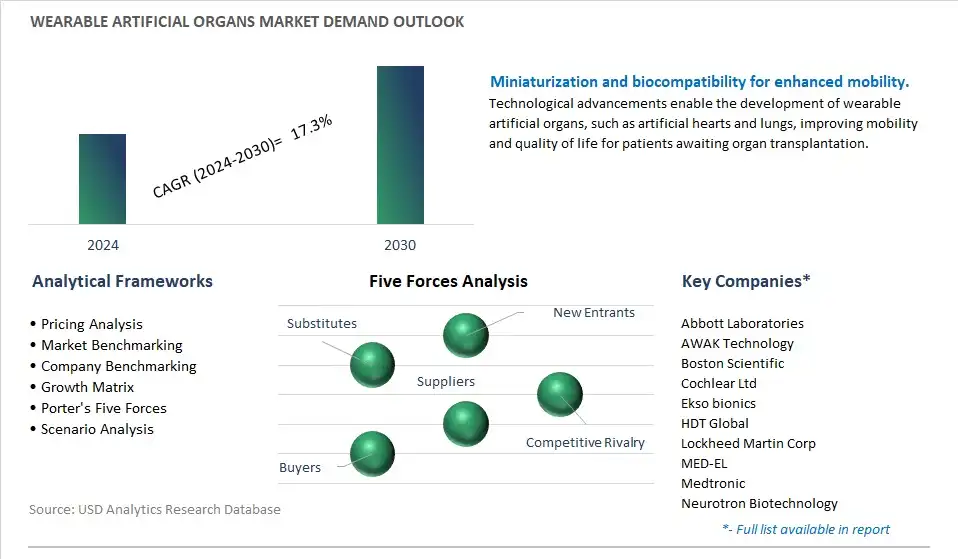
The global Wearable Artificial Organs Market is one of the lucrative growth markets, poised to register a 17.3% growth (CAGR) between 2024 and 2030.
Emerging Markets across Asia Pacific, Europe, and Americas present robust growth prospects.
Abbott Laboratories, AWAK Technology, Boston Scientific, Cochlear Ltd, Ekso bionics, HDT Global, Lockheed Martin Corp, MED-EL, Medtronic, Neurotron Biotechnology, Retina Implant AG, ReWalk Robotics, Rex Bionics Plc, Second Sight Medical Products Inc, Suit X, Touch Bionics Inc
Base Year- 2023; Estimated Year- 2024; Historic Period- 2018-2023; Forecast period- 2024 to 2030; Currency: USD; Volume