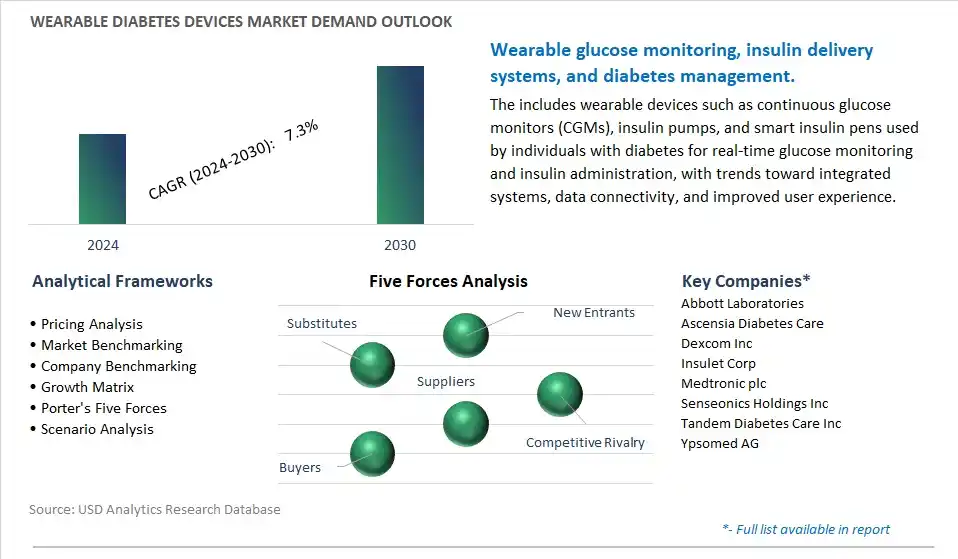
Wearable Diabetes Devices Market is estimated to increase at a Compounded Annual Growth Rate of 7.3% CAGR over the forecast period from 2024 to 2030
The Wearable Diabetes Devices Market study analyzes and forecasts the market size across 6 regions and 24 countries for diverse segments- By Device (Continuous Glucose Monitoring Devices, Insulin Pumps), By Type (Non-Invasive Glucose Monitoring Devices, Invasive Glucose Monitoring Devices), By End-User (Hospitals, Clinics, Personal).
An Introduction to Wearable Diabetes Devices Market in 2024
In 2024, the market for wearable diabetes devices continues to revolutionize diabetes management by providing convenient and continuous monitoring of glucose levels, insulin delivery, and metabolic parameters for individuals with diabetes. Wearable diabetes devices encompass a variety of technologies, including continuous glucose monitors (CGMs), insulin pumps, and hybrid closed-loop systems (also known as artificial pancreas systems), designed to enhance glycemic control, reduce hypoglycemia risk, and improve quality of life for diabetes patients. With advancements in sensor accuracy, insulin delivery algorithms, and connectivity features, wearable diabetes devices offer real-time insights into glucose dynamics, customizable insulin dosing options, and seamless integration with mobile apps and cloud-based platforms for data analysis and remote monitoring. Moreover, the market is influenced by trends such as the development of smaller and more discreet wearable devices for enhanced comfort and aesthetics, the expansion of interoperability standards and device compatibility to support integrated diabetes management solutions, and the incorporation of artificial intelligence and machine learning algorithms for predictive analytics and personalized therapy recommendations. Additionally, ongoing research focuses on advancing closed-loop control algorithms, exploring non-invasive glucose monitoring technologies, and optimizing user interfaces and decision support tools to empower diabetes patients and healthcare providers in optimizing diabetes care and outcomes, reflecting the continuous innovation and advancement in wearable diabetes devices to address the evolving needs of the diabetes community.
Market Trend: Integration of Continuous Glucose Monitoring with Wearable Devices
A prominent market trend in wearable diabetes devices is the integration of continuous glucose monitoring (CGM) technology with wearable devices. As the management of diabetes becomes increasingly personalized and data-driven, there's a growing demand for wearable devices that not only track physical activity and vital signs but also provide real-time monitoring of blood glucose levels. Integration of CGM sensors into wearable devices, such as smartwatches, fitness trackers, and patches, allows individuals with diabetes to conveniently and discreetly monitor their glucose levels throughout the day, facilitating proactive management of blood sugar fluctuations and optimization of treatment regimens. This trend towards seamless integration of CGM technology with wearable devices enhances user experience, improves adherence to glucose monitoring protocols, and empowers individuals with diabetes to make informed lifestyle choices for better glycemic control.
Market Driver: Rising Prevalence of Diabetes and Demand for Remote Monitoring Solutions
A significant driver fueling the growth of the wearable diabetes devices market is the rising prevalence of diabetes and the growing demand for remote monitoring solutions. Diabetes is a global epidemic, affecting millions of people worldwide and posing significant healthcare challenges due to its chronic nature and associated complications. As the burden of diabetes continues to increase, there's a pressing need for innovative technologies that enable remote monitoring of blood glucose levels, enhance patient engagement, and support self-management efforts. Wearable diabetes devices offer a convenient and non-invasive solution for continuous glucose monitoring, enabling individuals with diabetes and their caregivers to track glucose trends, detect hypo- and hyperglycemic episodes, and adjust treatment strategies in real-time. The demand for wearable diabetes devices is further driven by the shift towards value-based care models, which emphasize preventive care, patient-centered approaches, and leveraging technology to improve health outcomes and reduce healthcare costs associated with diabetes management.
Market Opportunity: Development of AI-Powered Predictive Analytics Solutions
An intriguing opportunity within the wearable diabetes devices market lies in the development of artificial intelligence (AI)-powered predictive analytics solutions that leverage data generated by wearable devices to forecast future glucose trends and anticipate hypoglycemic or hyperglycemic events. By harnessing machine learning algorithms and big data analytics, wearable diabetes device manufacturers can develop predictive models that analyze patterns in glucose data, physiological parameters, lifestyle factors, and contextual information to predict glycemic fluctuations and provide personalized recommendations for glucose management. These AI-powered predictive analytics solutions have the potential to revolutionize diabetes management by empowering individuals with actionable insights, facilitating proactive interventions, and preventing adverse events before they occur. Moreover, the integration of predictive analytics capabilities into wearable diabetes devices can enhance their value proposition, differentiate them in the competitive landscape, and drive adoption among healthcare providers, payers, and individuals with diabetes seeking innovative solutions for better glycemic control and improved quality of life.
Wearable Diabetes Devices Market Share Analysis: Continuous Glucose Monitoring (CGM) Devices for Personal Use
In the Wearable Diabetes Devices Market, the segment experiencing rapid growth is Continuous Glucose Monitoring (CGM) Devices for Personal Use. CGM devices offer individuals with diabetes real-time monitoring of their glucose levels, allowing for better glycemic control and management of the condition. The growth of CGM devices for personal use is driven by several factors, including the increasing prevalence of diabetes worldwide, the growing adoption of technology-enabled self-management solutions, and advancements in CGM device technology that enhance accuracy, comfort, and ease of use. Personal CGM devices empower individuals with diabetes to track their glucose levels continuously, make informed decisions about diet and lifestyle choices, and proactively manage their condition outside of traditional healthcare settings. Moreover, the trend towards patient-centered care and self-monitoring encourages the adoption of CGM devices among individuals seeking greater autonomy and control over their diabetes management. As the demand for personalized and convenient diabetes management solutions continues to rise, the market for CGM devices for personal use is expected to witness significant growth in the wearable diabetes devices market.
Wearable Diabetes Devices Competitive Analysis
The market research study provides in-depth insights into leading companies including the SWOT analyses, product profile, financial details, and recent developments acrossAbbott Laboratories, Ascensia Diabetes Care, Dexcom Inc, Insulet Corp, Medtronic plc, Senseonics Holdings Inc, Tandem Diabetes Care Inc, Ypsomed AG
Wearable Diabetes Devices Market Segmentation
By Device
Continuous Glucose Monitoring Devices
-Sensors
-Durables
Insulin Pumps
-Insulin Pump Devices
-Insulin Infusion Sets
-Reservoirs
By Type
Non-Invasive Glucose Monitoring Devices
Invasive Glucose Monitoring Devices
By End-User
Hospital/Clinics
Home/Personal
Geographical Analysis
North America (United States, Canada, Mexico)
Europe (Germany, France, United Kingdom, Spain, Italy, Rest of Europe)
Asia Pacific (China, India, Japan, South Korea, Rest of Asia Pacific)
South America (Brazil, Argentina, Rest of South America)
Middle East and Africa (Saudi Arabia, UAE, Rest of Middle East, South Africa, Egypt, Rest of Africa)
Wearable Diabetes Devices Market Companies
Abbott Laboratories
Ascensia Diabetes Care
Dexcom Inc
Insulet Corp
Medtronic plc
Senseonics Holdings Inc
Tandem Diabetes Care Inc
Ypsomed AG
Reasons to Buy the Wearable Diabetes Devices Market Study
• Deepen your industry insights and navigate uncertainties for strategy formulation, CAPEX, and Operational decisions
• Gain access to detailed insights on the Wearable Diabetes Devices Market, encompassing current market size, growth trends, and forecasts till 2030.
• Access detailed competitor analysis, enabling competitive advantage through a thorough understanding of market players, strategies, and potential differentiation opportunities
• Stay ahead of the curve with insights on technological advancements, innovations, and upcoming trends
• Identify lucrative investment avenues and expansion opportunities within the Wearable Diabetes Devices Market industry, guided by robust, data-backed analysis.
• Understand regional and global markets through country-wise analysis, regional market potential, regulatory nuances, and dynamics
• Execute strategies with confidence and speed through information, analytics, and insights on the industry value chain
• Corporate leaders, strategists, financial experts, shareholders, asset managers, and governmental representatives can make long-term planning scenarios and build an integrated and timely understanding of market dynamics
• Benefit from tailored solutions and expert consultation based on report insights, providing personalized strategies aligned with specific business needs.
TABLE OF CONTENTS
1 Introduction to 2024 Wearable Diabetes Devices Market
1.1 Market Overview
1.2 Quick Facts
1.3 Scope/Objective of the Study
1.4 Market Definition
1.5 Countries and Regions Covered
1.6 Units, Currency, and Conversions
1.7 Industry Value Chain
2 Research Methodology
2.1 Market Size Estimation
2.2 Sources and Research Methodology
2.3 Data Triangulation
2.4 Assumptions and Limitations
3 Executive Summary
3.1 Global Wearable Diabetes Devices Market Size Outlook, $ Million, 2021 to 2030
3.2 Wearable Diabetes Devices Market Outlook by Type, $ Million, 2021 to 2030
3.3 Wearable Diabetes Devices Market Outlook by Product, $ Million, 2021 to 2030
3.4 Wearable Diabetes Devices Market Outlook by Application, $ Million, 2021 to 2030
3.5 Wearable Diabetes Devices Market Outlook by Key Countries, $ Million, 2021 to 2030
4 Market Dynamics
4.1 Key Driving Forces of Wearable Diabetes Devices Industry
4.2 Key Market Trends in Wearable Diabetes Devices Industry
4.3 Potential Opportunities in Wearable Diabetes Devices Industry
4.4 Key Challenges in Wearable Diabetes Devices Industry
5 Market Factor Analysis
5.1 Value Chain Analysis
5.2 Competitive Landscape
5.2.1 Global Wearable Diabetes Devices Market Share by Company (%), 2023
5.2.2 Product Offerings by Company
5.3 Porter’s Five Forces Analysis
5.4 Pricing Analysis and Outlook
6 Growth Outlook Across Scenarios
6.1 Growth Analysis-Case Scenario Definitions
6.2 Low Growth Scenario Forecasts
6.3 Reference Growth Scenario Forecasts
6.4 High Growth Scenario Forecasts
7 Global Wearable Diabetes Devices Market Outlook by Segments
7.1 Wearable Diabetes Devices Market Outlook by Segments, $ Million, 2021- 2030
By Device
Continuous Glucose Monitoring Devices
-Sensors
-Durables
Insulin Pumps
-Insulin Pump Devices
-Insulin Infusion Sets
-Reservoirs
By Type
Non-Invasive Glucose Monitoring Devices
Invasive Glucose Monitoring Devices
By End-User
Hospital/Clinics
Home/Personal
8 North America Wearable Diabetes Devices Market Analysis and Outlook To 2030
8.1 Introduction to North America Wearable Diabetes Devices Markets in 2024
8.2 North America Wearable Diabetes Devices Market Size Outlook by Country, 2021-2030
8.2.1 United States
8.2.2 Canada
8.2.3 Mexico
8.3 North America Wearable Diabetes Devices Market size Outlook by Segments, 2021-2030
By Device
Continuous Glucose Monitoring Devices
-Sensors
-Durables
Insulin Pumps
-Insulin Pump Devices
-Insulin Infusion Sets
-Reservoirs
By Type
Non-Invasive Glucose Monitoring Devices
Invasive Glucose Monitoring Devices
By End-User
Hospital/Clinics
Home/Personal
9 Europe Wearable Diabetes Devices Market Analysis and Outlook To 2030
9.1 Introduction to Europe Wearable Diabetes Devices Markets in 2024
9.2 Europe Wearable Diabetes Devices Market Size Outlook by Country, 2021-2030
9.2.1 Germany
9.2.2 France
9.2.3 Spain
9.2.4 United Kingdom
9.2.4 Italy
9.2.5 Russia
9.2.6 Norway
9.2.7 Rest of Europe
9.3 Europe Wearable Diabetes Devices Market Size Outlook by Segments, 2021-2030
By Device
Continuous Glucose Monitoring Devices
-Sensors
-Durables
Insulin Pumps
-Insulin Pump Devices
-Insulin Infusion Sets
-Reservoirs
By Type
Non-Invasive Glucose Monitoring Devices
Invasive Glucose Monitoring Devices
By End-User
Hospital/Clinics
Home/Personal
10 Asia Pacific Wearable Diabetes Devices Market Analysis and Outlook To 2030
10.1 Introduction to Asia Pacific Wearable Diabetes Devices Markets in 2024
10.2 Asia Pacific Wearable Diabetes Devices Market Size Outlook by Country, 2021-2030
10.2.1 China
10.2.2 India
10.2.3 Japan
10.2.4 South Korea
10.2.5 Indonesia
10.2.6 Malaysia
10.2.7 Australia
10.2.8 Rest of Asia Pacific
10.3 Asia Pacific Wearable Diabetes Devices Market size Outlook by Segments, 2021-2030
By Device
Continuous Glucose Monitoring Devices
-Sensors
-Durables
Insulin Pumps
-Insulin Pump Devices
-Insulin Infusion Sets
-Reservoirs
By Type
Non-Invasive Glucose Monitoring Devices
Invasive Glucose Monitoring Devices
By End-User
Hospital/Clinics
Home/Personal
11 South America Wearable Diabetes Devices Market Analysis and Outlook To 2030
11.1 Introduction to South America Wearable Diabetes Devices Markets in 2024
11.2 South America Wearable Diabetes Devices Market Size Outlook by Country, 2021-2030
11.2.1 Brazil
11.2.2 Argentina
11.2.3 Rest of South America
11.3 South America Wearable Diabetes Devices Market size Outlook by Segments, 2021-2030
By Device
Continuous Glucose Monitoring Devices
-Sensors
-Durables
Insulin Pumps
-Insulin Pump Devices
-Insulin Infusion Sets
-Reservoirs
By Type
Non-Invasive Glucose Monitoring Devices
Invasive Glucose Monitoring Devices
By End-User
Hospital/Clinics
Home/Personal
12 Middle East and Africa Wearable Diabetes Devices Market Analysis and Outlook To 2030
12.1 Introduction to Middle East and Africa Wearable Diabetes Devices Markets in 2024
12.2 Middle East and Africa Wearable Diabetes Devices Market Size Outlook by Country, 2021-2030
12.2.1 Saudi Arabia
12.2.2 UAE
12.2.3 Oman
12.2.4 Rest of Middle East
12.2.5 Egypt
12.2.6 Nigeria
12.2.7 South Africa
12.2.8 Rest of Africa
12.3 Middle East and Africa Wearable Diabetes Devices Market size Outlook by Segments, 2021-2030
By Device
Continuous Glucose Monitoring Devices
-Sensors
-Durables
Insulin Pumps
-Insulin Pump Devices
-Insulin Infusion Sets
-Reservoirs
By Type
Non-Invasive Glucose Monitoring Devices
Invasive Glucose Monitoring Devices
By End-User
Hospital/Clinics
Home/Personal
13 Company Profiles
13.1 Company Snapshot
13.2 SWOT Profiles
13.3 Products and Services
13.4 Recent Developments
13.5 Financial Profile
List of Companies
Abbott Laboratories
Ascensia Diabetes Care
Dexcom Inc
Insulet Corp
Medtronic plc
Senseonics Holdings Inc
Tandem Diabetes Care Inc
Ypsomed AG
14 Appendix
14.1 Customization Offerings
14.2 Subscription Services
14.3 Related Reports
14.4 Publisher Expertise
By Device
Continuous Glucose Monitoring Devices
-Sensors
-Durables
Insulin Pumps
-Insulin Pump Devices
-Insulin Infusion Sets
-Reservoirs
By Type
Non-Invasive Glucose Monitoring Devices
Invasive Glucose Monitoring Devices
By End-User
Hospital/Clinics
Home/Personal
Countries Analyzed
North America (United States, Canada, Mexico)
Europe (Germany, France, United Kingdom, Spain, Italy, Rest of Europe)
Asia Pacific (China, India, Japan, South Korea, Rest of Asia Pacific)
South America (Brazil, Argentina, Rest of South America)
Middle East and Africa (Saudi Arabia, UAE, Rest of Middle East, South Africa, Egypt, Rest of Africa)
