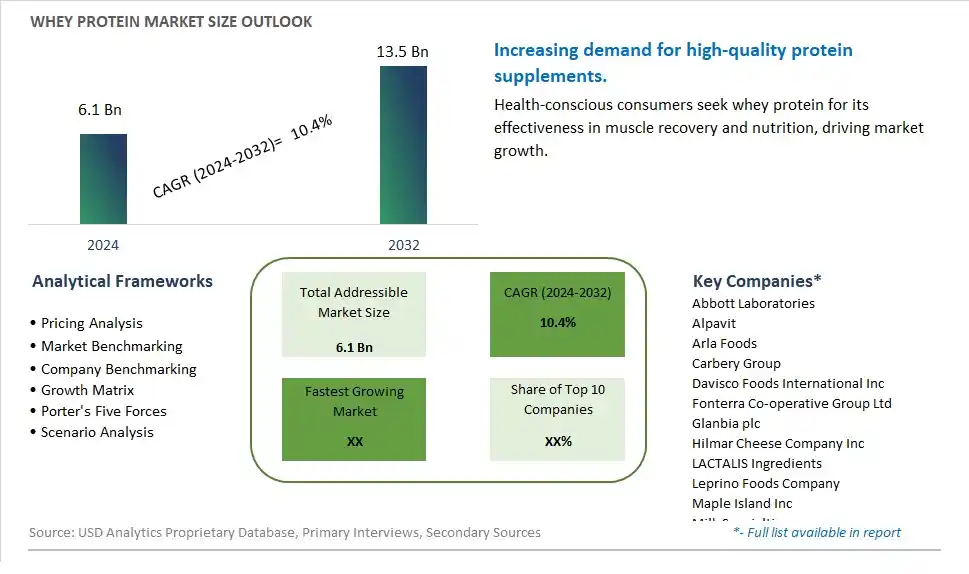
Global Whey Protein Market Size is valued at $6.1 Billion in 2024 and is forecast to register a growth rate (CAGR) of 10.4% to reach $13.5 Billion by 2032.
The global Whey Protein Market Comprehensive Study analyzes and forecasts the market size across 6 regions and 24 countries for diverse segments -By Type (Whey Protein Isolates (WPI), Whey Protein Concentrates (WPC), Whey Protein Hydrolysates (WPH)), By Application (Sports Nutrition, Dietary Supplements, Infant Formula, Food Additives, Beverages, Feed)
An Introduction to Whey Protein Market
The whey protein market is thriving in 2024, driven by the increasing demand for high-quality protein supplements, the growing popularity of sports nutrition and fitness trends, and the expanding applications in food, beverage, and nutraceutical products. Whey protein, derived from milk during the cheese-making process, is renowned for its complete amino acid profile, high biological value, and rapid absorption rate, making it a preferred choice among athletes, bodybuilders, and health-conscious consumers seeking to support muscle growth, recovery, and overall fitness goals. With consumers prioritizing active and healthy lifestyles, whey protein is gaining traction as a convenient and effective nutritional supplement, available in various forms such as protein powders, shakes, bars, and ready-to-drink beverages. Moreover, the food and beverage industry are incorporating whey protein into a wide range of products, including dairy alternatives, baked goods, snacks, and functional foods, to enhance protein content, texture, and nutritional value. Additionally, the pharmaceutical and nutraceutical sectors are exploring the therapeutic applications of whey protein in managing malnutrition, muscle wasting, and metabolic disorders, driving market expansion and innovation. As consumers seek functional and performance-driven nutrition solutions, the whey protein market is poised for continued growth and diversification, with opportunities for product innovation, market segmentation, and strategic partnerships shaping the future of the global sports nutrition industry.
Whey Protein Competitive Landscape
The market report analyses the leading companies in the industry including Abbott Laboratories, Alpavit, Arla Foods, Carbery Group, Davisco Foods International Inc, Fonterra Co-operative Group Ltd, Glanbia plc, Hilmar Cheese Company Inc, LACTALIS Ingredients, Leprino Foods Company, Maple Island Inc, Milk Specialties, Milkaut SA, Nestle S.A., Nutricia (Danone), Olam International, Sanofi S.A., Saputo Inc, Wheyco GmbH, and Others.
Whey Protein Market Dynamics
Whey Protein Market Trend: Increasing Demand for Sports Nutrition and Fitness Supplements
One prominent trend in the whey protein market is the increasing demand for sports nutrition and fitness supplements. As more individuals prioritize health and fitness, there is a growing interest in dietary supplements that support muscle growth, recovery, and overall athletic performance. Whey protein, derived from milk during the cheese-making process, is renowned for its high-quality protein content and essential amino acid profile, making it a popular choice among athletes, bodybuilders, and fitness enthusiasts. This trend is driving the demand for whey protein as a convenient and effective source of protein to supplement workout routines and promote muscle recovery and growth.
Market Driver: Rising Health and Wellness Awareness
A key driver in the whey protein market is the rising health and wellness awareness among consumers. With increasing concerns about obesity, sedentary lifestyles, and chronic diseases, individuals are becoming more proactive about managing their health through diet and exercise. Whey protein is recognized for its role in supporting muscle health, weight management, and overall nutritional needs, making it a sought-after ingredient in a variety of functional foods, beverages, and supplements. The growing emphasis on preventive healthcare and the pursuit of healthier lifestyles are driving the demand for whey protein as consumers seek out products that align with their wellness goals and dietary preferences.
Market Opportunity: Expansion into Functional and Fortified Products
An emerging opportunity in the whey protein market is the expansion into functional and fortified products. Beyond traditional protein powders and supplements, there's potential to incorporate whey protein into a diverse range of functional foods and beverages to enhance their nutritional profile and health benefits. Manufacturers can explore opportunities to develop whey protein-fortified products such as ready-to-drink shakes, protein bars, yogurt, cereal, and bakery items to cater to different consumer preferences and usage occasions. Additionally, there's an opportunity to innovate with specialized whey protein formulations tailored to specific dietary needs, such as whey protein isolates for lactose-intolerant individuals or hydrolyzed whey protein for faster absorption. By capitalizing on the functional properties of whey protein, companies can tap into the growing market for convenient and nutritious functional foods and beverages.
Whey Protein Market Share Analysis: Whey Protein Concentrates (WPC) held the dominant market share in 2024
Whey Protein Concentrates (WPC) emerge as the largest segment within the Whey Protein market, primarily due to their versatile applications and cost-effectiveness. WPCs contain varying levels of protein, ranging from 30% to 80%, making them suitable for a wide range of dietary and nutritional products. Their popularity stems from being a balanced protein source, providing essential amino acids crucial for muscle building and overall health. Further, WPCs are widely utilized in sports nutrition, functional foods, and beverages, owing to their excellent solubility and flavor profile. Additionally, the relatively lower production costs of WPCs compared to other whey protein types contribute to their dominance in the market. As the demand for protein supplements continues to surge, driven by the growing health and fitness consciousness among consumers globally, the WPC segment is poised to maintain its leading position in the Whey Protein market.
Whey Protein Market Share Analysis: Sports Nutrition market is poised to register the fastest growth rae over the forecast period to 2032
The Sports Nutrition segment is the fastest-growing sector within the Whey Protein market, propelled by several key factors. With the increasing emphasis on fitness and health-conscious lifestyles, there's a rising demand for high-quality protein supplements among athletes, bodybuilders, and fitness enthusiasts to support muscle recovery, growth, and overall performance. Whey protein's superior amino acid profile, particularly its high content of essential amino acids like leucine, makes it an ideal choice for post-workout recovery and muscle synthesis. Further, advancements in sports nutrition science and the growing popularity of functional foods and beverages fortified with whey protein further drive the segment's growth. Additionally, the expansion of the sports nutrition market beyond traditional gym-goers to include a broader demographic, including casual exercisers and older adults, amplifies the demand for whey protein in sports nutrition applications. As consumer awareness regarding the importance of protein intake for athletic performance continues to grow, the Sports Nutrition segment is poised for sustained rapid expansion in the Whey Protein market.
Whey Protein Market Segmentation
By Type
Whey Protein Isolates (WPI)
Whey Protein Concentrates (WPC)
Whey Protein Hydrolysates (WPH)
By Application
Sports Nutrition
Dietary Supplements
Infant Formula
Food Additives
Beverages
Feed
Countries Analyzed
North America (US, Canada, Mexico)
Europe (Germany, UK, France, Spain, Italy, Russia, Rest of Europe)
Asia Pacific (China, India, Japan, South Korea, Australia, South East Asia, Rest of Asia)
South America (Brazil, Argentina, Rest of South America)
Middle East and Africa (Saudi Arabia, UAE, Rest of Middle East, South Africa, Egypt, Rest of Africa)
Whey Protein Companies Profiled in the Study
Abbott Laboratories
Alpavit
Arla Foods
Carbery Group
Davisco Foods International Inc
Fonterra Co-operative Group Ltd
Glanbia plc
Hilmar Cheese Company Inc
LACTALIS Ingredients
Leprino Foods Company
Maple Island Inc
Milk Specialties
Milkaut SA
Nestle S.A.
Nutricia (Danone)
Olam International
Sanofi S.A.
Saputo Inc
Wheyco GmbH
*- List Not Exhaustive
Chapter 1. TABLE OF CONTENTS
Chapter 2. Introduction to Whey Protein Market
2.1. Market Overview
2.2. Key Statistics and Report Highlights
2.3. Scope of the Comprehensive Study
2.3.1. Market Definition
2.3.2 Countries and Regions Covered
2.3.3 Research Objective
2.3.4 Units, Currency, and Conversions
2.3.5 Industry Value Chain
2.4. Key Market Segments
2.5. Key Companies
2.6. Study Period
Chapter 3. Strategic Analysis Review
3.1. Whey Protein Pricing Analysis and Forecast
3.2. Porter’s Five Forces
3.3. Market Ecosystem
3.4. SWOT Analysis
3.5. Regulatory Scenario
3.3. Effects of Inflation, Russia-Ukraine War, moderating economic growth, and other macroeconomic factors
Chapter 4. Competitive Landscape
4.1. Market Share Analysis
4.1.1. Global Whey Protein Market Share by Company, 2023
4.1.2. Product Offerings of Leading Whey Protein Companies
4.2. Market Entropy
4.2.1. New Product Launches in the Industry
4.2.2. Mergers, Acquisitions, Joint ventures, and Partnerships
4.3. Key Strategies and Best Practices
Chapter 5. Global Market Projections: Best, Reference, and Low Case Scenarios
5.1. Growth Analysis- Case Scenario Definitions
5.2. Low Growth Case Scenario Forecasts
5.3. Reference Growth Case Scenario Forecasts
5.4. High Growth Case Scenario Forecasts
Chapter 6. Market Dynamics
6.1. Whey Protein Market Drivers
6.2. Whey Protein Market Challenges
6.6. Whey Protein Market Opportunities
6.4. Whey Protein Market Trends
Chapter 7. Global Whey Protein Market Outlook Trends
7.1. Global Whey Protein Revenue (USD Million) and CAGR (%) by Type (2021-2032)
7.2. Global Whey Protein Revenue (USD Million) and CAGR (%) by Application (2021-2032)
7.3. Global Whey Protein Revenue (USD Million) and CAGR (%) by Product (2021-2032)
By Type
Whey Protein Isolates (WPI)
Whey Protein Concentrates (WPC)
Whey Protein Hydrolysates (WPH)
By Application
Sports Nutrition
Dietary Supplements
Infant Formula
Food Additives
Beverages
Feed
Chapter 8. Global Whey Protein Regional Analysis and Outlook
8.1. Global Whey Protein Revenue (USD Million) By Regions (2021- 2032)
8.2. North America Whey Protein Revenue (USD Million) by Country (2021-2032)
8.2.1. United States Whey Protein Regional Analysis and Outlook
8.2.2. Canada Whey Protein Regional Analysis and Outlook
8.2.3. Mexico Whey Protein Regional Analysis and Outlook
8.3. Europe Whey Protein Revenue (USD Million), by Country (2021-2032)
8.3.1. Germany Whey Protein Regional Analysis and Outlook
8.3.2. France Whey Protein Regional Analysis and Outlook
8.3.3. United Kingdom Whey Protein Regional Analysis and Outlook
8.3.4. Spain Whey Protein Regional Analysis and Outlook
8.3.5. Italy Whey Protein Regional Analysis and Outlook
8.3.6. Russia Whey Protein Regional Analysis and Outlook
8.3.7. Rest of Europe Whey Protein Regional Analysis and Outlook
8.4. Asia Pacific Whey Protein Revenue (USD Million) by Country (2021-2032)
8.4.1. China Whey Protein Regional Analysis and Outlook
8.4.2. Japan Whey Protein Regional Analysis and Outlook
8.4.3. India Whey Protein Regional Analysis and Outlook
8.4.4. South Korea Whey Protein Regional Analysis and Outlook
8.4.5. Australia Whey Protein Regional Analysis and Outlook
8.4.6. South East Asia Whey Protein Regional Analysis and Outlook
8.4.7. Rest of Asia Pacific Whey Protein Regional Analysis and Outlook
8.5. South America Whey Protein Revenue (USD Million), by Country (2021-2032)
8.5.1. Brazil Whey Protein Regional Analysis and Outlook
8.5.2. Argentina Whey Protein Regional Analysis and Outlook
8.5.3. Rest of South America Whey Protein Regional Analysis and Outlook
8.6. Middle East and Africa Whey Protein Revenue (USD Million) by Country (2021-2032)
8.6.1. Middle East Whey Protein Regional Analysis and Outlook
8.6.2. Africa Whey Protein Regional Analysis and Outlook
Chapter 9. North America Whey Protein Analysis and Outlook
9.1. North America Whey Protein Revenue (USD Million) by Segments (2021-2032)
9.1.1. North America Whey Protein Revenue (USD Million) by Type (2021-2032)
9.1.2. North America Whey Protein Revenue (USD Million) by Application (2021-2032)
9.1.3. North America Whey Protein Revenue (USD Million) by Product (2021-2032)
By Type
Whey Protein Isolates (WPI)
Whey Protein Concentrates (WPC)
Whey Protein Hydrolysates (WPH)
By Application
Sports Nutrition
Dietary Supplements
Infant Formula
Food Additives
Beverages
Feed
Chapter 10. Europe Whey Protein Analysis and Outlook
10.1. Europe Whey Protein Revenue (USD Million), by Segments (USD Million) (2021-2032)
10.1.1. Europe Whey Protein Revenue (USD Million) by Type (2021-2032)
10.1.2. Europe Whey Protein Revenue (USD Million) by Application (2021-2032)
10.1.3. Europe Whey Protein Revenue (USD Million) by Product (2021-2032)
By Type
Whey Protein Isolates (WPI)
Whey Protein Concentrates (WPC)
Whey Protein Hydrolysates (WPH)
By Application
Sports Nutrition
Dietary Supplements
Infant Formula
Food Additives
Beverages
Feed
Chapter 11. Asia Pacific Whey Protein Analysis and Outlook
11.1. Asia Pacific Whey Protein Revenue (USD Million), and Revenue (USD Million) by Segments (2021-2032)
11.1.1. Asia Pacific Whey Protein Revenue (USD Million) by Type (2021-2032)
11.1.2. Asia Pacific Whey Protein Revenue (USD Million) by Application (2021-2032)
11.1.3. Asia Pacific Whey Protein Revenue (USD Million) by Product (2021-2032)
By Type
Whey Protein Isolates (WPI)
Whey Protein Concentrates (WPC)
Whey Protein Hydrolysates (WPH)
By Application
Sports Nutrition
Dietary Supplements
Infant Formula
Food Additives
Beverages
Feed
Chapter 12. South America Whey Protein Analysis and Outlook
12.1. South America Whey Protein Revenue (USD Million), by Segments (2021-2032)
12.1.1. South America Whey Protein Revenue (USD Million) by Type (2021-2032)
12.1.2. South America Whey Protein Revenue (USD Million) by Application (2021-2032)
12.1.3. South America Whey Protein Revenue (USD Million) by Product (2021-2032)
By Type
Whey Protein Isolates (WPI)
Whey Protein Concentrates (WPC)
Whey Protein Hydrolysates (WPH)
By Application
Sports Nutrition
Dietary Supplements
Infant Formula
Food Additives
Beverages
Feed
Chapter 13. Middle East and Africa Whey Protein Analysis and Outlook
13.1. Middle East and Africa Whey Protein Revenue (USD Million), by Segments (2021-2032)
13.1.1. Middle East and Africa Whey Protein Revenue (USD Million) by Type (2021-2032)
13.1.2. Middle East and Africa Whey Protein Revenue (USD Million) by Application (2021-2032)
13.1.3. Middle East and Africa Whey Protein Revenue (USD Million) by Product (2021-2032)
By Type
Whey Protein Isolates (WPI)
Whey Protein Concentrates (WPC)
Whey Protein Hydrolysates (WPH)
By Application
Sports Nutrition
Dietary Supplements
Infant Formula
Food Additives
Beverages
Feed
Chapter 14. Whey Protein Company Profiles
14.1 Business Overview
14.2 Product Profiles
14.3 SWOT Profiles
14.5 Recent Developments
14.6 Financial Profile
List of Companies
Abbott Laboratories
Alpavit
Arla Foods
Carbery Group
Davisco Foods International Inc
Fonterra Co-operative Group Ltd
Glanbia plc
Hilmar Cheese Company Inc
LACTALIS Ingredients
Leprino Foods Company
Maple Island Inc
Milk Specialties
Milkaut SA
Nestle S.A.
Nutricia (Danone)
Olam International
Sanofi S.A.
Saputo Inc
Wheyco GmbH
15. Methodology and Data Sources
15.1 Customization Offerings
15.2 Subscription Services
15.3 Related Reports
15.4 Publisher Expertise
LIST OF TABLES
Table 1 Market Segmentation Analysis
Table 2 Global Whey Protein Market Share of Leading Companies, 2023
Table 3 Product Offerings of Leading Companies
Table 4 Low Growth Scenario Forecasts
Table 5 Reference Case Growth Scenario
Table 6 High Growth Case Scenario
Table 7 Global Whey Protein Revenue (USD Million) And CAGR (%) By Type (2021-2032)
Table 8 Global Whey Protein Revenue (USD Million) And CAGR (%) By Application (2021-2032)
Table 9 Global Whey Protein Revenue (USD Million) And CAGR (%) By Product (2021-2032)
Table 10 Global Whey Protein Market Revenue (USD Million) By Regions (2021-2032)
Table 11 Global Whey Protein Market Share (%) By Regions (2021-2032)
Table 12 North America Whey Protein Revenue (USD Million) By Country (2021-2032)
Table 13 Europe Whey Protein Revenue (USD Million) By Country (2021-2032)
Table 14 Asia Pacific Whey Protein Revenue (USD Million) By Country (2021-2032)
Table 15 South America Whey Protein Revenue (USD Million) By Country (2021-2032)
Table 16 Middle East and Africa Whey Protein Revenue (USD Million) By Region (2021-2032)
Table 17 North America Whey Protein Revenue (USD Million) By Type (2021-2032)
Table 18 North America Whey Protein Revenue (USD Million) By Application (2021-2032)
Table 19 North America Whey Protein Revenue (USD Million) By Product (2021-2032)
Table 20 Europe Whey Protein Revenue (USD Million) By Type (2021-2032)
Table 21 Europe Whey Protein Revenue (USD Million) By Application (2021-2032)
Table 22 Europe Whey Protein Revenue (USD Million) By Product (2021-2032)
Table 23 Asia Pacific Whey Protein Revenue (USD Million) By Type (2021-2032)
Table 24 Asia Pacific Whey Protein Revenue (USD Million) By Application (2021-2032)
Table 25 Asia Pacific Whey Protein Revenue (USD Million) By Product (2021-2032)
Table 26 South America Whey Protein Revenue (USD Million) By Type (2021-2032)
Table 27 South America Whey Protein Revenue (USD Million) By Application (2021-2032)
Table 28 South America Whey Protein Revenue (USD Million) By Product (2021-2032)
Table 29 Middle East and Africa Whey Protein Revenue (USD Million) By Type (2021-2032)
Table 30 Middle East and Africa Whey Protein Revenue (USD Million) By Application (2021-2032)
Table 31 Middle East and Africa Whey Protein Revenue (USD Million) By Product (2021-2032)
LIST OF FIGURES
Figure 1. Market Scope
Figure 2. Pricing Forecasts Per Unit, 2023- 2032
Figure 3. Porter’s Five Forces
Figure 4. Global Whey Protein Market Revenue (USD Million) By Regions (2021-2032)
Figure 5. Global Whey Protein Market Share (%) By Regions (2023)
Figure 6. North America Whey Protein Revenue (USD Million) By Country (2021-2032)
Figure 7. United States Whey Protein Revenue (USD Million) By Country (2021-2032)
Figure 8. Canada Whey Protein Revenue (USD Million) By Country (2021-2032)
Figure 9. Mexico Whey Protein Revenue (USD Million) By Country (2021-2032)
Figure 10. Europe Whey Protein Revenue (USD Million) By Country (2021-2032)
Figure 11. Germany Whey Protein Revenue (USD Million) By Country (2021-2032)
Figure 12. France Whey Protein Revenue (USD Million) By Country (2021-2032)
Figure 13. United Kingdom Whey Protein Revenue (USD Million) By Country (2021-2032)
Figure 14. Spain Whey Protein Revenue (USD Million) By Country (2021-2032)
Figure 15. Italy Whey Protein Revenue (USD Million) By Country (2021-2032)
Figure 16. Russia Whey Protein Revenue (USD Million) By Country (2021-2032)
Figure 17. Rest of Europe Whey Protein Revenue (USD Million) By Country (2021-2032)
Figure 11. Asia Pacific Whey Protein Revenue (USD Million) By Country (2021-2032)
Figure 12. China Whey Protein Revenue (USD Million) By Country (2021-2032)
Figure 13. Japan Whey Protein Revenue (USD Million) By Country (2021-2032)
Figure 14. India Whey Protein Revenue (USD Million) By Country (2021-2032)
Figure 15. South Korea Whey Protein Revenue (USD Million) By Country (2021-2032)
Figure 16. Australia Whey Protein Revenue (USD Million) By Country (2021-2032)
Figure 17. South East Asia Whey Protein Revenue (USD Million) By Country (2021-2032)
Figure 18. South America Whey Protein Revenue (USD Million) By Country (2021-2032)
Figure 19. Brazil Whey Protein Revenue (USD Million) By Country (2021-2032)
Figure 20. Argentina Whey Protein Revenue (USD Million) By Country (2021-2032)
Figure 21. Rest of Asia Pacific Whey Protein Revenue (USD Million) By Country (2021-2032)
Figure 22. Middle East and Africa Whey Protein Revenue (USD Million) By Region (2021-2032)
Figure 23. Saudi Arabia Whey Protein Revenue (USD Million) By Region (2021-2032)
Figure 24. The UAE Whey Protein Revenue (USD Million) By Region (2021-2032)
Figure 25. Rest of Middle East Whey Protein Revenue (USD Million) By Region (2021-2032)
Figure 26. South Africa Whey Protein Revenue (USD Million) By Region (2021-2032)
Figure 27. Africa Whey Protein Revenue (USD Million) By Region (2021-2032)
Figure 28. North America Whey Protein Revenue (USD Million) By Type (2021-2032)
Figure 29. North America Whey Protein Revenue (USD Million) By Application (2021-2032)
Figure 30. North America Whey Protein Revenue (USD Million) By Product (2021-2032)
Figure 31. Europe Whey Protein Revenue (USD Million) By Type (2021-2032)
Figure 32. Europe Whey Protein Revenue (USD Million) By Application (2021-2032)
Figure 33. Europe Whey Protein Revenue (USD Million) By Product (2021-2032)
Figure 34. Asia Pacific Whey Protein Revenue (USD Million) By Type (2021-2032)
Figure 35. Asia Pacific Whey Protein Revenue (USD Million) By Application (2021-2032)
Figure 36. Asia Pacific Whey Protein Revenue (USD Million) By Product (2021-2032)
Figure 37. South America Whey Protein Revenue (USD Million) By Type (2021-2032)
Figure 38. South America Whey Protein Revenue (USD Million) By Application (2021-2032)
Figure 39. South America Whey Protein Revenue (USD Million) By Product (2021-2032)
Figure 40. Middle East and Africa Whey Protein Revenue (USD Million) By Type (2021-2032)
Figure 41. Middle East and Africa Whey Protein Revenue (USD Million) By Application (2021-2032)
Figure 42. Middle East and Africa Whey Protein Revenue (USD Million) By Product (2021-2032)
By Type
Whey Protein Isolates (WPI)
Whey Protein Concentrates (WPC)
Whey Protein Hydrolysates (WPH)
By Application
Sports Nutrition
Dietary Supplements
Infant Formula
Food Additives
Beverages
Feed
Countries Analyzed
North America (US, Canada, Mexico)
Europe (Germany, UK, France, Spain, Italy, Russia, Rest of Europe)
Asia Pacific (China, India, Japan, South Korea, Australia, South East Asia, Rest of Asia)
South America (Brazil, Argentina, Rest of South America)
Middle East and Africa (Saudi Arabia, UAE, Rest of Middle East, South Africa, Egypt, Rest of Africa)
