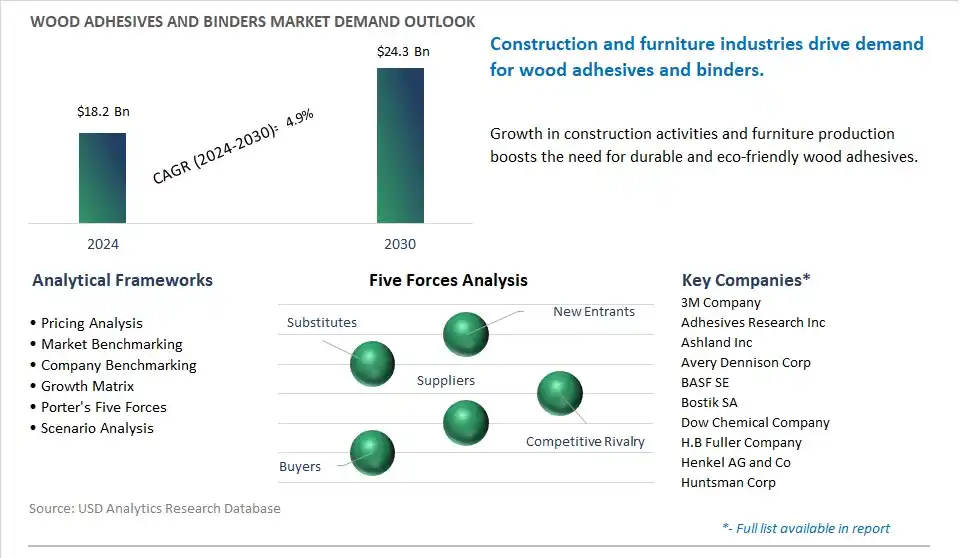
The global Wood Adhesives and Binders Market is poised to register a 4.9% CAGR from $18.2 Billion in 2024 to $24.3 Billion in 2030.
The global Wood Adhesives and Binders Market Study analyzes and forecasts the market size across 6 regions and 24 countries for diverse segments -By Product (Urea-Formaldehyde, Melamine Urea-Formaldehyde, Phenol- Formaldehyde, Isocyanates, Soy-Based, Others), By Application (Cabinets, Flooring and Plywood, Furniture and Subcomponents, Windows and Doors, Others).
An Introduction to Global Wood Adhesives and Binders Market in 2024
The wood adhesives and binders market is witnessing steady growth driven by increasing demand in construction, furniture manufacturing, and woodworking industries. Key trends shaping the future of the industry include the growing adoption of eco-friendly and high-performance wood adhesives, driven by sustainability concerns and regulatory requirements for indoor air quality. Moreover, there's a rising emphasis on innovation in adhesive formulations, such as water-based, bio-based, and formaldehyde-free adhesives, to meet stringent environmental standards and consumer preferences. Additionally, advancements in adhesive application techniques, bonding technologies, and curing processes are driving innovation and market expansion, enabling manufacturers to offer reliable, durable, and cost-effective solutions for diverse wood bonding applications in the global wood adhesives and binders market.
Wood Adhesives and Binders Market Competitive Landscape
The market report analyses the leading companies in the industry including 3M Company, Adhesives Research Inc, Ashland Inc, Avery Dennison Corp, BASF SE, Bostik SA, Dow Chemical Company, H.B Fuller Company, Henkel AG and Co, Huntsman Corp.
Wood Adhesives and Binders Market Dynamics
Wood Adhesives and Binders Market Trend: Increasing Demand for Sustainable and Eco-Friendly Adhesives
The most prominent market trend for wood adhesives and binders is the increasing demand for sustainable and eco-friendly adhesives. With growing concerns about environmental impact and health hazards associated with traditional solvent-based adhesives, there is a rising preference for adhesives that are low in volatile organic compounds (VOCs), formaldehyde-free, and derived from renewable resources. Wood adhesives and binders formulated with bio-based ingredients, water-based formulations, and environmentally friendly additives are gaining popularity among consumers, manufacturers, and regulatory agencies. This trend is driven by sustainability initiatives, green building certifications, and consumer preferences for safer and healthier indoor environments, shaping the future of the wood adhesive industry.
Wood Adhesives and Binders Market Driver: Growth in Construction and Furniture Manufacturing Industries
A key market driver for wood adhesives and binders is the growth in the construction and furniture manufacturing industries. As global population growth and urbanization drive demand for housing, infrastructure, and furnishings, there is an increasing need for high-performance adhesives to bond wood materials used in construction, cabinetry, flooring, and woodworking applications. Wood adhesives play a critical role in providing structural integrity, durability, and aesthetic appeal to wood-based products, meeting the performance requirements of architects, builders, and furniture manufacturers. The driver is further fueled by trends such as modular construction, prefabrication, and interior design preferences for natural materials, which drive demand for innovative wood adhesive solutions that offer bonding strength, moisture resistance, and compatibility with various substrates and finishes.
Wood Adhesives and Binders Market Opportunity: Innovation in Bio-Based Formulations and Advanced Bonding Technologies
An exciting opportunity in the wood adhesives and binders market lies in innovation in bio-based formulations and advanced bonding technologies. There is potential to develop wood adhesives and binders using renewable feedstocks such as soy, starch, lignin, and tannins, offering sustainable alternatives to petroleum-based resins and formaldehyde-based adhesives. Opportunities exist to optimize adhesive formulations for specific wood species, bonding applications, and environmental conditions, enhancing performance properties such as adhesion strength, water resistance, and heat resistance. Additionally, there is an opportunity to innovate in bonding technologies such as cross-linking, nanotechnology, and hybrid adhesives, offering solutions for challenging wood bonding applications and emerging market needs. By investing in research and development, collaboration with raw material suppliers, and customer-driven product development, adhesive manufacturers can capitalize on the opportunity to offer innovative wood adhesive solutions that meet the performance, sustainability, and regulatory requirements of end-users, driving market differentiation and growth in the wood adhesives and binders segment. This opportunity allows adhesive suppliers to position themselves as leaders in sustainable adhesive technology, capture market share, and contribute to green building practices and circular economy initiatives in the wood products industry.
Wood Adhesives and Binders Market Share Analysis: Urea-Formaldehyde product segment generated the highest revenue in the industry
The largest segment in the Wood Adhesives and Binders Market is the Urea-Formaldehyde product segment. This dominance can be attributed to diverse factors. The urea-formaldehyde adhesives have been widely used in the wood industry for many years due to their excellent bonding strength, versatility, and cost-effectiveness. Urea-formaldehyde resins are known for their ability to bond various wood substrates, including plywood, particleboard, MDF (medium-density fiberboard), and laminated veneer lumber (LVL). Additionally, urea-formaldehyde adhesives offer good heat resistance and water resistance, making them suitable for interior and exterior applications in both dry and wet environments. In addition, urea-formaldehyde resins can be easily modified and formulated to meet specific performance requirements and regulatory standards, further enhancing their suitability for a wide range of wood bonding applications. Further, urea-formaldehyde adhesives are widely available and cost-effective compared to other types of wood adhesives, making them a preferred choice for manufacturers and consumers alike. With their long-standing reputation for reliability, versatility, and affordability, the urea-formaldehyde product segment remains the largest segment in the Wood Adhesives and Binders Market.
Wood Adhesives and Binders Market Share Analysis: Flooring and Plywood application Segment is poised to register the fastest growth rate (CAGR) over the forecast period to 2030
The fastest-growing segment in the Wood Adhesives and Binders Market is the Flooring and Plywood application segment. The rapid growth is driven by the construction industry, particularly the residential and commercial building sectors, is experiencing significant growth globally, driving demand for wood-based products such as flooring and plywood. Wood adhesives and binders are essential components in the manufacturing of flooring materials and plywood panels, providing the necessary bonding strength and durability to withstand the rigors of everyday use. Additionally, the increasing popularity of engineered wood products, such as engineered hardwood flooring and engineered plywood, further boosts the demand for wood adhesives in the flooring and plywood segment. In addition, the growth of the construction industry is accompanied by a rise in renovation and remodeling activities, leading to increased demand for wood-based flooring materials as homeowners and businesses upgrade their interiors. Further, technological advancements in wood adhesive formulations and application methods, such as moisture-cured polyurethane adhesives and hot-melt adhesives, contribute to improved performance and efficiency in flooring and plywood manufacturing processes. With the expanding construction market and the ongoing trend towards wood-based building materials, the flooring and plywood application segment is the fastest-growing segment in the Wood Adhesives and Binders Market.
Wood Adhesives and Binders Market Report Segmentation
By Product
Urea-Formaldehyde
Melamine Urea-Formaldehyde
Phenol- Formaldehyde
Isocyanates
Soy-Based
Others
By Application
Cabinets
Flooring and Plywood
Furniture and Subcomponents
Windows and Doors
Others
Regions Included
North America (US, Canada, Mexico)
Europe (Germany, UK, France, Spain, Italy, Russia, Rest of Europe)
Asia Pacific (China, India, Japan, South Korea, Australia, South East Asia, Rest of Asia)
South America (Brazil, Argentina, Rest of South America)
Middle East and Africa (Saudi Arabia, UAE, Rest of Middle East, South Africa, Egypt, Rest of Africa)
Wood Adhesives and Binders Companies Profiled in the Market Study
3M Company
Adhesives Research Inc
Ashland Inc
Avery Dennison Corp
BASF SE
Bostik SA
Dow Chemical Company
H.B Fuller Company
Henkel AG and Co
Huntsman Corp
*- List Not Exhaustive
TABLE OF CONTENTS
1 Introduction to 2024 Wood Adhesives and Binders Market
1.1 Market Overview
1.2 Quick Facts
1.3 Scope/Objective of the Study
1.4 Market Definition
1.5 Countries and Regions Covered
1.6 Units, Currency, and Conversions
1.7 Industry Value Chain
2 Research Methodology
2.1 Market Size Estimation
2.2 Sources and Research Methodology
2.3 Data Triangulation
2.4 Assumptions and Limitations
3 Executive Summary
3.1 Global Wood Adhesives and Binders Market Size Outlook, $ Million, 2021 to 2030
3.2 Wood Adhesives and Binders Market Outlook by Type, $ Million, 2021 to 2030
3.3 Wood Adhesives and Binders Market Outlook by Product, $ Million, 2021 to 2030
3.4 Wood Adhesives and Binders Market Outlook by Application, $ Million, 2021 to 2030
3.5 Wood Adhesives and Binders Market Outlook by Key Countries, $ Million, 2021 to 2030
4 Market Dynamics
4.1 Key Driving Forces of Wood Adhesives and Binders Industry
4.2 Key Market Trends in Wood Adhesives and Binders Industry
4.3 Potential Opportunities in Wood Adhesives and Binders Industry
4.4 Key Challenges in Wood Adhesives and Binders Industry
5 Market Factor Analysis
5.1 Value Chain Analysis
5.2 Competitive Landscape
5.2.1 Global Wood Adhesives and Binders Market Share by Company (%), 2023
5.2.2 Product Offerings by Company
5.3 Porter’s Five Forces Analysis
5.4 Pricing Analysis and Outlook
6 Growth Outlook Across Scenarios
6.1 Growth Analysis-Case Scenario Definitions
6.2 Low Growth Scenario Forecasts
6.3 Reference Growth Scenario Forecasts
6.4 High Growth Scenario Forecasts
7 Global Wood Adhesives and Binders Market Outlook by Segments
7.1 Wood Adhesives and Binders Market Outlook by Segments, $ Million, 2021- 2030
By Product
Urea-Formaldehyde
Melamine Urea-Formaldehyde
Phenol- Formaldehyde
Isocyanates
Soy-Based
Others
By Application
Cabinets
Flooring and Plywood
Furniture and Subcomponents
Windows and Doors
Others
8 North America Wood Adhesives and Binders Market Analysis and Outlook To 2030
8.1 Introduction to North America Wood Adhesives and Binders Markets in 2024
8.2 North America Wood Adhesives and Binders Market Size Outlook by Country, 2021-2030
8.2.1 United States
8.2.2 Canada
8.2.3 Mexico
8.3 North America Wood Adhesives and Binders Market size Outlook by Segments, 2021-2030
By Product
Urea-Formaldehyde
Melamine Urea-Formaldehyde
Phenol- Formaldehyde
Isocyanates
Soy-Based
Others
By Application
Cabinets
Flooring and Plywood
Furniture and Subcomponents
Windows and Doors
Others
9 Europe Wood Adhesives and Binders Market Analysis and Outlook To 2030
9.1 Introduction to Europe Wood Adhesives and Binders Markets in 2024
9.2 Europe Wood Adhesives and Binders Market Size Outlook by Country, 2021-2030
9.2.1 Germany
9.2.2 France
9.2.3 Spain
9.2.4 United Kingdom
9.2.4 Italy
9.2.5 Russia
9.2.6 Norway
9.2.7 Rest of Europe
9.3 Europe Wood Adhesives and Binders Market Size Outlook by Segments, 2021-2030
By Product
Urea-Formaldehyde
Melamine Urea-Formaldehyde
Phenol- Formaldehyde
Isocyanates
Soy-Based
Others
By Application
Cabinets
Flooring and Plywood
Furniture and Subcomponents
Windows and Doors
Others
10 Asia Pacific Wood Adhesives and Binders Market Analysis and Outlook To 2030
10.1 Introduction to Asia Pacific Wood Adhesives and Binders Markets in 2024
10.2 Asia Pacific Wood Adhesives and Binders Market Size Outlook by Country, 2021-2030
10.2.1 China
10.2.2 India
10.2.3 Japan
10.2.4 South Korea
10.2.5 Indonesia
10.2.6 Malaysia
10.2.7 Australia
10.2.8 Rest of Asia Pacific
10.3 Asia Pacific Wood Adhesives and Binders Market size Outlook by Segments, 2021-2030
By Product
Urea-Formaldehyde
Melamine Urea-Formaldehyde
Phenol- Formaldehyde
Isocyanates
Soy-Based
Others
By Application
Cabinets
Flooring and Plywood
Furniture and Subcomponents
Windows and Doors
Others
11 South America Wood Adhesives and Binders Market Analysis and Outlook To 2030
11.1 Introduction to South America Wood Adhesives and Binders Markets in 2024
11.2 South America Wood Adhesives and Binders Market Size Outlook by Country, 2021-2030
11.2.1 Brazil
11.2.2 Argentina
11.2.3 Rest of South America
11.3 South America Wood Adhesives and Binders Market size Outlook by Segments, 2021-2030
By Product
Urea-Formaldehyde
Melamine Urea-Formaldehyde
Phenol- Formaldehyde
Isocyanates
Soy-Based
Others
By Application
Cabinets
Flooring and Plywood
Furniture and Subcomponents
Windows and Doors
Others
12 Middle East and Africa Wood Adhesives and Binders Market Analysis and Outlook To 2030
12.1 Introduction to Middle East and Africa Wood Adhesives and Binders Markets in 2024
12.2 Middle East and Africa Wood Adhesives and Binders Market Size Outlook by Country, 2021-2030
12.2.1 Saudi Arabia
12.2.2 UAE
12.2.3 Oman
12.2.4 Rest of Middle East
12.2.5 Egypt
12.2.6 Nigeria
12.2.7 South Africa
12.2.8 Rest of Africa
12.3 Middle East and Africa Wood Adhesives and Binders Market size Outlook by Segments, 2021-2030
By Product
Urea-Formaldehyde
Melamine Urea-Formaldehyde
Phenol- Formaldehyde
Isocyanates
Soy-Based
Others
By Application
Cabinets
Flooring and Plywood
Furniture and Subcomponents
Windows and Doors
Others
13 Company Profiles
13.1 Company Snapshot
13.2 SWOT Profiles
13.3 Products and Services
13.4 Recent Developments
13.5 Financial Profile
3M Company
Adhesives Research Inc
Ashland Inc
Avery Dennison Corp
BASF SE
Bostik SA
Dow Chemical Company
H.B Fuller Company
Henkel AG and Co
Huntsman Corp
14 Appendix
14.1 Customization Offerings
14.2 Subscription Services
14.3 Related Reports
14.4 Publisher Expertise
By Product
Urea-Formaldehyde
Melamine Urea-Formaldehyde
Phenol- Formaldehyde
Isocyanates
Soy-Based
Others
By Application
Cabinets
Flooring and Plywood
Furniture and Subcomponents
Windows and Doors
Others
Countries Analyzed
North America (US, Canada, Mexico)
Europe (Germany, UK, France, Spain, Italy, Russia, Rest of Europe)
Asia Pacific (China, India, Japan, South Korea, Australia, South East Asia, Rest of Asia)
South America (Brazil, Argentina, Rest of South America)
Middle East and Africa (Saudi Arabia, UAE, Rest of Middle East, South Africa, Egypt, Rest of Africa)
