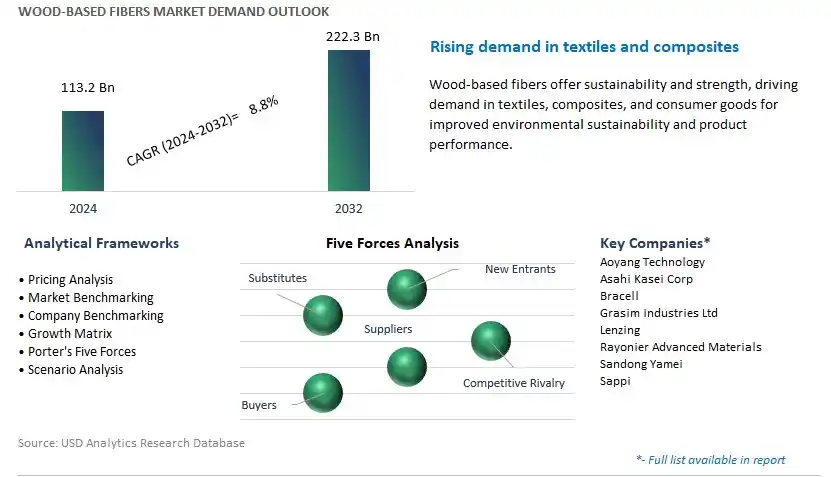
Global Wood-based Fibers Market Size is valued at $113.2 Billion in 2024 and is forecast to register a growth rate (CAGR) of 8.8% to reach $222.3 Billion by 2032.
The global Wood-based Fibers Market Study analyzes and forecasts the market size across 6 regions and 24 countries for diverse segments -By Type (Viscose, Modal, Lyocell, Cupro, Others), By Application (Textile, Healthcare, Automotive, Others).
An Introduction to Wood-based Fibers Market in 2024
Wood-based fibers, also known as cellulose fibers, are derived from wood pulp through mechanical or chemical processing methods, offering a renewable and biodegradable alternative to synthetic fibers in textile and non-woven applications. With their unique combination of properties such as softness, absorbency, and strength, wood-based fibers find applications in apparel, hygiene products, and industrial textiles. Through processes such as viscose, lyocell, or modal production, wood pulp is transformed into fibers that can be spun into yarns or incorporated into non-woven fabrics for diverse end uses. As sustainability concerns drive market demand for eco-friendly textiles and packaging materials, wood-based fibers to gain prominence as a renewable and resource-efficient solution, spurring investments in pulp and fiber production technologies and expanding market opportunities for cellulose-based products.
Wood-based Fibers Market Competitive Landscape
The market report analyses the leading companies in the industry including Aoyang Technology, Asahi Kasei Corp, Bracell, Grasim Industries Ltd, Lenzing, Rayonier Advanced Materials, Sandong Yamei, Sappi, and others.
Wood-based Fibers Market Dynamics
Market Trend: Surge in Demand for Sustainable and Renewable Materials
A prominent trend in the Wood-Based Fibers market is the surge in demand for sustainable and renewable materials across various industries. With increasing environmental awareness and concerns about deforestation, there's a notable shift towards utilizing wood-based fibers derived from responsibly managed forests and recycled sources. Wood-based fibers offer advantages such as biodegradability, recyclability, and low environmental impact, making them preferred choices for applications in the paper and packaging, textiles, automotive, and construction industries. This trend is driving the development of innovative processes and technologies for producing wood-based fibers with enhanced properties and performance, meeting the growing demand for eco-friendly materials in the global market.
Market Driver: Growing Preference for Eco-Friendly and Biobased Products
A key driver in the Wood-Based Fibers market is the growing preference for eco-friendly and biobased products among consumers and businesses alike. With increasing awareness of environmental issues and climate change, there's a shift towards reducing dependence on fossil fuels and non-renewable resources in favor of sustainable alternatives. Wood-based fibers, derived from wood pulp or recycled wood products, offer a renewable and biodegradable solution for replacing traditional materials such as plastics, textiles, and concrete additives. The demand for wood-based fibers is further driven by initiatives promoting circular economy principles and sustainable manufacturing practices, as well as regulations encouraging the use of bio-based materials in various applications.
Market Opportunity: Expansion into Advanced Applications and Emerging Markets
Amidst the evolving market dynamics, there exists a significant opportunity for Wood-Based Fibers manufacturers to expand into advanced applications and emerging markets. While wood-based fibers are traditionally used in industries such as pulp and paper, textiles, and packaging, there's potential for growth in niche applications such as biocomposites, filtration media, medical textiles, and 3D printing. By leveraging their expertise in fiber processing and collaborating with technology developers and end-users, companies can develop tailored solutions for specialized applications, thereby tapping into new market segments and diversifying their product portfolio. Furthermore, exploring emerging markets in developing economies experiencing rapid urbanization and industrialization presents opportunities for expanding market reach and driving business growth in the wood-based fibers industry.
Wood-based Fibers Market Share Analysis: Lyocell is poised to register the fastest CAGR over the forecast period
The Lyocell segment is the most lucrative segment in driving rapid growth within the Wood-based Fibers market. Lyocell, a type of cellulosic fiber derived from wood pulp, has garnered significant attention and demand due to its exceptional properties and eco-friendly characteristics. As sustainability becomes a paramount concern across industries, Lyocell stands out as a sustainable alternative to conventional fibers, thanks to its closed-loop production process that minimizes environmental impact and chemical usage. Additionally, Lyocell offers superior moisture absorption, breathability, and softness compared to other wood-based fibers, making it highly desirable for applications in textiles, apparel, and home furnishings. The versatility of Lyocell further fuels its growth, as it can be blended with other fibers or processed into various forms like yarns, fabrics, and non-wovens to meet diverse market demands. With increasing consumer awareness regarding sustainable and eco-friendly products, coupled with the textile industry's shift towards greener practices, the Lyocell segment is poised for exponential growth, solidifying its position as the driving force in the Wood-based Fibers market.
Wood-based Fibers Market Share Analysis: Healthcare segment is poised to register the fastest CAGR over the forecast period
The Healthcare segment is the fastest-growing segment within the Wood-based Fibers market. With the increasing emphasis on healthcare and hygiene, especially in light of global health crises such as the COVID-19 pandemic, the demand for medical textiles made from wood-based fibers has skyrocketed. Wood-based fibers offer inherent properties such as breathability, absorbency, and hypoallergenic nature, making them ideal for use in medical textiles including surgical gowns, masks, wound dressings, and sanitary products. Moreover, the biodegradable and biocompatible nature of wood-based fibers aligns with the growing trend towards sustainable healthcare solutions, driving their adoption in environmentally conscious healthcare facilities. Additionally, advancements in fiber technologies have enabled the production of wood-based fibers with enhanced performance characteristics, further expanding their application scope in the healthcare sector. As healthcare infrastructures continue to evolve and prioritize patient comfort, safety, and sustainability, the Healthcare segment is poised for rapid growth, solidifying its position as a key driver in the Wood-based Fibers market.
Wood-based Fibers Market
By Type
Viscose
Modal
Lyocell
Cupro
Others
By Application
Textile
Healthcare
Automotive
Others
Countries Analyzed
North America (US, Canada, Mexico)
Europe (Germany, UK, France, Spain, Italy, Russia, Rest of Europe)
Asia Pacific (China, India, Japan, South Korea, Australia, South East Asia, Rest of Asia)
South America (Brazil, Argentina, Rest of South America)
Middle East and Africa (Saudi Arabia, UAE, Rest of Middle East, South Africa, Egypt, Rest of Africa)
Wood based Fibers Companies Profiled in the Study
Aoyang Technology
Asahi Kasei Corp
Bracell
Grasim Industries Ltd
Lenzing
Rayonier Advanced Materials
Sandong Yamei
Sappi
*- List Not Exhaustive
TABLE OF CONTENTS
1 Introduction to 2024 Wood based Fibers Market
1.1 Market Overview
1.2 Quick Facts
1.3 Scope/Objective of the Study
1.4 Market Definition
1.5 Countries and Regions Covered
1.6 Units, Currency, and Conversions
1.7 Industry Value Chain
2 Research Methodology
2.1 Market Size Estimation
2.2 Sources and Research Methodology
2.3 Data Triangulation
2.4 Assumptions and Limitations
3 Executive Summary
3.1 Global Wood based Fibers Market Size Outlook, $ Million, 2021 to 2032
3.2 Wood based Fibers Market Outlook by Type, $ Million, 2021 to 2032
3.3 Wood based Fibers Market Outlook by Product, $ Million, 2021 to 2032
3.4 Wood based Fibers Market Outlook by Application, $ Million, 2021 to 2032
3.5 Wood based Fibers Market Outlook by Key Countries, $ Million, 2021 to 2032
4 Market Dynamics
4.1 Key Driving Forces of Wood based Fibers Industry
4.2 Key Market Trends in Wood based Fibers Industry
4.3 Potential Opportunities in Wood based Fibers Industry
4.4 Key Challenges in Wood based Fibers Industry
5 Market Factor Analysis
5.1 Value Chain Analysis
5.2 Competitive Landscape
5.2.1 Global Wood based Fibers Market Share by Company (%), 2023
5.2.2 Product Offerings by Company
5.3 Porter’s Five Forces Analysis
5.4 Pricing Analysis and Outlook
6 Growth Outlook Across Scenarios
6.1 Growth Analysis-Case Scenario Definitions
6.2 Low Growth Scenario Forecasts
6.3 Reference Growth Scenario Forecasts
6.4 High Growth Scenario Forecasts
7 Global Wood based Fibers Market Outlook by Segments
7.1 Wood based Fibers Market Outlook by Segments, $ Million, 2021- 2032
By Type
Viscose
Modal
Lyocell
Cupro
Others
By Application
Textile
Healthcare
Automotive
Others
8 North America Wood based Fibers Market Analysis and Outlook To 2032
8.1 Introduction to North America Wood based Fibers Markets in 2024
8.2 North America Wood based Fibers Market Size Outlook by Country, 2021-2032
8.2.1 United States
8.2.2 Canada
8.2.3 Mexico
8.3 North America Wood based Fibers Market size Outlook by Segments, 2021-2032
By Type
Viscose
Modal
Lyocell
Cupro
Others
By Application
Textile
Healthcare
Automotive
Others
9 Europe Wood based Fibers Market Analysis and Outlook To 2032
9.1 Introduction to Europe Wood based Fibers Markets in 2024
9.2 Europe Wood based Fibers Market Size Outlook by Country, 2021-2032
9.2.1 Germany
9.2.2 France
9.2.3 Spain
9.2.4 United Kingdom
9.2.4 Italy
9.2.5 Russia
9.2.6 Norway
9.2.7 Rest of Europe
9.3 Europe Wood based Fibers Market Size Outlook by Segments, 2021-2032
By Type
Viscose
Modal
Lyocell
Cupro
Others
By Application
Textile
Healthcare
Automotive
Others
10 Asia Pacific Wood based Fibers Market Analysis and Outlook To 2032
10.1 Introduction to Asia Pacific Wood based Fibers Markets in 2024
10.2 Asia Pacific Wood based Fibers Market Size Outlook by Country, 2021-2032
10.2.1 China
10.2.2 India
10.2.3 Japan
10.2.4 South Korea
10.2.5 Indonesia
10.2.6 Malaysia
10.2.7 Australia
10.2.8 Rest of Asia Pacific
10.3 Asia Pacific Wood based Fibers Market size Outlook by Segments, 2021-2032
By Type
Viscose
Modal
Lyocell
Cupro
Others
By Application
Textile
Healthcare
Automotive
Others
11 South America Wood based Fibers Market Analysis and Outlook To 2032
11.1 Introduction to South America Wood based Fibers Markets in 2024
11.2 South America Wood based Fibers Market Size Outlook by Country, 2021-2032
11.2.1 Brazil
11.2.2 Argentina
11.2.3 Rest of South America
11.3 South America Wood based Fibers Market size Outlook by Segments, 2021-2032
By Type
Viscose
Modal
Lyocell
Cupro
Others
By Application
Textile
Healthcare
Automotive
Others
12 Middle East and Africa Wood based Fibers Market Analysis and Outlook To 2032
12.1 Introduction to Middle East and Africa Wood based Fibers Markets in 2024
12.2 Middle East and Africa Wood based Fibers Market Size Outlook by Country, 2021-2032
12.2.1 Saudi Arabia
12.2.2 UAE
12.2.3 Oman
12.2.4 Rest of Middle East
12.2.5 Egypt
12.2.6 Nigeria
12.2.7 South Africa
12.2.8 Rest of Africa
12.3 Middle East and Africa Wood based Fibers Market size Outlook by Segments, 2021-2032
By Type
Viscose
Modal
Lyocell
Cupro
Others
By Application
Textile
Healthcare
Automotive
Others
13 Company Profiles
13.1 Company Snapshot
13.2 SWOT Profiles
13.3 Products and Services
13.4 Recent Developments
13.5 Financial Profile
Aoyang Technology
Asahi Kasei Corp
Bracell
Grasim Industries Ltd
Lenzing
Rayonier Advanced Materials
Sandong Yamei
Sappi
14 Appendix
14.1 Customization Offerings
14.2 Subscription Services
14.3 Related Reports
14.4 Publisher Expertise
By Type
Viscose
Modal
Lyocell
Cupro
Others
By Application
Textile
Healthcare
Automotive
Others
Countries Analyzed
North America (US, Canada, Mexico)
Europe (Germany, UK, France, Spain, Italy, Russia, Rest of Europe)
Asia Pacific (China, India, Japan, South Korea, Australia, South East Asia, Rest of Asia)
South America (Brazil, Argentina, Rest of South America)
Middle East and Africa (Saudi Arabia, UAE, Rest of Middle East, South Africa, Egypt, Rest of Africa)
