The global Wood Preservation Chemical Market is poised to register a 5.6% CAGR from $1.6 Billion in 2024 to $2.2 Billion in 2030.
The global Wood Preservation Chemical Market Study analyzes and forecasts the market size across 6 regions and 24 countries for diverse segments -By Type (Water-based, Oil-based), By Application (Wood Floor, Railway Wood, Public Buildings, Others).
An Introduction to Global Wood Preservation Chemical Market in 2024
The wood preservation chemical market is witnessing significant growth driven by the construction industry, infrastructure development, and the need for long-lasting and durable wood products in outdoor applications. Wood preservation chemicals, including preservatives, fungicides, and insecticides, are essential for protecting wood against decay, rot, termites, and other wood-damaging organisms. Key trends shaping the future of the wood preservation chemical industry include the development of environmentally friendly and low-toxicity formulations to address regulatory restrictions and consumer concerns about chemical exposure. Moreover, with advancements in nanotechnology and biotechnology, there is a trend towards the development of next-generation wood preservatives with improved efficacy, durability, and leach resistance, ensuring long-term protection of treated wood products in harsh outdoor environments. Additionally, innovations in application techniques such as vacuum pressure impregnation (VPI) and micronized copper technology (MCT) are enhancing the penetration and distribution of preservatives in wood, resulting in more uniform and effective treatment. Furthermore, with the growing demand for sustainable construction materials and green building certifications, there is a rising interest in naturally durable wood species and alternative wood treatment methods such as thermal modification and acetylation, reducing reliance on chemical preservatives and promoting the use of renewable and eco-friendly wood resources.
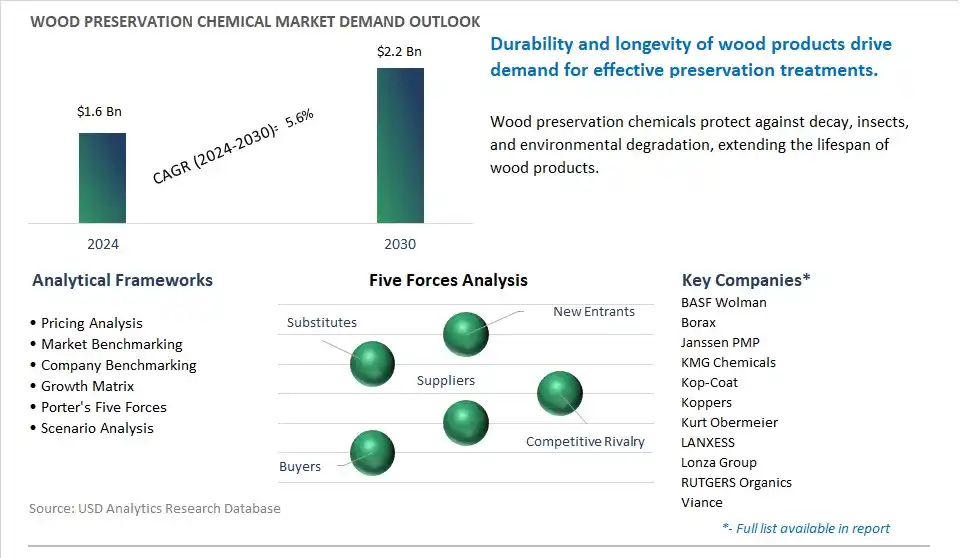
Wood Preservation Chemical Market Competitive Landscape
The market report analyses the leading companies in the industry including BASF Wolman, Borax, Janssen PMP, KMG Chemicals, Kop-Coat, Koppers, Kurt Obermeier, LANXESS, Lonza Group, RUTGERS Organics, Viance.
Wood Preservation Chemical Market Dynamics
Wood Preservation Chemical Market Trend: Growing Focus on Environmentally Friendly Solutions
A prominent trend in the wood preservation chemical market is the growing focus on environmentally friendly solutions. With increasing concerns about the environmental impact of chemicals used in wood treatment processes, there is a rising demand for eco-friendly alternatives that minimize harm to the environment and human health. Manufacturers and consumers alike are seeking wood preservation chemicals that are free from toxic substances such as arsenic, chromium, and creosote, and that comply with stringent environmental regulations. This trend is driven by regulatory pressures, consumer preferences for sustainable products, and industry initiatives to promote responsible forestry practices and green building standards.
Wood Preservation Chemical Market Driver: Expansion of Construction and Infrastructure Development
The primary driver for the wood preservation chemical market is the expansion of construction and infrastructure development activities worldwide. As populations grow and urbanization accelerates, there is an increasing demand for wood products in residential, commercial, and infrastructure projects, including bridges, railway ties, utility poles, and building structures. Wood preservation chemicals play a crucial role in protecting wood against decay, insect infestation, and weathering, thereby extending its service life and ensuring the durability and safety of wooden structures. Factors such as population growth, economic development, and investments in infrastructure drive the need for wood preservation chemicals, stimulating market growth.
Wood Preservation Chemical Market Opportunity: Development of Bio-Based and Non-Toxic Formulations
An opportunity for market advancement in the wood preservation chemical segment lies in the development of bio-based and non-toxic formulations. By investing in research and development, manufacturers can explore alternative ingredients and formulations derived from renewable sources such as plant extracts, natural oils, and biodegradable polymers. Bio-based wood preservation chemicals offer several advantages, including reduced environmental impact, lower toxicity, and improved compatibility with green building standards. Additionally, non-toxic formulations address concerns about health hazards associated with traditional wood preservatives, making them suitable for use in indoor applications such as furniture, flooring, and interior woodwork. By innovating towards sustainable and safer alternatives, manufacturers can meet the growing demand for environmentally friendly wood preservation solutions and gain a competitive edge in the market.
Wood Preservation Chemical Market Share Analysis: Water-based Wood Preservation Chemicals generated the highest revenue in 2024
Water-based wood preservation chemicals dominate the Wood Preservation Chemical Market as the largest segment. water-based formulations are environmentally friendly and comply with increasingly stringent regulations regarding chemical emissions and environmental impact. They contain lower levels of volatile organic compounds (VOCs) compared to oil-based counterparts, making them safer for both workers and the environment during application and throughout the lifespan of the treated wood. Additionally, water-based chemicals offer excellent penetration and adhesion properties, effectively protecting wood against decay, rot, fungi, and insect infestation. Further, water-based formulations are versatile and suitable for various wood species and applications, including residential and commercial construction, landscaping, and outdoor furniture. Their ease of application, quick drying time, and compatibility with existing wood treatment processes contribute to their widespread adoption in the market. As sustainability and environmental consciousness continue to drive consumer and industry preferences, the demand for water-based wood preservation chemicals is expected to further increase, solidifying their position as the largest segment in the Wood Preservation Chemical Market.
Wood Preservation Chemical Market Share Analysis: Railway Wood segment is poised to register the fastest growth rate (CAGR) over the forecast period to 2030
The fastest-growing segment in the Wood Preservation Chemical Market is the Railway Wood category. railway wood is subjected to harsh environmental conditions and heavy loads, making it prone to decay, rot, and insect damage. Accordingly, there is a critical need to enhance the durability and longevity of railway wood to ensure the safety and reliability of railway infrastructure. Wood preservation chemicals play a crucial role in protecting railway wood against biological degradation, extending its service life and reducing maintenance costs. Additionally, railway networks are expanding globally, driven by urbanization, population growth, and the need for efficient transportation systems. As new railway lines are constructed and existing ones are upgraded or expanded, the demand for treated railway wood is expected to increase significantly. Further, advancements in wood preservation technology, including the development of more effective and environmentally friendly chemical formulations, are driving adoption in the railway sector. Furthermore, government initiatives aimed at improving railway infrastructure and safety standards further fuel the demand for wood preservation chemicals in the railway industry. As a result of these factors, the railway wood application segment is experiencing rapid growth in the Wood Preservation Chemical Market.
Wood Preservation Chemical Market Report Segmentation
By Type
Water-based
Oil-based
By Application
Wood Floor
Railway Wood
Public Buildings
Others
Regions Included
North America (US, Canada, Mexico)
Europe (Germany, UK, France, Spain, Italy, Russia, Rest of Europe)
Asia Pacific (China, India, Japan, South Korea, Australia, South East Asia, Rest of Asia)
South America (Brazil, Argentina, Rest of South America)
Middle East and Africa (Saudi Arabia, UAE, Rest of Middle East, South Africa, Egypt, Rest of Africa)
Wood Preservation Chemical Companies Profiled in the Market Study
BASF Wolman
Borax
Janssen PMP
KMG Chemicals
Kop-Coat
Koppers
Kurt Obermeier
LANXESS
Lonza Group
RUTGERS Organics
Viance
*- List Not Exhaustive
TABLE OF CONTENTS
1 Introduction to 2024 Wood Preservation Chemical Market
1.1 Market Overview
1.2 Quick Facts
1.3 Scope/Objective of the Study
1.4 Market Definition
1.5 Countries and Regions Covered
1.6 Units, Currency, and Conversions
1.7 Industry Value Chain
2 Research Methodology
2.1 Market Size Estimation
2.2 Sources and Research Methodology
2.3 Data Triangulation
2.4 Assumptions and Limitations
3 Executive Summary
3.1 Global Wood Preservation Chemical Market Size Outlook, $ Million, 2021 to 2030
3.2 Wood Preservation Chemical Market Outlook by Type, $ Million, 2021 to 2030
3.3 Wood Preservation Chemical Market Outlook by Product, $ Million, 2021 to 2030
3.4 Wood Preservation Chemical Market Outlook by Application, $ Million, 2021 to 2030
3.5 Wood Preservation Chemical Market Outlook by Key Countries, $ Million, 2021 to 2030
4 Market Dynamics
4.1 Key Driving Forces of Wood Preservation Chemical Industry
4.2 Key Market Trends in Wood Preservation Chemical Industry
4.3 Potential Opportunities in Wood Preservation Chemical Industry
4.4 Key Challenges in Wood Preservation Chemical Industry
5 Market Factor Analysis
5.1 Value Chain Analysis
5.2 Competitive Landscape
5.2.1 Global Wood Preservation Chemical Market Share by Company (%), 2023
5.2.2 Product Offerings by Company
5.3 Porter’s Five Forces Analysis
5.4 Pricing Analysis and Outlook
6 Growth Outlook Across Scenarios
6.1 Growth Analysis-Case Scenario Definitions
6.2 Low Growth Scenario Forecasts
6.3 Reference Growth Scenario Forecasts
6.4 High Growth Scenario Forecasts
7 Global Wood Preservation Chemical Market Outlook by Segments
7.1 Wood Preservation Chemical Market Outlook by Segments, $ Million, 2021- 2030
By Type
Water-based
Oil-based
By Application
Wood Floor
Railway Wood
Public Buildings
Others
8 North America Wood Preservation Chemical Market Analysis and Outlook To 2030
8.1 Introduction to North America Wood Preservation Chemical Markets in 2024
8.2 North America Wood Preservation Chemical Market Size Outlook by Country, 2021-2030
8.2.1 United States
8.2.2 Canada
8.2.3 Mexico
8.3 North America Wood Preservation Chemical Market size Outlook by Segments, 2021-2030
By Type
Water-based
Oil-based
By Application
Wood Floor
Railway Wood
Public Buildings
Others
9 Europe Wood Preservation Chemical Market Analysis and Outlook To 2030
9.1 Introduction to Europe Wood Preservation Chemical Markets in 2024
9.2 Europe Wood Preservation Chemical Market Size Outlook by Country, 2021-2030
9.2.1 Germany
9.2.2 France
9.2.3 Spain
9.2.4 United Kingdom
9.2.4 Italy
9.2.5 Russia
9.2.6 Norway
9.2.7 Rest of Europe
9.3 Europe Wood Preservation Chemical Market Size Outlook by Segments, 2021-2030
By Type
Water-based
Oil-based
By Application
Wood Floor
Railway Wood
Public Buildings
Others
10 Asia Pacific Wood Preservation Chemical Market Analysis and Outlook To 2030
10.1 Introduction to Asia Pacific Wood Preservation Chemical Markets in 2024
10.2 Asia Pacific Wood Preservation Chemical Market Size Outlook by Country, 2021-2030
10.2.1 China
10.2.2 India
10.2.3 Japan
10.2.4 South Korea
10.2.5 Indonesia
10.2.6 Malaysia
10.2.7 Australia
10.2.8 Rest of Asia Pacific
10.3 Asia Pacific Wood Preservation Chemical Market size Outlook by Segments, 2021-2030
By Type
Water-based
Oil-based
By Application
Wood Floor
Railway Wood
Public Buildings
Others
11 South America Wood Preservation Chemical Market Analysis and Outlook To 2030
11.1 Introduction to South America Wood Preservation Chemical Markets in 2024
11.2 South America Wood Preservation Chemical Market Size Outlook by Country, 2021-2030
11.2.1 Brazil
11.2.2 Argentina
11.2.3 Rest of South America
11.3 South America Wood Preservation Chemical Market size Outlook by Segments, 2021-2030
By Type
Water-based
Oil-based
By Application
Wood Floor
Railway Wood
Public Buildings
Others
12 Middle East and Africa Wood Preservation Chemical Market Analysis and Outlook To 2030
12.1 Introduction to Middle East and Africa Wood Preservation Chemical Markets in 2024
12.2 Middle East and Africa Wood Preservation Chemical Market Size Outlook by Country, 2021-2030
12.2.1 Saudi Arabia
12.2.2 UAE
12.2.3 Oman
12.2.4 Rest of Middle East
12.2.5 Egypt
12.2.6 Nigeria
12.2.7 South Africa
12.2.8 Rest of Africa
12.3 Middle East and Africa Wood Preservation Chemical Market size Outlook by Segments, 2021-2030
By Type
Water-based
Oil-based
By Application
Wood Floor
Railway Wood
Public Buildings
Others
13 Company Profiles
13.1 Company Snapshot
13.2 SWOT Profiles
13.3 Products and Services
13.4 Recent Developments
13.5 Financial Profile
BASF Wolman
Borax
Janssen PMP
KMG Chemicals
Kop-Coat
Koppers
Kurt Obermeier
LANXESS
Lonza Group
RUTGERS Organics
Viance
14 Appendix
14.1 Customization Offerings
14.2 Subscription Services
14.3 Related Reports
14.4 Publisher Expertise
By Type
Water-based
Oil-based
By Application
Wood Floor
Railway Wood
Public Buildings
Others
Countries Analyzed
North America (US, Canada, Mexico)
Europe (Germany, UK, France, Spain, Italy, Russia, Rest of Europe)
Asia Pacific (China, India, Japan, South Korea, Australia, South East Asia, Rest of Asia)
South America (Brazil, Argentina, Rest of South America)
Middle East and Africa (Saudi Arabia, UAE, Rest of Middle East, South Africa, Egypt, Rest of Africa)
