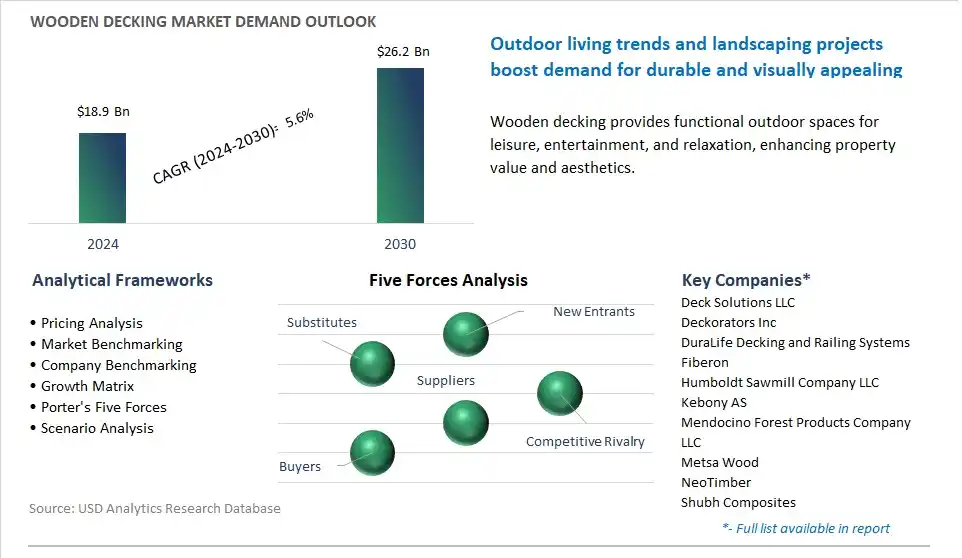
The global Wooden Decking Market is poised to register a 5.6% CAGR from $18.9 Billion in 2024 to $26.2 Billion in 2030.
The global Wooden Decking Market Study analyzes and forecasts the market size across 6 regions and 24 countries for diverse segments -By Type (Pressure-treated Wood, RedWood, Tropical Hardwood, Cedar, Wood-Plastic Composites (WPC), Others), By Application (Railing, Floor, Wall, Others), By End-User (Residential, Non-residential).
An Introduction to Global Wooden Decking Market in 2024
The wooden decking market is witnessing steady growth driven by residential construction, outdoor living trends, and the increasing popularity of decking as a functional and aesthetic element in landscaping and outdoor spaces. Wooden decks provide a versatile and durable outdoor flooring solution, offering homeowners and commercial property developers an opportunity to extend living and entertainment areas into the outdoors. Key trends shaping the future of the wooden decking industry include the adoption of sustainable forestry practices and responsible sourcing of wood materials to meet environmental regulations and consumer sustainability preferences. Moreover, with advancements in wood treatment technologies and preservatives, there is a trend towards the development of high-performance decking materials with enhanced resistance to decay, rot, insects, and weathering, ensuring long-term durability and low maintenance requirements. Additionally, innovations in decking design and installation systems are enabling easier and faster assembly, as well as customization options to accommodate various architectural styles and site conditions. Furthermore, with the growing focus on outdoor leisure and wellness, there is an increasing demand for eco-friendly and low-toxicity decking materials, as well as innovative features such as slip resistance, heat reflection, and integrated lighting and drainage systems, enhancing safety, comfort, and usability of wooden decks in residential and commercial applications.
Wooden Decking Market Competitive Landscape
The market report analyses the leading companies in the industry including Deck Solutions LLC, Deckorators Inc, DuraLife Decking and Railing Systems, Fiberon, Humboldt Sawmill Company LLC, Kebony AS, Mendocino Forest Products Company LLC, Metsa Wood, NeoTimber, Shubh Composites, Tecnodeck, The AZEK Company LLC, Thermory, Trex Company Inc, United Construction Products Inc.
Wooden Decking Market Dynamics
Wooden Decking Market Trend: Increased Demand for Outdoor Living Spaces
A prominent trend in the wooden decking market is the increased demand for outdoor living spaces. With more people spending time at home and seeking ways to enhance their outdoor environments, there's a growing interest in creating functional and aesthetically pleasing outdoor living areas. Wooden decking provides an ideal solution for extending living spaces outdoors, allowing homeowners to create areas for relaxation, entertaining, and dining. This trend is driven by lifestyle preferences, urbanization, and a desire to connect with nature, prompting homeowners to invest in decking projects to beautify their outdoor spaces and increase property value.
Wooden Decking Market Driver: Growth in Residential Construction and Remodeling
The primary driver for the wooden decking market is the growth in residential construction and remodeling activities. As housing markets rebound and homeowners undertake renovation projects, there's a steady demand for decking materials to enhance outdoor areas such as patios, balconies, and backyard decks. Wooden decking, known for its natural beauty, versatility, and durability, remains a popular choice among homeowners and builders for outdoor flooring solutions. Factors such as population growth, housing affordability, and the desire for outdoor leisure spaces drive the demand for wooden decking, stimulating market growth.
Wooden Decking Market Opportunity: Expansion into Sustainable and Low-Maintenance Decking Solutions
An opportunity for market advancement in the wooden decking segment lies in the expansion into sustainable and low-maintenance decking solutions. With increasing concerns about environmental sustainability and the desire for hassle-free outdoor living, there's a growing demand for decking materials that offer both eco-friendly attributes and reduced maintenance requirements. Manufacturers can capitalize on this opportunity by developing decking products made from sustainable wood sources, recycled materials, or alternative decking materials such as composite wood or PVC. Additionally, offering low-maintenance decking options that resist fading, staining, and mold growth can appeal to homeowners seeking easy-to-care-for outdoor spaces. By aligning with sustainability goals and addressing consumer preferences for convenience and durability, manufacturers can differentiate their products in the market and capture a larger share of the growing demand for wooden decking.
Wooden Decking Market Share Analysis: Pressure-treated Wood generated the highest revenue in 2024
The largest segment in the Wooden Decking Market is the Pressure-treated Wood category. pressure-treated wood offers a cost-effective solution for decking applications, making it highly accessible to a wide range of consumers. This type of wood is treated with chemical preservatives under high pressure, which enhances its durability and resistance to decay, rot, and insect damage. Additionally, pressure-treated wood is readily available in various dimensions and grades, allowing for versatile design options to suit different decking requirements and budget constraints. Further, pressure-treated wood is easy to work with and install, making it a popular choice for both DIY enthusiasts and professional contractors. Furthermore, pressure-treated wood decking has a long lifespan when properly maintained, offering excellent value for money over the years. Further, pressure-treated wood decking is compatible with various finishing options such as stains and sealants, allowing homeowners to customize the appearance of their decks according to their preferences. Lastly, pressure-treated wood is widely recognized and trusted for its reliability and performance, making it the preferred choice for decking projects in residential, commercial, and industrial settings. These factors contribute to the dominance of pressure-treated wood as the largest segment in the Wooden Decking Market.
Wooden Decking Market Share Analysis: Floor segment is poised to register the fastest growth rate (CAGR) over the forecast period to 2030
The fastest-growing segment in the Wooden Decking Market is the Floor application category. Diverse factors contribute to the rapid growth of wooden decking in floor applications. outdoor living spaces have become increasingly popular, with homeowners seeking to extend their living areas outdoors for relaxation, entertainment, and recreation purposes. Wooden decking provides an attractive and functional flooring solution for outdoor decks, patios, and terraces, enhancing the aesthetics and usability of these spaces. Additionally, advancements in wood treatment and finishing technologies have improved the durability and performance of wooden decking, making it suitable for outdoor use in various climates and environments. Further, the COVID-19 pandemic has accelerated the trend towards outdoor living, as people spend more time at home and seek safe and comfortable outdoor spaces for socializing and leisure activities. Accordingly, there is a growing demand for wooden decking to create functional and inviting outdoor floors that blend seamlessly with the natural surroundings. Furthermore, wooden decking offers versatility in design, with options for different wood species, colors, textures, and installation patterns to suit individual preferences and architectural styles. Additionally, wooden decking is relatively easy to install and maintain, making it a practical choice for homeowners and contractors alike. Over the forecast period, the floor application segment is experiencing rapid growth in the Wooden Decking Market due to increasing demand for outdoor living spaces and the versatility, durability, and aesthetic appeal of wooden decking for flooring applications.
Wooden Decking Market Share Analysis: Residential segment is poised to register the fastest growth rate (CAGR) over the forecast period to 2030
The fastest-growing segment in the Wooden Decking Market is the Residential end-user category. Diverse factors contribute to the rapid growth of wooden decking in residential applications. There is a growing trend towards outdoor living spaces among homeowners, driven by a desire for outdoor relaxation, entertainment, and recreation areas. Wooden decking provides an attractive and versatile flooring solution for residential decks, patios, balconies, and terraces, enhancing the aesthetic appeal and functionality of outdoor areas. Additionally, the COVID-19 pandemic has accelerated the demand for residential outdoor spaces as people spend more time at home and seek safe and comfortable environments for socializing, dining, and leisure activities. Accordingly, there is a heightened interest in creating inviting outdoor living spaces with features such as wooden decks, pergolas, and outdoor kitchens. Further, wooden decking offers homeowners a wide range of design options, including different wood species, colors, finishes, and installation patterns, allowing them to customize their outdoor spaces according to their preferences and lifestyle. Furthermore, wooden decking is relatively easy to install and maintain, making it an attractive choice for DIY enthusiasts and professional contractors alike. Over the forecast period, the residential segment is experiencing rapid growth in the Wooden Decking Market due to increasing demand for outdoor living spaces, the versatility and aesthetic appeal of wooden decking, and the desire for comfortable and functional outdoor environments among homeowners.
Wooden Decking Market Report Segmentation
By Type
Pressure-treated Wood
RedWood
Tropical Hardwood
Cedar
Wood-Plastic Composites (WPC)
Others
By Application
Railing
Floor
Wall
Others
By End-User
Residential
Non-residential
Regions Included
North America (US, Canada, Mexico)
Europe (Germany, UK, France, Spain, Italy, Russia, Rest of Europe)
Asia Pacific (China, India, Japan, South Korea, Australia, South East Asia, Rest of Asia)
South America (Brazil, Argentina, Rest of South America)
Middle East and Africa (Saudi Arabia, UAE, Rest of Middle East, South Africa, Egypt, Rest of Africa)
Wooden Decking Companies Profiled in the Market Study
Deck Solutions LLC
Deckorators Inc
DuraLife Decking and Railing Systems
Fiberon
Humboldt Sawmill Company LLC
Kebony AS
Mendocino Forest Products Company LLC
Metsa Wood
NeoTimber
Shubh Composites
Tecnodeck
The AZEK Company LLC
Thermory
Trex Company Inc
United Construction Products Inc
*- List Not Exhaustive
TABLE OF CONTENTS
1 Introduction to 2024 Wooden Decking Market
1.1 Market Overview
1.2 Quick Facts
1.3 Scope/Objective of the Study
1.4 Market Definition
1.5 Countries and Regions Covered
1.6 Units, Currency, and Conversions
1.7 Industry Value Chain
2 Research Methodology
2.1 Market Size Estimation
2.2 Sources and Research Methodology
2.3 Data Triangulation
2.4 Assumptions and Limitations
3 Executive Summary
3.1 Global Wooden Decking Market Size Outlook, $ Million, 2021 to 2030
3.2 Wooden Decking Market Outlook by Type, $ Million, 2021 to 2030
3.3 Wooden Decking Market Outlook by Product, $ Million, 2021 to 2030
3.4 Wooden Decking Market Outlook by Application, $ Million, 2021 to 2030
3.5 Wooden Decking Market Outlook by Key Countries, $ Million, 2021 to 2030
4 Market Dynamics
4.1 Key Driving Forces of Wooden Decking Industry
4.2 Key Market Trends in Wooden Decking Industry
4.3 Potential Opportunities in Wooden Decking Industry
4.4 Key Challenges in Wooden Decking Industry
5 Market Factor Analysis
5.1 Value Chain Analysis
5.2 Competitive Landscape
5.2.1 Global Wooden Decking Market Share by Company (%), 2023
5.2.2 Product Offerings by Company
5.3 Porter’s Five Forces Analysis
5.4 Pricing Analysis and Outlook
6 Growth Outlook Across Scenarios
6.1 Growth Analysis-Case Scenario Definitions
6.2 Low Growth Scenario Forecasts
6.3 Reference Growth Scenario Forecasts
6.4 High Growth Scenario Forecasts
7 Global Wooden Decking Market Outlook by Segments
7.1 Wooden Decking Market Outlook by Segments, $ Million, 2021- 2030
By Type
Pressure-treated Wood
RedWood
Tropical Hardwood
Cedar
Wood-Plastic Composites (WPC)
Others
By Application
Railing
Floor
Wall
Others
By End-User
Residential
Non-residential
8 North America Wooden Decking Market Analysis and Outlook To 2030
8.1 Introduction to North America Wooden Decking Markets in 2024
8.2 North America Wooden Decking Market Size Outlook by Country, 2021-2030
8.2.1 United States
8.2.2 Canada
8.2.3 Mexico
8.3 North America Wooden Decking Market size Outlook by Segments, 2021-2030
By Type
Pressure-treated Wood
RedWood
Tropical Hardwood
Cedar
Wood-Plastic Composites (WPC)
Others
By Application
Railing
Floor
Wall
Others
By End-User
Residential
Non-residential
9 Europe Wooden Decking Market Analysis and Outlook To 2030
9.1 Introduction to Europe Wooden Decking Markets in 2024
9.2 Europe Wooden Decking Market Size Outlook by Country, 2021-2030
9.2.1 Germany
9.2.2 France
9.2.3 Spain
9.2.4 United Kingdom
9.2.4 Italy
9.2.5 Russia
9.2.6 Norway
9.2.7 Rest of Europe
9.3 Europe Wooden Decking Market Size Outlook by Segments, 2021-2030
By Type
Pressure-treated Wood
RedWood
Tropical Hardwood
Cedar
Wood-Plastic Composites (WPC)
Others
By Application
Railing
Floor
Wall
Others
By End-User
Residential
Non-residential
10 Asia Pacific Wooden Decking Market Analysis and Outlook To 2030
10.1 Introduction to Asia Pacific Wooden Decking Markets in 2024
10.2 Asia Pacific Wooden Decking Market Size Outlook by Country, 2021-2030
10.2.1 China
10.2.2 India
10.2.3 Japan
10.2.4 South Korea
10.2.5 Indonesia
10.2.6 Malaysia
10.2.7 Australia
10.2.8 Rest of Asia Pacific
10.3 Asia Pacific Wooden Decking Market size Outlook by Segments, 2021-2030
By Type
Pressure-treated Wood
RedWood
Tropical Hardwood
Cedar
Wood-Plastic Composites (WPC)
Others
By Application
Railing
Floor
Wall
Others
By End-User
Residential
Non-residential
11 South America Wooden Decking Market Analysis and Outlook To 2030
11.1 Introduction to South America Wooden Decking Markets in 2024
11.2 South America Wooden Decking Market Size Outlook by Country, 2021-2030
11.2.1 Brazil
11.2.2 Argentina
11.2.3 Rest of South America
11.3 South America Wooden Decking Market size Outlook by Segments, 2021-2030
By Type
Pressure-treated Wood
RedWood
Tropical Hardwood
Cedar
Wood-Plastic Composites (WPC)
Others
By Application
Railing
Floor
Wall
Others
By End-User
Residential
Non-residential
12 Middle East and Africa Wooden Decking Market Analysis and Outlook To 2030
12.1 Introduction to Middle East and Africa Wooden Decking Markets in 2024
12.2 Middle East and Africa Wooden Decking Market Size Outlook by Country, 2021-2030
12.2.1 Saudi Arabia
12.2.2 UAE
12.2.3 Oman
12.2.4 Rest of Middle East
12.2.5 Egypt
12.2.6 Nigeria
12.2.7 South Africa
12.2.8 Rest of Africa
12.3 Middle East and Africa Wooden Decking Market size Outlook by Segments, 2021-2030
By Type
Pressure-treated Wood
RedWood
Tropical Hardwood
Cedar
Wood-Plastic Composites (WPC)
Others
By Application
Railing
Floor
Wall
Others
By End-User
Residential
Non-residential
13 Company Profiles
13.1 Company Snapshot
13.2 SWOT Profiles
13.3 Products and Services
13.4 Recent Developments
13.5 Financial Profile
Deck Solutions LLC
Deckorators Inc
DuraLife Decking and Railing Systems
Fiberon
Humboldt Sawmill Company LLC
Kebony AS
Mendocino Forest Products Company LLC
Metsa Wood
NeoTimber
Shubh Composites
Tecnodeck
The AZEK Company LLC
Thermory
Trex Company Inc
United Construction Products Inc
14 Appendix
14.1 Customization Offerings
14.2 Subscription Services
14.3 Related Reports
14.4 Publisher Expertise
By Type
Pressure-treated Wood
RedWood
Tropical Hardwood
Cedar
Wood-Plastic Composites (WPC)
Others
By Application
Railing
Floor
Wall
Others
By End-User
Residential
Non-residential
Countries Analyzed
North America (US, Canada, Mexico)
Europe (Germany, UK, France, Spain, Italy, Russia, Rest of Europe)
Asia Pacific (China, India, Japan, South Korea, Australia, South East Asia, Rest of Asia)
South America (Brazil, Argentina, Rest of South America)
Middle East and Africa (Saudi Arabia, UAE, Rest of Middle East, South Africa, Egypt, Rest of Africa)
