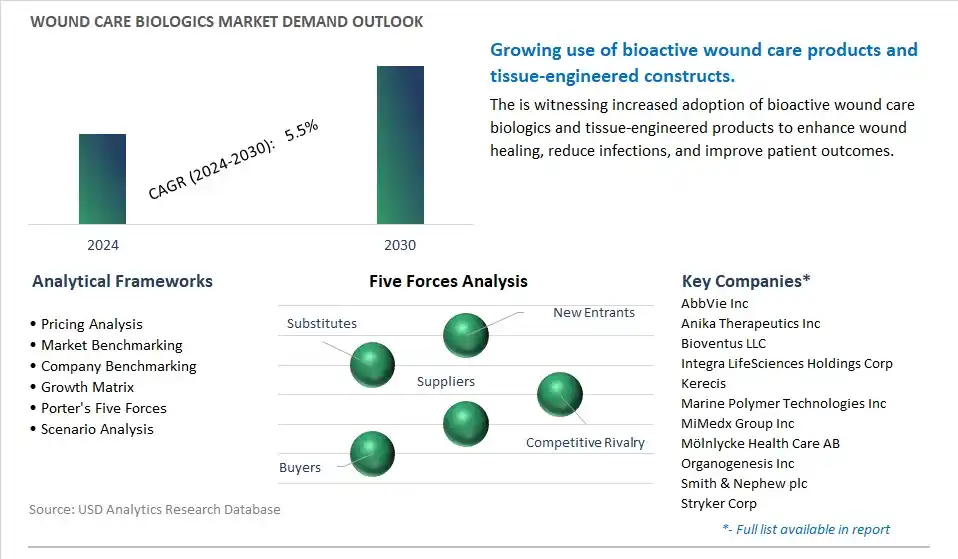
Wound Care Biologics Market is estimated to increase at a Compounded Annual Growth Rate of 5.5% CAGR over the forecast period from 2024 to 2030
The Wound Care Biologics Market study analyzes and forecasts the market size across 6 regions and 24 countries for diverse segments- By Product (Biological Skin Substitutes, Topical Agents), By Wound Type (Ulcers, Surgical & Traumatic Wounds, Burns), By End-User (Hospitals, Ambulatory Surgery Centers, Burn Care Centers & Wound Clinics).
An Introduction to Wound Care Biologics Market in 2024
Wound care biologics are advanced therapeutic products derived from biological sources such as human cells, growth factors, and extracellular matrices, designed to promote wound healing, tissue regeneration, and repair in acute and chronic wounds. In 2024, the field of wound care biologics experiences continued growth and innovation, driven by the demand for effective solutions to address the rising prevalence of chronic wounds, diabetic ulcers, and complex surgical wounds. By harnessing the regenerative properties of biological materials, wound care biologics offer unique mechanisms of action to accelerate wound closure, reduce inflammation, and enhance tissue regeneration, thereby improving healing outcomes and reducing the risk of complications. Moreover, with advancements in tissue engineering, biomaterials science, and cell therapy technologies, researchers are developing next-generation biologic products with enhanced efficacy, safety, and cost-effectiveness, paving the way for personalized wound care solutions tailored to individual patient needs. By offering innovative treatment options for challenging wound cases and improving quality of life for patients with chronic wounds, wound care biologics play a crucial role in advancing the field of wound management and promoting better patient outcomes in wound care practice.
Market Trend: Increasing Adoption of Advanced Wound Healing Technologies
A prominent trend in the wound care biologics market is the increasing adoption of advanced wound healing technologies. Healthcare providers are increasingly turning to biologic-based wound care products, such as growth factors, cytokines, and stem cells, to promote wound healing and tissue regeneration. This trend is driven by the growing recognition of the limitations of traditional wound care treatments and the desire for more effective and targeted solutions for complex wounds, including diabetic ulcers, pressure ulcers, and chronic wounds. Advanced wound care biologics offer the potential to accelerate healing, reduce complications, and improve outcomes for patients with difficult-to-treat wounds, driving their adoption in clinical practice and wound care management protocols.
Market Driver: Rising Incidence of Chronic Wounds and Surgical Procedures
The primary driver behind the growth of the wound care biologics market is the rising incidence of chronic wounds and surgical procedures. Factors such as an aging population, increasing prevalence of diabetes and obesity, and rising rates of surgical interventions contribute to a growing population at risk for chronic wounds and surgical site complications. Additionally, the growing demand for minimally invasive surgical procedures and the rising incidence of traumatic injuries further drive the need for advanced wound care solutions. As healthcare providers seek to improve patient outcomes and reduce healthcare costs associated with wound care management, there is a growing reliance on biologic-based products that stimulate tissue repair, enhance wound closure, and promote favorable healing environments.
Market Opportunity: Development of Next-Generation Biologic Therapies
An opportunity within the wound care biologics market lies in the development of next-generation biologic therapies that offer enhanced efficacy, safety, and convenience. With advancements in biotechnology and regenerative medicine, there is potential to develop novel biologic-based wound care products with improved therapeutic profiles and delivery systems. Opportunities exist for the development of biologic scaffolds, engineered growth factors, and cell-based therapies that address specific mechanisms involved in wound healing and tissue regeneration. Additionally, there is an opportunity to optimize the formulation and delivery of biologic therapies to maximize their therapeutic effects while minimizing adverse reactions and administration challenges. By investing in the development of next-generation biologic therapies, manufacturers can address unmet needs in wound care management, differentiate their products in the competitive market landscape, and contribute to improved patient outcomes in wound healing.
Wound Care Biologics Market Share Analysis: Biological Skin Substitutes is the fastest growing segment over the forecast period to 2030
The fastest-growing segment in the Wound Care Biologics Market is Biological Skin Substitutes, particularly propelled by the increasing demand for advanced wound healing solutions and the growing prevalence of chronic wounds. Biological skin substitutes, including human donor tissue-derived products, acellular animal-derived products, and biosynthetic products, offer innovative approaches to wound management by providing a scaffold for tissue regeneration and promoting healing. With the rising incidence of chronic wounds such as diabetic foot ulcers, venous ulcers, and pressure ulcers, there is a growing need for effective and durable wound care interventions. Biological skin substitutes offer several advantages over traditional wound care methods, including reduced healing time, enhanced wound closure rates, and decreased risk of infection. Additionally, the expanding adoption of biological skin substitutes across various healthcare settings, including hospitals, ambulatory surgery centers, and burn care centers & wound clinics, further contributes to their rapid growth. As healthcare providers increasingly prioritize advanced wound care solutions to improve patient outcomes and reduce healthcare costs associated with chronic wounds, the demand for biological skin substitutes is expected to continue surging, solidifying its position as a key driver of expansion in the Wound Care Biologics Market.
Wound Care Biologics Competitive Analysis
The market research study provides in-depth insights into leading companies including the SWOT analyses, product profile, financial details, and recent developments acrossAbbVie Inc, Anika Therapeutics Inc, Bioventus LLC, Integra LifeSciences Holdings Corp, Kerecis, Marine Polymer Technologies Inc, MiMedx Group Inc, Mölnlycke Health Care AB, Organogenesis Inc, Smith & Nephew plc, Stryker Corp, Vericel Corp
Wound Care Biologics Market Segmentation
By Product
Biological Skin Substitutes
-Human Donor Tissue-derived Products
-Acellular Animal-derived Products
-Biosynthetic Products
Topical Agents
By Wound Type
Ulcers
-Diabetic Foot Ulcers
-Venous Ulcers
-Pressure Ulcers
-Others
Surgical & Traumatic Wounds
Burns
By End-User
Hospitals
Ambulatory Surgery Centers
Burn Care Centers & Wound Clinics
Geographical Analysis
North America (United States, Canada, Mexico)
Europe (Germany, France, United Kingdom, Spain, Italy, Rest of Europe)
Asia Pacific (China, India, Japan, South Korea, Rest of Asia Pacific)
South America (Brazil, Argentina, Rest of South America)
Middle East and Africa (Saudi Arabia, UAE, Rest of Middle East, South Africa, Egypt, Rest of Africa)
Wound Care Biologics Market Companies
AbbVie Inc
Anika Therapeutics Inc
Bioventus LLC
Integra LifeSciences Holdings Corp
Kerecis
Marine Polymer Technologies Inc
MiMedx Group Inc
Mölnlycke Health Care AB
Organogenesis Inc
Smith & Nephew plc
Stryker Corp
Vericel Corp
Reasons to Buy the Wound Care Biologics Market Study
• Deepen your industry insights and navigate uncertainties for strategy formulation, CAPEX, and Operational decisions
• Gain access to detailed insights on the Wound Care Biologics Market, encompassing current market size, growth trends, and forecasts till 2030.
• Access detailed competitor analysis, enabling competitive advantage through a thorough understanding of market players, strategies, and potential differentiation opportunities
• Stay ahead of the curve with insights on technological advancements, innovations, and upcoming trends
• Identify lucrative investment avenues and expansion opportunities within the Wound Care Biologics Market industry, guided by robust, data-backed analysis.
• Understand regional and global markets through country-wise analysis, regional market potential, regulatory nuances, and dynamics
• Execute strategies with confidence and speed through information, analytics, and insights on the industry value chain
• Corporate leaders, strategists, financial experts, shareholders, asset managers, and governmental representatives can make long-term planning scenarios and build an integrated and timely understanding of market dynamics
• Benefit from tailored solutions and expert consultation based on report insights, providing personalized strategies aligned with specific business needs.
TABLE OF CONTENTS
1 Introduction to 2024 Wound Care Biologics Market
1.1 Market Overview
1.2 Quick Facts
1.3 Scope/Objective of the Study
1.4 Market Definition
1.5 Countries and Regions Covered
1.6 Units, Currency, and Conversions
1.7 Industry Value Chain
2 Research Methodology
2.1 Market Size Estimation
2.2 Sources and Research Methodology
2.3 Data Triangulation
2.4 Assumptions and Limitations
3 Executive Summary
3.1 Global Wound Care Biologics Market Size Outlook, $ Million, 2021 to 2030
3.2 Wound Care Biologics Market Outlook by Type, $ Million, 2021 to 2030
3.3 Wound Care Biologics Market Outlook by Product, $ Million, 2021 to 2030
3.4 Wound Care Biologics Market Outlook by Application, $ Million, 2021 to 2030
3.5 Wound Care Biologics Market Outlook by Key Countries, $ Million, 2021 to 2030
4 Market Dynamics
4.1 Key Driving Forces of Wound Care Biologics Industry
4.2 Key Market Trends in Wound Care Biologics Industry
4.3 Potential Opportunities in Wound Care Biologics Industry
4.4 Key Challenges in Wound Care Biologics Industry
5 Market Factor Analysis
5.1 Value Chain Analysis
5.2 Competitive Landscape
5.2.1 Global Wound Care Biologics Market Share by Company (%), 2023
5.2.2 Product Offerings by Company
5.3 Porter’s Five Forces Analysis
5.4 Pricing Analysis and Outlook
6 Growth Outlook Across Scenarios
6.1 Growth Analysis-Case Scenario Definitions
6.2 Low Growth Scenario Forecasts
6.3 Reference Growth Scenario Forecasts
6.4 High Growth Scenario Forecasts
7 Global Wound Care Biologics Market Outlook by Segments
7.1 Wound Care Biologics Market Outlook by Segments, $ Million, 2021- 2030
By Product
Biological Skin Substitutes
-Human Donor Tissue-derived Products
-Acellular Animal-derived Products
-Biosynthetic Products
Topical Agents
By Wound Type
Ulcers
-Diabetic Foot Ulcers
-Venous Ulcers
-Pressure Ulcers
-Others
Surgical & Traumatic Wounds
Burns
By End-User
Hospitals
Ambulatory Surgery Centers
Burn Care Centers & Wound Clinics
8 North America Wound Care Biologics Market Analysis and Outlook To 2030
8.1 Introduction to North America Wound Care Biologics Markets in 2024
8.2 North America Wound Care Biologics Market Size Outlook by Country, 2021-2030
8.2.1 United States
8.2.2 Canada
8.2.3 Mexico
8.3 North America Wound Care Biologics Market size Outlook by Segments, 2021-2030
By Product
Biological Skin Substitutes
-Human Donor Tissue-derived Products
-Acellular Animal-derived Products
-Biosynthetic Products
Topical Agents
By Wound Type
Ulcers
-Diabetic Foot Ulcers
-Venous Ulcers
-Pressure Ulcers
-Others
Surgical & Traumatic Wounds
Burns
By End-User
Hospitals
Ambulatory Surgery Centers
Burn Care Centers & Wound Clinics
9 Europe Wound Care Biologics Market Analysis and Outlook To 2030
9.1 Introduction to Europe Wound Care Biologics Markets in 2024
9.2 Europe Wound Care Biologics Market Size Outlook by Country, 2021-2030
9.2.1 Germany
9.2.2 France
9.2.3 Spain
9.2.4 United Kingdom
9.2.4 Italy
9.2.5 Russia
9.2.6 Norway
9.2.7 Rest of Europe
9.3 Europe Wound Care Biologics Market Size Outlook by Segments, 2021-2030
By Product
Biological Skin Substitutes
-Human Donor Tissue-derived Products
-Acellular Animal-derived Products
-Biosynthetic Products
Topical Agents
By Wound Type
Ulcers
-Diabetic Foot Ulcers
-Venous Ulcers
-Pressure Ulcers
-Others
Surgical & Traumatic Wounds
Burns
By End-User
Hospitals
Ambulatory Surgery Centers
Burn Care Centers & Wound Clinics
10 Asia Pacific Wound Care Biologics Market Analysis and Outlook To 2030
10.1 Introduction to Asia Pacific Wound Care Biologics Markets in 2024
10.2 Asia Pacific Wound Care Biologics Market Size Outlook by Country, 2021-2030
10.2.1 China
10.2.2 India
10.2.3 Japan
10.2.4 South Korea
10.2.5 Indonesia
10.2.6 Malaysia
10.2.7 Australia
10.2.8 Rest of Asia Pacific
10.3 Asia Pacific Wound Care Biologics Market size Outlook by Segments, 2021-2030
By Product
Biological Skin Substitutes
-Human Donor Tissue-derived Products
-Acellular Animal-derived Products
-Biosynthetic Products
Topical Agents
By Wound Type
Ulcers
-Diabetic Foot Ulcers
-Venous Ulcers
-Pressure Ulcers
-Others
Surgical & Traumatic Wounds
Burns
By End-User
Hospitals
Ambulatory Surgery Centers
Burn Care Centers & Wound Clinics
11 South America Wound Care Biologics Market Analysis and Outlook To 2030
11.1 Introduction to South America Wound Care Biologics Markets in 2024
11.2 South America Wound Care Biologics Market Size Outlook by Country, 2021-2030
11.2.1 Brazil
11.2.2 Argentina
11.2.3 Rest of South America
11.3 South America Wound Care Biologics Market size Outlook by Segments, 2021-2030
By Product
Biological Skin Substitutes
-Human Donor Tissue-derived Products
-Acellular Animal-derived Products
-Biosynthetic Products
Topical Agents
By Wound Type
Ulcers
-Diabetic Foot Ulcers
-Venous Ulcers
-Pressure Ulcers
-Others
Surgical & Traumatic Wounds
Burns
By End-User
Hospitals
Ambulatory Surgery Centers
Burn Care Centers & Wound Clinics
12 Middle East and Africa Wound Care Biologics Market Analysis and Outlook To 2030
12.1 Introduction to Middle East and Africa Wound Care Biologics Markets in 2024
12.2 Middle East and Africa Wound Care Biologics Market Size Outlook by Country, 2021-2030
12.2.1 Saudi Arabia
12.2.2 UAE
12.2.3 Oman
12.2.4 Rest of Middle East
12.2.5 Egypt
12.2.6 Nigeria
12.2.7 South Africa
12.2.8 Rest of Africa
12.3 Middle East and Africa Wound Care Biologics Market size Outlook by Segments, 2021-2030
By Product
Biological Skin Substitutes
-Human Donor Tissue-derived Products
-Acellular Animal-derived Products
-Biosynthetic Products
Topical Agents
By Wound Type
Ulcers
-Diabetic Foot Ulcers
-Venous Ulcers
-Pressure Ulcers
-Others
Surgical & Traumatic Wounds
Burns
By End-User
Hospitals
Ambulatory Surgery Centers
Burn Care Centers & Wound Clinics
13 Company Profiles
13.1 Company Snapshot
13.2 SWOT Profiles
13.3 Products and Services
13.4 Recent Developments
13.5 Financial Profile
List of Companies
AbbVie Inc
Anika Therapeutics Inc
Bioventus LLC
Integra LifeSciences Holdings Corp
Kerecis
Marine Polymer Technologies Inc
MiMedx Group Inc
Mölnlycke Health Care AB
Organogenesis Inc
Smith & Nephew plc
Stryker Corp
Vericel Corp
14 Appendix
14.1 Customization Offerings
14.2 Subscription Services
14.3 Related Reports
14.4 Publisher Expertise
By Product
Biological Skin Substitutes
-Human Donor Tissue-derived Products
-Acellular Animal-derived Products
-Biosynthetic Products
Topical Agents
By Wound Type
Ulcers
-Diabetic Foot Ulcers
-Venous Ulcers
-Pressure Ulcers
-Others
Surgical & Traumatic Wounds
Burns
By End-User
Hospitals
Ambulatory Surgery Centers
Burn Care Centers & Wound Clinics
Countries Analyzed
North America (United States, Canada, Mexico)
Europe (Germany, France, United Kingdom, Spain, Italy, Rest of Europe)
Asia Pacific (China, India, Japan, South Korea, Rest of Asia Pacific)
South America (Brazil, Argentina, Rest of South America)
Middle East and Africa (Saudi Arabia, UAE, Rest of Middle East, South Africa, Egypt, Rest of Africa)
