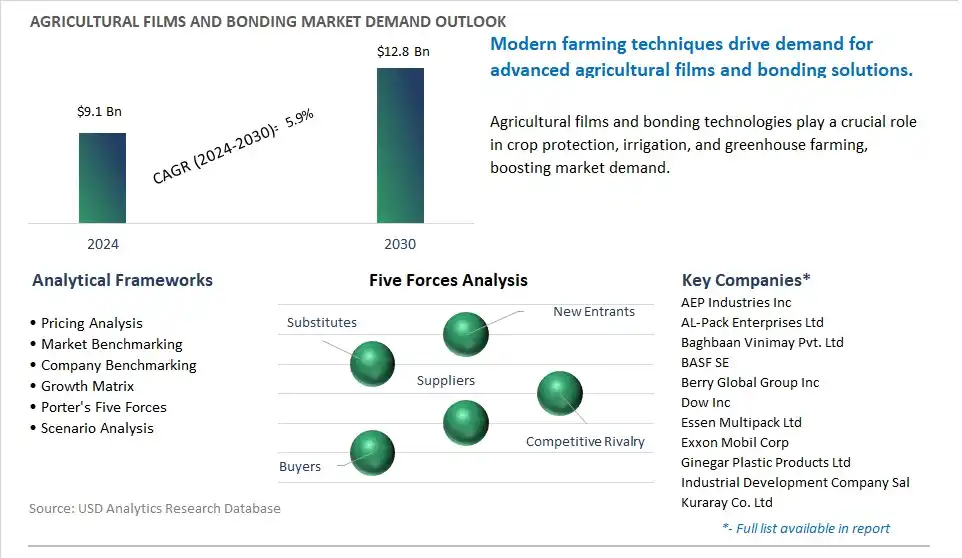
The global Agricultural Films and Bonding Market is poised to register a 5.9% CAGR from $9.1 Billion in 2024 to $12.8 Billion in 2030.
The global Agricultural Films and Bonding Market Study analyzes and forecasts the market size across 6 regions and 24 countries for diverse segments -By Product (Films, Twine, Nettings, Others), By Raw Material (Polypropylene (PP), Low-Density Polyethylene (LDPE), High-Density Polyethylene (HDPE), Ethylene-Vinyl Acetate (EVA), Reclaim, Others), By Color (Opaque, Transparent, Translucent), By Feature (Moisture Proof, Water Soluble), By Films (Stretch, Shrink, Metallized, Release, Twist), By Process (Blow Molding, Casting, Multiple Extrusion, Injection Molding), By Application (Greenhouse, Mulching, Silage, Vegetable Packing, Fruit Packing, Bale, Anti-Insects, Others).
An Introduction to Global Agricultural Films and Bonding Market in 2024
The agricultural films and bonding market is experiencing significant growth driven by the increasing adoption of greenhouse farming and high tunnel cultivation methods globally. Key trends shaping the future of the industry include the growing demand for mulch films, silage wraps, and greenhouse covers to optimize crop growth, improve yield, and conserve water resources. Moreover, there's a rising emphasis on technological innovations in film materials, such as biodegradable polymers and UV-stabilized films, to enhance durability and environmental sustainability. Additionally, advancements in bonding agents and adhesives for joining film seams and repairing tears are driving innovation and market expansion, enabling manufacturers to offer reliable and cost-effective solutions for diverse agricultural applications in the global agricultural films and bonding market.
Agricultural Films and Bonding Market Competitive Landscape
The market report analyses the leading companies in the industry including AEP Industries Inc, AL-Pack Enterprises Ltd, Baghbaan Vinimay Pvt. Ltd, BASF SE, Berry Global Group Inc, Dow Inc, Essen Multipack Ltd, Exxon Mobil Corp, Ginegar Plastic Products Ltd, Industrial Development Company Sal, Kuraray Co. Ltd, Mono Industries, Novamont S.p.A., RKW Group, Shivam Polymers.
Agricultural Films and Bonding Market Dynamics
Agricultural Films And Bonding Market Trend: Adoption of Advanced Mulching and Covering Techniques
A prominent market trend for agricultural films and bonding is the increasing adoption of advanced mulching and covering techniques. With the growing emphasis on sustainable agriculture and efficient crop management practices, farmers are turning to agricultural films and bonding solutions to improve soil moisture retention, control weed growth, and enhance crop protection. Advanced mulching films, including biodegradable films, photodegradable films, and reflective films, offer benefits such as increased soil temperature, reduced water evaporation, and improved nutrient uptake, contributing to higher crop yields and quality. The trend towards advanced mulching and covering techniques reflects the industry's ongoing efforts to optimize resource use efficiency, reduce environmental impact, and improve farm productivity.
Agricultural Films And Bonding Market Driver: Need for Crop Protection and Yield Optimization
A significant driver for the agricultural films and bonding market is the need for crop protection and yield optimization. As global population growth and food demand increase, there's mounting pressure on farmers to maximize crop yields while mitigating risks from pests, diseases, and adverse weather conditions. Agricultural films and bonding solutions play a crucial role in providing physical protection to crops, shielding them from external threats such as pests, weeds, wind, and hail. Additionally, films and bonding materials contribute to microclimate management, creating favorable growing conditions for crops and extending the growing season, particularly in regions with challenging climates. The imperative to safeguard crop yields and ensure food security drives market demand for agricultural films and bonding products, supporting industry growth and innovation in film technologies.
Agricultural Films And Bonding Market Opportunity: Development of Biodegradable and Recyclable Films
An opportunity for the agricultural films and bonding market lies in the development of biodegradable and recyclable films. With increasing environmental concerns and regulatory pressure to reduce plastic waste, there's growing demand for sustainable alternatives to traditional polyethylene films used in agriculture. Manufacturers have the opportunity to innovate and develop biodegradable films made from renewable materials such as bioplastics, starch-based polymers, and compostable polymers. Additionally, there's an opportunity to invest in research and development initiatives to improve the performance and durability of biodegradable films while ensuring compatibility with existing agricultural practices and equipment. By offering environmentally friendly film solutions that address sustainability challenges, agricultural films and bonding manufacturers can tap into new market segments, meet customer demand for eco-friendly products, and contribute to a more sustainable future for agriculture.
Agricultural Films and Bonding Market Share Analysis: Films segment generated the highest revenue in the industry
The largest segment in the Agricultural Films and Bonding Market is the Films category. This dominance can be attributed to diverse factors. Agricultural films, including mulch films, greenhouse films, and silage films, play a crucial role in modern agriculture by providing essential functions such as weed control, moisture retention, temperature regulation, and protection against pests and diseases. These films create a controlled environment for crop growth, enabling farmers to extend growing seasons, improve crop yields, and enhance crop quality. Mulch films, for example, help suppress weed growth, conserve soil moisture, and regulate soil temperature, leading to improved seed germination, root development, and Over the forecast period plant growth. Greenhouse films create a favorable microclimate for plant growth by trapping solar radiation, maintaining higher temperatures, and protecting crops from adverse weather conditions. Silage films are used to preserve forage crops by creating an anaerobic environment that inhibits microbial growth and reduces nutrient loss during storage. Additionally, advancements in film technology, such as the development of biodegradable and photodegradable films, have further expanded the application scope of agricultural films and driven their widespread adoption. These eco-friendly films address environmental concerns related to plastic pollution and offer sustainable alternatives for crop production. In addition, the growing demand for food security, increasing adoption of protected cultivation techniques, and rising investments in greenhouse farming contribute to the demand for agricultural films globally. Further, government subsidies, incentives, and regulations supporting the adoption of agricultural films for sustainable farming practices further fuel market growth. With their indispensable role in modern agriculture and diverse applications across various crop production systems, films remain the largest and most essential category in the Agricultural Films and Bonding Market.
Agricultural Films and Bonding Market Share Analysis: Ethylene-Vinyl Acetate (EVA) Segment is poised to register the fastest growth rate (CAGR) over the forecast period to 2030
The fastest-growing segment in the Agricultural Films and Bonding Market is the Ethylene-Vinyl Acetate (EVA) category. Diverse factors contribute to its rapid growth. EVA films offer unique properties and advantages that make them increasingly popular in agricultural applications. The EVA films provide excellent flexibility, elasticity, and puncture resistance, making them well-suited for use in greenhouse covers, mulch films, and silage bags. Their flexibility allows for easy installation and handling, while their puncture resistance ensures durability and longevity in harsh agricultural environments. Additionally, EVA films exhibit superior optical properties, such as high light transmission and diffusion, which promote uniform light distribution and optimize photosynthesis in crops, leading to improved growth and yield. In addition, EVA films offer good thermal insulation properties, helping to maintain stable temperatures inside greenhouses and protect crops from temperature fluctuations, frost, and heat stress. Further, EVA films are compatible with various agricultural chemicals and pesticides, allowing for safe and effective application without compromising film integrity or performance. Additionally, EVA films are increasingly preferred for their environmental sustainability characteristics. Unlike conventional polyethylene films, which are derived from fossil fuels and may contribute to plastic pollution, EVA films can be produced from renewable resources and are recyclable, biodegradable, or compostable, reducing environmental impact and meeting consumer demand for eco-friendly agricultural solutions. Further, advancements in EVA film manufacturing technology, including multi-layer co-extrusion and additive formulations, have enhanced film performance and expanded application possibilities, driving market growth. With their unique combination of properties, environmental benefits, and technological advancements, EVA films emerge as the fastest-growing segment in the Agricultural Films and Bonding Market.
Agricultural Films and Bonding Market Share Analysis: Transparent Segment is poised to register the fastest growth rate (CAGR) over the forecast period to 2030
The fastest-growing segment in the Agricultural Films and Bonding Market is the Transparent category. The rapid growth is driven by transparent films offer diverse advantages in agricultural applications. They allow for higher light transmission, which is essential for maximizing photosynthesis and promoting healthy plant growth. Transparent films enable better penetration of sunlight, ensuring that crops receive sufficient light energy for photosynthesis, even during periods of low sunlight or cloudy weather. Additionally, transparent films provide growers with better visibility and monitoring of crops, facilitating observation of plant health, pest infestations, and irrigation needs. This enhanced visibility allows for timely intervention and management practices, leading to improved crop yields and quality. In addition, transparent films create a warmer microclimate within greenhouses, helping to maintain optimal temperatures for crop growth, especially during cooler seasons or in colder climates. This thermal insulation property of transparent films contributes to extended growing seasons and increased productivity. Further, the increasing adoption of protected cultivation techniques, such as greenhouse farming and high-tunnel systems, drives the demand for transparent films. Growers recognize the benefits of transparent films in providing a controlled environment for crop production, reducing external environmental stresses, and enhancing crop performance and profitability. Additionally, advancements in film technology, such as UV stabilization, anti-condensation coatings, and anti-drip properties, further enhance the performance and durability of transparent films, driving their adoption in various agricultural settings. With their numerous benefits for crop production, enhanced light transmission, and improved growing conditions, transparent films emerge as the fastest-growing segment in the Agricultural Films and Bonding Market.
Agricultural Films and Bonding Market Report Segmentation
By Product
Films
Twine
Nettings
Others
By Raw Material
Polypropylene (PP)
Low-Density Polyethylene (LDPE)
High-Density Polyethylene (HDPE)
Ethylene-Vinyl Acetate (EVA)
Reclaim
Others
By Color
Opaque
Transparent
Translucent
By Feature
Moisture Proof
Water Soluble
By Films
Stretch
Shrink
Metallized
Release
Twist
By Process
Blow Molding
Casting
Multiple Extrusion
Injection Molding
By Application
Greenhouse
Mulching
Silage
Vegetable Packing
Fruit Packing
Bale
Anti-Insects
Others
Regions Included
North America (US, Canada, Mexico)
Europe (Germany, UK, France, Spain, Italy, Russia, Rest of Europe)
Asia Pacific (China, India, Japan, South Korea, Australia, South East Asia, Rest of Asia)
South America (Brazil, Argentina, Rest of South America)
Middle East and Africa (Saudi Arabia, UAE, Rest of Middle East, South Africa, Egypt, Rest of Africa)
Agricultural Films and Bonding Companies Profiled in the Market Study
AEP Industries Inc
AL-Pack Enterprises Ltd
Baghbaan Vinimay Pvt. Ltd
BASF SE
Berry Global Group Inc
Dow Inc
Essen Multipack Ltd
Exxon Mobil Corp
Ginegar Plastic Products Ltd
Industrial Development Company Sal
Kuraray Co. Ltd
Mono Industries
Novamont S.p.A.
RKW Group
Shivam Polymers
*- List Not Exhaustive
TABLE OF CONTENTS
1 Introduction to 2024 Agricultural Films and Bonding Market
1.1 Market Overview
1.2 Quick Facts
1.3 Scope/Objective of the Study
1.4 Market Definition
1.5 Countries and Regions Covered
1.6 Units, Currency, and Conversions
1.7 Industry Value Chain
2 Research Methodology
2.1 Market Size Estimation
2.2 Sources and Research Methodology
2.3 Data Triangulation
2.4 Assumptions and Limitations
3 Executive Summary
3.1 Global Agricultural Films and Bonding Market Size Outlook, $ Million, 2021 to 2030
3.2 Agricultural Films and Bonding Market Outlook by Type, $ Million, 2021 to 2030
3.3 Agricultural Films and Bonding Market Outlook by Product, $ Million, 2021 to 2030
3.4 Agricultural Films and Bonding Market Outlook by Application, $ Million, 2021 to 2030
3.5 Agricultural Films and Bonding Market Outlook by Key Countries, $ Million, 2021 to 2030
4 Market Dynamics
4.1 Key Driving Forces of Agricultural Films and Bonding Industry
4.2 Key Market Trends in Agricultural Films and Bonding Industry
4.3 Potential Opportunities in Agricultural Films and Bonding Industry
4.4 Key Challenges in Agricultural Films and Bonding Industry
5 Market Factor Analysis
5.1 Value Chain Analysis
5.2 Competitive Landscape
5.2.1 Global Agricultural Films and Bonding Market Share by Company (%), 2023
5.2.2 Product Offerings by Company
5.3 Porter’s Five Forces Analysis
5.4 Pricing Analysis and Outlook
6 Growth Outlook Across Scenarios
6.1 Growth Analysis-Case Scenario Definitions
6.2 Low Growth Scenario Forecasts
6.3 Reference Growth Scenario Forecasts
6.4 High Growth Scenario Forecasts
7 Global Agricultural Films and Bonding Market Outlook by Segments
7.1 Agricultural Films and Bonding Market Outlook by Segments, $ Million, 2021- 2030
By Product
Films
Twine
Nettings
Others
By Raw Material
Polypropylene (PP)
Low-Density Polyethylene (LDPE)
High-Density Polyethylene (HDPE)
Ethylene-Vinyl Acetate (EVA)
Reclaim
Others
By Color
Opaque
Transparent
Translucent
By Feature
Moisture Proof
Water Soluble
By Films
Stretch
Shrink
Metallized
Release
Twist
By Process
Blow Molding
Casting
Multiple Extrusion
Injection Molding
By Application
Greenhouse
Mulching
Silage
Vegetable Packing
Fruit Packing
Bale
Anti-Insects
Others
8 North America Agricultural Films and Bonding Market Analysis and Outlook To 2030
8.1 Introduction to North America Agricultural Films and Bonding Markets in 2024
8.2 North America Agricultural Films and Bonding Market Size Outlook by Country, 2021-2030
8.2.1 United States
8.2.2 Canada
8.2.3 Mexico
8.3 North America Agricultural Films and Bonding Market size Outlook by Segments, 2021-2030
By Product
Films
Twine
Nettings
Others
By Raw Material
Polypropylene (PP)
Low-Density Polyethylene (LDPE)
High-Density Polyethylene (HDPE)
Ethylene-Vinyl Acetate (EVA)
Reclaim
Others
By Color
Opaque
Transparent
Translucent
By Feature
Moisture Proof
Water Soluble
By Films
Stretch
Shrink
Metallized
Release
Twist
By Process
Blow Molding
Casting
Multiple Extrusion
Injection Molding
By Application
Greenhouse
Mulching
Silage
Vegetable Packing
Fruit Packing
Bale
Anti-Insects
Others
9 Europe Agricultural Films and Bonding Market Analysis and Outlook To 2030
9.1 Introduction to Europe Agricultural Films and Bonding Markets in 2024
9.2 Europe Agricultural Films and Bonding Market Size Outlook by Country, 2021-2030
9.2.1 Germany
9.2.2 France
9.2.3 Spain
9.2.4 United Kingdom
9.2.4 Italy
9.2.5 Russia
9.2.6 Norway
9.2.7 Rest of Europe
9.3 Europe Agricultural Films and Bonding Market Size Outlook by Segments, 2021-2030
By Product
Films
Twine
Nettings
Others
By Raw Material
Polypropylene (PP)
Low-Density Polyethylene (LDPE)
High-Density Polyethylene (HDPE)
Ethylene-Vinyl Acetate (EVA)
Reclaim
Others
By Color
Opaque
Transparent
Translucent
By Feature
Moisture Proof
Water Soluble
By Films
Stretch
Shrink
Metallized
Release
Twist
By Process
Blow Molding
Casting
Multiple Extrusion
Injection Molding
By Application
Greenhouse
Mulching
Silage
Vegetable Packing
Fruit Packing
Bale
Anti-Insects
Others
10 Asia Pacific Agricultural Films and Bonding Market Analysis and Outlook To 2030
10.1 Introduction to Asia Pacific Agricultural Films and Bonding Markets in 2024
10.2 Asia Pacific Agricultural Films and Bonding Market Size Outlook by Country, 2021-2030
10.2.1 China
10.2.2 India
10.2.3 Japan
10.2.4 South Korea
10.2.5 Indonesia
10.2.6 Malaysia
10.2.7 Australia
10.2.8 Rest of Asia Pacific
10.3 Asia Pacific Agricultural Films and Bonding Market size Outlook by Segments, 2021-2030
By Product
Films
Twine
Nettings
Others
By Raw Material
Polypropylene (PP)
Low-Density Polyethylene (LDPE)
High-Density Polyethylene (HDPE)
Ethylene-Vinyl Acetate (EVA)
Reclaim
Others
By Color
Opaque
Transparent
Translucent
By Feature
Moisture Proof
Water Soluble
By Films
Stretch
Shrink
Metallized
Release
Twist
By Process
Blow Molding
Casting
Multiple Extrusion
Injection Molding
By Application
Greenhouse
Mulching
Silage
Vegetable Packing
Fruit Packing
Bale
Anti-Insects
Others
11 South America Agricultural Films and Bonding Market Analysis and Outlook To 2030
11.1 Introduction to South America Agricultural Films and Bonding Markets in 2024
11.2 South America Agricultural Films and Bonding Market Size Outlook by Country, 2021-2030
11.2.1 Brazil
11.2.2 Argentina
11.2.3 Rest of South America
11.3 South America Agricultural Films and Bonding Market size Outlook by Segments, 2021-2030
By Product
Films
Twine
Nettings
Others
By Raw Material
Polypropylene (PP)
Low-Density Polyethylene (LDPE)
High-Density Polyethylene (HDPE)
Ethylene-Vinyl Acetate (EVA)
Reclaim
Others
By Color
Opaque
Transparent
Translucent
By Feature
Moisture Proof
Water Soluble
By Films
Stretch
Shrink
Metallized
Release
Twist
By Process
Blow Molding
Casting
Multiple Extrusion
Injection Molding
By Application
Greenhouse
Mulching
Silage
Vegetable Packing
Fruit Packing
Bale
Anti-Insects
Others
12 Middle East and Africa Agricultural Films and Bonding Market Analysis and Outlook To 2030
12.1 Introduction to Middle East and Africa Agricultural Films and Bonding Markets in 2024
12.2 Middle East and Africa Agricultural Films and Bonding Market Size Outlook by Country, 2021-2030
12.2.1 Saudi Arabia
12.2.2 UAE
12.2.3 Oman
12.2.4 Rest of Middle East
12.2.5 Egypt
12.2.6 Nigeria
12.2.7 South Africa
12.2.8 Rest of Africa
12.3 Middle East and Africa Agricultural Films and Bonding Market size Outlook by Segments, 2021-2030
By Product
Films
Twine
Nettings
Others
By Raw Material
Polypropylene (PP)
Low-Density Polyethylene (LDPE)
High-Density Polyethylene (HDPE)
Ethylene-Vinyl Acetate (EVA)
Reclaim
Others
By Color
Opaque
Transparent
Translucent
By Feature
Moisture Proof
Water Soluble
By Films
Stretch
Shrink
Metallized
Release
Twist
By Process
Blow Molding
Casting
Multiple Extrusion
Injection Molding
By Application
Greenhouse
Mulching
Silage
Vegetable Packing
Fruit Packing
Bale
Anti-Insects
Others
13 Company Profiles
13.1 Company Snapshot
13.2 SWOT Profiles
13.3 Products and Services
13.4 Recent Developments
13.5 Financial Profile
AEP Industries Inc
AL-Pack Enterprises Ltd
Baghbaan Vinimay Pvt. Ltd
BASF SE
Berry Global Group Inc
Dow Inc
Essen Multipack Ltd
Exxon Mobil Corp
Ginegar Plastic Products Ltd
Industrial Development Company Sal
Kuraray Co. Ltd
Mono Industries
Novamont S.p.A.
RKW Group
Shivam Polymers
14 Appendix
14.1 Customization Offerings
14.2 Subscription Services
14.3 Related Reports
14.4 Publisher Expertise
By Product
Films
Twine
Nettings
Others
By Raw Material
Polypropylene (PP)
Low-Density Polyethylene (LDPE)
High-Density Polyethylene (HDPE)
Ethylene-Vinyl Acetate (EVA)
Reclaim
Others
By Color
Opaque
Transparent
Translucent
By Feature
Moisture Proof
Water Soluble
By Films
Stretch
Shrink
Metallized
Release
Twist
By Process
Blow Molding
Casting
Multiple Extrusion
Injection Molding
By Application
Greenhouse
Mulching
Silage
Vegetable Packing
Fruit Packing
Bale
Anti-Insects
Others
Countries Analyzed
North America (US, Canada, Mexico)
Europe (Germany, UK, France, Spain, Italy, Russia, Rest of Europe)
Asia Pacific (China, India, Japan, South Korea, Australia, South East Asia, Rest of Asia)
South America (Brazil, Argentina, Rest of South America)
Middle East and Africa (Saudi Arabia, UAE, Rest of Middle East, South Africa, Egypt, Rest of Africa)
