AI Data Center Optical Interconnects Market Overview: High-Speed Optical Networking, Silicon Photonics and AI Infrastructure Expansion
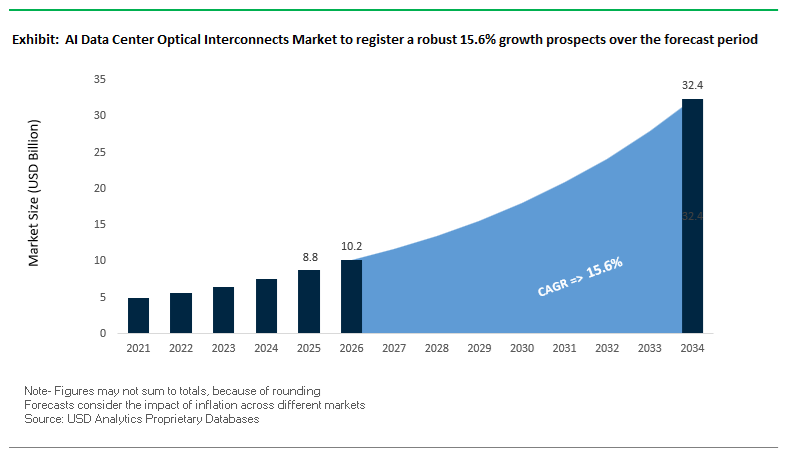
The global AI Data Center Optical Interconnects Market is valued at USD 10.2 billion in 2026 and is projected to reach USD 32.5 billion by 2034, registering a CAGR of 15.6% during the forecast period. AI data center optical interconnects encompass high-speed optical connectivity technologies that enable data transmission between GPUs, AI accelerators, servers, network switches and geographically distributed computing facilities. Major technology categories include 400G, 800G and 1.6T optical transceivers, active optical cables (AOCs), silicon photonics, co-packaged optics (CPO), near-packaged optics (NPO), optical digital signal processors (DSPs), photonic integrated circuits (PICs) and fiber-optic connectivity systems. These technologies support high-bandwidth communication across AI training clusters, hyperscale cloud networks and high-performance computing infrastructure. Commercial demand increasingly reflects the relationship between network throughput, accelerator utilization, optical port density, equipment reliability and the cost of operating large-scale AI computing environments.
Expansion of generative AI, large language model training, AI inference and hyperscale GPU clusters is increasing the volume of data transferred between computing nodes, placing greater commercial importance on network bandwidth and interconnect reliability. As AI infrastructure extends across multiple racks and data center campuses, conventional copper connections encounter distance and signal-integrity limitations, supporting wider deployment of high-speed optical networking. The transition from 800G to 1.6T Ethernet connectivity enables greater data throughput per port, while silicon photonics and optical engine integration introduce alternative approaches to managing power consumption and switch density. For cloud service providers, AI infrastructure operators and enterprise computing buyers, optical network performance influences GPU idle time, distributed training efficiency, AI workload completion times and networking total cost of ownership (TCO). Optical link failures, network congestion and restricted bandwidth can reduce the productive utilization of expensive accelerator infrastructure, particularly in tightly synchronized computing environments.
The competitive landscape includes NVIDIA, Broadcom, Marvell, Coherent, Lumentum, Cisco, Arista Networks, Credo Technology, optical module manufacturers and specialist photonics suppliers. Competition is extending beyond transceiver data rates toward power consumption per transmitted bit, optical link stability, component manufacturing capacity, supplier qualification and system-level integration. Commercially available 800G and emerging 1.6T optical platforms coexist with developing 3.2T transceivers, advanced silicon photonics engines and co-packaged optical architectures. NVIDIA reported that its Spectrum-X Ethernet Photonics technology entered production in May 2026, while suppliers are expanding indium phosphide laser manufacturing and photonic component integration for subsequent AI hardware generations. The market's commercial structure also reflects the differing economics of replaceable pluggable optics and integrated photonic architectures, including installation complexity, thermal requirements, servicing costs and supply availability across large hyperscale deployments.
Key Insights: AI Data Center Optical Interconnects Market
- Market Growth: The global market is valued at USD 10.2 billion in 2026 and is projected to reach USD 32.5 billion by 2034, registering a CAGR of 15.6%.
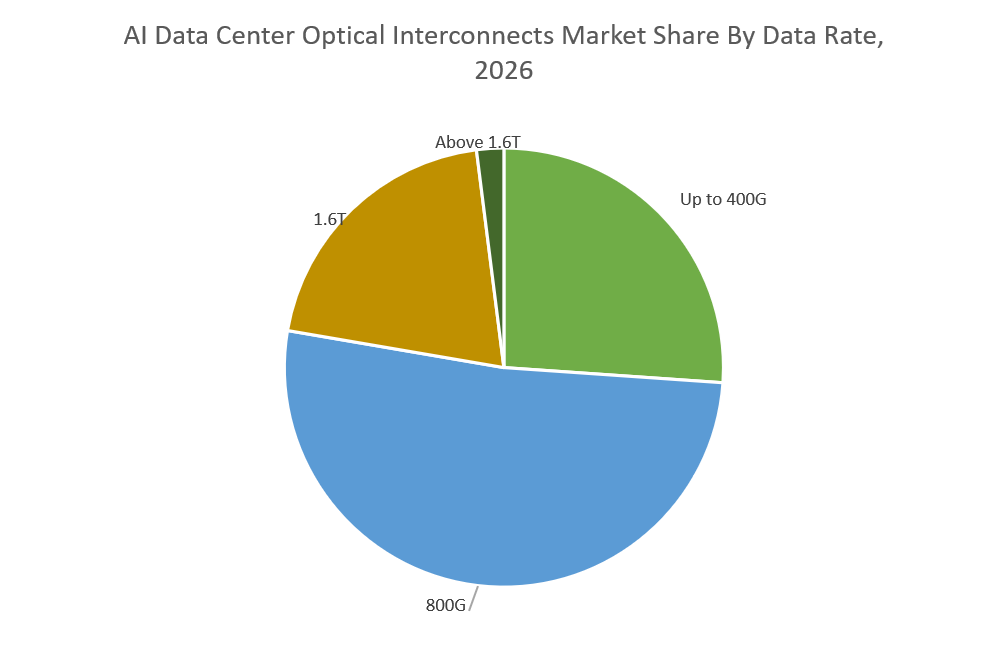
- Leading Data Rate: 800G optical interconnects account for an estimated 51.6% revenue share in 2026, supported by hyperscale AI networking and GPU cluster expansion.
- Leading Technology: Conventional DSP-Based Pluggable Optics hold an estimated 49.7% market share, reflecting established interoperability, equipment availability and field-replaceable module architectures.
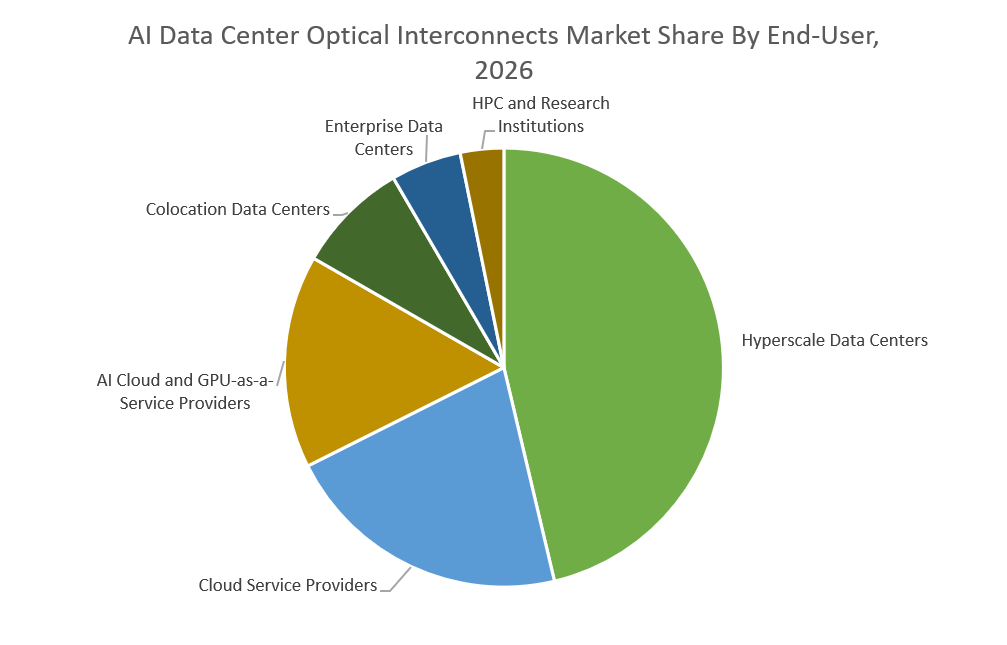
- Largest End-User: Hyperscale Data Centers represent the leading segment, accounting for an estimated 46.3% of global revenue in 2026, driven by high-bandwidth AI training and inference infrastructure.
- Emerging Technologies: 1.6T optical transceivers, silicon photonics, co-packaged optics and optical circuit switching are expanding applications in high-density AI networking, optical power efficiency and distributed computing.
Recent Developments and Company Strategies in the AI Data Center Optical Interconnects Market
The AI Data Center Optical Interconnects Market is witnessing increasing commercialization of high-bandwidth optical connectivity designed to address network reliability, power consumption and deployment requirements in large AI computing clusters. On October 12, 2026, Credo Technology unveiled its 1.6T ZeroFlap active light cable architecture, targeting optical connections of up to 50 meters with a designed power consumption of 12 W per cable end. The company expects shipments to begin in 2027. Its micro-emitter-based design targets the distance gap between conventional copper interconnects and higher-power pluggable optics, with potential commercial relevance for row-scale AI networking, cable density and electricity consumption. In September 2026, Credo also introduced 224G-based 1.6T ZeroFlap optical transceivers, integrating silicon photonics with real-time optical link monitoring. The associated PILOT platform provides remote diagnostics for link faults and intermittent connectivity, addressing network troubleshooting and service continuity in GPU-intensive infrastructure.
Optical equipment manufacturers are simultaneously advancing higher-bandwidth transceivers and integrated photonic platforms for future AI network generations. At ECOC 2026 in September, Coherent demonstrated a 3.2T optical transceiver architecture incorporating two 1.6T optical paths in an OSFP-size package, alongside a 6.4T near-packaged optical engine for high-density AI scale-up and scale-out networks. The company also introduced its PhotonLink integrated optical technology platform and new fiber-attachment components addressing assembly and maintenance requirements. During the same event, Marvell presented 2-nanometer optical connectivity demonstrations covering 400G-per-lane PAM4 transmission, 800G coherent optics and 1.6T data center interconnect technologies. These demonstrations indicate a developing supplier ecosystem around higher optical bandwidth density, advanced semiconductor manufacturing and integrated photonic packaging. For hyperscale operators, the commercial significance extends to the number of network ports, available equipment space and electrical power required to support successive GPU generations, although demonstrated platforms do not necessarily represent volume production.
The transition toward co-packaged optics and silicon photonics networking has progressed from development programs into selected production deployments. In May 2026, NVIDIA announced that Spectrum-X Ethernet Photonics had entered production, integrating co-packaged optical technology with its Spectrum-X networking architecture for large-scale AI facilities. Earlier, Broadcom confirmed production-volume shipments of its 102.4 Tbps Tomahawk 6 Ethernet switch family in March 2026, following the October 2025 introduction and shipment announcement for its Tomahawk 6 Davisson co-packaged optics variant. Broadcom also released its 3-nanometer Taurus optical DSP supporting 400G-per-lane interfaces for 1.6T transceiver applications. These developments expand the commercial range of optical networking architectures available for AI clusters, where switch capacity, energy consumption, optical link availability and network scalability directly influence data center infrastructure economics. Pluggable optical transceivers nevertheless remain important because their replaceable form factors support established servicing and equipment integration practices.
Corporate consolidation and semiconductor supply agreements are expanding optical connectivity capabilities across the AI infrastructure value chain. In February 2026, Marvell completed its acquisition of Celestial AI, incorporating the Photonic Fabric platform for high-bandwidth optical scale-up connectivity within and between AI computing systems. The acquisition extends Marvell's activities beyond conventional optical DSPs and Ethernet interconnects toward optical communication between closely coupled accelerators and computing packages. In March 2026, NVIDIA separately announced USD 2 billion equity commitments to Coherent and Lumentum, alongside multiyear commercial agreements intended to expand the supply of advanced laser and optical networking technologies. In June 2026, Coherent began expanding its 6-inch indium phosphide manufacturing facility in Sherman, Texas, while Lumentum's March 2026 announcement detailed a 240,000-square-foot Greensboro, North Carolina facility intended for advanced InP laser production, with manufacturing ramp-up targeted for mid-2028. These developments reflect the growing commercial importance of semiconductor fabrication capacity, optical component availability and multiyear customer-supplier agreements.
Optical connectivity commercialization is also extending into fiber installation, data center interconnects and the physical reliability of hyperscale networks. In July 2026, Microsoft and 3M announced an agreement to introduce Expanded Beam Optical (EBO) connectivity into Azure data centers. Microsoft's early deployments indicated potential reductions in installation and maintenance requirements through optical interfaces designed to tolerate contamination and repeated handling more effectively than conventional physical-contact connectors. Earlier, Meta and Corning established a multiyear optical fiber, cable and connectivity supply agreement valued at up to USD 6 billion, followed by the commencement of manufacturing expansion in North Carolina during 2026. These developments demonstrate the increasing scale of commercial commitments across optical transceivers, fiber cabling, connectors and associated infrastructure. Installation reliability, fiber handling requirements, manufacturing lead times and network availability are becoming prominent commercial characteristics of large AI data center optical interconnect deployments.
AI Data Center Optical Interconnects Market Drivers
AI GPU Cluster Expansion and East-West Network Traffic Drive High-Speed Optical Transceiver Demand
The expansion of hyperscale AI data centers, GPU computing clusters and generative AI infrastructure is accelerating demand for high-speed optical transceivers and fiber-optic networking systems. Distributed AI training and large-scale inference require continuous data exchange between GPUs, servers and network switches, increasing east-west traffic across AI scale-out networks. Network congestion and restricted bandwidth can extend training times and reduce the productive utilization of expensive accelerator infrastructure, making optical network throughput and cost per bit important commercial performance indicators. In March 2026, Broadcom confirmed production-volume shipments of its 102.4 Tbps Tomahawk 6 switching platform, supporting higher aggregate network capacity for large AI clusters. Demand for 800G and 1.6T optical interconnects, high-density Ethernet switching and optical networking components is expanding across hyperscale cloud providers, AI infrastructure operators and GPU-as-a-service facilities.
Copper Interconnect Limitations and AI Network Reliability Accelerate Fiber-Optic Connectivity Adoption
Increasing data transmission speeds are exposing the reach, signal-integrity and power limitations of conventional copper interconnects in high-density AI computing environments. Passive direct-attach copper cables (DACs) remain commercially relevant for short-distance connections, while active electrical cables (AECs) extend usable reach through signal conditioning. However, longer rack-to-rack and row-level connections increasingly favor active optical cables (AOCs), pluggable optical transceivers and structured fiber-optic networks. The commercial importance extends beyond cable distance because link interruptions, transmission errors and network instability can delay synchronized GPU workloads and increase maintenance expenditure. Credo's September 2026 introduction of 1.6T ZeroFlap optical transceivers incorporated real-time link-health telemetry and fault diagnostics to address intermittent connectivity. Competition increasingly encompasses optical link reliability, fault isolation, network availability, interconnect power consumption and total cost of ownership (TCO) across large AI data center networks.
Emerging Trends in the AI Data Center Optical Interconnects Market
Transition from 800G to 1.6T Optical Transceivers Increases AI Network Bandwidth Density
The transition from 800G Ethernet to 1.6T optical transceivers is advancing optical bandwidth density and switching capacity across next-generation AI data center networks. Emerging 1.6T platforms commonly employ 200G-per-lane PAM4 signaling, supporting higher aggregate throughput through OSFP and other compatible module configurations. In June 2026, Arista Networks introduced its 7060XE7 series, including 64-port 1.6T switch configurations with initial availability scheduled for the fourth quarter of 2026. Higher port bandwidth can reduce the number of physical connections required for a given network capacity, affecting switch deployment density, optical cabling complexity and infrastructure expenditure. The transition also expands competition in optical digital signal processors (DSPs), photonic integrated circuits, high-speed lasers and Ethernet transceiver manufacturing. Commercial adoption depends on switch compatibility, module power consumption, fiber infrastructure, interoperability and the availability of qualified optical components.
Pluggable Optics, LPO and Co-Packaged Optics Reshape Power Efficiency and Networking TCO
Competition among DSP-based pluggable optics, linear-drive pluggable optics (LPO) and co-packaged optics (CPO) is reshaping power efficiency and lifecycle economics in AI data center networking. Conventional pluggable transceivers retain an established position through standardized interfaces and field-replaceable modules. LPO architectures reduce module-level signal-processing requirements, while CPO integrates optical engines closer to switching silicon to reduce high-speed electrical transmission losses. In February 2026, Cisco reported 50% lower module power consumption for its 800G LPO implementation compared with its referenced conventional configuration. NVIDIA's Spectrum-X Ethernet Photonics entered production in May 2026, demonstrating commercial progress in CPO-based switching. Silicon photonics and indium phosphide laser technologies remain complementary across different optical designs. Competitive differentiation centers on bandwidth per watt, optical module serviceability, cooling requirements, link stability and networking TCO, with savings dependent on equipment architecture.
Comparison of Optical Interconnect Architectures for AI Data Center Networks
|
Optical Architecture
|
Commercial Characteristics
|
Key Cost and Performance Factors
|
|
DSP-Based Pluggable Optics
|
Established, field-replaceable optical modules for 400G, 800G and emerging 1.6T networks
|
Module power consumption, replacement costs, interoperability and maintenance
|
|
Linear Pluggable Optics (LPO/LRO)
|
Reduced or simplified module signal processing; adoption depends on compatible host platforms
|
Power efficiency, host integration, transmission reach and signal integrity
|
|
Co-Packaged Optics (CPO)
|
Optical engines integrated close to switching ASICs; selected production deployments
|
System power consumption, packaging complexity, laser architecture and serviceability
|
Source: Cisco, Broadcom and NVIDIA official technical disclosures, 2025–2026. Power-efficiency improvements vary by platform and reference configuration.
Optical Circuit Switching and Software-Defined AI Network Fabrics Advance Cluster Efficiency
Optical circuit switching (OCS) and software-defined networking (SDN) are gaining attention as alternative approaches to managing connectivity across large AI computing clusters. Unlike conventional packet-switched architectures, OCS establishes reconfigurable optical paths between network endpoints, potentially reducing reliance on intermediate electronic switching stages for selected traffic patterns. Google's Jupiter network architecture demonstrates commercial application of optical circuit switches combined with centralized software-defined traffic engineering. Its published system-level research reported 30% lower capital expenditure and 41% lower power consumption relative to an earlier network architecture, with the results attributable to multiple design changes rather than optical switching alone. The Open Compute Project's Optical Circuit Switching initiative is developing open specifications covering hardware, software controls, telemetry and interoperability. Commercial relevance encompasses AI fabric reconfiguration, network scalability, electrical power expenditure, operational complexity and GPU utilization, particularly in large-scale hyperscale computing environments.
AI Data Center Optical Interconnects Market Opportunities
AI Data Center Upgrades and High-Density Fiber Connectivity Expand Optical Infrastructure Demand
Modernization of existing enterprise data centers, AI-ready colocation facilities and hyperscale networking infrastructure is expanding commercial applications for high-density fiber-optic cabling, optical transceiver upgrades and advanced connector assemblies. Increasing port density and migration toward 800G and 1.6T networking are placing greater demands on fiber management, connector footprint and installation reliability. Very Small Form Factor (VSFF) connectors, including SN, MDC and SN-MT, offer alternative arrangements to conventional MPO/MTP connectivity in space-constrained networking environments. SENKO reports that its SN-MT16 connector provides 2.7 times the connector density of MPO16 under its specified comparison. In January 2026, Meta and Corning announced a multiyear optical fiber and connectivity supply agreement valued at up to USD 6 billion, accompanied by planned manufacturing expansion in North Carolina. Commercial activity encompasses structured fiber cabling, pre-terminated assemblies, optical connectivity installation, transceiver replacement and network infrastructure upgrades.
Coherent Optical Interconnects Expand Scale-Across Networking for Distributed AI Data Centers
Development of distributed AI data centers, multi-campus computing infrastructure and high-capacity data center interconnects (DCI) is expanding demand for coherent optical networking technologies. Power availability, facility capacity limitations and geographically distributed computing requirements are increasing the commercial relevance of optical links connecting separate AI computing sites. In August 2025, NVIDIA introduced Spectrum-XGS Ethernet, designed to support communication across distributed AI data centers through scale-across networking. Meanwhile, the Optical Internetworking Forum released its 1600ZR coherent interface implementation agreement in September 2026, specifying interoperable 1.6T coherent transmission for amplified point-to-point DWDM links up to 120 kilometers. These developments extend the application scope of 800ZR, 1600ZR coherent optics, wavelength-division multiplexing and high-capacity fiber networks. Commercial demand depends on transmission distance, available fiber routes, network latency, optical transport equipment costs and compatibility with existing cloud and hyperscale networking infrastructure.
Regulatory and Technical Standards for AI Data Center Optical Interconnects
The AI Data Center Optical Interconnects Market is influenced by Ethernet interoperability requirements, optical communication specifications, laser safety regulations and data center infrastructure standards. The IEEE P802.3dj Ethernet standardization project addresses Ethernet interfaces operating at 200 Gbps, 400 Gbps, 800 Gbps and 1.6 Tbps, including electrical and optical transmission requirements. Its third Standards Association recirculation ballot concluded successfully on October 10, 2026, although final standard publication remained pending. Separately, the Optical Internetworking Forum released its 1600ZR coherent interface implementation agreement in September 2026, addressing interoperable 1.6T coherent transmission for data center interconnect applications. These industry specifications provide technical reference points for multivendor networking equipment compatibility, transmission performance and optical module qualification.
Physical connectivity and laser safety are additional considerations for optical transceivers, active optical cables and photonic components. ISO/IEC 11801-5:2017 specifies generic cabling infrastructure for data center environments, including connections within and to computer-room spaces. IEC 60825-1:2014, with applicable interpretations, establishes laser product classification and safety requirements relevant to optical transmitters and laser-containing equipment. Optical interface performance is also influenced by insertion loss, signal integrity, optical power levels, fiber connectivity and equipment interoperability. Industry-developed specifications from OIF and other technical organizations support common interfaces, but voluntary implementation agreements are distinct from legally mandatory product safety obligations.
Environmental compliance further influences optical networking component manufacturing and data center operations. The European Union's Restriction of Hazardous Substances (RoHS) Directive 2011/65/EU restricts specified substances in covered electrical and electronic equipment, subject to applicable exclusions and exemptions. The EU Energy Efficiency Directive also establishes energy-performance reporting requirements for qualifying data centers without mandating a specific optical interconnect technology. For commercial AI networks, equipment qualification encompasses regulatory conformity, optical link reliability, power consumption, product traceability and compatibility across successive generations of networking hardware.
AI Data Center Optical Interconnects Market Share Analysis by Data Rate, Technology and End-User
By Data Rate: 800G Optical Transceivers Lead AI Data Center Interconnect Market Share
800G optical interconnects dominate the AI Data Center Optical Interconnects Market, accounting for 51.6% of global revenue in 2026, supported by commercial deployment across hyperscale AI data centers, GPU computing clusters and high-bandwidth Ethernet fabrics. The segment's leading position reflects established transceiver availability, increasing network port density and the growing importance of bandwidth per watt in large-scale AI infrastructure. 1.6T optical interconnects represent 20.3% of market revenue, reflecting the progression toward higher-speed networking architectures for next-generation AI accelerators. The transition supports greater data throughput per switch port and higher aggregate network capacity, with commercial implications for optical cabling, equipment footprint and networking cost per bit. Lower-speed optical technologies retain demand across existing cloud and enterprise infrastructure, while higher-capacity platforms are increasingly associated with advanced AI scale-out networking.
By Optical Interconnect Technology: DSP-Based Pluggable Optics Lead as Silicon Photonics Adoption Expands
Conventional DSP-Based Pluggable Optics account for 49.7% of the AI Data Center Optical Interconnects Market in 2026, maintaining the leading position through established deployment across Ethernet and InfiniBand networks. Their commercial advantages include field-replaceable modules, compatibility with widely deployed networking equipment and established manufacturing supply chains. Silicon Photonics-Based Optical Interconnects represent 23.5% of market revenue under the report's technology classification, reflecting growing integration of photonic components into high-bandwidth optical engines and transceiver architectures. Linear-drive optics, co-packaged optics and optical circuit switching are expanding architectural alternatives for applications where module power consumption, networking density and electrical signal losses influence operating economics. Competition increasingly centers on optical bandwidth per watt, module serviceability, photonic integration, manufacturing scalability and total cost of ownership, particularly across hyperscale AI networking infrastructure.
By End-User: Hyperscale Data Centers Dominate Optical Interconnect Demand and AI Networking Expenditure
Hyperscale Data Centers lead the AI Data Center Optical Interconnects Market with a 46.3% revenue share in 2026, reflecting extensive deployment of high-speed optical networking across large GPU clusters, AI training environments and cloud computing infrastructure. Hyperscale operators generate demand for 800G and 1.6T transceivers, silicon photonics, high-density fiber connectivity and advanced optical switching architectures supporting increasingly distributed AI workloads. Cloud Service Providers account for 21.3% of market revenue, representing additional demand for scalable optical connectivity across cloud computing platforms and multi-tenant digital infrastructure. Specialized AI cloud and GPU-as-a-Service operators contribute through accelerator-focused networking installations, while colocation facilities and enterprise data centers support optical infrastructure modernization. End-user expenditure is closely associated with GPU utilization, network capacity expansion, optical link reliability, electricity consumption and lifecycle networking costs.
AI Data Center Optical Interconnects Market Competitive Landscape: High-Speed Transceivers, Silicon Photonics and AI Networking Infrastructure
The global AI Data Center Optical Interconnects Market is characterized by competition among optical semiconductor manufacturers, high-speed transceiver suppliers, AI networking platform providers and fiber-optic connectivity companies. NVIDIA, Broadcom, Cisco and Arista Networks compete through integrated AI networking architectures, high-bandwidth Ethernet switching and optical connectivity technologies. NVIDIA's Spectrum-X Ethernet Photonics platform and Broadcom's 102.4 Tbps Tomahawk 6 architecture illustrate the progression toward co-packaged optics and higher network switching capacity. Competitive differentiation increasingly centers on 800G and 1.6T optical connectivity, GPU cluster utilization, bandwidth per watt, network availability and total cost of ownership (TCO). Hyperscale cloud providers and AI infrastructure operators represent major customers for high-density optical networking systems supporting large-scale AI training and inference.
Competition in silicon photonics, optical DSPs, laser technologies and photonic integrated circuits includes Marvell Technology, Coherent, Lumentum and Credo Technology. Marvell's completed acquisition of Celestial AI in February 2026 expanded its capabilities in optical scale-up interconnects, while Coherent and Lumentum are developing advanced indium phosphide lasers, silicon photonics components and optical engines for next-generation AI networking. Credo competes through high-speed optical connectivity, active light cables and link-monitoring technologies. Supplier positioning reflects optical power efficiency, semiconductor manufacturing capacity, component qualification, product reliability and integration with AI networking equipment. Laser supply availability and manufacturing scale are becoming increasingly relevant to commercial competition as hyperscale operators expand high-bandwidth optical infrastructure.
The 800G and 1.6T optical transceiver market includes established manufacturers such as Zhongji InnoLight, Eoptolink Technology, Accelink Technologies and Applied Optoelectronics (AOI). These companies compete across pluggable optical modules, active optical cables, silicon photonics-based transceivers and high-speed data center connectivity. In March 2026, AOI reported its first volume order for 1.6T data center transceivers from a major hyperscale customer, followed by manufacturing expansion activity in Texas supporting additional optical module production. Competition among transceiver suppliers is increasingly influenced by cost per transmitted bit, OSFP and QSFP-DD compatibility, optical link distance, module power consumption, manufacturing yields and delivery capacity. Commercial qualification and consistent component availability are particularly significant for large AI networking deployments involving substantial quantities of optical modules.
Within coherent optical networking and data center interconnect infrastructure, Ciena, Nokia and Corning provide complementary capabilities spanning coherent transmission, optical transport equipment, fiber-optic cables and high-density connectivity systems. Ciena's WaveLogic 6 portfolio addresses high-capacity data center interconnects, while Nokia's completed acquisition of Infinera strengthened its optical networking and photonic semiconductor capabilities. Corning competes through optical fiber manufacturing, structured cabling and connectivity infrastructure for hyperscale facilities. Industry competition increasingly encompasses 800ZR and 1600ZR coherent optics, metro data center interconnects, high-density fiber connectivity, installation reliability and network expansion costs. Across the wider market, competitive positioning reflects the relationship between optical bandwidth, networking expenditure, energy consumption, equipment serviceability and long-term supply availability.
AI Data Center Optical Interconnects Market Geographical Analysis: Hyperscale AI Networking, Silicon Photonics and Regional Optical Infrastructure
United States AI Data Center Optical Interconnects Market: Hyperscale Networking and Domestic Photonics Manufacturing
The United States AI Data Center Optical Interconnects Market is supported by hyperscale AI infrastructure expansion, optical semiconductor manufacturing and large-scale cloud networking deployments. In March 2026, NVIDIA announced separate USD 2 billion commitments to Coherent and Lumentum, accompanied by multiyear commercial agreements covering advanced lasers and optical networking technologies. In May 2026, NVIDIA and Corning announced a partnership under which Corning plans to expand U.S. optical connectivity manufacturing capacity tenfold and establish three additional manufacturing facilities. Competition involving NVIDIA, Broadcom, Marvell, Coherent, Lumentum and Corning encompasses high-speed optical transceivers, silicon photonics, co-packaged optics, laser components and fiber infrastructure. Commercial demand is closely associated with GPU cluster expansion, optical bandwidth per watt, networking total cost of ownership and reliable component availability across AI data center deployments.
China AI Data Center Optical Interconnects Market: High-Speed Transceiver Manufacturing and Optical Component Supply
China's AI Data Center Optical Interconnects Market is characterized by an established optical module manufacturing ecosystem, high-speed transceiver development and increasing participation in global AI networking supply chains. Zhongji InnoLight offers optical transceiver portfolios spanning 400G, 800G and 1.6T connectivity, supported by silicon photonics and high-speed signal-processing technologies. Luxshare Precision has also developed 800G and 1.6T optical interconnect products incorporating silicon photonics engines, advanced DSPs and high-speed optical interfaces. Additional manufacturers, including Accelink and Eoptolink, participate across optical modules, photonic components and data center networking technologies. Competition centers on 800G and 1.6T optical transceiver manufacturing, OSFP compatibility, optical module power consumption, component production yields and cost per transmitted bit. Export-market demand and domestic AI computing development contribute to the commercial positioning of Chinese optical connectivity suppliers.
Taiwan AI Data Center Optical Interconnects Market: Silicon Photonics and Co-Packaged Optics Manufacturing
Taiwan's AI Data Center Optical Interconnects Market is distinguished by advanced semiconductor fabrication, photonic integration and heterogeneous packaging technologies supporting next-generation optical networking hardware. In 2026, TSMC identified its Compact Universal Photonic Engine (COUPE) as a key development platform, with co-packaged optics production targeted to begin during the year. Its disclosed configuration combines photonic and electronic components within advanced semiconductor packages, targeting higher transmission efficiency and reduced signal latency. ASE Technology Holding separately demonstrated a co-packaged optics assembly with manufacturer-reported energy consumption below 5 picojoules per bit, highlighting developments in optical engine integration and advanced packaging. Commercial activity encompasses silicon photonics, photonic integrated circuits, co-packaged optics, optical semiconductor packaging and high-density AI networking components. Manufacturing scalability, assembly yields, component integration and equipment qualification are central competitive factors in Taiwan's photonics ecosystem.
Japan AI Data Center Optical Interconnects Market: Coherent Optical Networking and Distributed GPU Infrastructure
Japan's AI Data Center Optical Interconnects Market is supported by optical communications engineering, advanced laser technologies and the development of geographically distributed computing networks. In August 2025, NTT DOCOMO BUSINESS demonstrated 800G-ZR connectivity between data centers approximately 40 km apart, incorporating remote direct memory access (RDMA) technology for high-speed data transfer. In July 2026, the company introduced its GPU over APN Testbed, connecting GPU resources across eight Japanese locations through an optical networking environment supporting 100 Gbps-class transmission. NTT, Sumitomo Electric and domestic optical technology suppliers contribute to development across optical transport, coherent connectivity, laser components and photonic devices. Market applications encompass coherent optical transceivers, all-photonics networks, data center interconnects and low-latency AI networking, where transmission reliability and distributed computing efficiency influence infrastructure operating costs.
Germany AI Data Center Optical Interconnects Market: Coherent Optics and High-Capacity Data Center Connectivity
Germany's AI Data Center Optical Interconnects Market is influenced by Frankfurt's established cloud connectivity ecosystem, advanced optical transport infrastructure and demand for high-capacity networking between data centers. In November 2025, DE-CIX Frankfurt established an 800 Gigabit Ethernet customer connection using Nokia's 800G ZR+ single-wavelength optical technology, demonstrating the deployment of higher-speed coherent interfaces within commercial interconnection infrastructure. DE-CIX subsequently reported that Frankfurt network traffic reached a peak of 18.73 Tbps during 2025, reflecting substantial aggregate connectivity demand. The country's optical networking ecosystem includes Nokia, Adtran and data center interconnection providers, supporting coherent optical transport, pluggable optics and automated network management. Commercial activity spans 800G coherent transceivers, metropolitan data center interconnects, optical line systems and high-capacity fiber connectivity, with network expansion economics and service availability influencing equipment adoption.
Singapore AI Data Center Optical Interconnects Market: AI-Ready Colocation and Regional Fiber Connectivity
Singapore's AI Data Center Optical Interconnects Market is supported by AI-ready colocation development, international fiber connectivity and increasing demand for high-bandwidth cloud networking. In February 2026, Nxera, Singtel's data center business, opened its 58 MW DC Tuas facility, increasing its Singapore data center capacity to 120 MW, with more than 90% of the new facility's capacity committed before opening. The carrier-neutral facility integrates a submarine cable landing station, enabling direct access to domestic and international networks. Singapore's Infocomm Media Development Authority also launched a further allocation process covering at least 200 MW of additional data center capacity. Commercial demand encompasses 800G optical transceivers, high-density fiber connectivity, data center interconnects, optical network equipment and structured cabling across hyperscale, cloud and colocation infrastructure. Network latency, international connectivity, fiber-route diversity and optical infrastructure operating costs remain important characteristics of the regional market.
AI Data Center Optical Interconnects Market Report Scope
AI Data Center Optical Interconnects Market Report Scope, Segmentation and Technology Coverage (2026–2034)
|
Parameter
|
Details
|
|
Market Size (2026)
|
USD 10.2 Billion
|
|
Market Size (2034)
|
USD 32.5 Billion
|
|
Market Growth Rate
|
CAGR of 15.6%
|
|
Segments
|
By Component / Product Type: Optical Transceivers, Active Optical Cables (AOCs), Optical Engines and Photonic Components, Optical Circuit Switching Equipment, Fiber-Optic Connectivity Infrastructure; By Data Rate: Up to 400G, 800G, 1.6T, Above 1.6T; By Optical Interconnect Technology: DSP-Based Pluggable Optics, LPO/LRO, Silicon Photonics-Based Interconnects, CPO/NPO, Coherent Optical Interconnects (ZR/ZR+), Optical Circuit Switching (OCS); By Photonic Material and Device Platform: Silicon Photonics (SiPh), Indium Phosphide (InP), GaAs VCSEL, Thin-Film Lithium Niobate (TFLN); By Network Application: AI Scale-Up, AI Scale-Out, AI Scale-Across Networking; By End-User: Hyperscale Data Centers, Cloud Service Providers, AI Cloud and GPU-as-a-Service Providers, Colocation Data Centers, Enterprise Data Centers, HPC and Research Institutions
|
|
Study Period
|
Historical: 2020–2025; Forecast: 2026–2034
|
|
Units
|
Revenue (USD Billion)
|
|
Technology Coverage
|
400G, 800G and 1.6T Optical Transceivers, 200G-per-Lane PAM4, OSFP and QSFP-DD Modules, Silicon Photonics, Photonic Integrated Circuits (PICs), Linear Pluggable Optics (LPO/LRO), Co-Packaged Optics (CPO), Near-Packaged Optics (NPO), Optical Circuit Switching (OCS), Coherent Optical Interconnects (400ZR/800ZR/1600ZR), Optical DSPs, Active Optical Cables, High-Density Fiber Connectivity and VSFF Connectors
|
|
Qualitative Analysis
|
Porter's Five Forces, SWOT Profiles, Market Share Analysis, Market Dynamics, Industry Benchmarking, Competitive Landscape, Market Ecosystem, Technology Trends, Supply-Chain Analysis and Regional Outlook
|
|
Regulatory & Standards Coverage
|
IEEE 802.3 Ethernet Standards and IEEE P802.3dj (1.6T Ethernet Development), Optical Internetworking Forum (OIF) Implementation Agreements, Open Compute Project (OCP) Optical Networking Specifications, IEC 60825-1 (Laser Product Safety), ISO/IEC 11801-5 (Data Center Cabling), EU RoHS Directive and Applicable EU Data Center Energy Efficiency Reporting Requirements
|
|
Companies
|
NVIDIA, Broadcom, Marvell Technology, Coherent, Lumentum, Cisco (Acacia), Arista Networks, Zhongji InnoLight, Eoptolink Technology, Accelink Technologies, Applied Optoelectronics, Credo Technology, Ciena, Corning, Nokia (Infinera)
|
|
Countries
|
US, Canada, Mexico, Germany, France, Spain, Italy, UK, Russia, China, India, Japan, South Korea, Australia, Southeast Asia, Brazil, Argentina, Middle East, Africa
|
AI Data Center Optical Interconnects Market Segmentation
By Component / Product Type
- Optical Transceivers
- Pluggable Optical Transceivers
- Coherent Optical Transceivers
- Active Optical Cables (AOCs)
- Optical Engines and Photonic Components
- Silicon Photonics Engines
- Optical DSPs, Drivers and Receivers
- Laser and Photonic Integrated Circuit Components
- Optical Circuit Switching Equipment
- Fiber-Optic Connectivity Infrastructure
- Optical Fiber Cables
- High-Density Fiber Connectors
- Fiber Assemblies and Patch Panels
By Data Rate
- Up to 400G
- 800G
- 1.6T
- Above 1.6T
By Optical Interconnect Technology
- Conventional DSP-Based Pluggable Optics
- Linear-Drive and Linear-Receive Pluggable Optics (LPO/LRO)
- Silicon Photonics-Based Optical Interconnects
- Co-Packaged Optics (CPO) and Near-Packaged Optics (NPO)
- Coherent Optical Interconnects (ZR/ZR+)
- Optical Circuit Switching (OCS)
By Network Application
- AI Scale-Up Networking
- GPU-to-GPU Optical Interconnects
- Rack-Scale and Multi-Rack Accelerator Connectivity
- AI Scale-Out Networking
- AI Cluster Ethernet Fabrics
- InfiniBand Optical Interconnects
- Rack-to-Rack and Data Hall Connectivity
- AI Scale-Across Networking
- Campus Data Center Interconnects
- Metro and Regional Data Center Interconnects
- Coherent Optical Transport
By Photonic Material and Device Platform
- Silicon Photonics (SiPh)
- Silicon Photonic Integrated Circuits (PICs)
- Silicon-Based Optical Modulators and Receivers
- Indium Phosphide (InP)
- Electro-Absorption Modulated Lasers (EMLs)
- Continuous-Wave (CW) Lasers and InP Photonic Components
- Gallium Arsenide (GaAs) VCSEL Technology
- Vertical-Cavity Surface-Emitting Lasers
- Short-Reach Multimode Optical Interconnects
- Thin-Film Lithium Niobate (TFLN)
- TFLN Optical Modulators
- TFLN Photonic Integrated Circuits and Hybrid Photonics
By End-User
- Hyperscale Data Centers
- Cloud Service Providers
- AI Cloud and GPU-as-a-Service Providers
- Colocation Data Centers
- Enterprise Data Centers
- High-Performance Computing (HPC) and Research Institutions
Countries Analyzed
- North America (US, Canada, Mexico)
- Europe (Germany, UK, France, Spain, Italy, Russia, Rest of Europe)
- Asia Pacific (China, India, Japan, South Korea, Australia, South East Asia, Rest of Asia)
- South America (Brazil, Argentina, Rest of South America)
- Middle East and Africa (Saudi Arabia, UAE, Rest of Middle East, South Africa, Egypt, Rest of Africa)
Leading Players in the AI Data Center Optical Interconnects Industry
- NVIDIA Corporation
- Broadcom Inc.
- Marvell Technology, Inc.
- Coherent Corp.
- Lumentum Holdings Inc.
- Cisco Systems, Inc. (including Acacia)
- Arista Networks, Inc.
- Zhongji InnoLight Co., Ltd.
- Eoptolink Technology Inc., Ltd.
- Accelink Technologies Co., Ltd.
- Applied Optoelectronics, Inc. (AOI)
- Credo Technology Group Holding Ltd.
- Ciena Corporation
- Corning Incorporated
- Nokia Corporation (including Infinera)
*List not exhaustive.
AI Data Center Optical Interconnects Market Research Methodology
The AI Data Center Optical Interconnects Market research incorporates a structured assessment of high-speed optical networking technologies, industry developments, competitive positioning and regional demand. Secondary research draws on company annual reports, investor presentations, official product specifications, semiconductor manufacturer disclosures, government publications and industry standards organizations, including IEEE, OIF and the Open Compute Project. The research covers optical transceivers, active optical cables, silicon photonics, co-packaged optics, coherent optical interconnects and fiber-optic connectivity infrastructure, with emphasis on hyperscale AI data centers, GPU clusters and cloud networking applications.
Market sizing and forecasting are structured around supply-side and demand-side assessments, revenue segmentation and data triangulation across optical products, transmission speeds, interconnect technologies, end-users and geographical markets. The analytical framework considers AI accelerator deployment, 800G and 1.6T transceiver adoption, optical networking expenditure, manufacturing capacity and data center connectivity expansion. Forecast analysis incorporates bandwidth density, networking total cost of ownership, optical power efficiency, component availability and technology commercialization, maintaining consistency with USDAnalytics market definitions and the 2026–2034 forecast period.
Deliverables:
- Comprehensive Market Research Report (PDF and Excel) with detailed tables, charts, and interactive visualizations.
- Country-Specific Forecasts & Analysis.
- Segment-Wise Revenue Forecasts (2025–2034).
- Competitive Analysis, Benchmarking, and SWOT Profiles.
- Recent Developments & Innovation Tracker.
- Executive Summary & Analyst Commentary.
- Post-Purchase Analyst Support for Client-Specific Questions and Custom Data Requirements.
Table of Contents: AI Data Center Optical Interconnects Market, 2026–2034
1. Executive Summary
1.1. Global AI Data Center Optical Interconnects Market Highlights
1.2. Market Size and Growth Projections, 2026–2034
1.3. Key Industry Findings and Market Developments
1.4. 800G and 1.6T Optical Transceiver Technology Outlook
1.5. AI GPU Cluster Networking and Optical Interconnect Demand
1.6. Leading End-User Segments and Regional Market Outlook
1.7. Competitive Landscape and Industry Structure
2. AI Data Center Optical Interconnects Market Outlook (2026–2034)
2.1. Introduction to the Global AI Data Center Optical Interconnects Industry
2.2. Market Definition, Scope and Technology Coverage
2.3. Global Market Valuation and Growth Projections
2.3.1. Market Size in 2026: USD 10.2 Billion
2.3.2. Forecast Market Size in 2034: USD 32.5 Billion
2.3.3. Compound Annual Growth Rate (CAGR): 15.6%
2.4. AI Optical Networking Industry Value Chain
2.5. Optical Transceivers, Photonic Components and Fiber Connectivity Infrastructure
2.6. AI Scale-Up, Scale-Out and Scale-Across Network Architectures
2.7. Silicon Photonics, Co-Packaged Optics and High-Speed Ethernet Technologies
2.8. Hyperscale AI Data Centers, Cloud Infrastructure and GPU Computing Applications
2.9. Optical Networking Economics, Bandwidth Density and Cost per Bit
2.10. Key Market Insights and Commercial Demand Characteristics
3. AI Data Center Optical Interconnects Market Drivers, Trends and Opportunities
3.1. Key Market Drivers
3.1.1. AI GPU Cluster Expansion and East-West Network Traffic Drive High-Speed Optical Transceiver Demand
3.1.2. Copper Interconnect Limitations and AI Network Reliability Accelerate Fiber-Optic Connectivity Adoption
3.2. Emerging Market Trends
3.2.1. Transition from 800G to 1.6T Optical Transceivers Increases AI Network Bandwidth Density
3.2.2. Pluggable Optics, LPO and Co-Packaged Optics Reshape Power Efficiency and Networking TCO
3.2.3. Optical Circuit Switching and Software-Defined AI Network Fabrics Advance Cluster Efficiency
3.2.4. Comparative Analysis of DSP-Based Pluggable Optics, LPO/LRO and CPO Architectures
3.3. Emerging Market Opportunities
3.3.1. AI Data Center Upgrades and High-Density Fiber Connectivity Expand Optical Infrastructure Demand
3.3.2. Coherent Optical Interconnects Expand Scale-Across Networking for Distributed AI Data Centers
3.4. Market Restraints and Industry Challenges
3.4.1. High-Speed Optical Component Manufacturing and Supply Constraints
3.4.2. Optical Transceiver Power Consumption and Thermal Management
3.4.3. Network Interoperability and Equipment Qualification Requirements
3.4.4. Silicon Photonics Packaging Complexity and Manufacturing Yields
3.4.5. AI Networking Capital Expenditure and Optical Infrastructure Costs
3.4.6. Optical Link Reliability, Maintenance and Component Replacement
4. AI Data Center Optical Interconnects Market Recent Developments and Technical Framework
4.1. Recent Product Launches and Technology Commercialization (2024–2026)
4.1.1. 800G and 1.6T Optical Transceiver Product Developments
4.1.2. Next-Generation 3.2T Optical Module Demonstrations
4.1.3. Silicon Photonics and Photonic Integrated Circuit Developments
4.1.4. Co-Packaged Optics and Near-Packaged Optics Commercialization
4.1.5. Linear-Drive and Linear-Receive Optical Technologies
4.1.6. Optical Circuit Switching and AI Networking Fabric Developments
4.1.7. Coherent Optical Networking and Data Center Interconnect Technologies
4.2. Manufacturing Expansion and Corporate Developments
4.2.1. Optical Transceiver Manufacturing Capacity Expansion
4.2.2. Indium Phosphide Laser Manufacturing and Semiconductor Supply
4.2.3. Silicon Photonics Fabrication and Advanced Packaging
4.2.4. Hyperscale Optical Component Supply Agreements
4.2.5. Acquisitions, Partnerships and Technology Collaborations
4.2.6. Optical Fiber and High-Density Connectivity Manufacturing
4.3. Optical Networking Standards and Interoperability
4.3.1. IEEE 802.3 Ethernet Standards and High-Speed Optical Interfaces
4.3.2. IEEE P802.3dj and 1.6T Ethernet Development
4.3.3. Optical Internetworking Forum (OIF) Implementation Agreements
4.3.4. Coherent Optical Interfaces: 400ZR, 800ZR and 1600ZR
4.3.5. Open Compute Project Optical Networking Specifications
4.3.6. Optical Transceiver Form Factors and Multi-Source Agreements
4.4. Regulatory, Safety and Environmental Framework
4.4.1. IEC 60825-1 Laser Product Safety Requirements
4.4.2. ISO/IEC 11801-5 Data Center Cabling Infrastructure
4.4.3. EU Restriction of Hazardous Substances (RoHS) Directive
4.4.4. Data Center Energy Efficiency and Electricity Consumption Reporting
4.4.5. Optical Equipment Testing, Reliability and Product Qualification
4.4.6. Optical Component Traceability and Supply-Chain Compliance
5. AI Data Center Optical Interconnects Market Segmentation and Market Share Analysis
5.1. Global Market Size and Segment Revenue Forecast, 2026–2034
5.2. AI Data Center Optical Interconnects Market by Component / Product Type
5.2.1. Optical Transceivers
5.2.1.1. Pluggable Optical Transceivers
5.2.1.2. Coherent Optical Transceivers
5.2.2. Active Optical Cables (AOCs)
5.2.3. Optical Engines and Photonic Components
5.2.3.1. Silicon Photonics Optical Engines
5.2.3.2. Optical DSPs, Drivers and Receivers
5.2.3.3. Laser Sources and Photonic Integrated Circuits
5.2.4. Optical Circuit Switching Equipment
5.2.5. Fiber-Optic Connectivity Infrastructure
5.2.5.1. Optical Fiber Cables
5.2.5.2. High-Density Fiber Connectors
5.2.5.3. Fiber Assemblies and Patch Panels
5.3. AI Data Center Optical Interconnects Market by Data Rate
5.3.1. Up to 400G Optical Interconnects
5.3.2. 800G Optical Interconnects
5.3.3. 1.6T Optical Interconnects
5.3.4. Above 1.6T Optical Interconnects
5.3.5. Data Rate Market Share and Revenue Outlook
5.3.6. Transition from 800G to 1.6T and Next-Generation Networking
5.4. AI Data Center Optical Interconnects Market by Optical Interconnect Technology
5.4.1. Conventional DSP-Based Pluggable Optics
5.4.2. Linear-Drive and Linear-Receive Pluggable Optics (LPO/LRO)
5.4.3. Silicon Photonics-Based Optical Interconnects
5.4.4. Co-Packaged Optics (CPO) and Near-Packaged Optics (NPO)
5.4.5. Coherent Optical Interconnects (ZR/ZR+)
5.4.6. Optical Circuit Switching (OCS)
5.4.7. Technology Market Share and Commercial Adoption Analysis
5.5. AI Data Center Optical Interconnects Market by Photonic Material and Device Platform
5.5.1. Silicon Photonics (SiPh)
5.5.1.1. Silicon Photonic Integrated Circuits
5.5.1.2. Silicon-Based Modulators and Optical Receivers
5.5.2. Indium Phosphide (InP)
5.5.2.1. Electro-Absorption Modulated Lasers (EMLs)
5.5.2.2. Continuous-Wave Lasers and InP Photonic Components
5.5.3. Gallium Arsenide (GaAs) VCSEL Technology
5.5.3.1. Vertical-Cavity Surface-Emitting Lasers
5.5.3.2. Short-Reach Multimode Optical Interconnects
5.5.4. Thin-Film Lithium Niobate (TFLN)
5.5.4.1. TFLN Optical Modulators
5.5.4.2. Hybrid Photonic Integrated Circuits
5.5.5. Material Platform Technology Benchmarking and Manufacturing Analysis
5.6. AI Data Center Optical Interconnects Market by Network Application
5.6.1. AI Scale-Up Networking
5.6.1.1. GPU-to-GPU Optical Interconnects
5.6.1.2. Rack-Scale and Multi-Rack Accelerator Connectivity
5.6.2. AI Scale-Out Networking
5.6.2.1. AI Cluster Ethernet Fabrics
5.6.2.2. InfiniBand Optical Interconnects
5.6.2.3. Rack-to-Rack and Data Hall Connectivity
5.6.3. AI Scale-Across Networking
5.6.3.1. Campus Data Center Interconnects
5.6.3.2. Metro and Regional Data Center Interconnects
5.6.3.3. Coherent Optical Transport
5.7. AI Data Center Optical Interconnects Market by End-User
5.7.1. Hyperscale Data Centers
5.7.2. Cloud Service Providers
5.7.3. AI Cloud and GPU-as-a-Service Providers
5.7.4. Colocation Data Centers
5.7.5. Enterprise Data Centers
5.7.6. High-Performance Computing (HPC) and Research Institutions
5.8. AI Data Center Optical Interconnects Market Share Analysis
5.8.1. 800G Optical Transceivers Market Position
5.8.2. 1.6T Optical Interconnect Technology Adoption
5.8.3. DSP-Based Pluggable Optics and Silicon Photonics Market Shares
5.8.4. CPO, LPO/LRO and OCS Commercialization Outlook
5.8.5. Hyperscale AI Data Center Optical Networking Demand
5.8.6. Cloud, Colocation and GPU-as-a-Service Market Outlook
6. AI Data Center Optical Interconnects Market Country Analysis and Outlook
6.1. North America AI Data Center Optical Interconnects Market
6.1.1. United States: Hyperscale AI Optical Networking and Domestic Photonics Manufacturing
6.1.1.1. Optical Semiconductor and Laser Manufacturing Capacity
6.1.1.2. 800G/1.6T Optical Networking and Hyperscale Infrastructure Demand
6.1.2. Canada: AI Computing Infrastructure and High-Speed Optical Connectivity
6.1.3. Mexico: Data Center Expansion and Fiber-Optic Networking Infrastructure
6.2. Europe AI Data Center Optical Interconnects Market
6.2.1. Germany: Coherent Optics and High-Capacity Data Center Connectivity
6.2.1.1. 800G Coherent Networking and Frankfurt Interconnection Infrastructure
6.2.1.2. Optical Transport Systems and Cloud Network Expansion
6.2.2. United Kingdom: AI Data Center Networking and Optical Semiconductor Technologies
6.2.3. France: Hyperscale Computing and High-Speed Fiber Infrastructure
6.2.4. Spain: Cloud Data Center Interconnects and Optical Networking Demand
6.2.5. Italy: Data Center Connectivity and Photonic Technology Applications
6.2.6. Russia: Data Center Optical Networking and Domestic Connectivity Infrastructure
6.2.7. Rest of Europe: Regional Optical Technology and AI Infrastructure Developments
6.3. Asia Pacific AI Data Center Optical Interconnects Market
6.3.1. China: High-Speed Optical Transceiver Manufacturing and Optical Component Supply
6.3.1.1. 800G and 1.6T Optical Module Manufacturing
6.3.1.2. Silicon Photonics, Laser Components and Optical Transceiver Exports
6.3.2. India: AI Data Center Expansion and High-Bandwidth Networking Demand
6.3.3. Japan: Coherent Optical Networking and Distributed GPU Infrastructure
6.3.3.1. 800G-ZR Data Center Interconnect Technologies
6.3.3.2. All-Photonics Networking and Distributed AI Computing
6.3.4. South Korea: AI Computing Infrastructure and Optical Semiconductor Development
6.3.5. Australia: Hyperscale Cloud Infrastructure and Regional Data Center Interconnects
6.3.6. Southeast Asia: AI-Ready Colocation and High-Speed Optical Networking
6.3.6.1. Singapore: Hyperscale Connectivity and International Fiber Infrastructure
6.3.6.2. Other Southeast Asian Data Center Markets
6.3.7. Rest of Asia Pacific
6.3.7.1. Taiwan: Silicon Photonics, Co-Packaged Optics and Advanced Semiconductor Packaging
6.3.7.2. Other Asia Pacific Optical Interconnect Markets
6.4. South America AI Data Center Optical Interconnects Market
6.4.1. Brazil: Hyperscale Cloud Data Centers and Optical Fiber Infrastructure
6.4.2. Argentina: Data Center Connectivity and Enterprise Optical Networking
6.4.3. Rest of South America: Regional Data Center Interconnect Development
6.5. Middle East and Africa AI Data Center Optical Interconnects Market
6.5.1. Middle East: Hyperscale AI Computing and Regional Optical Networking
6.5.1.1. Saudi Arabia: AI Data Center Infrastructure and High-Speed Connectivity
6.5.1.2. United Arab Emirates: AI Cloud Infrastructure and Data Center Optical Interconnects
6.5.1.3. Rest of Middle East
6.5.2. Africa: Data Center Development and Optical Fiber Infrastructure
6.5.2.1. South Africa: Cloud Data Centers and Optical Interconnection
6.5.2.2. Egypt: Data Center Connectivity and Regional Fiber Networks
6.5.2.3. Rest of Africa
7. AI Data Center Optical Interconnects Market Size Outlook by Region (2026–2034)
7.1. North America AI Data Center Optical Interconnects Market Size Outlook
7.1.1. Revenue Forecast by Component / Product Type
7.1.2. Revenue Forecast by Data Rate
7.1.3. Revenue Forecast by Optical Interconnect Technology
7.1.4. Photonic Material and Device Platform Outlook
7.1.5. Revenue Forecast by Network Application
7.1.6. Revenue Forecast by End-User
7.1.7. Country Outlook: United States, Canada and Mexico
7.2. Europe AI Data Center Optical Interconnects Market Size Outlook
7.2.1. Revenue Forecast by Component / Product Type
7.2.2. Revenue Forecast by Data Rate
7.2.3. Revenue Forecast by Optical Interconnect Technology
7.2.4. Photonic Material and Device Platform Outlook
7.2.5. Revenue Forecast by Network Application
7.2.6. Revenue Forecast by End-User
7.2.7. Country Outlook: Germany, United Kingdom, France, Spain, Italy, Russia and Rest of Europe
7.3. Asia Pacific AI Data Center Optical Interconnects Market Size Outlook
7.3.1. Revenue Forecast by Component / Product Type
7.3.2. Revenue Forecast by Data Rate
7.3.3. Revenue Forecast by Optical Interconnect Technology
7.3.4. Photonic Material and Device Platform Outlook
7.3.5. Revenue Forecast by Network Application
7.3.6. Revenue Forecast by End-User
7.3.7. Country Outlook: China, India, Japan, South Korea, Australia, Southeast Asia and Rest of Asia Pacific
7.3.8. Taiwan Silicon Photonics and Advanced Packaging Industry Outlook
7.4. South America AI Data Center Optical Interconnects Market Size Outlook
7.4.1. Revenue Forecast by Component / Product Type
7.4.2. Revenue Forecast by Data Rate
7.4.3. Revenue Forecast by Optical Interconnect Technology
7.4.4. Revenue Forecast by Network Application
7.4.5. Revenue Forecast by End-User
7.4.6. Country Outlook: Brazil, Argentina and Rest of South America
7.5. Middle East and Africa AI Data Center Optical Interconnects Market Size Outlook
7.5.1. Revenue Forecast by Component / Product Type
7.5.2. Revenue Forecast by Data Rate
7.5.3. Revenue Forecast by Optical Interconnect Technology
7.5.4. Revenue Forecast by Network Application
7.5.5. Revenue Forecast by End-User
7.5.6. Middle East Outlook: Saudi Arabia, United Arab Emirates and Rest of Middle East
7.5.7. Africa Outlook: South Africa, Egypt and Rest of Africa
8. AI Data Center Optical Interconnects Market Competitive Landscape
8.1. Global AI Optical Networking Industry Competitive Structure
8.2. Leading Optical Transceiver and Photonic Semiconductor Manufacturers
8.3. AI Networking Platforms and High-Speed Ethernet Switch Suppliers
8.4. Silicon Photonics, Optical DSP and Laser Component Manufacturers
8.5. Co-Packaged Optics and Advanced Photonic Packaging Companies
8.6. Coherent Optical Networking and Data Center Interconnect Suppliers
8.7. Optical Fiber, Connectors and Structured Cabling Manufacturers
8.8. Competitive Benchmarking by Technology and Product Portfolio
8.8.1. 400G, 800G and 1.6T Optical Transceiver Capabilities
8.8.2. Optical Bandwidth Density and Power Consumption
8.8.3. Silicon Photonics and CPO Technology Integration
8.8.4. Optical Link Reliability and Module Serviceability
8.8.5. Manufacturing Capacity, Component Availability and Supply Networks
8.8.6. Optical Networking Cost per Bit and Lifecycle Expenditure
8.9. Strategic Partnerships, Acquisitions and Manufacturing Developments
8.10. Market Share, Competitive Positioning and Industry Benchmarking
9. Company Profiles: Leading AI Data Center Optical Interconnects Market Players
9.1. NVIDIA Corporation
9.2. Broadcom Inc.
9.3. Marvell Technology, Inc.
9.4. Coherent Corp.
9.5. Lumentum Holdings Inc.
9.6. Cisco Systems, Inc. (including Acacia)
9.7. Arista Networks, Inc.
9.8. Zhongji InnoLight Co., Ltd.
9.9. Eoptolink Technology Inc., Ltd.
9.10. Accelink Technologies Co., Ltd.
9.11. Applied Optoelectronics, Inc.
9.12. Credo Technology Group Holding Ltd.
9.13. Ciena Corporation
9.14. Corning Incorporated
9.15. Nokia Corporation (including Infinera)
9.16. Company Profile and Comparative Analysis Framework
9.16.1. Company Overview and Business Segments
9.16.2. Optical Transceiver and Photonic Technology Portfolio
9.16.3. 800G, 1.6T and Next-Generation Product Capabilities
9.16.4. Silicon Photonics, CPO and Optical Component Technologies
9.16.5. Manufacturing Facilities and Geographical Presence
9.16.6. Strategic Partnerships, Acquisitions and Customer Agreements
9.16.7. Competitive Positioning and SWOT Analysis
10. AI Data Center Optical Interconnects Market Research Methodology
10.1. Research Scope and Market Definition
10.2. Primary and Secondary Research Framework
10.3. Market Size Estimation and Forecasting Methodology
10.4. Supply-Side and Demand-Side Market Assessment
10.5. Optical Component and Product Revenue Classification
10.6. Data Rate Segmentation and Technology Adoption Analysis
10.7. Optical Interconnect Technology and Photonic Material Platform Assessment
10.8. Scale-Up, Scale-Out and Scale-Across Network Application Classification
10.9. End-User Segmentation and Revenue Attribution
10.10. Component-Level Revenue Allocation and Double-Counting Controls
10.11. Regional Market Analysis and Country-Level Forecasting
10.12. Data Validation, Triangulation and Forecast Assumptions
10.13. Research Limitations and Market Boundaries
11. Appendix
11.1. Acronyms and Abbreviations
11.2. List of Tables
11.3. List of Figures
11.4. Market Segmentation Definitions
11.5. Optical Data Rate and Transceiver Classification Notes
11.6. Photonic Material and Device Platform Definitions
11.7. Optical Technology Commercialization and Standards References
11.8. Market Research Assumptions and Data Notes
11.9. Related AI Data Center Infrastructure Market Research