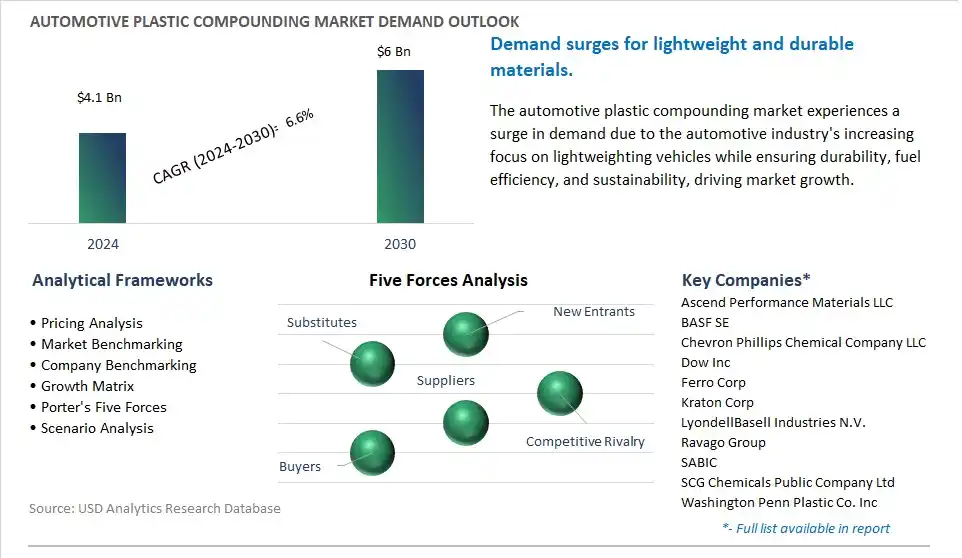
The global Automotive Plastic Compounding Market is poised to register a 6.6% CAGR from $4.1 Billion in 2024 to $6 Billion in 2030.
The global Automotive Plastic Compounding Market Study analyzes and forecasts the market size across 6 regions and 24 countries for diverse segments -By Product (Polypropylene (PP), Polyethylene (PE), Thermoplastic Elastomers (TPE), Polybutylene Terephthalate (PBT), Polyamide (PA), Polycarbonate (PC), Acrylonitrile Butadiene Systems (ABS), Styrene Acrylonitrile (SAN), Polymethyl Methacrylate (PMMA), Polyoxymethylene (POM), Blends), By Application (Interior, Exterior, Under The Hood, Structural Parts, Electrical Components & Lighting, Others).
An Introduction to Global Automotive Plastic Compounding Market in 2024
The market for automotive plastic compounding is evolving to meet the performance, durability, and sustainability requirements of modern vehicles. Key trends shaping the future of this industry include the development of specialized plastic compounds tailored to automotive applications, such as interior trim, under-the-hood components, and exterior body panels. These compounds often incorporate additives, fillers, and reinforcements to enhance mechanical properties, UV resistance, and flame retardancy while maintaining lightweight characteristics. Additionally, advancements in compounding technologies enable the incorporation of recycled and bio-based materials into plastic formulations, supporting circular economy initiatives and reducing the environmental footprint of automotive manufacturing. Moreover, the adoption of digital simulation tools and predictive modeling facilitates the design and optimization of plastic compounds for specific performance criteria, accelerating product development cycles and reducing time-to-market. As automakers and suppliers prioritize sustainability and regulatory compliance, the demand for high-performance and eco-friendly plastic compounds is expected to continue growing, driving innovation and market expansion in this sector.
Automotive Plastic Compounding Market Competitive Landscape
The market report analyses the leading companies in the industry including Ascend Performance Materials LLC, BASF SE, Chevron Phillips Chemical Company LLC, Dow Inc, Ferro Corp, Kraton Corp, LyondellBasell Industries N.V., Ravago Group, SABIC, SCG Chemicals Public Company Ltd, Washington Penn Plastic Co. Inc.
Automotive Plastic Compounding Market Dynamics
Automotive Plastic Compounding Market Trend: Shift Towards Lightweighting and Enhanced Performance
The automotive industry is witnessing a prominent trend towards lightweighting and enhanced performance, driving the demand for automotive plastic compounding. As automakers strive to meet stringent fuel efficiency standards and reduce emissions, there is a growing emphasis on replacing traditional materials like metal with lightweight plastics. Automotive plastic compounding enables the formulation of advanced materials that offer superior strength-to-weight ratios, allowing for weight reduction without compromising on performance or safety. Additionally, these compounded plastics can be customized to meet specific application requirements, such as resistance to heat, chemicals, and wear, further enhancing their appeal to automotive manufacturers.
Automotive Plastic Compounding Market Driver: Regulatory Pressure and Sustainability Initiatives
A key driver behind the increasing demand for automotive plastic compounding is regulatory pressure and sustainability initiatives aimed at reducing carbon emissions and promoting eco-friendly manufacturing practices. Governments worldwide are imposing strict regulations on vehicle emissions and fuel economy standards, compelling automakers to explore alternative materials that offer environmental benefits. Plastic compounds derived from recyclable and bio-based materials align with sustainability goals by reducing reliance on fossil fuels and minimizing the carbon footprint of vehicles. Moreover, advancements in plastic compounding technologies enable the development of high-performance materials that meet regulatory requirements while delivering cost-effective solutions for automotive applications. As regulatory mandates become more stringent and consumer preferences shift towards sustainable products, the demand for automotive plastic compounding is poised to grow substantially.
Automotive Plastic Compounding Market Opportunity: Electrification and the Rise of Electric Vehicles
An emerging opportunity in the automotive plastic compounding market lies in the rapid electrification of vehicles and the proliferation of electric vehicles (EVs). As automakers accelerate their efforts to electrify their fleets in response to environmental concerns and market demand, there is a growing need for specialized plastic compounds tailored for electric drivetrains and battery systems. These compounds must exhibit properties such as high electrical insulation, thermal stability, and flame retardancy to ensure the safety and reliability of EV components. Furthermore, lightweight plastic compounds can contribute to extending the driving range of electric vehicles by reducing overall vehicle weight and improving energy efficiency. With the electrification trend expected to gain momentum in the coming years, suppliers of automotive plastic compounding have a significant opportunity to develop innovative materials that address the unique requirements of electric vehicles, thereby driving growth and differentiation in the market.
Automotive Plastic Compounding Market Ecosystem
The automotive plastic compounding market begins with resin and additive supply, where chemical companies including BASF SE and Dow Inc. provide plastic resins and functional additives. Compounding involves blending these materials precisely to tailor properties for automotive applications, with specialty plastic compounders including RTP Company and A. Schulman Inc. leading in this sector.
Logistics and distribution ensure timely delivery of compounded plastics to automotive parts manufacturers, facilitated by logistics companies and compounders with established distribution networks. Automotive parts manufacturers, including Tier 1 suppliers including Magna International Inc. and Faurecia SE, utilize these compounded plastics to manufacture various automotive parts through processes including injection molding and extrusion.
Automakers including Toyota and Volkswagen then integrate these plastic parts into vehicles during the assembly process, ensuring compatibility with other components.
Automotive Plastic Compounding Market Share Analysis: Polypropylene (PP) held the dominant revenue share in 2024
Polypropylene (PP) is the largest segment in the automotive plastic compounding market due to its versatile properties, wide-ranging applications, and significant demand across the automotive industry. PP is a thermoplastic polymer known for its excellent chemical resistance, high melting point, and mechanical strength, making it an ideal material for various automotive components. In automotive applications, PP is commonly used in interior and exterior parts such as bumpers, dashboard trims, door panels, and under-the-hood components due to its lightweight nature, durability, and cost-effectiveness. Additionally, PP can be easily modified through compounding processes to enhance specific properties such as impact resistance, UV stability, and flame retardancy, further expanding its utility in automotive applications. In addition, the growing emphasis on lightweighting strategies, fuel efficiency, and sustainability in the automotive industry drives the demand for PP compounds as they offer weight reduction benefits without compromising performance or quality. As automotive manufacturers continue to prioritize the adoption of lightweight and eco-friendly materials, the dominance of PP in the automotive plastic compounding market is expected to persist, solidifying its position as the largest segment in the industry.
Automotive Plastic Compounding Market Share Analysis: Exterior is the fastest growing market segment over the forecast period to 2030
The segment of exterior components is the fastest-growing segment in the automotive plastic compounding market due to diverse key factors driving its accelerated demand and adoption. Exterior components play a crucial role in vehicle aesthetics, durability, and functionality, making them prime targets for material substitution and lightweighting initiatives. Automotive manufacturers are increasingly turning to advanced plastic compounds to replace traditional materials like metal and glass in exterior applications such as body panels, bumpers, grilles, and trim components. Plastic compounds offer numerous advantages, including weight reduction, design flexibility, corrosion resistance, and enhanced impact absorption, making them well-suited for exterior applications where performance and aesthetics are paramount. In addition, advancements in compounding technologies enable the customization of plastic formulations to meet specific performance requirements, including UV stability, weather resistance, and color consistency, further driving their adoption in exterior components. Additionally, the growing trend toward electric and autonomous vehicles necessitates lightweight materials to improve energy efficiency and extend driving range, further fueling the demand for plastic compounds in exterior applications. As automotive manufacturers continue to prioritize lightweighting and sustainability goals, the exterior segment of the automotive plastic compounding market is poised for continued rapid growth and innovation.
Automotive Plastic Compounding Market Report Scope-
By Product
Polypropylene (PP)
Polyethylene (PE)
Thermoplastic Elastomers (TPE)
Polybutylene Terephthalate (PBT)
Polyamide (PA)
Polycarbonate (PC)
Acrylonitrile Butadiene Systems (ABS)
Styrene Acrylonitrile (SAN)
Polymethyl Methacrylate (PMMA)
Polyoxymethylene (POM)
Blends
By Application
Interior
Exterior
Under The Hood
Structural Parts
Electrical Components & Lighting
Others
Automotive Plastic Compounding Market Companies Profiled
Ascend Performance Materials LLC
BASF SE
Chevron Phillips Chemical Company LLC
Dow Inc
Ferro Corp
Kraton Corp
LyondellBasell Industries N.V.
Ravago Group
SABIC
SCG Chemicals Public Company Ltd
Washington Penn Plastic Co. Inc
*- List Not Exhaustive
TABLE OF CONTENTS
1 Introduction to 2024 Automotive Plastic Compounding Market
1.1 Market Overview
1.2 Quick Facts
1.3 Scope/Objective of the Study
1.4 Market Definition
1.5 Countries and Regions Covered
1.6 Units, Currency, and Conversions
1.7 Industry Value Chain
2 Research Methodology
2.1 Market Size Estimation
2.2 Sources and Research Methodology
2.3 Data Triangulation
2.4 Assumptions and Limitations
3 Executive Summary
3.1 Global Automotive Plastic Compounding Market Size Outlook, $ Million, 2021 to 2030
3.2 Automotive Plastic Compounding Market Outlook by Type, $ Million, 2021 to 2030
3.3 Automotive Plastic Compounding Market Outlook by Product, $ Million, 2021 to 2030
3.4 Automotive Plastic Compounding Market Outlook by Application, $ Million, 2021 to 2030
3.5 Automotive Plastic Compounding Market Outlook by Key Countries, $ Million, 2021 to 2030
4 Market Dynamics
4.1 Key Driving Forces of Automotive Plastic Compounding Industry
4.2 Key Market Trends in Automotive Plastic Compounding Industry
4.3 Potential Opportunities in Automotive Plastic Compounding Industry
4.4 Key Challenges in Automotive Plastic Compounding Industry
5 Market Factor Analysis
5.1 Value Chain Analysis
5.2 Competitive Landscape
5.2.1 Global Automotive Plastic Compounding Market Share by Company (%), 2023
5.2.2 Product Offerings by Company
5.3 Porter’s Five Forces Analysis
5.4 Pricing Analysis and Outlook
6 Growth Outlook Across Scenarios
6.1 Growth Analysis-Case Scenario Definitions
6.2 Low Growth Scenario Forecasts
6.3 Reference Growth Scenario Forecasts
6.4 High Growth Scenario Forecasts
7 Global Automotive Plastic Compounding Market Outlook by Segments
7.1 Automotive Plastic Compounding Market Outlook by Segments, $ Million, 2021- 2030
By Product
Polypropylene (PP)
Polyethylene (PE)
Thermoplastic Elastomers (TPE)
Polybutylene Terephthalate (PBT)
Polyamide (PA)
Polycarbonate (PC)
Acrylonitrile Butadiene Systems (ABS)
Styrene Acrylonitrile (SAN)
Polymethyl Methacrylate (PMMA)
Polyoxymethylene (POM)
Blends
By Application
Interior
Exterior
Under The Hood
Structural Parts
Electrical Components & Lighting
Others
8 North America Automotive Plastic Compounding Market Analysis and Outlook To 2030
8.1 Introduction to North America Automotive Plastic Compounding Markets in 2024
8.2 North America Automotive Plastic Compounding Market Size Outlook by Country, 2021-2030
8.2.1 United States
8.2.2 Canada
8.2.3 Mexico
8.3 North America Automotive Plastic Compounding Market size Outlook by Segments, 2021-2030
By Product
Polypropylene (PP)
Polyethylene (PE)
Thermoplastic Elastomers (TPE)
Polybutylene Terephthalate (PBT)
Polyamide (PA)
Polycarbonate (PC)
Acrylonitrile Butadiene Systems (ABS)
Styrene Acrylonitrile (SAN)
Polymethyl Methacrylate (PMMA)
Polyoxymethylene (POM)
Blends
By Application
Interior
Exterior
Under The Hood
Structural Parts
Electrical Components & Lighting
Others
9 Europe Automotive Plastic Compounding Market Analysis and Outlook To 2030
9.1 Introduction to Europe Automotive Plastic Compounding Markets in 2024
9.2 Europe Automotive Plastic Compounding Market Size Outlook by Country, 2021-2030
9.2.1 Germany
9.2.2 France
9.2.3 Spain
9.2.4 United Kingdom
9.2.4 Italy
9.2.5 Russia
9.2.6 Norway
9.2.7 Rest of Europe
9.3 Europe Automotive Plastic Compounding Market Size Outlook by Segments, 2021-2030
By Product
Polypropylene (PP)
Polyethylene (PE)
Thermoplastic Elastomers (TPE)
Polybutylene Terephthalate (PBT)
Polyamide (PA)
Polycarbonate (PC)
Acrylonitrile Butadiene Systems (ABS)
Styrene Acrylonitrile (SAN)
Polymethyl Methacrylate (PMMA)
Polyoxymethylene (POM)
Blends
By Application
Interior
Exterior
Under The Hood
Structural Parts
Electrical Components & Lighting
Others
10 Asia Pacific Automotive Plastic Compounding Market Analysis and Outlook To 2030
10.1 Introduction to Asia Pacific Automotive Plastic Compounding Markets in 2024
10.2 Asia Pacific Automotive Plastic Compounding Market Size Outlook by Country, 2021-2030
10.2.1 China
10.2.2 India
10.2.3 Japan
10.2.4 South Korea
10.2.5 Indonesia
10.2.6 Malaysia
10.2.7 Australia
10.2.8 Rest of Asia Pacific
10.3 Asia Pacific Automotive Plastic Compounding Market size Outlook by Segments, 2021-2030
By Product
Polypropylene (PP)
Polyethylene (PE)
Thermoplastic Elastomers (TPE)
Polybutylene Terephthalate (PBT)
Polyamide (PA)
Polycarbonate (PC)
Acrylonitrile Butadiene Systems (ABS)
Styrene Acrylonitrile (SAN)
Polymethyl Methacrylate (PMMA)
Polyoxymethylene (POM)
Blends
By Application
Interior
Exterior
Under The Hood
Structural Parts
Electrical Components & Lighting
Others
11 South America Automotive Plastic Compounding Market Analysis and Outlook To 2030
11.1 Introduction to South America Automotive Plastic Compounding Markets in 2024
11.2 South America Automotive Plastic Compounding Market Size Outlook by Country, 2021-2030
11.2.1 Brazil
11.2.2 Argentina
11.2.3 Rest of South America
11.3 South America Automotive Plastic Compounding Market size Outlook by Segments, 2021-2030
By Product
Polypropylene (PP)
Polyethylene (PE)
Thermoplastic Elastomers (TPE)
Polybutylene Terephthalate (PBT)
Polyamide (PA)
Polycarbonate (PC)
Acrylonitrile Butadiene Systems (ABS)
Styrene Acrylonitrile (SAN)
Polymethyl Methacrylate (PMMA)
Polyoxymethylene (POM)
Blends
By Application
Interior
Exterior
Under The Hood
Structural Parts
Electrical Components & Lighting
Others
12 Middle East and Africa Automotive Plastic Compounding Market Analysis and Outlook To 2030
12.1 Introduction to Middle East and Africa Automotive Plastic Compounding Markets in 2024
12.2 Middle East and Africa Automotive Plastic Compounding Market Size Outlook by Country, 2021-2030
12.2.1 Saudi Arabia
12.2.2 UAE
12.2.3 Oman
12.2.4 Rest of Middle East
12.2.5 Egypt
12.2.6 Nigeria
12.2.7 South Africa
12.2.8 Rest of Africa
12.3 Middle East and Africa Automotive Plastic Compounding Market size Outlook by Segments, 2021-2030
By Product
Polypropylene (PP)
Polyethylene (PE)
Thermoplastic Elastomers (TPE)
Polybutylene Terephthalate (PBT)
Polyamide (PA)
Polycarbonate (PC)
Acrylonitrile Butadiene Systems (ABS)
Styrene Acrylonitrile (SAN)
Polymethyl Methacrylate (PMMA)
Polyoxymethylene (POM)
Blends
By Application
Interior
Exterior
Under The Hood
Structural Parts
Electrical Components & Lighting
Others
13 Company Profiles
13.1 Company Snapshot
13.2 SWOT Profiles
13.3 Products and Services
13.4 Recent Developments
13.5 Financial Profile
Ascend Performance Materials LLC
BASF SE
Chevron Phillips Chemical Company LLC
Dow Inc
Ferro Corp
Kraton Corp
LyondellBasell Industries N.V.
Ravago Group
SABIC
SCG Chemicals Public Company Ltd
Washington Penn Plastic Co. Inc
14 Appendix
14.1 Customization Offerings
14.2 Subscription Services
14.3 Related Reports
14.4 Publisher Expertise
By Product
Polypropylene (PP)
Polyethylene (PE)
Thermoplastic Elastomers (TPE)
Polybutylene Terephthalate (PBT)
Polyamide (PA)
Polycarbonate (PC)
Acrylonitrile Butadiene Systems (ABS)
Styrene Acrylonitrile (SAN)
Polymethyl Methacrylate (PMMA)
Polyoxymethylene (POM)
Blends
By Application
Interior
Exterior
Under The Hood
Structural Parts
Electrical Components & Lighting
Others
Countries Analyzed
North America (US, Canada, Mexico)
Europe (Germany, UK, France, Spain, Italy, Russia, Rest of Europe)
Asia Pacific (China, India, Japan, South Korea, Australia, South East Asia, Rest of Asia)
South America (Brazil, Argentina, Rest of South America)
Middle East and Africa (Saudi Arabia, UAE, Rest of Middle East, South Africa, Egypt, Rest of Africa)
