Market Overview: Capacity Expansion, Pharmaceutical Actuator Innovation, and Sustainability Investments Drive Bag On Valve Products Market
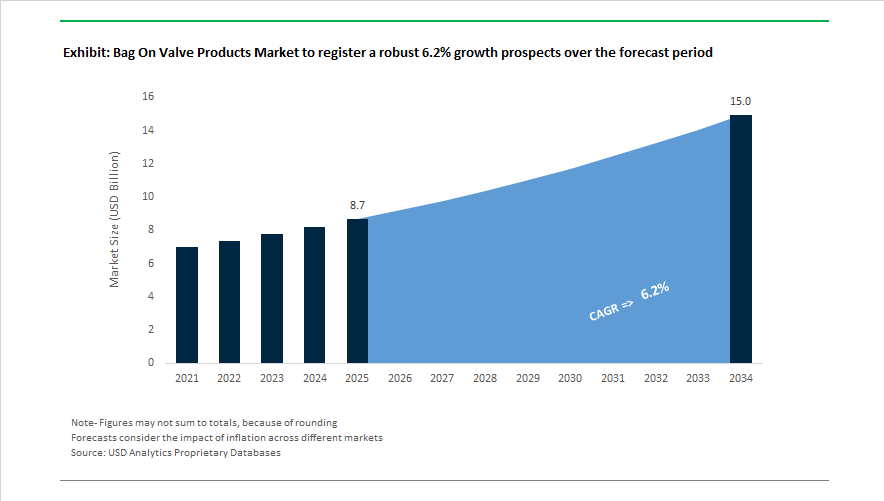
The Bag On Valve (BoV) products market is valued at $8.7 billion in 2025 and is projected to reach $14.9 billion by 2034, advancing at a 6.2% CAGR. Growth is anchored in rising adoption of compressed air aerosol technology, preservative-free dispensing systems, 360-degree spray valves, sterile pharmaceutical delivery, air-powered cosmetic packaging, food-grade spray systems, and sustainable aerosol components. Technology diversification accelerated in July 2024 when Lindal Group introduced the Glide actuator engineered for highly viscous formulations such as gels, creams, and industrial lubricants, solving flow restriction challenges that historically limited BoV use in dense products. In August 2024, Lindal expanded North American production for its Pinocchio nasal actuator to support rising demand for preservative-free saline nasal sprays, strengthening BoV’s role in sterile drug delivery.
Manufacturing scale-up and regional supply chain localization became central themes through 2024 and 2025. Summit Packaging Systems secured approvals in September 2024 to double the size of its Keene, New Hampshire engineering facility, increasing capacity for high-precision BoV valve assembly. Later in December 2024, Summit Europe expanded its Almere headquarters footprint by 40% to address strong growth in European food aerosol packaging. Summit strengthened global reach in September 2025 by opening a Toluca, Mexico production facility to support Latin American pharmaceutical and personal care brands. Capacity for personal care actuators further increased in October 2025 when Summit Europe added a 64-cavity mold line for Europa actuators used in deodorant and hairspray BoV formats. In January 2026, Lindal acquired a new facility in Wismar, Germany, positioning it as a strategic hub for advanced valve assembly in Europe.
Sustainability and pharmaceutical precision dispensing technologies shaped competitive positioning. In November 2024, Coster Group transitioned all global manufacturing sites to 100% renewable electricity under its 2026 sustainability roadmap, enhancing the carbon profile of its BoV components. Lindal expanded its PCR-based recyclable valve portfolio in 2025, reducing virgin plastic consumption in high-pressure compressed air systems. On the medical front, Aptar Pharma launched the FlipStraw dual-spray actuator in April 2025, enabling selectable mist or jet application for wound care and dermal therapies. Aptar strengthened pharmaceutical capabilities in December 2025 through the acquisition of Sommaplast, integrating precision molding expertise into specialized BoV drug-delivery platforms. Looking ahead, Summit Packaging confirmed participation in Paris Packaging Week in February 2026, where high-fidelity, eco-friendly BoV delivery mechanisms will be presented to global brand owners, reinforcing the market’s shift toward sustainable aerosol packaging, sterile medical dispensing, advanced actuator engineering, and localized manufacturing ecosystems.
Trends and Opportunities Reshaping Growth in the Bag-On-Valve (BOV) Products Market
Market Trend: Pharmaceutical Adoption Accelerates Due to Sterility and Clean-Label Compliance
Bag-on-Valve technology is becoming a core enabler of preservative-free medicine delivery. The pharmaceutical sector is actively replacing standard aerosols and mechanical pumps with BOV formats to maintain sterility across multi-dose usage. As of December 2025, global output of medical-grade BOV reached 240 million units, growing 19.4% from the previous year. This trajectory reflects a fundamental shift toward oxygen-barrier packaging for biologics, chronic wound solutions, and sterile ophthalmic rinses that cannot tolerate atmospheric contamination.
Clinical adoption is also driven by regulations and patient adherence. More than 320 pharmaceutical brands have already transitioned to BOV packaging, supported by evidence that eliminating preservatives in nasal sprays improves mucosal comfort, compliance, and overall therapeutic outcomes. New performance benchmarks emerging in 2025 show that laminated four-layer aluminum BOV bags extend the shelf life of sensitive formulations by up to 100% compared to propellant-contacting aerosol systems. As a result, BOV is moving from a niche packaging format to a strategic pharmaceutical delivery platform.
Market Trend: Airless Packaging Redefines Luxury Personal Care and Natural Beauty
Premium skincare and haircare brands are adopting BOV to safeguard high-potency active ingredients like Vitamin C, retinol, and peptides from air exposure. In 2024–2025, the personal care category represented 38.3% of global BOV consumption, with over 560 million units produced. Brands market 360-degree dispensing as a lifestyle and usability advantage, particularly for sun care sprays and facial mists intended for overhead or inverted application.
A notable driver is the clean-beauty consumer segment. Market data from 2025 confirms that nearly half of all natural and organic products – 49.2% – rely on BOV packaging to achieve "preservative-free" positioning. The technology allows ingredients to avoid contact with ambient air, thereby retaining antioxidant potency and delaying degradation that normally begins within weeks in pump-based bottles. Innovation at the premium tier is focused on dual-chamber BOV systems that keep two reactive ingredients separate until activation, offering chemists and dermatological brands new formulation freedoms similar to multi-step clinical serums.
Market Opportunity: Low-VOC Household and Industrial Disinfection as Regulation Tightens
Government pressure to phase down VOCs in home care and institutional cleaning formulations is creating a structural opening for BOV systems. Because nitrogen or compressed air act as non-flammable propellants, BOV is naturally aligned with 2025 EU–UK aerosol guidelines that push manufacturers toward low-emission packaging formats.
The technology is proving operationally superior as well. In the I&I segment, fine-mist spray uniformity is crucial for standardized surface disinfection across healthcare, foodservice, and sanitation protocols. Approximately 190 million home care and disinfectant units used BOV in 2024, largely due to reduced clogging and better delivery of viscous formulas. The 99% evacuation rate is a direct cost advantage, especially for commercial cleaning clients that typically lose 5 to 10% of product volume in traditional cans due to residual fluid wastage. For facility operators justifying procurement based on life-cycle cost, BOV provides a compelling economic argument.
Market Opportunity: Emergency Nutrition and Tactical Medical Gel Delivery for Defense
Defense and emergency-response sectors are adopting BOV for use cases that require one-handed dispensing reliability in extreme climates. The U.S. DEVCOM program nearing deployment is developing polymer-strengthened BOV units capable of storing high-viscosity calorie gels for field rations. The value proposition is practicality: a soldier with one free hand must still be able to consume nutrition or apply treatment in motion or low-temperature environments.
Viscosity control is a technical differentiator. Unlike aerosol valves that sputter under thick payloads, BOV’s cuff-pressure mechanism forces consistent flow without propellant contamination. This is expanding its use in emergency medical supply kits, where BOV enables sterile dispensing of burn gels, wound hydration fluids, and trauma-response nutrition sachets that must perform during disaster-relief operations.
Bag-On-Valve (BOV) Products Market Share and Segmentation Insights
Product Type Market Share: Aerosol BOV Leads Adoption While Non-Spray Formats Accelerate in Pharma
In 2025, aerosol bag-on-valve products account for 58% of global BOV market share, making them the most commercially mature format across pharmaceuticals and premium personal care. These systems use compressed air or nitrogen to dispense product without chemical propellants, supporting strong demand for saline sprays, wound care, sunscreens, and mousses as consumers increasingly favor “gas-free” packaging. Standard BOV formats serve viscous products such as lotions, gels, and creams, with growing penetration in food applications including edible oils and sauces, where sterility and oxidation prevention are critical differentiators. Non-spray BOV represents the smallest but fastest-growing segment (around 15%), covering drops, dots, and stream delivery for eye care, nasal rinses, and contact lens solutions. This highly regulated pharmaceutical niche commands premium pricing and high entry barriers, positioning non-spray BOV as a strategic growth engine within advanced dispensing and sterile packaging ecosystems.
End-Use Market Share: Personal Care Dominates Volumes as Pharmaceuticals Deliver Highest Value
By end-use, cosmetics and personal care capture 44% of BOV product demand in 2025, driven by 360-degree spraying, consistent dosing, and full evacuation without propellant contamination. Sunscreens, dry shampoos, facial mists, and self-tanners are key volume drivers, with premiumization and clean beauty positioning steadily pulling share from traditional aerosol cans. Pharmaceuticals represent the highest-value segment, leveraging BOV for preservative-free nasal sprays, sterile wound cleaners, and topical anesthetics, supported by regulatory momentum favoring multi-dose sterile delivery systems and long qualification cycles that create sticky OEM relationships. Household and industrial applications remain underpenetrated but expanding, as disinfectants and air fresheners migrate to compressed-gas claims, while specialty lubricants add margin-rich niches. Food and beverage is the highest-potential emerging segment, enabling propellant-free oil sprays, condiments, and dessert toppings, with Europe leading adoption and North America and Asia-Pacific rapidly catching up.
Bag On Valve Products Market Competitive Landscape
The Bag On Valve (BoV) products market in 2026 is defined by pharmaceutical-grade dispensing, recyclable valve architectures, high-barrier laminate innovation, and digitally enabled system design. Competition is shifting from basic aerosol components toward fully integrated BoV platforms that combine sterile filling compatibility, dose accuracy, sustainability metrics, and localized production. Market leaders are differentiating through ISO-certified traceability, monomaterial-ready bags, compressed-air propellants, and plug-and-play valve systems. Growth is being fueled by healthcare sprays, clean-label food, premium personal care, and industrial coatings, with manufacturers increasingly optimizing BoV for adherence tracking, dual-dispensing, and circular aluminum recovery.
Pharmaceutical-grade BoV leadership and dose-counting innovation by AptarGroup, Inc.
Aptar enters 2026 as the technology benchmark for medical Bag On Valve systems through its Aptar Pharma division, delivering multi-dose nasal, dermal, and wound-care platforms with bag volumes ranging from 30 ml to 500 ml. In 2025/2026, the company commercialized the industry’s first integrated dose-counting actuators for BoV nasal sprays, supporting adherence-tracking medical devices. Aptar’s advanced analytical laboratories qualify customer formulations for viscosity and pH stability before scale-up, reducing regulatory risk. Strategically, Aptar emphasizes “medical-grade transparency,” implementing ISO 15378-certified Change Control Procedures to ensure full traceability, positioning its BoV solutions as the gold standard for sterile healthcare dispensing.
High-volume sustainable BoV systems and digital prototyping from LINDAL Group
LINDAL dominates personal care and technical BoV applications, backed by aggressive capacity expansion and a sustainability-first manufacturing roadmap. In early 2026, the company expanded globally through the acquisition of a Wismar, Germany facility and new high-speed BoV lines in North America. Its 2024–2026 Sustainability Roadmap prioritizes lightweight, fully recyclable valve components and reduced plastic content. LINDAL is a preferred supplier for shaving gels, sunscreens, and industrial lubricants, including dual-dispensing systems. A key differentiator is its 3D Aerosol Configurator, enabling brands to digitally prototype complete BoV assemblies, accelerating product development while reducing tooling iterations.
Global volume scale and high-barrier BoV bags from Precision Valve Corporation
Precision Valve Corporation remains the global volume leader in BoV through its unmatched distribution footprint and standardized valve platforms. During 2025–2026, Precision established regional assembly hubs across APAC and LATAM to localize production and cut logistics-related emissions. Its high-barrier multilayer BoV bags deliver near-zero oxygen permeation, supporting the fast-growing clean-label food segment. Precision’s plug-and-play valve architecture allows contract fillers to adopt BoV with minimal line modifications. Strategically, the company is focused on supply resilience, diversifying laminate film sourcing to ensure uninterrupted production for multinational FMCG brands following recent global supply chain disruptions.
Integrated BoV components and filling machinery by Coster Technologie Speciali S.p.A.
Coster stands apart as the only major BoV supplier manufacturing both valve components and filling equipment, enabling unmatched hardware-chemistry synergy. In late 2025, it launched a next-generation Eco-Valve optimized for compressed air and nitrogen, delivering LPG-like spray consistency without hydrocarbon propellants. Coster’s proprietary under-the-cup filling technology ensures stable gas pressure across product life, enhancing dispensing reliability. Female valves, now its fastest-growing segment, support premium cosmetic aesthetics. Strategically, Coster is advancing “circular aluminum,” collaborating with European recyclers to achieve over 80% recycled content in BoV can systems, aligning performance with circular packaging mandates.
Lean manufacturing and niche BoV customization from Summit Packaging Systems
Summit Packaging Systems specializes in vertically integrated BoV valves and actuators tailored for high-pressure industrial coatings and automotive waxes. In 2025, Summit expanded technical service centers in New Hampshire and Wisconsin, offering valve-formulation matching for emerging plant-based food and specialty brands. Its lean manufacturing model targets cost reduction, helping democratize BoV technology for mass-market household cleaners. Unlike large conglomerates, Summit emphasizes relationship-driven supply chains, providing bespoke development for niche applications such as specialty adhesives. This boutique-scale approach allows Summit to compete through agility, rapid prototyping, and customized engineering rather than sheer production volume.
High-barrier laminate innovation and food-grade BoV growth at Gualapack S.p.A.
Gualapack has emerged as a disruptive BoV player by applying its flexible packaging expertise to advanced laminate bags. In 2025, the company introduced monomaterial-ready BoV laminates, supporting the 2026 recyclability push across aerosol packaging. Its pouch-in-can solutions enable dispensing of over 99% of contents, a critical advantage for premium serums and concentrated foods. Gualapack leads the Food & Beverage BoV segment, supplying high-barrier systems for edible oils, whipped creams, and liquid seasonings. Strategically, the company integrates lifecycle analysis into customer projects, positioning BoV as a circular alternative to traditional bottles and legacy aerosols.
United States Bag On Valve Products Market: Regulatory Acceleration and Rapid BOV Conversion in Personal Care and Pharma
The United States Bag-On-Valve products industry is entering a mature consolidation and compliance-driven growth phase, underpinned by regulatory modernization and accelerated adoption across pharmaceuticals and personal care. A defining structural event was the completion of Parker-Hannifin Corporation’s USD 9.25 billion acquisition of Filtration Group in early 2026. While historically filtration-focused, this consolidation is strategically relevant to the BOV ecosystem as it unifies advanced barrier materials, sterile dispensing technologies, and life sciences-grade container systems under one global platform. The transaction reflects growing convergence between filtration science and BOV-based drug delivery and barrier packaging solutions.
Regulatory facilitation is further accelerating BOV adoption. In 2025, the U.S. Food and Drug Administration expanded its Emerging Technology Program to offer streamlined post-market review pathways for BOV-based container-closure systems. The initiative explicitly targets nasal and topical drug conversions, enabling faster transition from traditional aerosols to BOV platforms for emergency therapies and chronic care medications. On the manufacturing side, U.S. contract fillers significantly expanded Ultra-Low Viscosity filling infrastructure in late 2025, supporting BOV sunscreen sprays, skin-repair mists, and dermatological formulations that rely exclusively on nitrogen or compressed air propellants. Environmental compliance remains a decisive catalyst. Following the 2025 update by the California Air Resources Board, over 65% of U.S. personal care aerosol manufacturers transitioned to BOV technology to eliminate volatile organic compound emissions and meet stricter indoor air quality benchmarks. This positions BOV as the default format for non-flammable, propellant-free dispensing in the U.S. consumer and medical packaging landscape.
India Bag On Valve Products Market: Pharma-Led Adoption and Policy-Aligned Manufacturing Localization
India’s Bag-On-Valve products industry is advancing rapidly through pharmaceutical innovation, government-backed manufacturing programs, and growing demand for preservative-free medical and dermatological packaging. In Q4 2025, leading domestic pharmaceutical players Emcure Pharmaceuticals and Entod Pharmaceuticals launched specialized BOV-packaged nasal and wellness therapies, including Lubrinase and Poviztra. These launches highlight the industry’s shift toward BOV formats that ensure 360-degree dispensing, consistent dose delivery, and near-total product evacuation, attributes increasingly valued in weight management and nasal hydration therapies.
Clinical-grade skincare is also emerging as a high-growth BOV segment. Indian biopharma innovators such as Emcutix introduced AquaOat in late 2025, a BOV-dispensed sunscreen and skincare innovation designed to maintain sterility without reliance on heavy preservatives. This aligns with rising dermatology-led demand for airless, contamination-resistant packaging. From a supply chain perspective, localization is being reinforced by policy and regional manufacturing hubs. Under the Department of Chemicals and Petrochemicals 2025 Plastic Park guidelines, newly designated chemical zones are prioritizing BOV manufacturers as part of the “Make in India” initiative for export-grade medical packaging. While valve assembly capacity serving India is currently anchored offshore, Summit Packaging Systems’s high-speed valve assembly hub inaugurated in 2025 now acts as the primary supply base for Indian and Latin American markets, ensuring scalable access to over 250 million BOV valve units annually.
Mexico Bag On Valve Products Market: North American Valve Manufacturing and Quality Standardization Hub
Mexico has emerged as a critical node in the global Bag-On-Valve supply chain, particularly for valve assembly and North American market servicing. In August 2025, Summit Packaging Systems officially commissioned its 3,500-square-meter facility in Toluca, equipped with two advanced assembly lines dedicated to high-speed BOV valve production. The facility strengthens supply chain resilience for the U.S. personal care and pharmaceutical sectors, supporting nearshoring strategies amid growing regulatory and logistics complexity.
Beyond capacity expansion, Mexico’s role is increasingly centered on quality and workforce development. The Toluca site established a specialized training center in 2025 to ensure that locally manufactured BOV components consistently meet the stringent quality and performance standards required by multinational FMCG and healthcare brands. This focus on standardized manufacturing excellence positions Mexico not only as a cost-efficient production base, but also as a quality-assured exporter of critical BOV components.
Germany Bag On Valve Products Market: Sustainability Leadership and Smart Valve Engineering
Germany represents the technological and sustainability benchmark for the global Bag-On-Valve products industry. In December 2025, LINDAL Group published its 2024/2025 Sustainability Report, outlining a strategic transition toward fully recyclable PET aerosol dispensers and metal-free BOV systems. These developments are aligned with European PET Bottle Platform guidelines and reinforce Germany’s leadership in circular packaging solutions for aerosols and BOV formats.
Engineering innovation is further differentiating the German market. At Pack Expo 2025, German engineers from Coster Group and LINDAL showcased next-generation Smart Valve technologies, integrating IoT-enabled sensors capable of real-time pressure and flow-rate monitoring. These systems are particularly relevant for industrial lubricants and medical BOV applications where precision dispensing and performance traceability are critical. From an operational standpoint, Germany has also set a new sustainability benchmark. Major BOV manufacturing plants reached 100% renewable electricity usage by January 2026, positioning Central Europe as the global leader in low-carbon and green aerosol production.
China Bag On Valve Products Market: Policy-Driven Manufacturing Scale and Export-Oriented Expansion
China’s Bag-On-Valve products industry is benefiting from explicit policy support and export-oriented manufacturing strategies. Under the national “2025 Action Plan for Stabilizing Foreign Investment,” BOV-based healthcare and automated packaging solutions are formally classified as encouraged sectors. This designation provides tax incentives and regulatory facilitation for manufacturers integrating BOV technology into pharmaceutical and medical packaging lines, accelerating domestic capacity build-out.
China’s export strategy is also reinforcing BOV infrastructure investment. In 2025, the Ministry of Commerce of China reported USD 23.2 billion in engagement across technology and manufacturing sectors, with a meaningful share directed toward high-speed aerosol and BOV filling systems. These investments are closely linked to servicing Belt and Road partner markets, positioning China as a volume-driven exporter of BOV-packaged healthcare and personal care products. The combination of automation incentives, healthcare prioritization, and export alignment is rapidly embedding BOV technology into China’s advanced packaging manufacturing ecosystem.
Country-Level Strategic Snapshot: Bag-On-Valve Products Industry
Bag-On-Valve (BOV) Products Market County Level Snapshot
Country
Strategic Focus Area
Key Developments (2025–2026)
United States
Regulatory acceleration and aerosol conversion
FDA pathway modernization, CARB-driven BOV migration, ULV filling expansion
India
Pharma-led innovation and policy-backed localization
Nasal spray launches, clinical skincare adoption, Plastic Park prioritization
Mexico
Valve manufacturing and quality standardization
Toluca assembly hub, workforce training for global FMCG compliance
Germany
Sustainable and smart BOV engineering
Recyclable PET systems, IoT-enabled smart valves, renewable-powered production
China
Policy-supported scale-up and export manufacturing
Encouraged-sector incentives, BOV filling investments tied to Belt and Road markets
Bag-On-Valve (BOV) Products Market Report Scope
Bag On Valve Products Market
Parameter
Details
Market Size (2025)
$8.7 Billion
Market Size (2034)
$14.9 Billion
Market Growth Rate
6.2%
Segments
By Product Type (Aerosol Bag On Valve, Standard Bag On Valve, Non Spray Bag On Valve), By Container Material (Aluminum, Tinplate, Plastic, Glass), By Valve Actuation Type (Continuous Flow Valves, Metered Dose Valves, Lockable Actuators), By Capacity (Below 100 mL, 100 mL to 300 mL, 300 mL to 500 mL, Above 500 mL), By End Use Application (Pharmaceuticals, Cosmetics and Personal Care, Food and Beverage, Household and Industrial)
Study Period
2019- 2025 and 2026-2034
Units
Revenue (USD)
Qualitative Analysis
Porter’s Five Forces, SWOT Profile, Market Share, Scenario Forecasts, Market Ecosystem, Company Ranking, Market Dynamics, Industry Benchmarking
Companies
AptarGroup, Lindal Group, Coster Tecnologie Speciali, Summit Packaging Systems, Precision Valve Corporation, Silgan Holdings, Majesty Packaging Systems, Koh I Noor Mlada Vozice, Salvalco, Aerosol Service, Gualapack, Chicago Aerosol, Toyo and Deutsche Aerosol, DuPont, Signature Filling Company
Countries
US, Canada, Mexico, Germany, France, Spain, Italy, UK, Russia, China, India, Japan, South Korea, Australia, South East Asia, Brazil, Argentina, Middle East, Africa
Bag On Valve Products Market Segmentation
By Product Type
Aerosol Bag On Valve
Standard Bag On Valve
Non Spray Bag On Valve
By Container Material
Aluminum
Tinplate
Plastic
Glass
By Valve Actuation Type
Continuous Flow Valves
Metered Dose Valves
Lockable Actuators
By Capacity
Below 100 mL
100 mL to 300 mL
300 mL to 500 mL
Above 500 mL
By End Use Application
Pharmaceuticals
Cosmetics and Personal Care
Food and Beverage
Household and Industrial
By Region
North America (United States, Canada, Mexico)
Europe (Germany, France, United Kingdom, Spain, Italy, Rest of Europe)
Asia Pacific (China, India, Japan, South Korea, Australia, Rest of APAC)
South and Central America (Brazil, Argentina, Rest of SCA)
Middle East and Africa (Saudi Arabia, UAE, South Africa, Rest of Middle East, Rest of Africa)
2. Bag On Valve Products Market Landscape & Outlook (2025–2034)
2.1. Introduction to Bag On Valve Products Market
2.2. Market Valuation and Growth Projections (2025–2034)
2.3. Key Growth Drivers: Pharmaceutical Sterility, Clean Beauty Adoption, and Sustainable Aerosol Packaging
2.4. Regulatory Environment: VOC Reduction, Preservative-Free Compliance, and Medical Packaging Standards
2.5. Supply Chain Evolution: Capacity Expansion, Regional Localization, and Valve Innovation
3. Innovations Reshaping the Bag On Valve Products Market
3.1. Trend: Pharmaceutical Adoption Accelerates Due to Sterility and Clean-Label Compliance
3.2. Trend: Airless Packaging Redefines Luxury Personal Care and Natural Beauty
3.3. Opportunity: Low-VOC Household and Industrial Disinfection Applications
3.4. Opportunity: Emergency Nutrition and Tactical Medical Gel Delivery for Defense
4. Competitive Landscape and Strategic Initiatives
4.1. Mergers and Acquisitions
4.2. Actuator Engineering and Valve Technology Innovation
4.3. Sustainability Investments and Circular Packaging Strategies
4.4. Market Expansion and Regional Manufacturing Footprint
5. Market Share and Segmentation Insights: Bag On Valve Products Market
5.1. By Product Type
5.1.1. Aerosol Bag On Valve
5.1.2. Standard Bag On Valve
5.1.3. Non Spray Bag On Valve
5.2. By Container Material
5.2.1. Aluminum
5.2.2. Tinplate
5.2.3. Plastic
5.2.4. Glass
5.3. By Valve Actuation Type
5.3.1. Continuous Flow Valves
5.3.2. Metered Dose Valves
5.3.3. Lockable Actuators
5.4. By Capacity
5.4.1. Below 100 mL
5.4.2. 100 mL to 300 mL
5.4.3. 300 mL to 500 mL
5.4.4. Above 500 mL
5.5. By End Use Application
5.5.1. Pharmaceuticals
5.5.2. Cosmetics and Personal Care
5.5.3. Food and Beverage
5.5.4. Household and Industrial
6. Country Analysis and Outlook of Bag On Valve Products Market
6.1. United States
6.2. Canada
6.3. Mexico
6.4. Germany
6.5. France
6.6. Spain
6.7. Italy
6.8. UK
6.9. Russia
6.10. China
6.11. India
6.12. Japan
6.13. South Korea
6.14. Australia
6.15. South East Asia
6.16. Brazil
6.17. Argentina
6.18. Middle East
6.19. Africa
7. Bag On Valve Products Market Size Outlook by Region (2025–2034)
7.1. North America Bag On Valve Products Market Size Outlook
7.1.1. By Product Type
7.1.2. By Container Material
7.1.3. By Valve Actuation Type
7.1.4. By Capacity
7.1.5. By End Use Application
7.2. Europe Bag On Valve Products Market Size Outlook
7.2.1. By Product Type
7.2.2. By Container Material
7.2.3. By Valve Actuation Type
7.2.4. By Capacity
7.2.5. By End Use Application
7.3. Asia Pacific Bag On Valve Products Market Size Outlook
7.3.1. By Product Type
7.3.2. By Container Material
7.3.3. By Valve Actuation Type
7.3.4. By Capacity
7.3.5. By End Use Application
7.4. South America Bag On Valve Products Market Size Outlook
7.4.1. By Product Type
7.4.2. By Container Material
7.4.3. By Valve Actuation Type
7.4.4. By Capacity
7.4.5. By End Use Application
7.5. Middle East and Africa Bag On Valve Products Market Size Outlook
7.5.1. By Product Type
7.5.2. By Container Material
7.5.3. By Valve Actuation Type
7.5.4. By Capacity
7.5.5. By End Use Application
8. Company Profiles: Leading Players in the Bag On Valve Products Market
8.1. AptarGroup
8.2. Lindal Group
8.3. Coster Tecnologie Speciali
8.4. Summit Packaging Systems
8.5. Precision Valve Corporation
8.6. Silgan Holdings
8.7. Majesty Packaging Systems
8.8. Koh I Noor Mlada Vozice
8.9. Salvalco
8.10. Aerosol Service
8.11. Gualapack
8.12. Chicago Aerosol
8.13. Toyo and Deutsche Aerosol
8.14. DuPont
8.15. Signature Filling Company
9. Methodology
9.1. Research Scope
9.2. Market Research Approach
9.3. Market Sizing and Forecasting Model
9.4. Research Coverage
9.5. Data Horizon
9.6. Deliverables
10. Appendix
10.1. Acronyms and Abbreviations
10.2. List of Tables
10.3. List of Figures
Bag On Valve Products Market Segmentation
By Product Type
Aerosol Bag On Valve
Standard Bag On Valve
Non Spray Bag On Valve
By Container Material
Aluminum
Tinplate
Plastic
Glass
By Valve Actuation Type
Continuous Flow Valves
Metered Dose Valves
Lockable Actuators
By Capacity
Below 100 mL
100 mL to 300 mL
300 mL to 500 mL
Above 500 mL
By End Use Application
Pharmaceuticals
Cosmetics and Personal Care
Food and Beverage
Household and Industrial
By Region
North America (United States, Canada, Mexico)
Europe (Germany, France, United Kingdom, Spain, Italy, Rest of Europe)
Asia Pacific (China, India, Japan, South Korea, Australia, Rest of APAC)
South and Central America (Brazil, Argentina, Rest of SCA)
Middle East and Africa (Saudi Arabia, UAE, South Africa, Rest of Middle East, Rest of Africa)
The Bag On Valve Products Market stands at $8.7 billion in 2025 and is forecast to reach $14.9 billion by 2034, expanding at a 6.2% CAGR. Growth is powered by preservative-free pharmaceutical sprays, clean beauty aerosols, compressed-air household products, and rising adoption of sterile, 360-degree dispensing systems across healthcare and personal care.
Cosmetics and personal care dominate volumes with roughly 44% share, led by sunscreens, facial mists, dry shampoos, and airless skincare. Pharmaceuticals deliver the highest value per unit, driven by preservative-free nasal sprays, wound care, and topical therapies. Food-grade sprays and industrial disinfectants are emerging as high-growth niches due to oxidation control and low-VOC regulations.
Pharma companies are rapidly migrating to BOV to enable multi-dose sterile delivery without preservatives. Laminated high-barrier bags now double shelf life versus conventional aerosols, while dose-accurate actuators support regulatory compliance and patient adherence. By late 2025, medical-grade BOV output exceeded 240 million units, signaling a structural shift toward oxygen-isolated drug packaging platforms.
The United States leads conversion from traditional aerosols due to VOC regulations and FDA pathway modernization. India is accelerating pharma-led BOV adoption under manufacturing localization policies. Germany anchors smart valve engineering and circular packaging, Mexico is emerging as a North American valve assembly hub, and China is scaling export-oriented BOV production under healthcare manufacturing incentives.

 Products Market Share By End Use Application, 2025.png)