Market Overview: EVOH Capacity Expansion, Fiber-Based Gas Barriers, and Recyclable Retort Structures Drive Barrier Materials Market Growth
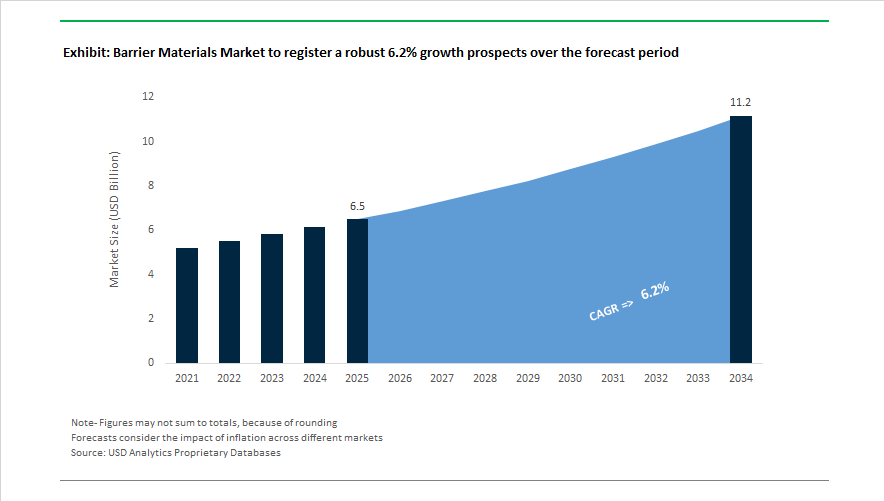
The Barrier Materials Market is valued at $6.5 billion in 2025 and is projected to reach $11.2 billion by 2034, advancing at a 6.2% CAGR. Growth is supported by rising demand for EVOH barrier resins, high oxygen-barrier polymers, gas-barrier coatings, recyclable barrier laminates, mono-material packaging, aluminum-free structures, paper-based barrier technologies, and medical-grade protective films. Capacity expansion in advanced barrier polymers began in April 2024 when Kuraray committed $140 million to build a new Ethylene Vinyl Alcohol copolymer plant in Singapore. The Jurong Island facility, designed for 36,000 tonnes front-end capacity, will start operations by the end of 2026 and supports food preservation materials demand across Asia. Sustainability momentum intensified in 2025 with Kuraray’s launch of 100% bio-based Circular EVAL at its Antwerp facility, with commercial availability in late 2025 for brands seeking fossil-free high-barrier packaging solutions.
Fiber-based barrier technology and recyclable medical laminates gained prominence through 2025. Mitsubishi Chemical Corporation announced in October 2025 a paper coating process using SoarnoL resin that imparts strong gas and oil barrier properties, enabling substitution of plastic-heavy food packaging. Amcor confirmed in early 2026 that it is in the final stage of its pledge to make its packaging portfolio recyclable or reusable by the end of 2025, recently introducing mono-PE medical laminates that replace aluminum foil. Regional technical service expansion occurred in July 2025 when Kuraray opened a Mumbai technical laboratory, accelerating local validation of EVOH multilayer structures. Pregis strengthened North American supply in April 2025 by expanding South Carolina EVOH film output for oxygen-sensitive grocery delivery and hygienic packaging applications.
Paper substitution, mono-polymer retort barriers, and upstream polymer investments further shaped the market. Tetra Pak committed €60 million in September 2025 to pilot aluminum-free carton barrier systems aimed at achieving nearly full renewable content. Ahlstrom launched LamiBak Flex in March 2025, a PFAS-free, wood pulp–based barrier paper engineered for recyclability and compostability in flexible food packaging. A collaboration among Bobst Group, Brückner Group, and Mitsui Chemicals delivered a recyclable mono-material retort film in 2025, enabling high-barrier sterilizable pouches compatible with PE recycling streams. Taghleef Industries introduced smart leak-detection metallized films the same year, targeting pharmaceutical and medical device integrity monitoring. Upstream resin security improved in March 2025 when LyondellBasell approved a Houston propylene expansion project, reinforcing supply of polyolefin feedstocks essential for barrier film structures. Process innovation advanced in September 2025 as Heidelberger Druckmaschinen AG and Solenis introduced an inline barrier coating method that applies moisture-resistant layers during printing, enabling scalable production of recyclable fiber packaging formats.
Trends and Opportunities Shaping the Barrier Materials Market
Market Trend: ALD and Hybrid Barrier Technologies Become Standard for Next-Generation Electronics
Barrier requirements in electronics are changing rapidly as device form factors become thinner, flexible, and more heat-sensitive. Atomic Layer Deposition (ALD) is emerging as the dominant high-performance barrier solution because it enables angstrom-level coating uniformity that prevents moisture and gas penetration on semiconductor surfaces and OLED substrates.
The ALD equipment segment exceeded USD 3.63 billion in valuation by December 2025, supported by the semiconductor industry's surge in high-density logic nodes. Major foundries, including TSMC, have integrated hundreds of ALD steps into 2nm Gate-All-Around (GAA) platforms targeted for late-2025 mass production. ALD improves electrical reliability by keeping dielectric layers stable and lowering device power consumption by approximately 25 to 30% compared with 3nm systems.
Scalability depends on emerging variants such as Spatial ALD and Plasma Enhanced ALD, which enable coating at temperatures below 100°C. This allows application onto polymer substrates found in flexible smartphones, AR wearables, and foldable screens. In parallel, industrial gas suppliers like Air Liquide are expanding into environmentally safer precursor chemistries that reduce toxic emissions during deposition, aligning ALD adoption with global EHS and clean-manufacturing policies.
Market Trend: PVC-Free, High-Barrier Polymers Gain Traction in Pharma Blister Packaging
Barrier material innovation is accelerating inside the pharmaceutical supply chain, where moisture-sensitive medicines, hygroscopic powders, and biologics require oxygen- and humidity-controlled packaging. A clear industry movement is underway to phase out PVC-based blister packs due to sustainability concerns and limited compatibility with recycling systems.
In November 2025, Honeywell and Evertis announced a strategic program to integrate Aclar® barrier coatings into recyclable PET blister films, allowing pharmaceutical packaging to deliver high barrier performance without halogenated plastics. Similarly, Perlen Packaging began producing Mono-PP and PP/COC/PP laminates to meet the EU Packaging and Packaging Waste Regulation (PPWR), which fully comes into force in 2025 and incentivizes halogen-free and circular-design primary packaging.
TOPAS® COC continues to lead the medical-grade market, offering exceptional moisture protection and low extractables, making it the preferred choice for multi-dose nasal delivery devices and sensitive parenteral applications. For pharmaceutical companies, the competitive edge lies in pairing high barrier performance with regulatory-compliant sustainability.
Market Opportunity: Moisture-Barrier Solutions for Perovskite and Organic Photovoltaics
Barrier materials are becoming essential for achieving commercial viability in lightweight solar modules. Perovskite and OPV cells degrade rapidly when exposed to humidity. As a result, encapsulation layers must reach ultra-low Water Vapor Transmission Rates (WVTR) near 10⁻⁴ g/m²/day to ensure stability.
A breakthrough highlighted in October 2025 by Science Advances demonstrated that integrating dodecyltrimethylammonium bromide (DTAB) into perovskite structures produced a self-crystallizing hydrophobic layer that maintained 94.6% of the cell’s initial efficiency after 2,600 hours of ambient exposure. Laboratory efficiency milestones have now reached 27% in single-junction cells and more than 34.85% in tandem silicon formats by early 2025.
As commercialization approaches, barrier materials will determine the bankability of solar roll-to-roll technologies used in BIPV (Building-Integrated PV), industrial textile coatings, and off-grid energy wearables. Suppliers that can provide scalable, flexible, ultra-barrier encapsulation films are positioned to enter one of the fastest-growing clean-energy material categories globally.
Market Opportunity: Gas-Barrier Liners for Green Hydrogen Transport and Storage
Hydrogen’s extremely small molecular size makes permeation prevention one of the most difficult engineering challenges in energy infrastructure. Growth in the green hydrogen economy depends on developing specialty polymer liners capable of preventing leakage and embrittlement across pipelines, tanks, and mobility systems.
High-pressure composite Type IV tanks, already used by companies such as Hexagon Purus, Luxfer Gas Cylinders, and Worthington Enterprises, depend on high-density polyethylene (HDPE) or polyamide-6 liners engineered for ultra-low permeation at storage pressures above 700 bar. Beyond storage, pipeline modernization research published in April 2025 shows that nanofiller-reinforced liners—using graphene or montmorillonite clay—can protect steel from hydrogen embrittlement, supporting the strategy of repurposing existing natural-gas networks rather than building new infrastructure.
Demand is driven primarily by heavy-duty vehicles, hydrogen aviation concepts, and industrial fleet decarbonization across North America, Japan, and the European Union. Over the next decade, barrier-grade polymer systems are expected to become foundational in zero-emission logistics after 2025 regulatory carbon-compliance cycles.
Barrier Materials Market Share and Segmentation Insights
Material Type Market Share: Aluminum Foil Still Leads at 32% as EVOH and Vapor-Deposited Coatings Reshape High-Barrier Packaging
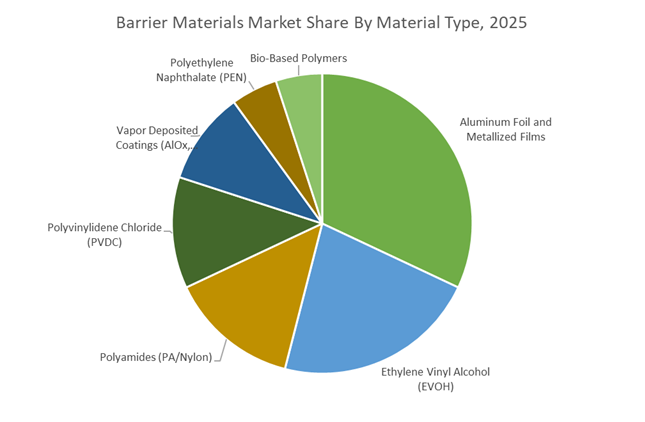
In 2025, aluminum foil and metallized films hold 32% of global barrier materials market share, retaining leadership due to their absolute light, moisture, and gas barrier performance. However, this segment is in structural decline as foil remains non-recyclable in flexible formats, prone to flex cracking, and energy-intensive to manufacture, accelerating phase-out across Western Europe while persisting in Asia and North America for shelf-stable retort packaging. EVOH continues as the premium oxygen barrier standard, indispensable in modified atmosphere packaging for meat, cheese, and ready meals, with next-generation grades improving performance at higher humidity. Polyamides (PA/Nylon) dominate vacuum meat packaging through puncture resistance and thermoformability, while MXD6 increasingly competes with EVOH. Vapor-deposited AlOx and SiOx coatings are the fastest-growing segment, offering transparent, microwaveable, recyclable-compatible barriers. PVDC faces regulatory pressure, PEN remains niche, and bio-based polymers grow slowly under policy mandates.
End-Use Industry Market Share: Food and Beverage Anchors Demand as Electronics and Healthcare Drive Technical Premiums
By end use, food and beverage accounts for 54% of barrier materials consumption in 2025, driven by shelf-life extension, food waste reduction, and lightweight packaging. Meat, dairy, and coffee represent the highest-value applications, with brand owners actively transitioning from PVDC and foil toward EVOH and vacuum-deposited coatings to meet recyclability commitments aligned with CEFLEX and Ellen MacArthur Foundation guidelines. Pharmaceutical and healthcare remains the most regulation-intensive segment, led by solid-dose blister packaging under USP <671> and ISO 15378 compliance, delivering high margins and long qualification cycles. Electronics and semiconductors demand ultra-high barrier performance (WVTR < 10⁻³ g/m²/day) for OLEDs and flexible photovoltaics, favoring inorganic-coated polymers and PEN substrates. Automotive and aerospace are emerging growth pockets, supporting EV battery insulation and sensor protection, while construction and infrastructure stay mature and price-driven, dominated by foil laminates with limited EVOH penetration.
Barrier Materials Market Competitive Landscape
The Barrier Materials Market in 2026 is defined by mono-material migration, aluminum-foil replacement technologies, PFAS-free coatings, and vertically integrated resin-to-film ecosystems. Leading players are investing heavily in transparent vapor-deposited barriers, EVOH oxygen-control layers, paper-based high-barrier substrates, and AI-enabled shelf-life modeling. Competitive advantage now hinges on recyclable packaging compliance, healthcare-grade thermoforming, biomass-derived polymers, and supply-chain resilience amid feedstock volatility. Strategic M&A, venture funding for nature-based additives, and large-scale capacity expansions across Asia, Europe, and North America are accelerating adoption across food, medical, electronics, and EV battery protection applications.
Mono-material dominance and high-barrier innovation by Amcor plc
Amcor enters 2026 as the undisputed global leader after completing the integration of Berry Global Inc., creating a specialized material science powerhouse in high-barrier packaging. Through its 2025/26 Lift-Off Challenge, Amcor is investing up to $500,000 per startup in home-compostable adhesives and nature-based barrier additives. Flagship AmFiber™ Performance Paper and AmLite® Ultra Recyclable lines deliver foil-like oxygen and moisture protection via proprietary coatings. In early 2026, Amcor launched APET-based AmSecure™ healthcare trays as a sustainable PETG alternative. Strategically, the company is prioritizing mono-PE and mono-PP structures to help brands avoid EU and UK packaging taxes.
Transparent vapor-deposited barrier leadership from Toppan Inc.
Toppan remains the global authority in transparent vapor-deposited barrier films, supporting visible, long-shelf-life food and medical packaging. After acquiring Sonoco’s TFP business in April 2025, Toppan established a major North American footprint under Toppan Specialty Films. In late 2025, it installed a hybrid BOPP/BOPE production line in India to meet accelerating mono-material demand. Its proprietary GL BARRIER technology uses alumina and silica coatings to deliver world-class barrier performance while remaining metal-detector friendly. Newly launched GL-SP BOPP films target high-speed FMCG lines, reinforcing Toppan’s leadership in sustainable, transparent barrier substrates.
Global EVOH supply control and thin-wall technology by Kuraray Co., Ltd.
Kuraray acts as the engine of the barrier materials industry, controlling a majority share of global EVOH production. Under its PASSION 2026 plan, the company is scaling biomass-derived barriers while expanding into high-speed communication and regenerative medicine materials. Its EVAL™ EVOH resin series now emphasizes thin-walling, enabling up to 20% resin reduction without sacrificing oxygen barrier performance. A major organizational overhaul in January 2026 created the Life Innovation Development Division to accelerate advanced applications. With integration spanning monomers to finished MonoSol films, Kuraray uniquely stabilizes EVOH supply amid 2025–2026 feedstock volatility, serving food, pharmaceutical, and specialty coating markets worldwide.
PFAS-free green chemistry transformation at Mitsubishi Chemical Group
Mitsubishi Chemical Group is driving the sector’s green chemistry shift through biodegradable and PFAS-free barrier solutions. In January 2026, it unveiled a breakthrough SoarnoL™ EVOH paper coating that delivers oil and gas resistance surpassing traditional PFAS systems, even under heat and folding stress. Guided by KAITEKI Vision 30, Mitsubishi has positioned food quality preservation as a core pillar, targeting reduced global food waste via extended shelf life. The company also showcased bio-based barrier resins at New Functional Materials EXPO 2026. Beyond packaging, Mitsubishi supplies moisture-protective films for EV batteries and high-speed electronics, strengthening its cross-sector barrier materials portfolio.
Paper-first high-barrier packaging leadership by Mondi Group
Mondi leads the paper-first barrier movement, proving paper can rival plastic in high-barrier applications. Its FunctionalBarrier Paper Ultimate, backed by a $17 million investment in late 2025, replaces plastic-aluminum laminates in dry food and coffee packaging. Mondi’s vertically integrated model spans sustainable forestry, pulp, coating, and converting, enabling production of ultra-strong kraft barrier papers. By 2025/2026, over 80% of Mondi revenue came from “sustainable by design” products, surpassing MAP2030 targets. Looking ahead, Mondi’s Circular Economy 2.0 strategy emphasizes mono-material PE laminates for pet food and personal care, fully aligned with European recycling streams.
Resin architecture and recycling compatibility from Dow Inc.
Dow operates as the infrastructure architect of the barrier materials market, supplying high-performance resins and adhesives that bind complex structures. Through its global Pack Studios network, Dow offers real-time barrier testing and AI-driven shelf-life modeling to minimize material thickness. In late 2025, Dow partnered with ExxonMobil and Henkel AG & Co. KGaA to commercialize the first 100% mono-material PE high-barrier pouch for liquid filling. Its INNATE™ Precision Resins and RETAIN™ Polymer Modifiers enable mechanical recycling of multilayer films by compatibilizing polymers, anchoring Dow’s leadership in recycling-ready barrier infrastructure.
India Barrier Materials Market: Regulation-Driven Circularity and Indigenous Barrier Innovation
India’s barrier materials industry is undergoing a decisive transformation as regulatory mandates, domestic innovation, and circular economy investments converge. Effective April 2025, the Ministry of Environment, Forest, and Climate Change enforced compulsory recycled content thresholds across all packaging formats. This regulatory pivot has immediately accelerated demand for recycled PET and recycled polyethylene barrier resins, particularly across fast-moving consumer goods and pharmaceutical packaging where compliance timelines are tight and audit visibility is high. In parallel, the Hazardous and Other Wastes Amendment Rules 2025 extended Extended Producer Responsibility to non-ferrous metals such as aluminum and zinc. This development is materially impacting foil-based barrier laminates and is pushing brand owners to redesign structures using fiber-based barriers or mono-polymer alternatives that simplify recyclability and EPR reporting.
On the innovation front, India is rapidly building technical depth in advanced barrier solutions. TOPPAN Speciality Films commenced commercial production of GL-SP in late 2024 and early 2025, introducing a transparent vapor-deposited barrier film based on biaxially oriented polypropylene. This solution targets export-oriented sustainable packaging applications by combining high moisture and oxygen resistance with mono-material recyclability. Circular feedstock development is also gaining traction. In 2025, the Technology Development Board signed a strategic agreement with APChemi Pvt. Ltd. to scale purified pyrolysis oil production for use in circular plastics and sustainable barrier chemicals. Functional barriers are expanding beyond packaging. Panlys Nanotech launched visible-light-activated titanium dioxide antimicrobial nano-coatings in 2025, enabling pathogen-neutralizing and VOC-reducing barrier layers for medical packaging and cold-chain logistics. Supporting this ecosystem, the government has sanctioned over ₹345 crore to establish 18 Centres of Excellence focused on bio-based barrier materials and indigenous recycling technologies, positioning India as a long-term innovation hub rather than a volume-only market.
United States Barrier Materials Market: Consolidation, PFAS Elimination, and High-Performance Barrier Demand
The United States barrier materials industry is being reshaped by structural consolidation, chemical safety regulation, and cross-sector demand from healthcare, food, and construction. A defining milestone was the completion of Amcor plc’s acquisition of Berry Global Group, Inc. in early 2025. This merger created a dominant supplier of high-performance barrier films with a clear strategic focus on circularity-ready solutions for protein packaging and regulated healthcare applications in North America. The combined platform has strengthened scale in recyclable multilayer structures and accelerated commercialization of fiber-based and downgauged barrier formats.
Regulatory pressure is accelerating material substitution. Following enforcement of the California Food Safety Act through 2025, U.S. manufacturers have rapidly phased out PFAS-based oil and grease resistant coatings, replacing them with aqueous functional barriers across foodservice and retail packaging. Healthcare-linked barrier demand is also expanding. 3M Company finalized a USD 146 million expansion of its biopharma filtration and barrier membrane manufacturing capacity in 2025, supporting domestic production of advanced biologics that require stringent contamination control. Fiber-based barriers are moving into mainstream adoption. Amcor expanded its AmFiber Performance Paper portfolio in North America, achieving How2Recycle widely recyclable status for high-barrier laminated papers used in snacks and confectionery. Beyond packaging, updated green building energy codes are driving structural demand. The rise of energy-efficient construction has increased adoption of high-density polyethylene vapor barriers in residential and industrial buildings, supporting compliance with modern insulation and moisture-control standards.
Germany Barrier Materials Market: Mono-Material Leadership and Intelligent Barrier Layers
Germany continues to set the benchmark for advanced, regulation-aligned barrier materials, combining mono-material packaging leadership with intelligent functional layers. In late 2024 and early 2025, Klöckner Pentaplast introduced KP FlexiFlow EH 155 R, a recyclable high-barrier flow-wrap that reduces packaging weight by up to 75% compared to traditional rigid formats. This innovation directly supports European mandates for packaging reduction and recyclability while maintaining barrier integrity for meat and dairy applications.
Material intelligence is emerging as a differentiator. The German startup AIVAM launched AI-Varnish in 2025, a sensor-embedded smart varnish that can be applied to barrier foils to detect temperature deviations, moisture ingress, and package tampering. Circular chemistry is reinforcing supply security. BASF’s Zhanjiang and Ludwigshafen facilities reached peak output of Ultramid® Ccycled® in 2025, enabling chemically recycled polyamide barrier layers for cheese and meat packaging. Paper-based barrier investment is also scaling. Mondi Group finalized a USD 16.8 million investment in its FunctionalBarrier Paper Ultimate range, providing ultra-high-barrier paper solutions designed to replace aluminum and plastic multi-layer structures across European markets.
China Barrier Materials Market: Scale-Oriented Standards and Industrial Barrier Diversification
China’s barrier materials industry is evolving through national standards aligned with e-commerce growth, electrification, and infrastructure resilience. The 2025 National Packaging Blueprint has shifted domestic packaging toward mono-material flexible films incorporating post-consumer recycled content, addressing the scale and waste intensity of China’s e-commerce ecosystem. This policy direction is reshaping procurement strategies for consumer goods and logistics packaging suppliers.
Industrial demand is driving diversification beyond food packaging. Chinese manufacturers such as Shanghai Yingfan Engineering Material have expanded production of high-density water vapor barriers to support rapid growth in automotive and new energy vehicle battery facilities, where moisture control is critical for safety and performance. Functional coatings are also advancing. Guangdong Yufeng Industries introduced specialized RTV silicone antifouling barrier coatings in 2025. These hydrophobic layers prevent conductive water films on electrical infrastructure, increasing flash-over voltage resistance and improving grid reliability in humid and coastal regions.
Canada Barrier Materials Market: Forest-Based Barrier Science and Government-Backed R&D
Canada’s barrier materials industry is distinguished by bio-based innovation and strong federal support for sustainable materials science. In late 2025, CelluForce launched CelluShield™, a cellulose nanocrystal-based barrier coating delivering oxygen transmission rates below 1 cc per square meter per day. This performance enables mono-material polyethylene and polypropylene structures to replace complex multi-layer laminates in food and medical packaging, significantly improving recyclability.
Public funding is reinforcing commercialization pathways. Natural Resources Canada’s Transformative Technology Program has provided targeted support for forest-product-based barrier technologies, accelerating pilot-to-commercial scale transitions. This policy-backed innovation model positions Canada as a strategic supplier of renewable, high-performance barrier coatings for global packaging markets seeking alternatives to fossil-based multilayer structures.
Country-Level Strategic Snapshot: Barrier Materials Industry
Barrier Materials Market County Level Snapshot
Country
Strategic Emphasis
Key Industry Developments
India
Regulation-led circular materials and local innovation
By Material Type (Ethylene Vinyl Alcohol, Polyvinylidene Chloride, Polyethylene Naphthalate, Aluminum Foil and Metallized Films, Polyamides, Vapor Deposited Coatings, Bio Based Polymers), By Product Form (Barrier Films and Wraps, Barrier Coatings, Barrier Sheets and Trays, Barrier Bottles and Vials), By Functionality (Oxygen Barriers, Moisture and Vapor Barriers, Grease and Oil Barriers, Antimicrobial Barriers, Thermal Barrier Coatings), By End Use Industry (Food and Beverage, Pharmaceutical and Healthcare, Electronics and Semiconductors, Automotive and Aerospace, Construction and Infrastructure)
Study Period
2019- 2025 and 2026-2034
Units
Revenue (USD)
Qualitative Analysis
Porter’s Five Forces, SWOT Profile, Market Share, Scenario Forecasts, Market Ecosystem, Company Ranking, Market Dynamics, Industry Benchmarking
US, Canada, Mexico, Germany, France, Spain, Italy, UK, Russia, China, India, Japan, South Korea, Australia, South East Asia, Brazil, Argentina, Middle East, Africa
Barrier Materials Market Segmentation
By Material Type
Ethylene Vinyl Alcohol
Polyvinylidene Chloride
Polyethylene Naphthalate
Aluminum Foil and Metallized Films
Polyamides
Vapor Deposited Coatings
Bio Based Polymers
By Product Form
Barrier Films and Wraps
Barrier Coatings
Barrier Sheets and Trays
Barrier Bottles and Vials
By Functionality
Oxygen Barriers
Moisture and Vapor Barriers
Grease and Oil Barriers
Antimicrobial Barriers
Thermal Barrier Coatings
By End Use Industry
Food and Beverage
Pharmaceutical and Healthcare
Electronics and Semiconductors
Automotive and Aerospace
Construction and Infrastructure
By Region
North America (United States, Canada, Mexico)
Europe (Germany, France, United Kingdom, Spain, Italy, Rest of Europe)
Asia Pacific (China, India, Japan, South Korea, Australia, Rest of APAC)
South and Central America (Brazil, Argentina, Rest of SCA)
Middle East and Africa (Saudi Arabia, UAE, South Africa, Rest of Middle East, Rest of Africa)
2. Barrier Materials Market Landscape & Outlook (2025–2034)
2.1. Introduction to Barrier Materials Market
2.2. Market Valuation and Growth Projections (2025–2034)
2.3. Key Growth Drivers: EVOH Expansion, Paper-Based Gas Barriers, and Recyclable Retort Structures
2.4. Regulatory Landscape: PPWR, PFAS Phase-Out, EPR Mandates, and Circular Packaging Standards
2.5. Supply Chain Evolution: Polymer Capacity Investments, ALD Integration, and Regional Localization
3. Innovations Reshaping the Barrier Materials Market
3.1. Trend: ALD and Hybrid Barrier Technologies Become Standard for Next-Generation Electronics
3.2. Trend: PVC-Free High-Barrier Polymers Gain Traction in Pharmaceutical Blister Packaging
3.3. Opportunity: Moisture-Barrier Solutions for Perovskite and Organic Photovoltaics
3.4. Opportunity: Gas-Barrier Liners for Green Hydrogen Transport and Storage
4. Competitive Landscape and Strategic Initiatives
4.1. Mergers and Acquisitions
4.2. High-Barrier Polymer and Coating Innovation
4.3. Sustainability, PFAS-Free Chemistry, and Circular Design Strategies
4.4. Market Expansion and Regional Manufacturing Investments
5. Market Share and Segmentation Insights: Barrier Materials Market
5.1. By Material Type
5.1.1. Ethylene Vinyl Alcohol
5.1.2. Polyvinylidene Chloride
5.1.3. Polyethylene Naphthalate
5.1.4. Aluminum Foil and Metallized Films
5.1.5. Polyamides
5.1.6. Vapor Deposited Coatings
5.1.7. Bio Based Polymers
5.2. By Product Form
5.2.1. Barrier Films and Wraps
5.2.2. Barrier Coatings
5.2.3. Barrier Sheets and Trays
5.2.4. Barrier Bottles and Vials
5.3. By Functionality
5.3.1. Oxygen Barriers
5.3.2. Moisture and Vapor Barriers
5.3.3. Grease and Oil Barriers
5.3.4. Antimicrobial Barriers
5.3.5. Thermal Barrier Coatings
5.4. By End Use Industry
5.4.1. Food and Beverage
5.4.2. Pharmaceutical and Healthcare
5.4.3. Electronics and Semiconductors
5.4.4. Automotive and Aerospace
5.4.5. Construction and Infrastructure
6. Country Analysis and Outlook of Barrier Materials Market
6.1. United States
6.2. Canada
6.3. Mexico
6.4. Germany
6.5. France
6.6. Spain
6.7. Italy
6.8. UK
6.9. Russia
6.10. China
6.11. India
6.12. Japan
6.13. South Korea
6.14. Australia
6.15. South East Asia
6.16. Brazil
6.17. Argentina
6.18. Middle East
6.19. Africa
7. Barrier Materials Market Size Outlook by Region (2025–2034)
7.1. North America Barrier Materials Market Size Outlook
7.1.1. By Material Type
7.1.2. By Product Form
7.1.3. By Functionality
7.1.4. By End Use Industry
7.2. Europe Barrier Materials Market Size Outlook
7.2.1. By Material Type
7.2.2. By Product Form
7.2.3. By Functionality
7.2.4. By End Use Industry
7.3. Asia Pacific Barrier Materials Market Size Outlook
7.3.1. By Material Type
7.3.2. By Product Form
7.3.3. By Functionality
7.3.4. By End Use Industry
7.4. South America Barrier Materials Market Size Outlook
7.4.1. By Material Type
7.4.2. By Product Form
7.4.3. By Functionality
7.4.4. By End Use Industry
7.5. Middle East and Africa Barrier Materials Market Size Outlook
7.5.1. By Material Type
7.5.2. By Product Form
7.5.3. By Functionality
7.5.4. By End Use Industry
8. Company Profiles: Leading Players in the Barrier Materials Market
8.1. Amcor plc
8.2. Mondi Group
8.3. Sealed Air Corporation
8.4. Huhtamaki Oyj
8.5. Toppan Inc
8.6. Mitsubishi Chemical Group
8.7. Klockner Pentaplast
8.8. Uflex Limited
8.9. Winpak Ltd
8.10. Toray Industries
8.11. Cosmo First
8.12. Constantia Flexibles
8.13. Sonoco Products Company
8.14. Jindal Poly Films
8.15. Kuraray Co Ltd
9. Methodology
9.1. Research Scope
9.2. Market Research Approach
9.3. Market Sizing and Forecasting Model
9.4. Research Coverage
9.5. Data Horizon
9.6. Deliverables
10. Appendix
10.1. Acronyms and Abbreviations
10.2. List of Tables
10.3. List of Figures
Barrier Materials Market Segmentation
By Material Type
Ethylene Vinyl Alcohol
Polyvinylidene Chloride
Polyethylene Naphthalate
Aluminum Foil and Metallized Films
Polyamides
Vapor Deposited Coatings
Bio Based Polymers
By Product Form
Barrier Films and Wraps
Barrier Coatings
Barrier Sheets and Trays
Barrier Bottles and Vials
By Functionality
Oxygen Barriers
Moisture and Vapor Barriers
Grease and Oil Barriers
Antimicrobial Barriers
Thermal Barrier Coatings
By End Use Industry
Food and Beverage
Pharmaceutical and Healthcare
Electronics and Semiconductors
Automotive and Aerospace
Construction and Infrastructure
By Region
North America (United States, Canada, Mexico)
Europe (Germany, France, United Kingdom, Spain, Italy, Rest of Europe)
Asia Pacific (China, India, Japan, South Korea, Australia, Rest of APAC)
South and Central America (Brazil, Argentina, Rest of SCA)
Middle East and Africa (Saudi Arabia, UAE, South Africa, Rest of Middle East, Rest of Africa)
The Barrier Materials Market is valued at $6.5 billion in 2025 and is forecast to reach $11.2 billion by 2034, expanding at a 6.2% CAGR. Growth is fueled by EVOH capacity expansion, aluminum-free packaging, recyclable retort structures, pharmaceutical blister innovation, and rising demand from electronics, EV batteries, and renewable energy encapsulation.
EVOH remains the gold standard for oxygen control in food and medical packaging, while vapor-deposited AlOx and SiOx coatings are the fastest-growing transparent barrier formats. Paper-based gas barriers and mono-material PE/PP laminates are scaling rapidly under recyclability mandates, and ALD-based inorganic barriers are becoming essential in OLED, semiconductor, and flexible electronics applications.
Packaging regulations are accelerating the phase-out of aluminum foil, PVDC, and PVC toward recyclable mono-materials, PFAS-free coatings, and fiber-based barriers. Brand owners now prioritize verified recyclability and carbon footprint per pack, driving investment in EVOH thin-walling, aqueous coatings, and compostable structures across food, pharma, and personal care.
Food and beverage remains the volume anchor, while pharmaceuticals, flexible electronics, perovskite solar encapsulation, and hydrogen storage liners deliver the highest technical premiums. Asia-Pacific leads polymer capacity expansion, Europe drives circular material adoption, and North America is accelerating PFAS elimination and healthcare-grade barrier demand.