Global Bio-Acrylic Acid Market Size is valued at $486.2 Million in 2024 and is forecast to register a growth rate (CAGR) of 14.3% to reach $1416.4 Million by 2032.
The global Bio-Acrylic Acid Market Study analyzes and forecasts the market size across 6 regions and 24 countries for diverse segments -By Type (Methyl Acrylate, Ethyl Acrylate, Butyl Acrylate, Elastomers, 2-Ethylhexyl Acrylate, Superabsorbent Polymers), By Application (Paints and Coatings, Adhesives and Sealants, Surfactants, Textiles, Sanitary Products, Others).
An Introduction to Bio-Acrylic Acid Market in 2024
Bio acrylic acid is a renewable and sustainable alternative to conventional acrylic acid derived from petrochemical sources. It is produced through the fermentation of renewable feedstocks such as sugars, starches, or plant biomass by microorganisms such as bacteria or yeast. The market for bio acrylic acid is driven by the increasing demand for eco-friendly and biodegradable materials in various industries, including adhesives, coatings, textiles, and personal care products. Bio acrylic acid can be polymerized to form bio-based polymers such as bio-based polyacrylic acid (PAA) or used as a precursor in the production of bio-based superabsorbent polymers (SAPs) used in hygiene products and agricultural applications. Additionally, bio acrylic acid offers environmental benefits such as reduced carbon footprint, decreased dependency on fossil fuels, and mitigated environmental pollution. Further, advancements in biotechnological processes and fermentation techniques are driving innovation and cost competitiveness within the bio acrylic acid market. As industries strive to meet sustainability goals and regulatory requirements, bio acrylic acid presents a promising opportunity to transition towards a more circular and bio-based economy.
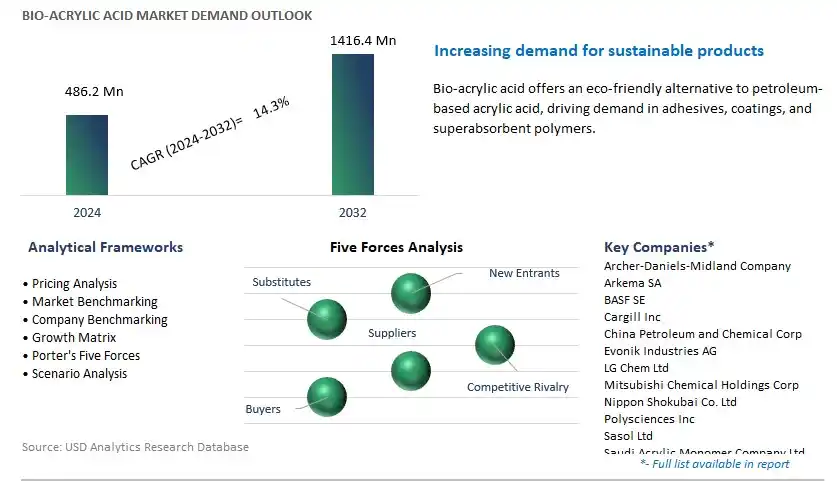
Bio-Acrylic Acid Market Competitive Landscape
The market report analyses the leading companies in the industry including Archer-Daniels-Midland Company, Arkema SA, BASF SE, Cargill Inc, China Petroleum and Chemical Corp, Evonik Industries AG, LG Chem Ltd, Mitsubishi Chemical Holdings Corp, Nippon Shokubai Co. Ltd, Polysciences Inc, Sasol Ltd, Saudi Acrylic Monomer Company Ltd, Taixing Jurong Chemical Co. Ltd, The Dow Chemical Company, The Lubrizol Corp, Toagosei Co. Ltd, Zhejiang Satellite Petrochemical Co. Ltd, and others.
Bio-Acrylic Acid Market Dynamics
Market Trend: Shift Towards Sustainable and Renewable Chemicals
A significant market trend for Bio Acrylic Acid is the shift towards sustainable and renewable chemicals driven by environmental concerns, regulatory pressures, and consumer demand for eco-friendly products. Bio acrylic acid, produced from renewable biomass sources such as sugar, starch, or cellulosic feedstocks, offers a more sustainable alternative to petroleum-based acrylic acid derived from fossil fuels. With increasing awareness of climate change, carbon footprint reduction goals, and the need to transition towards a circular economy, there is a growing interest in bio-based alternatives that minimize environmental impact and support a more sustainable chemical industry. This trend reflects a broader industry movement towards bioeconomy principles, bio-based materials, and green chemistry solutions, influencing the market dynamics and driving innovation in bio acrylic acid production and applications.
Market Driver: Regulatory Support and Incentives for Bio-based Chemicals
A significant market driver for Bio Acrylic Acid is the regulatory support and incentives provided by governments, industry associations, and environmental organizations to promote the development and adoption of bio-based chemicals. Many countries and regions have implemented policies, subsidies, and tax incentives to encourage investment in bioeconomy projects, renewable feedstock utilization, and reduction of greenhouse gas emissions from industrial processes. Regulatory frameworks such as renewable energy directives, bioeconomy strategies, and carbon pricing mechanisms create a favorable environment for the production and commercialization of bio acrylic acid, stimulating market growth and investment in bio-based chemical technologies. Additionally, corporate sustainability initiatives, supply chain commitments, and consumer preferences for greener products further drive the demand for bio acrylic acid as a sustainable ingredient in various industrial and consumer applications.
Market Opportunity: Expansion of Bio Acrylic Acid Applications and Market Penetration
An attractive opportunity in the Bio Acrylic Acid market lies in the expansion of applications and market penetration for bio-based acrylic acid derivatives in industries such as adhesives, coatings, superabsorbent polymers, and personal care products. As bio acrylic acid production technology advances and economies of scale improve, there is potential to develop new bio-based polymers, specialty chemicals, and performance materials that meet performance standards and customer specifications. Opportunities exist to collaborate with downstream manufacturers, brand owners, and end-users to co-develop bio-based solutions, formulate sustainable products, and create value-added applications that differentiate bio acrylic acid derivatives in the market. By leveraging the advantages of bio-based feedstocks, reducing dependence on fossil resources, and offering environmentally friendly alternatives, companies can capture market share, enhance competitiveness, and contribute to the transition towards a more sustainable and circular chemical industry.
Bio-Acrylic Acid Market Share Analysis: Butyl Acrylate segment generated the highest revenue in 2024
Butyl acrylate is the largest segment in the bio-acrylic acid market due to its versatile applications across various industries. Butyl acrylate is extensively used in the production of acrylic-based polymers, coatings, adhesives, and sealants, making it a vital raw material in sectors such as construction, automotive, textiles, and packaging. Its popularity stems from its excellent combination of properties, including good adhesion, flexibility, weatherability, and chemical resistance, making it suitable for a wide range of end-use applications. Moreover, the growing construction and automotive industries worldwide are driving the demand for butyl acrylate-based products, such as paints, coatings, and adhesives, further solidifying its position as the largest segment in the bio-acrylic acid market. With its indispensable role in multiple industries and continued advancements in manufacturing processes, butyl acrylate maintains its dominance as the largest segment within the bio-acrylic acid market.
Bio-Acrylic Acid Market Share Analysis: Surfactants is poised to register the fastest CAGR over the forecast period
Surfactants emerge as the fastest-growing segment in the bio-acrylic acid market due to their increasing demand across a wide range of industries. Surfactants play a crucial role in various applications such as detergents, personal care products, agricultural chemicals, and industrial cleaners, among others. The rise in environmental consciousness and regulatory pressure to shift towards sustainable and biodegradable alternatives are driving the demand for bio-based surfactants, including those derived from bio-acrylic acid. Additionally, the versatility of surfactants in enhancing the performance of cleaning products, improving dispersion, and stabilizing emulsions further contributes to their growing popularity. Furthermore, advancements in bio-acrylic acid production technology and increasing investments in research and development are facilitating the commercialization of bio-based surfactants, thereby fuelling the rapid growth of this segment. With the expanding applications and shifting consumer preferences towards eco-friendly solutions, surfactants stand out as the fastest-growing segment within the bio-acrylic acid market.
Bio-Acrylic Acid Market
By Type
Methyl Acrylate
Ethyl Acrylate
Butyl Acrylate
Elastomers
2-Ethylhexyl Acrylate
Superabsorbent Polymers
By Application
Paints and Coatings
Adhesives and Sealants
Surfactants
Textiles
Sanitary Products
Others
Countries Analyzed
North America (US, Canada, Mexico)
Europe (Germany, UK, France, Spain, Italy, Russia, Rest of Europe)
Asia Pacific (China, India, Japan, South Korea, Australia, South East Asia, Rest of Asia)
South America (Brazil, Argentina, Rest of South America)
Middle East and Africa (Saudi Arabia, UAE, Rest of Middle East, South Africa, Egypt, Rest of Africa)
Bio Acrylic Acid Companies Profiled in the Study
Archer-Daniels-Midland Company
Arkema SA
BASF SE
Cargill Inc
China Petroleum and Chemical Corp
Evonik Industries AG
LG Chem Ltd
Mitsubishi Chemical Holdings Corp
Nippon Shokubai Co. Ltd
Polysciences Inc
Sasol Ltd
Saudi Acrylic Monomer Company Ltd
Taixing Jurong Chemical Co. Ltd
The Dow Chemical Company
The Lubrizol Corp
Toagosei Co. Ltd
Zhejiang Satellite Petrochemical Co. Ltd
*- List Not Exhaustive
TABLE OF CONTENTS
1 Introduction to 2024 Bio Acrylic Acid Market
1.1 Market Overview
1.2 Quick Facts
1.3 Scope/Objective of the Study
1.4 Market Definition
1.5 Countries and Regions Covered
1.6 Units, Currency, and Conversions
1.7 Industry Value Chain
2 Research Methodology
2.1 Market Size Estimation
2.2 Sources and Research Methodology
2.3 Data Triangulation
2.4 Assumptions and Limitations
3 Executive Summary
3.1 Global Bio Acrylic Acid Market Size Outlook, $ Million, 2021 to 2032
3.2 Bio Acrylic Acid Market Outlook by Type, $ Million, 2021 to 2032
3.3 Bio Acrylic Acid Market Outlook by Product, $ Million, 2021 to 2032
3.4 Bio Acrylic Acid Market Outlook by Application, $ Million, 2021 to 2032
3.5 Bio Acrylic Acid Market Outlook by Key Countries, $ Million, 2021 to 2032
4 Market Dynamics
4.1 Key Driving Forces of Bio Acrylic Acid Industry
4.2 Key Market Trends in Bio Acrylic Acid Industry
4.3 Potential Opportunities in Bio Acrylic Acid Industry
4.4 Key Challenges in Bio Acrylic Acid Industry
5 Market Factor Analysis
5.1 Value Chain Analysis
5.2 Competitive Landscape
5.2.1 Global Bio Acrylic Acid Market Share by Company (%), 2023
5.2.2 Product Offerings by Company
5.3 Porter’s Five Forces Analysis
5.4 Pricing Analysis and Outlook
6 Growth Outlook Across Scenarios
6.1 Growth Analysis-Case Scenario Definitions
6.2 Low Growth Scenario Forecasts
6.3 Reference Growth Scenario Forecasts
6.4 High Growth Scenario Forecasts
7 Global Bio Acrylic Acid Market Outlook by Segments
7.1 Bio Acrylic Acid Market Outlook by Segments, $ Million, 2021- 2032
By Type
Methyl Acrylate
Ethyl Acrylate
Butyl Acrylate
Elastomers
2-Ethylhexyl Acrylate
Superabsorbent Polymers
By Application
Paints and Coatings
Adhesives and Sealants
Surfactants
Textiles
Sanitary Products
Others
8 North America Bio Acrylic Acid Market Analysis and Outlook To 2032
8.1 Introduction to North America Bio Acrylic Acid Markets in 2024
8.2 North America Bio Acrylic Acid Market Size Outlook by Country, 2021-2032
8.2.1 United States
8.2.2 Canada
8.2.3 Mexico
8.3 North America Bio Acrylic Acid Market size Outlook by Segments, 2021-2032
By Type
Methyl Acrylate
Ethyl Acrylate
Butyl Acrylate
Elastomers
2-Ethylhexyl Acrylate
Superabsorbent Polymers
By Application
Paints and Coatings
Adhesives and Sealants
Surfactants
Textiles
Sanitary Products
Others
9 Europe Bio Acrylic Acid Market Analysis and Outlook To 2032
9.1 Introduction to Europe Bio Acrylic Acid Markets in 2024
9.2 Europe Bio Acrylic Acid Market Size Outlook by Country, 2021-2032
9.2.1 Germany
9.2.2 France
9.2.3 Spain
9.2.4 United Kingdom
9.2.4 Italy
9.2.5 Russia
9.2.6 Norway
9.2.7 Rest of Europe
9.3 Europe Bio Acrylic Acid Market Size Outlook by Segments, 2021-2032
By Type
Methyl Acrylate
Ethyl Acrylate
Butyl Acrylate
Elastomers
2-Ethylhexyl Acrylate
Superabsorbent Polymers
By Application
Paints and Coatings
Adhesives and Sealants
Surfactants
Textiles
Sanitary Products
Others
10 Asia Pacific Bio Acrylic Acid Market Analysis and Outlook To 2032
10.1 Introduction to Asia Pacific Bio Acrylic Acid Markets in 2024
10.2 Asia Pacific Bio Acrylic Acid Market Size Outlook by Country, 2021-2032
10.2.1 China
10.2.2 India
10.2.3 Japan
10.2.4 South Korea
10.2.5 Indonesia
10.2.6 Malaysia
10.2.7 Australia
10.2.8 Rest of Asia Pacific
10.3 Asia Pacific Bio Acrylic Acid Market size Outlook by Segments, 2021-2032
By Type
Methyl Acrylate
Ethyl Acrylate
Butyl Acrylate
Elastomers
2-Ethylhexyl Acrylate
Superabsorbent Polymers
By Application
Paints and Coatings
Adhesives and Sealants
Surfactants
Textiles
Sanitary Products
Others
11 South America Bio Acrylic Acid Market Analysis and Outlook To 2032
11.1 Introduction to South America Bio Acrylic Acid Markets in 2024
11.2 South America Bio Acrylic Acid Market Size Outlook by Country, 2021-2032
11.2.1 Brazil
11.2.2 Argentina
11.2.3 Rest of South America
11.3 South America Bio Acrylic Acid Market size Outlook by Segments, 2021-2032
By Type
Methyl Acrylate
Ethyl Acrylate
Butyl Acrylate
Elastomers
2-Ethylhexyl Acrylate
Superabsorbent Polymers
By Application
Paints and Coatings
Adhesives and Sealants
Surfactants
Textiles
Sanitary Products
Others
12 Middle East and Africa Bio Acrylic Acid Market Analysis and Outlook To 2032
12.1 Introduction to Middle East and Africa Bio Acrylic Acid Markets in 2024
12.2 Middle East and Africa Bio Acrylic Acid Market Size Outlook by Country, 2021-2032
12.2.1 Saudi Arabia
12.2.2 UAE
12.2.3 Oman
12.2.4 Rest of Middle East
12.2.5 Egypt
12.2.6 Nigeria
12.2.7 South Africa
12.2.8 Rest of Africa
12.3 Middle East and Africa Bio Acrylic Acid Market size Outlook by Segments, 2021-2032
By Type
Methyl Acrylate
Ethyl Acrylate
Butyl Acrylate
Elastomers
2-Ethylhexyl Acrylate
Superabsorbent Polymers
By Application
Paints and Coatings
Adhesives and Sealants
Surfactants
Textiles
Sanitary Products
Others
13 Company Profiles
13.1 Company Snapshot
13.2 SWOT Profiles
13.3 Products and Services
13.4 Recent Developments
13.5 Financial Profile
Archer-Daniels-Midland Company
Arkema SA
BASF SE
Cargill Inc
China Petroleum and Chemical Corp
Evonik Industries AG
LG Chem Ltd
Mitsubishi Chemical Holdings Corp
Nippon Shokubai Co. Ltd
Polysciences Inc
Sasol Ltd
Saudi Acrylic Monomer Company Ltd
Taixing Jurong Chemical Co. Ltd
The Dow Chemical Company
The Lubrizol Corp
Toagosei Co. Ltd
Zhejiang Satellite Petrochemical Co. Ltd
14 Appendix
14.1 Customization Offerings
14.2 Subscription Services
14.3 Related Reports
14.4 Publisher Expertise
By Type
Methyl Acrylate
Ethyl Acrylate
Butyl Acrylate
Elastomers
2-Ethylhexyl Acrylate
Superabsorbent Polymers
By Application
Paints and Coatings
Adhesives and Sealants
Surfactants
Textiles
Sanitary Products
Others
Countries Analyzed
North America (US, Canada, Mexico)
Europe (Germany, UK, France, Spain, Italy, Russia, Rest of Europe)
Asia Pacific (China, India, Japan, South Korea, Australia, South East Asia, Rest of Asia)
South America (Brazil, Argentina, Rest of South America)
Middle East and Africa (Saudi Arabia, UAE, Rest of Middle East, South Africa, Egypt, Rest of Africa)
