Market Overview: PFAS Testing Expansion, Clinical Genomics CRMs, and ISO 17034 Accreditation Drive Certified Reference Materials Market
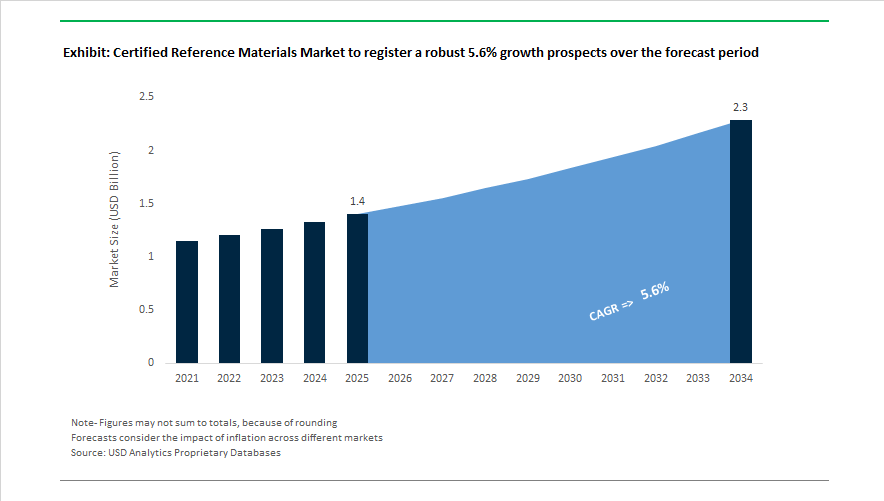
The Certified Reference Materials (CRM) Market is projected to expand from USD 1.4 billion in 2025 to USD 2.3 billion by 2034, registering a CAGR of 5.6% as laboratories intensify demand for high-purity analytical standards, traceable reference materials, and ISO-accredited CRMs across environmental testing, pharmaceutical validation, food safety, and molecular diagnostics. In September 2024, LGC Clinical Diagnostics entered pharmacogenomics with the Seraseq DPYD DNA Mutation Mix CRM, enabling validation of NGS assays used to predict chemotherapy toxicity. In December 2024, LGC Group strengthened molecular quality control capabilities through the acquisition of DiaMex, integrating serology and molecular QC materials into its global standards portfolio. Leadership alignment followed in January 2025 when Joydeep Goswami assumed the CEO role, accelerating LGC’s digitalization and global CRM distribution strategy.
Regulatory compliance and advanced contaminant testing defined mid-2025 market momentum. In May 2025, Waters Corporation launched BioResolve Protein A affinity columns benchmarked using NISTmAb RM 8671, improving bioprocess monitoring sensitivity in biopharmaceutical manufacturing. By August 2025, Waters reported rapid growth in PFAS and GLP-1 drug testing, driving increased procurement of ultra-high-purity CRMs. During the same month, Elemental Microanalysis Ltd introduced its first ISO 17034 accredited CRMs for elemental analysis. In September 2025, ASTM International achieved ISO 17034 accreditation for CRM production, enabling global laboratories to meet stringent regulatory audits. LGC Standards expanded its Dr. Ehrenstorfer line with 13C-labelled PFAS mixtures in September 2025, supporting EPA Method 1633. LGC Biosearch Technologies also signed an MoU with Genolution to integrate genomic CRMs into automated agrigenomics workflows. Complementing this expansion, LGC Group inaugurated a CAD 100 million Organic Chemistry Centre of Excellence in Vaughan to synthesize complex pharmaceutical impurity CRMs.
Consolidation and portfolio diversification accelerated into December 2025 and January 2026. LGC Standards acquired BioMatrix CRMs in December 2025 to strengthen biological and clinical reference materials for personalized medicine assays. In January 2026, Merck KGaA completed the acquisition of TraceCert Solutions, expanding its trace-level environmental contaminant CRM portfolio under the Sigma-Aldrich brand. Increasing PFAS regulations, precision medicine growth, and the globalization of quality assurance protocols continue to elevate CRM demand across environmental laboratories, clinical diagnostics, and advanced pharmaceutical research environments.
Major Market Trends: Matrix-Matched Validation and Pharmaceutical Value-Assignment Redefine CRM Requirements
Matrix-Matched CRMs Become Mandatory for Food Safety and Environmental Monitoring
Governments are moving from pure-substance standards toward matrix-matched reference materials that mimic real-world sample complexity. These CRMs compensate for fats, sugars, proteins, salts, and organic matter that interfere with detection accuracy, particularly at ultra-trace levels.
At the September 2025 Global Food Regulators Summit, regulators confirmed that food safety compliance will increasingly rely on AI-linked laboratory networks requiring validated datasets. LGC Standards’ launch of the v700 LC PestiMix Kit—designed to support mass pesticide screening across complex matrices—signals that market leadership is shifting to providers capable of supplying high-volume, broad-spectrum kits calibrated for infant formula, soil, milk, oil-based foods, and biological tissue.
The European Commission’s Joint Research Center (JRC) is also shaping market expectations. With over 200 ISO 17034-certified food-matrix CRMs, the EU is using CRM proliferation as an enforcement mechanism. Labs not using matrix-matched standards will face heightened risk of failed audits, false negatives, and regulatory penalties—forcing adoption through compliance rather than cost-benefit consideration.
Multicomponent CRMs Enable Biologics Quality Control and Multi-Attribute Methods (MAM)
The rise of biologics, antibody-drug conjugates, and personalized cell/gene therapies is creating a structural expansion in demand for peptide-based CRMs. Multi-Attribute Method (MAM) platforms require value-assigned peptide standards that can detect impurities below 1% relative abundance—performance levels that traditional HPLC cannot reliably validate.
Research published in the mAbs journal (Novartis and Genedata, October 2025) confirms that validated NPD workflows are now ready to replace legacy purity assays, but only when supported by peptide CRMs with precisely characterized mass fraction profiles. The BIPM’s ongoing CCQM-K115 project, leveraging Orbitrap-based metrology, is central to establishing global calibration uniformity. Suppliers that can commercialize these value-assigned calibrators first will dominate contract-manufacturing QC chains for Big Pharma.
PFAS-Specific Reference Materials Become Critical Under New Drinking Water Enforcement
PFAS regulation is now a dominant CRM demand catalyst. The U.S. EPA’s National Primary Drinking Water Regulation (NPDWR), finalized April 2024 and active through 2025, sets enforceable Maximum Contaminant Levels at 4.0 ppt for PFOA and PFOS—thresholds so low that only isotope-dilution CRMs can validate results.
To enable compliance, laboratories are integrating 13C-labeled PFAS standards. LGC Standards’ 20-analyte ISO 17034-certified PFAS mixture has become a procurement benchmark. Because PFAS is now classified as a hazardous substance under CERCLA (effective July 2024), legal “reopener” clauses for contaminated sites mean remediation labs must use CRMs that withstand judicial challenge. In this environment, PFAS CRMs are a regulatory shield for municipalities, engineering firms, and utilities.
The implication for the CRM market: PFAS testing is compulsory and recurring, creating annuity-style demand rather than one-time purchases.
Reference Materials for Lithium-Ion Battery Integrity and Critical Minerals Recycling
CRMs are now embedded in national industrial-policy roadmaps. The January 2025 approval of India’s National Critical Minerals Mission (NCMM), backed by ₹16,300 crore (~$1.95 billion), allocates funding for the development of lithium, cobalt, and nickel certification standards. These standards are intended to secure domestic beneficiation capacity and minimize foreign dependency—expanding the CRM market into mining, cathode-active material processing, and recycling ecosystems.
Battery makers are also increasing CRM consumption per facility. As India projects 40 GWh of domestic battery demand by 2025 (NITI Aayog), gigafactories are using ICP and ion chromatography CRMs to verify trace moisture and acid impurities in LFP and NMC chemistries. Sigma-Aldrich’s expansion of battery-grade analytical standards demonstrates supplier repositioning toward industrial-scale chemical QA, beyond academic or lab-scale calibration.
Certified Reference Materials (CRM) Market Share and Segmentation Insights
Market Share by Material Type: Organic CRMs Lead While Clinical Standards Accelerate
Organic reference materials hold 38% of CRM consumption in 2025, underpinning pharmaceutical quality control, food safety testing, environmental monitoring, and forensic analysis. These include certified pesticides, APIs, food additives, and organic contaminants, with demand reinforced by ISO 17034, USP, and EP compliance and the expansion of generic drug manufacturing. Inorganic reference materials rank second, supplying single- and multi-element standards, ores, and alloys for ICP-MS, XRF, and AAS calibration across mining, metals, and environmental laboratories. Biological and clinical CRMs are the fastest-growing segment, driven by precision medicine, IVD regulation, and biomarker standardization for glucose, cholesterol, DNA/RNA, and infectious disease assays. Physical property reference materials remain a specialized category, supporting calibration of viscosity, density, hardness, and thermal conductivity instruments in advanced manufacturing and materials science.
 Market Share By Material Type, 2025.png)
Market Share by End User: Testing Laboratories Dominate as Industry 4.0 Expands Quality Control
Testing and calibration laboratories account for 48% of CRM demand in 2025, driven by ISO/IEC 17025 accreditation requirements across environmental, food, pharmaceutical, and materials testing. Outsourcing of analytical services and globalization of supply chains continue to lift CRM consumption. Industrial quality control follows, with pharmaceuticals, chemicals, automotive, aerospace, electronics, and metals manufacturers deploying CRMs for incoming inspection, in-process control, and final release under Six Sigma and zero-defect frameworks. Research and academic institutions represent a steady segment for method development and interlaboratory studies. National metrology institutes remain the smallest by volume but foundational to the global measurement system, producing primary reference materials and ensuring traceability under international agreements, directly influencing downstream CRM standards and market integrity.
Competitive Landscape of the Certified Reference Materials Market
The global Certified Reference Materials (CRM) market in 2026 is shaped by accelerating demand from pharmaceutical quality control, environmental testing, food safety analysis, clinical diagnostics, and advanced biopharma workflows. Competition increasingly revolves around ISO 17034/17025 accreditation, PFAS standards, multi-residue pesticide CRMs, molecular biology controls, and workflow-integrated calibration solutions. Leading players are differentiating through regulatory-ready documentation, digital inventory management, isotope-labeled standards, and application-specific CRM kits for LC-MS, GC-MS, ICP-MS, and genomics platforms. Growth is strongest across PFAS compliance, mRNA therapeutics validation, biosimilars, cannabis testing, and automated laboratory QA/QC, positioning CRM suppliers as strategic partners rather than commodity providers.
Global measurement leadership through pesticide, PFAS, and genomic CRMs by LGC Standards
LGC Standards remains the 2026 benchmark for high-purity certified reference materials, supported by its role as the UK National Measurement Laboratory. Its Dr. Ehrenstorfer™ and Mikromol™ portfolios anchor global pesticide and pharmaceutical testing, with PestiMix leading multi-residue food analysis. The 2025 acquisition of BioMatrix CRMs enabled new genomic and proteomic standards for mRNA therapeutics and cell therapy validation. In 2026, LGC launched a comprehensive PFAS portfolio aligned with EU and US EPA Method 1633, including 13C-labeled solutions. Its AXIO Proficiency Testing schemes uniquely combine CRMs with performance verification, strengthening LGC’s position in regulatory compliance, environmental analytics, and end-to-end laboratory quality assurance.
Distribution-scale CRM leadership and pharma compliance driven by Merck KGaA
Operating through Supelco®, Merck KGaA dominates 2026 via unmatched catalog breadth and dual ISO 17034/17025 accreditation. The acquisition of TraceCert Solutions expanded its ultra-trace inorganic standards for ICP-OES and ICP-MS, while the TraceCERT® line now includes critical N-nitrosamine CRMs for pharmaceutical impurity testing. Cerilliant® continues to lead clinical and forensic toxicology, complemented by Certipur® inorganic standards. Merck’s Emprove® Program integrates CRM data directly into regulatory documentation, enabling automated QC and filings. This ecosystem positions Merck as a preferred supplier for pharma manufacturing, environmental monitoring, and compliance-driven analytical laboratories worldwide.
Instrument-integrated calibration workflows powered by Agilent Technologies
Agilent has evolved into a 2026 workflow partner, combining Ultra Scientific CRM heritage with LC-MS and GC-MS platforms. Its strategy centers on instrument-CRM synchronization, delivering tuning mixes and calibration standards optimized for Agilent hardware. The company leads cannabis and botanical testing with complete workflow kits spanning columns, sample prep, and certified standards. In 2026, Agilent introduced plastic-free CRM packaging to reduce laboratory carbon footprints and expanded CrossLab Compliance Services to provide on-site ISO accreditation support. This integration of hardware, software, and reference materials strengthens Agilent’s presence in regulated analytics, potency testing, and method validation services.
Environmental and molecular diagnostics CRMs advanced by Antylia Scientific
Antylia Scientific leverages SPEX® CertiPrep and ZeptoMetrix® to dominate environmental, water, and infectious disease reference materials in 2026. NATtrol™ technology provides non-infectious yet nucleic-acid-intact CRMs for molecular diagnostics, addressing biosafety and stability requirements. SPEX supplies custom multi-element standards tailored to regional regulations, while Environmental Express supports wastewater and occupational health testing. Antylia’s Traceable® platform monitors CRM storage conditions in real time, safeguarding certification integrity during transit. This mission-critical traceability and customization capability positions Antylia strongly across public health labs, environmental compliance, and diagnostic QA workflows.
Biopharma-grade chromatography standards delivered by Waters Corporation
Waters leads the 2026 large-molecule and biopharma CRM segment, supporting amino acid and glycan profiling through AccuQ•Tag™ and GlycoWorks™ standards. The February 2026 combination with BD’s Biosciences & Diagnostic Solutions business expanded Waters’ reach into clinical diagnostics and flow cytometry controls. Its Smart-Store RFID system automates CRM replenishment, while the company’s strategic focus on Process Analytical Technology (PAT) enables in-line reference materials for real-time bioprocess monitoring. With strong adoption in biosimilars and monoclonal antibody manufacturing, Waters is setting standards for chromatography-driven quality control and in-process biopharmaceutical analytics.
United States: 1,300+ New NIST SRMs, PFAS Matrix Standards, and AI-Enabled Smart Lab Calibration
The United States certified reference materials (CRM) industry continues to anchor global metrology through structured catalog expansion, forensic standardization, and clean energy validation. In February 2025, the National Institute of Standards and Technology released Special Publication 260-176-2025, introducing more than 1,300 new and updated Standard Reference Materials (SRMs) tailored for high-precision forensic chemistry, environmental monitoring, and advanced materials testing. Effective October 1, 2025, NIST restructured the Organization of Scientific Area Committees (OSAC), accelerating integration of CRMs into digital evidence, forensic toxicology, and DNA testing registries.
Regulatory enforcement surrounding PFAS has been a core demand catalyst. Following 2024–2025 EPA rulings on per- and polyfluoroalkyl substances, U.S. laboratories increased procurement of matrix-matched PFAS reference materials to ensure validated detection in water and soil matrices. LGC Standards expanded its Maryland and Maine operations in late 2025 to boost domestic capacity for calibration verification materials supporting clinical genomics and next-generation sequencing (NGS). The U.S. Department of Energy allocated over $35 million in June 2025 toward AI-enabled predictive maintenance and autonomous calibration systems, embedding CRMs into Smart Lab architectures. NIST also released new CRMs for lithium-ion battery cathode materials and hydrogen fuel purity, strengthening technical validation across the U.S. clean energy supply chain.
Canada: $100M Organic Chemistry Centre, PFAS Leadership, and Nuclear Forensics Expansion
Canada has emerged as a high-capacity synthesis and life sciences reference materials hub. On September 9, 2025, LGC Group inaugurated a CAD $100 million Organic Chemistry Synthesis Centre of Excellence in Vaughan, Ontario. Spanning 203,000 square feet, the facility is one of the largest global sites dedicated to complex organic CRM synthesis, supplying over 17,000 reference products to more than 170 countries for oncology, infectious disease, and mental health diagnostics.
Coinciding with the facility’s launch, Canada hosted a global PFAS symposium, positioning Toronto Research Chemicals as a leading supplier of specialized PFAS reference standards. The National Research Council Canada (NRC) expanded custom CRM programs in 2025 for cannabis and hemp sectors, providing isotope ratio and pesticide-residue standards for export compliance. In early 2026, NRC broadened its High Purity Materials portfolio to include new nuclear forensics CRMs, reinforcing Canada’s contribution to international non-proliferation monitoring frameworks.
India: First Indigenous REE CRM, BND® Fuel Standards, and ISO-REMCO Alignment
India’s certified reference materials market has entered a strategic self-reliance phase under Atmanirbhar Bharat. On November 17, 2025, the Department of Atomic Energy released Ferrocarbonatite (FC) – BARC B1401, the first rare earth element (REE) CRM developed domestically and only the fourth globally. Prepared by the National Centre for Compositional Characterisation of Materials, the CRM certifies 13 REEs including Ce, Dy, Nd, and Y, supporting mining analytics and electronics-grade material validation.
CSIR-National Physical Laboratory expanded its Bharatiya Nirdeshak Dravya (BND®) portfolio to over 28 petroleum-based CRMs in collaboration with Hindustan Petroleum Corporation Limited and Bharat Petroleum Corporation Limited, targeting BS-VI sulfur compliance and fuel quality monitoring. An MoU was signed in late 2025 to produce precious metal CRMs (Ag, Pt, Pd, Ir), addressing gold purity and hallmarking requirements. The Bureau of Indian Standards established a mirror committee aligned with ISO-REMCO to harmonize domestic CRMs with ISO 17034 accreditation norms. Additionally, NPL scaled Primary Reference Gas Mixtures (PRGMs) in early 2026 to support National Ambient Air Quality Standards (NAAQS) and greenhouse gas metrology.
European Union: Nanomaterial CRMs, Microplastics Standardization, and Digital Certification Platforms
The European Union is advancing CRM deployment through nanomaterial regulation, environmental monitoring, and pharmaceutical harmonization. On June 25, 2025, the Joint Research Centre released new titanium dioxide and barium sulfate CRMs to support REACH and CLP nanomaterial definitions. In February 2025, the JRC introduced the world’s first PET-based microplastics CRM in water, enabling harmonized measurement protocols for the 2026 EU monitoring cycle.
The European Directorate for the Quality of Medicines issued 18 new and replacement Ph. Eur. reference standards in late 2025 for herbal medicine and impurity profiling. Under the OECD’s Better Regulation 2025 framework, EU regulators have shifted toward smart enforcement models that rely heavily on ISO 17034-accredited CRM producers. Merck KGaA deployed automated purity analysis platforms in 2025, reducing manual error in certification of high-purity inorganic and organic reference materials.
China: ISO/IEC 17043 Surge, Rare Earth Self-Sufficiency, and Digital Metrology Integration
China’s CRM ecosystem is expanding rapidly alongside regulatory and digital metrology reforms. By early 2026, China surpassed several Western regions in the number of ISO/IEC 17043-accredited proficiency testing providers, strengthening CRM validation frameworks across industrial laboratories. In October 2025, the Ministry of Commerce of the People's Republic of China imposed stricter export controls on rare earth materials, prompting intensified domestic CRM development for high-tech manufacturing autonomy.
The National Institute of Metrology China released updated RoHS- and REACH-aligned CRMs in late 2025, focusing on lithium-ion batteries and electric mobility components. Effective July 2025, China’s Compulsory Certification (CCC) updates mandated SI-traceable CRMs for explosion-proof lighting and electrical equipment testing. The country is also transitioning legacy measurement systems toward software-defined networking platforms, embedding digital reference materials within AI-driven semiconductor and advanced computing strategies.
Japan: Green Procurement CRMs, Semiconductor Nanoparticle Standards, and Global SI Traceability
Japan’s certified reference materials industry emphasizes semiconductor metrology, green procurement compliance, and SI traceability distribution. In 2025, the National Metrology Institute of Japan expanded its Green Procurement CRM portfolio to support RoHS compliance and developed high-purity internal standards for quantitative NMR (qNMR) applications.
NMIJ prioritized industrial nanoparticle CRMs for semiconductor wafer polishing and advanced materials characterization, focusing on particle size distribution and specific surface area certification. In early 2026, FUJIFILM Wako Pure Chemical Corporation expanded global distribution of NMIJ-certified CRMs across the U.S. and EU, offering certified mass fractions for clinical chemistry and bioanalysis. Japan also introduced new 2025 ceramic CRMs for trace element analysis in aerospace-grade and high-temperature industrial ceramics, reinforcing its technical leadership in precision industrial metrology.
Certified Reference Materials Market Report Scope
Certified Reference Materials Market
|
Parameter
|
Details
|
|
Market Size (2025)
|
$1.4 Billion
|
|
Market Size (2034)
|
$2.3 Billion
|
|
Market Growth Rate
|
5.6%
|
|
Segments
|
By Material Type (Organic Reference Materials, Inorganic Reference Materials, Biological and Clinical Materials, Physical Property Reference Materials), By Form (Neat Substances, Matrix Materials, Solutions and Mixtures), By Application (Pharmaceutical and Biopharmaceutical, Environmental Monitoring, Food and Beverage Testing, Industrial Processing, Clinical and Forensic), By End User (National Metrology Institutes, Testing and Calibration Laboratories, Research and Academic Institutions, Industrial Quality Control)
|
|
Study Period
|
2019- 2025 and 2026-2034
|
|
Units
|
Revenue (USD)
|
|
Qualitative Analysis
|
Porter’s Five Forces, SWOT Profile, Market Share, Scenario Forecasts, Market Ecosystem, Company Ranking, Market Dynamics, Industry Benchmarking
|
|
Companies
|
LGC Standards, Merck, Waters Corporation, Agilent Technologies, Thermo Fisher Scientific, AnalytiChem Group, Eurofins Scientific, Inorganic Ventures, Starna Scientific, Aladdin Scientific, SGS, Bureau Veritas, Mettler Toledo, NIST, Joint Research Centre
|
|
Countries
|
US, Canada, Mexico, Germany, France, Spain, Italy, UK, Russia, China, India, Japan, South Korea, Australia, South East Asia, Brazil, Argentina, Middle East, Africa
|
Certified Reference Materials Market Segmentation
By Material Type
- Organic Reference Materials
- Inorganic Reference Materials
- Biological and Clinical Materials
- Physical Property Reference Materials
By Form
- Neat Substances
- Matrix Materials
- Solutions and Mixtures
By Application
- Pharmaceutical and Biopharmaceutical
- Environmental Monitoring
- Food and Beverage Testing
- Industrial Processing
- Clinical and Forensic
By End User
- National Metrology Institutes
- Testing and Calibration Laboratories
- Research and Academic Institutions
- Industrial Quality Control
By Region
- North America (United States, Canada, Mexico)
- Europe (Germany, France, United Kingdom, Spain, Italy, Rest of Europe)
- Asia Pacific (China, India, Japan, South Korea, Australia, Rest of APAC)
- South and Central America (Brazil, Argentina, Rest of SCA)
- Middle East and Africa (Saudi Arabia, UAE, South Africa, Rest of Middle East, Rest of Africa)
Top Companies in Certified Reference Materials Industry
- LGC Standards
- Merck
- Waters Corporation
- Agilent Technologies
- Thermo Fisher Scientific
- AnalytiChem Group
- Eurofins Scientific
- Inorganic Ventures
- Starna Scientific
- Aladdin Scientific
- SGS
- Bureau Veritas
- Mettler Toledo
- NIST
- Joint Research Centre
*- List not Exhaustive
