Market Overview: Bio-Based Feedstock Agreements, Sustainability Ratings, and Specialty Expansion Reshape the Cetanol Market
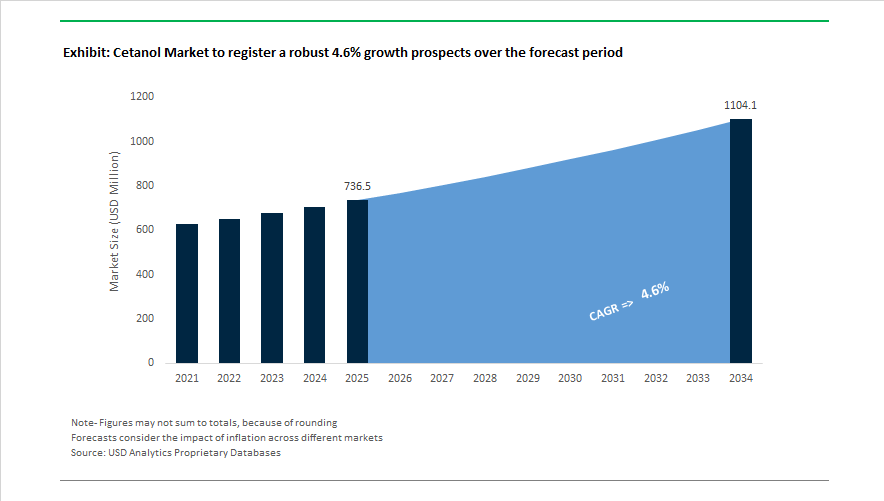
The Cetanol (Cetyl Alcohol) Market is projected to grow from USD 736.5 Million in 2025 to USD 1,104 Million by 2034, advancing at a CAGR of 4.6% as demand rises for fatty alcohols in personal care emulsifiers, pharmaceutical excipients, lubricants, and specialty surfactants. In October 2024, Kao Chemicals implemented targeted capacity optimization and process upgrades across its facilities to improve production efficiency and support growing demand for high-purity cetanol grades in premium cosmetics and industrial formulations. During the same month, Musim Mas achieved Science Based Targets initiative validation for its greenhouse gas reduction goals, reinforcing sustainability credentials in the palm-derived fatty alcohol value chain that underpins global cetyl alcohol supply.
Sustainability, leadership transitions, and specialty portfolio repositioning shaped developments through 2025. In March 2025, Kao Corporation signed an agreement with Future Origins for the bio-based alcohol NALO, initiating a transition toward fermentation-derived feedstocks for surfactant and cetanol formulations. In June 2025, Emery Oleochemicals earned ISO 50001 certification at its Cincinnati facility, demonstrating energy-efficient manufacturing of fatty alcohol derivatives. July 2025 saw Emery appoint Min Chong as Group CEO with a strategy pivot toward green polymer additives that incorporate cetanol into sustainable plasticizers and lubricants. In the same month, KLK OLEO received a Gold1 sustainability rating from RAM Sustainability, while Musim Mas renewed its partnership with AAK and Nestlé to secure deforestation-free palm supply chains. Also in July 2025, Procter & Gamble reported organic beauty and personal care sales growth, sustaining demand for fatty alcohol-based emollients in Europe and Latin America.
Specialty market expansion and operational resilience defined late-cycle developments. In August 2025, Sasol Limited reported improved adjusted EBITDA in its International Chemicals division, supported by margin gains in alcohol and surfactant portfolios. October 2025 marked the launch of the KLK OLEO Life Science business unit, targeting pharmaceutical and nutraceutical excipients such as high-purity cetyl alcohol. In December 2025, Sasol’s destoning plant reached beneficial operation, enhancing feedstock quality for synthetic alcohol production chains. By February 2026, Musim Mas retained CDP A-List status for Forests and Water Security for the third consecutive year, underscoring transparent sourcing practices critical for personal care and food-contact formulations.
Trends and Opportunities Defining the Cetanol (Cetyl Alcohol) Market
Sustainability-Driven Supply Chain Consolidation and Bio-Based Integration
Global buyers of fatty alcohols—particularly multinational FMCG brands—are no longer accepting marketing claims of “natural” or “plant-based” without real verification. Supply chains must now be traceable, audited, and emissions-accounted.
In March 2025, Wilmar International became one of the first major oleochemical players to receive SBTi-validation of its 2032 decarbonization pathway, mandating a 50.4% reduction in Scope 1 and 2 emissions. Since fatty alcohol production is energy-intensive, this validation directly affects procurement decisions for Cetanol, making buyers more inclined to contract suppliers with science-based climate targets rather than lower-cost, uncertified competitors.
Simultaneously, P&G Chemicals’ “Ultra Low” carbon-negative fatty alcohol portfolio is now shaping how ingredient decarbonization is implemented. These carbon-negative products are compliant with ISO 14067 cradle-to-gate carbon accounting frameworks, enabling personal care brands to achieve carbon-neutral label claims without needing offsets. This adds strategic pricing power and longer-term contract-lock opportunities for suppliers who can document carbon sequestration and biogenic uptake.
Premiumization and High-Purity “Skin-Barrier” Formulation Strategy
In 2025, personal care is no longer solely about texture or viscosity. Dermatology-led consumer demand is creating a functional upgrade, where ultra-pure cetyl alcohol (>98% ) is positioned as an “active lipid” for barrier reinforcement.
Clinical research in 2024–2025 maps Cetanol’s role in reducing Transepidermal Water Loss (TEWL), directly supporting acid mantle protection. Large players are embedding this science into revenue strategy—Kao Corporation’s “Global Sharp Top” strategy, driven by premium skin-barrier claims, achieved 29% YoY growth, showing how high-purity lipids translate into global brand performance.
Equally, Clean Beauty regulations and retailer certifications (COSMOS, Clean at Sephora) are accelerating the removal of mineral oils and low-grade fatty alcohols that carry C12/C14 impurities linked to irritation potential. Premium Cetanol grades are benefitting as a sensitivity-safe structuring agent, especially in baby care, dermatology, and hyper-sensitive formulations.
Cetanol as a Structural Enabler for Waterless and Solid Beauty
The shift toward Waterless Beauty is no longer an experimental niche—it is a supply chain and packaging transformation. Liquid lotions traditionally contain 70–80% water; removing it reduces packaging volume, eliminates plastic pumps, and cuts logistics emissions.
Cetanol is the backbone of this transformation due to its melt-control functionality and ability to deliver rigid structure, glide, and sensory payoff in ultra-concentrated forms. Shampoo bars, cleansing balms, and serum sticks rely on cetyl alcohol for hardness and controlled melt release.
Industry announcements forecast a $4.8 billion lift in waterless cosmetics value between 2024 and 2029, indicating that the addressable market for Cetanol-based solid formats is structurally expanding. Waterless formats also enable higher active-ingredient loading, improving efficacy and creating premium pricing tiers—an important commercial driver for both indie and prestige brands.
Advanced Lipid Nanoparticles and Drug Delivery Systems
Cetanol is gaining visibility in the pharmaceutical science community as a biocompatible lipid platform that enables controlled drug delivery.
Research published in February 2025 (PubMed-indexed) shows that Solid Lipid Nanoparticles (SLNs) made with cetyl alcohol increase ocular and transdermal drug permeability by creating a micro-reservoir that protects actives from enzymatic degradation. Pharmaceutical reviews published in July 2025 highlight cetyl palmitate in Nanostructured Lipid Carriers (NLCs), delivering higher drug-loading capacity and lower burst release—attributes that matter significantly in oncology and CNS drug delivery, where dose uniformity and slow-release kinetics impact therapeutic success.
For personal care brands, these developments open a cross-industry halo effect: skincare products increasingly borrow claims and language from pharmaceutical delivery, positioning Cetanol-based emulsions as “derm-science-validated.”
Cetanol Market Share and Segmentation Insights
Synthetic Cetanol Leads Supply Chains While Bio-Based Grades Accelerate Adoption
Synthetic cetanol dominates the global cetanol market, accounting for 52% market share in 2025, driven by its consistent quality, 99% + purity, and large-scale availability through petrochemical routes such as the Ziegler process, fatty acid hydrogenation, and ethylene oligomerization. This segment is widely used across industrial lubricants, pharmaceutical excipients, and mass-market personal care formulations, making it the backbone of commodity cetyl alcohol supply. Natural cetanol, derived from coconut oil and palm kernel oil, holds the second-largest share, supported by premium cosmetics, clean-label personal care, and food-grade applications. RSPO-certified and Rainforest Alliance–aligned sourcing increasingly influence procurement decisions. Bio-based cetanol is the fastest-growing segment, fueled by corporate net-zero targets, USDA BioPreferred programs, and the EU Renewable Energy Directive. Although production costs remain higher, fermentation-based and non-food oleochemical pathways are rapidly improving economics, positioning renewable cetanol as a key growth lever.
Cosmetics and Personal Care Anchors Demand as Pharma and Industrial Uses Expand
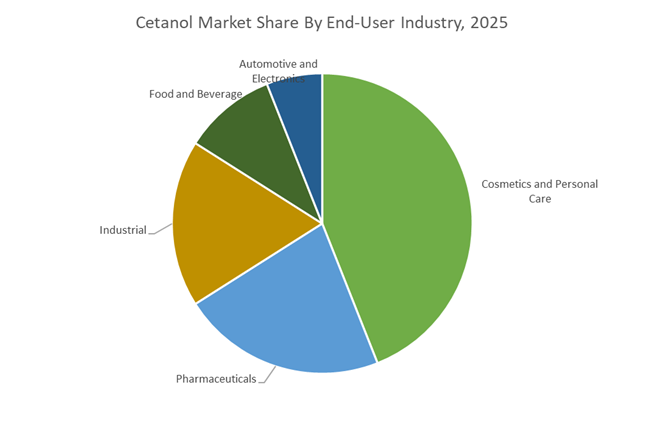
Cosmetics and personal care represent 44% of total cetanol consumption, making it the largest end-user segment. Cetyl alcohol functions as a critical emulsifier, thickener, and emollient in creams, lotions, conditioners, deodorants, and makeup, with rising demand for sulfate-free, plant-based, and premium formulations accelerating uptake of natural and bio-based cetanol, particularly across Asia-Pacific. Pharmaceuticals rank second, utilizing cetanol as an excipient in topical ointments, suppositories, controlled-release systems, and dermatological products, where USP and EP compliance is mandatory. Industrial applications form a substantial share, spanning metalworking fluids, textile processing, paper manufacturing, and specialty chemical intermediates such as cetostearyl alcohol and ethoxylates. Food and beverage applications remain stable, leveraging GRAS-approved cetanol (E529) as a glazing and release agent. Automotive and electronics represent a smaller but emerging segment, supported by EV battery components, antistatic additives, and specialty lubricants.
Competitive Landscape of the Cetanol Market
The global cetanol market in 2026 is defined by sustainability-driven sourcing, high-purity fatty alcohol production, and expanding demand from personal care, pharmaceuticals, industrial surfactants, and specialty coatings. Market leaders are differentiating through RSPO-certified palm-based supply chains, renewable carbon content (RCC), near-zero SVOC refining technologies, and vertically integrated oleochemical platforms. Competitive intensity is strongest across Europe and Asia-Pacific, where regulatory frameworks around indoor air quality, biodegradability, and green labeling standards are reshaping cetyl alcohol procurement strategies. Innovation in emollient performance, sensory optimization, and AI-driven supply chain digitization is elevating cetanol from a commodity fatty alcohol to a value-added functional ingredient.
High-purity renewable cetanol innovation led by BASF SE
BASF remains the 2026 global leader in high-purity cetanol, integrating production within its Nutrition & Care division to serve premium European cosmetics and specialty coatings markets. Its Lanette® 16 naturally derived cetyl alcohol is recognized for high renewable carbon content and ready biodegradability, making it a preferred alternative to synthetic waxes. In early 2026, BASF introduced Near-Zero SVOC technology to meet stringent indoor air quality and skin safety standards. Under its Beyond Beauty Vision showcased at Cosmet'Agora Paris, BASF emphasizes longevity skincare textures and environmental protection. The Q1 2026 launch of its Hyderabad Digital Hub further strengthens AI-driven oleochemical logistics and inventory optimization worldwide.
Plantation-to-consumer traceability advantage of KLK OLEO
KLK OLEO stands as the 2026 agri-based champion, leveraging fully integrated palm oil plantations to ensure RSPO-certified, traceable cetanol production. Its PALMERE fatty alcohols serve as primary feedstocks for eco-friendly surfactants and pharmaceutical emulsifiers across Europe and India. The company reinforced its sustainability leadership at the 2026 Palm and Lauric Oils Price Outlook Conference, promoting nature-derived home and personal care ingredients. Expanded participation at ChemExpo India 2026 reflects KLK OLEO’s focus on the rapidly localizing Indian pharmaceutical sector. With full plantation-to-consumer value chain control, KLK delivers carbon-efficient, transparent cetyl alcohol solutions aligned with evolving ESG mandates.
NDPE-driven scale and digital transparency at Wilmar International
Wilmar International enters 2026 as the world’s largest renewable feedstock processor, reinforcing its NDPE compliance strategy to maintain Tier-1 supplier status. Through its Integrated Agribusiness Model and network of over 1,000 manufacturing plants, Wilmar converts crude palm oil into large-scale cetyl and stearyl alcohol streams with strong margin efficiency. A 2025/2026 Timebound Action Plan ensures full grievance response transparency, supported by a digital Self-Reporting Tool that monitors all direct supplying mills. With projected 2026 net turnover of $83.5 billion driven by agricultural and bio-industrial growth, Wilmar strengthens its position in high-volume, deforestation-free cetanol supply for global FMCG and detergent manufacturers.
Sustainability transparency leadership by Musim Mas Group
Musim Mas is the 2026 benchmark for sustainability transparency, earning repeated CDP A List recognition for Forests and Water Security. Managing Indonesia’s largest independent smallholder program with over 40,000 trained farmers, the company ensures high-quality, responsibly sourced palm kernels for cetanol production. Collaboration with NTU Singapore on long-term sustainability research enhances supply chain resilience through 2028. Musim Mas offers customized fatty alcohol blends tailored for high-performance hair masks and advanced personal care emulsions. Its fully integrated plantation-to-oleochemical model provides comprehensive chain-of-custody certification, strengthening its appeal among multinational beauty brands seeking verified sustainable sourcing.
Precision sensory engineering in cetyl alcohol by Kao Corporation
Kao distinguishes itself in 2026 through precision chemistry tailored to premium Asian skincare markets. Its KALCOL series, particularly KALCOL 6098 high-purity cetyl alcohol, is the benchmark for luxury Japanese lotions requiring ultra-smooth sensory profiles and minimal impurities. Under the K27 Mid-term Plan, Kao transitioned cetanol production to 100% renewable electricity across Japanese and Malaysian facilities. The company’s competitive edge lies in sensory engineering, linking crystal structure and melting behavior of fatty alcohols to consumer emotional response during product application. Vertical integration ensures stable internal demand through Kao’s global brands, reinforcing supply reliability and rapid formulation feedback cycles.
South Asian manufacturing expansion driven by Godrej Industries Ltd.
Godrej Industries leads the South Asian cetanol market in 2026, expanding fractionated fatty alcohol capacity to support India’s Make in India pharmaceutical and personal care manufacturing ecosystem. Its GINOL fatty alcohol range dominates Middle East and Africa markets, supplying bulk cetanol for industrial detergents and cosmetic bases. The company’s Greener India initiative emphasizes responsible sourcing partnerships across Southeast Asia to align with emerging Indian green labeling standards. Integration with Godrej Consumer Products enables real-time formulation feedback, allowing rapid product optimization. This feedback-to-factory model strengthens Godrej’s competitiveness in pharmaceutical-grade ointments, creams, and emulsifier applications across high-growth regional markets.
Malaysia remains a structural anchor in the global Cetanol (Cetyl Alcohol, C16 fatty alcohol) industry, driven by ESG-certified palm kernel oil (PKO) integration and advanced oleochemical fractionation. In July 2025, Kuala Lumpur Kepong Berhad (KLK) received an upgrade from Gold2 to Gold1 by RAM Sustainability, recognizing industry-leading decarbonization efforts across its fatty alcohol production lines. By late 2025, KLK OLEO confirmed 100% RSPO traceability across its integrated complexes, ensuring that MASCOL™ and PALMERE™ cetyl alcohol grades originate from zero-deforestation plantations—an increasingly critical requirement under EU sustainability and CBAM frameworks.
Malaysian producers showcased low-VOC Cetanol variants at VietnamPlas 2025 and Fi Europe 2025, targeting premium cosmeceutical and pharmaceutical applications requiring high oxidative stability and low residual odor. Significant 2025 CAPEX allocations toward advanced fractionation columns enable production of ultra-pure C16 (98% minimum) cuts, serving semiconductor-grade and pharma-grade markets. Regulatory oversight also tightened domestically after updates to Malaysia’s Alcoholic Beverages Regulations in October 2025, indirectly impacting food-grade fatty alcohol emulsifier processing standards. Strategic partnerships expanded, with Timur Network Malaysia strengthening export channels into Europe to align with Carbon Border Adjustment Mechanism (CBAM) compliance requirements.
Indonesia: B40 Biodiesel Synergy, CDP A-List Recognition, and 15% Distillation Capacity Growth
Indonesia’s Cetanol industry benefits from structural palm oil dominance, biodiesel policy support, and vertically integrated sustainability programs. In July 2025, Musim Mas renewed its long-term partnership with Nestlé and AAK under the Rokan Hulu Landscape and Livelihoods Initiative, securing certified raw material supply for MASCOL™ fatty alcohol production. In January 2026, Musim Mas achieved CDP “A List” recognition for environmental transparency, strengthening ESG positioning for global cosmetic and personal care supply chains.
On October 7, 2025, the Indonesian government reaffirmed its B40 Biodiesel Program, optimizing PKO availability for downstream oleochemical synthesis of long-chain fatty alcohols such as Cetanol. By February 2025, 18 Musim Mas subsidiaries improved sustainability ratings under the PROPER program, reinforcing green industrialization goals. In May 2025, agreements were signed to expand fatty alcohol distillation capacity by 15% by end-2026 to meet APAC demand. The Rokan Hulu Initiative integrated over 5,000 independent smallholders into certified supply chains, stabilizing feedstock pricing and long-term Cetanol precursor availability.
United States: Safer Choice Tightening, USP/NF Pharma Compliance, and Smart Medical Adhesive R&D
The U.S. Cetanol market is shaped by regulatory scrutiny, pharmaceutical-grade compliance, and high-performance formulation innovation. Effective July 2025, the U.S. Environmental Protection Agency updated Safer Choice criteria, requiring Cetanol-derived emulsifiers in consumer products to demonstrate rapid mineralization to CO₂ within 10 days for eco-label eligibility. In late 2025, Sasol Chemicals confirmed that ALFOL 16 NF (petrochemical-based cetyl alcohol) maintained USP/NF compliance, reinforcing supply security for pharmaceutical excipients.
In early 2026, the U.S. Department of Commerce reported a shift toward “friend-shoring” oleochemical imports, with distributors such as Acme-Hardesty prioritizing Indonesia and Malaysia as strategic partners. U.S. research institutions are advancing Cetanol-PVA hydrogel systems for wound healing and cardiac repair, leveraging its emollient and structural stabilization properties. According to the Personal Care Products Council, a 12% surge in e-commerce beauty sales in 2025 increased demand for thermally stable formulations incorporating Cetanol. Proposed SNUR updates in November 2025 mandate 90-day notification for new chemical modifications of long-chain fatty alcohols, including P-24-71 and P-24-74 classifications.
Germany: Core Chemicals Focus, Digital Product Passports, and Green Hydrogen Trials
Germany’s Cetanol industry is undergoing portfolio rationalization and decarbonization modernization. In January 2026, BASF reported a strategic shift toward high-margin Core chemicals, including C16–C18 fatty alcohols, while divesting non-core decorative coatings. By February 2026, BASF accelerated its €1.1 billion cost-saving program, modernizing Ludwigshafen oleochemical lines to reduce energy intensity by 20% .
At the 2025 SEPAWA Congress, German manufacturers presented rhamnolipid-compatible Cetanol blends enabling 100% bio-based hair conditioning systems with improved performance versus traditional quats. Evonik Industries and BASF integrated Digital Product Passports in 2025, offering real-time carbon footprint transparency for every cetyl alcohol batch. Late 2025 trials across German chemical clusters tested green hydrogen in the hydrogenation phase of fatty alcohol synthesis, targeting carbon-neutral production cycles by 2030.
India: PLI-Driven Localization, FSSAI Reform, and Premium Skincare Demand Growth
India’s Cetanol industry is expanding through localization incentives and rising personal care consumption. In late 2025, Clean Science and Technology Limited, via CFCL, commissioned a specialty chemical facility supporting high-purity intermediates that utilize Cetanol as a stabilizing agent. The Food Safety and Standards Authority of India implemented First Amendment Regulations effective January 1, 2026, clarifying definitions for emulsifiers and stabilizers in alcoholic ready-to-drink beverages, indirectly impacting fatty alcohol standards.
Under the Production Linked Incentive (PLI) scheme, Fine Chemical Clusters are promoting domestic fatty alcohol distillation to reduce import reliance. The Ministry of Statistics and Programme Implementation reported a 14% increase in premium skincare consumption in 2025, driven by rapid urbanization. India’s agrochemical exports, valued at $5.4 billion in 2025, also created secondary demand for Cetanol as a surfactant and drift-control agent in carbamate pesticide formulations.
Singapore operates as a global logistics and ESG verification hub for Cetanol trade. Wilmar International committed in its 2025–2026 Timebound Action Plan to achieve 100% Traceability to Plantation (TtP), positioning Singapore as a clearinghouse for certified sustainable fatty alcohol exports. In 2025, Wilmar reported a 100% response rate under its ESG grievance mechanism, a key procurement criterion for European luxury cosmetics brands.
In September 2025, KLK OLEO expanded its Singapore innovation hub to accelerate nutraceutical and cosmeceutical R&D, specifically evaluating Cetanol’s role in enhancing transdermal delivery of bioactive compounds. This integration of logistics, ESG compliance, and high-value formulation research solidifies Singapore’s strategic position in the global Cetanol value chain.
Cetanol Market Report Scope
Cetanol Market
Parameter
Details
Market Size (2025)
$736.5 Million
Market Size (2034)
$1104 Million
Market Growth Rate
4.6%
Segments
By Type / Origin (Bio-based Cetanol, Synthetic Cetanol, Natural Cetanol), By Form (Waxy Solid, Liquid), By Grade (Industrial Grade, Cosmetic Grade, Pharmaceutical Grade, Food Grade), By Function (Emulsifiers and Stabilizers, Emollients, Thickening Agents, Anti-static Agents, Chemical Intermediates), By End-User Industry (Cosmetics and Personal Care, Pharmaceuticals, Food and Beverage, Industrial, Automotive and Electronics)
Study Period
2019- 2025 and 2026-2034
Units
Revenue (USD)
Qualitative Analysis
Porter’s Five Forces, SWOT Profile, Market Share, Scenario Forecasts, Market Ecosystem, Company Ranking, Market Dynamics, Industry Benchmarking
Companies
BASF SE, Procter and Gamble Chemicals, Kao Corporation, Emery Oleochemicals, Godrej Industries, Wilmar International, Musim Mas Group, VVF, Sinopec Catalyst Company, Sasol Limited, KLK Oleo, Croda International, Evonik Industries, Prasol Chemicals, Surfachem Group
Countries
US, Canada, Mexico, Germany, France, Spain, Italy, UK, Russia, China, India, Japan, South Korea, Australia, South East Asia, Brazil, Argentina, Middle East, Africa
Cetanol Market Segmentation
By Type / Origin
Bio-based Cetanol
Synthetic Cetanol
Natural Cetanol
By Form
Waxy Solid
Liquid
By Grade
Industrial Grade
Cosmetic Grade
Pharmaceutical Grade
Food Grade
By Function
Emulsifiers and Stabilizers
Emollients
Thickening Agents
Anti-static Agents
Chemical Intermediates
By End-User Industry
Cosmetics and Personal Care
Pharmaceuticals
Food and Beverage
Industrial
Automotive and Electronics
By Region
North America (United States, Canada, Mexico)
Europe (Germany, France, United Kingdom, Spain, Italy, Rest of Europe)
Asia Pacific (China, India, Japan, South Korea, Australia, Rest of APAC)
South and Central America (Brazil, Argentina, Rest of SCA)
Middle East and Africa (Saudi Arabia, UAE, South Africa, Rest of Middle East, Rest of Africa)
2. Cetanol Market Landscape and Outlook (2025–2034)
2.1. Introduction to Cetanol (Cetyl Alcohol) Market
2.2. Market Valuation and Growth Projections
2.3. Feedstock Evolution: Palm Kernel Oil, Synthetic Routes, and Fermentation-Based Alcohols
2.4. Regulatory Framework: RSPO, NDPE, USP/NF, ISO 14067, Safer Choice
2.5. Supply Chain Consolidation and ESG-Driven Procurement
3. Trends and Opportunities Shaping the Cetanol Market
3.1. Sustainability-Driven Supply Chain Integration and Carbon Accounting
3.2. Premiumization of High-Purity Cetanol in Skin-Barrier Formulations
3.3. Waterless Beauty and Solid Cosmetic Format Expansion
3.4. Lipid Nanoparticles and Controlled Drug Delivery Systems
3.5. Industrial and EV-Linked Specialty Lubricant Applications
4. Competitive Landscape and Strategic Developments
4.1. Capacity Expansion and Fractionation Technology Upgrades
4.2. Bio-Based Feedstock Agreements and Renewable Carbon Content Strategies
4.3. Digital Supply Chain Transparency and ESG Disclosure
4.4. Portfolio Diversification into Pharmaceutical and Life Sciences Grades
4.5. Mergers, Acquisitions, and Leadership Transitions
5. Market Share and Segmentation Insights: Cetanol Market
5.1. By Type / Origin
5.1.1. Bio-Based Cetanol
5.1.2. Synthetic Cetanol
5.1.3. Natural Cetanol
5.2. By Form
5.2.1. Waxy Solid
5.2.2. Liquid
5.3. By Grade
5.3.1. Industrial Grade
5.3.2. Cosmetic Grade
5.3.3. Pharmaceutical Grade
5.3.4. Food Grade
5.4. By Function
5.4.1. Emulsifiers and Stabilizers
5.4.2. Emollients
5.4.3. Thickening Agents
5.4.4. Anti-Static Agents
5.4.5. Chemical Intermediates
5.5. By End-User Industry
5.5.1. Cosmetics and Personal Care
5.5.2. Pharmaceuticals
5.5.3. Food and Beverage
5.5.4. Industrial
5.5.5. Automotive and Electronics
6. Country Analysis and Regional Developments
6.1. Malaysia
6.2. Indonesia
6.3. United States
6.4. Germany
6.5. India
6.6. Singapore
6.7. China
6.8. Japan
6.9. South Korea
6.10. Brazil
6.11. Argentina
6.12. Saudi Arabia
6.13. UAE
6.14. South Africa
6.15. Rest of World
7. Cetanol Market Size Outlook by Region (2025–2034)
7.1. North America Cetanol Market Size Outlook
7.1.1. By Type / Origin
7.1.2. By Form
7.1.3. By Grade
7.1.4. By Function
7.1.5. By End-User Industry
7.2. Europe Cetanol Market Size Outlook
7.2.1. By Type / Origin
7.2.2. By Form
7.2.3. By Grade
7.2.4. By Function
7.2.5. By End-User Industry
7.3. Asia Pacific Cetanol Market Size Outlook
7.3.1. By Type / Origin
7.3.2. By Form
7.3.3. By Grade
7.3.4. By Function
7.3.5. By End-User Industry
7.4. South and Central America Cetanol Market Size Outlook
7.4.1. By Type / Origin
7.4.2. By Form
7.4.3. By Grade
7.4.4. By Function
7.4.5. By End-User Industry
7.5. Middle East and Africa Cetanol Market Size Outlook
7.5.1. By Type / Origin
7.5.2. By Form
7.5.3. By Grade
7.5.4. By Function
7.5.5. By End-User Industry
8. Company Profiles: Leading Players in the Cetanol Market
8.1. BASF SE
8.2. Procter & Gamble Chemicals
8.3. Kao Corporation
8.4. Emery Oleochemicals
8.5. Godrej Industries
8.6. Wilmar International
8.7. Musim Mas Group
8.8. VVF
8.9. Sinopec Catalyst Company
8.10. Sasol Limited
8.11. KLK OLEO
8.12. Croda International
8.13. Evonik Industries
8.14. Prasol Chemicals
8.15. Surfachem Group
9. Research Methodology
9.1. Research Scope and Definitions
9.2. Data Collection and Validation
9.3. Forecasting Model and Assumptions
9.4. Market Breakdown and Triangulation
9.5. Limitations and Disclaimers
10. Appendix
10.1. Acronyms and Abbreviations
10.2. List of Tables
10.3. List of Figures
Cetanol Market Segmentation
By Type / Origin
Bio-based Cetanol
Synthetic Cetanol
Natural Cetanol
By Form
Waxy Solid
Liquid
By Grade
Industrial Grade
Cosmetic Grade
Pharmaceutical Grade
Food Grade
By Function
Emulsifiers and Stabilizers
Emollients
Thickening Agents
Anti-static Agents
Chemical Intermediates
By End-User Industry
Cosmetics and Personal Care
Pharmaceuticals
Food and Beverage
Industrial
Automotive and Electronics
By Region
North America (United States, Canada, Mexico)
Europe (Germany, France, United Kingdom, Spain, Italy, Rest of Europe)
Asia Pacific (China, India, Japan, South Korea, Australia, Rest of APAC)
South and Central America (Brazil, Argentina, Rest of SCA)
Middle East and Africa (Saudi Arabia, UAE, South Africa, Rest of Middle East, Rest of Africa)
The Cetanol Market is valued at USD 736.5 Million in 2025 and is projected to reach USD 1,104 Million by 2034, expanding at a CAGR of 4.6%. Growth is supported by rising demand for fatty alcohols in cosmetics and personal care, pharmaceutical excipients, specialty surfactants, lubricants, and emerging drug-delivery applications.
Major trends include rapid adoption of bio-based and RSPO-certified feedstocks, premiumization toward ultra-high-purity cetyl alcohol for skin-barrier formulations, expansion of waterless and solid beauty formats, and growing pharmaceutical use in lipid nanoparticles and controlled-release systems. Sustainability ratings, SBTi validation, and carbon-footprint transparency are now central to supplier selection.
Cosmetics and personal care account for roughly 44% of global consumption, using cetanol as an emollient, thickener, and emulsifier in creams, lotions, conditioners, and deodorants. Pharmaceuticals follow, where cetanol functions as an excipient in topical and controlled-release formulations. Industrial applications span lubricants, textiles, paper, and specialty chemical intermediates, while food and beverage remains a smaller, stable segment.
Multinational FMCG and beauty brands increasingly require deforestation-free palm sourcing, ISO 14067 carbon accounting, and science-based climate targets. This is accelerating demand for bio-based cetanol, fermentation-derived fatty alcohols, and suppliers with verified ESG credentials, shifting pricing power toward producers that can document traceability, renewable carbon content, and emissions reduction.
Key participants include BASF SE, Kao Corporation, Emery Oleochemicals, Wilmar International, Musim Mas Group, KLK OLEO, Godrej Industries, and Sasol Limited. Competition centers on high-purity grades, RSPO-certified supply chains, bio-based innovation, and vertically integrated oleochemical platforms.