Child Resistant Reclosable Edible Bags Market Forecast 2025–2034: $1.8 Billion to $3.1 Billion at 6.1% CAGR Driven by Regulatory Mandates and Sustainable Packaging Innovation
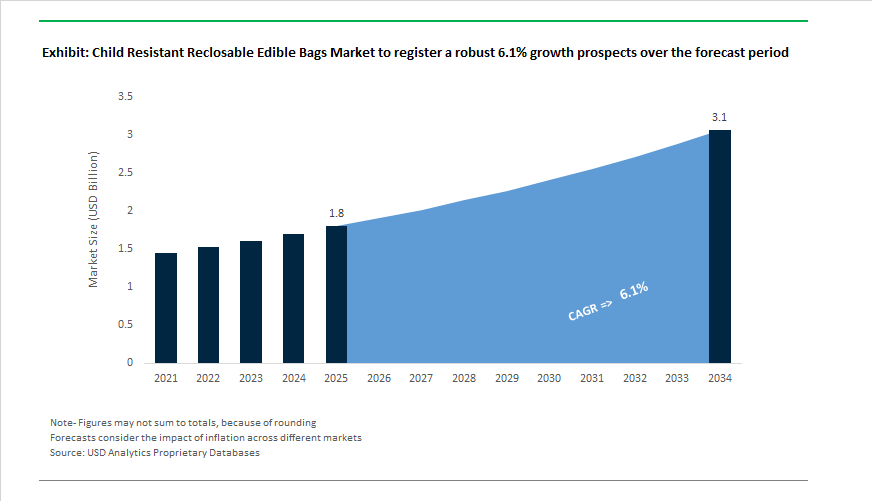
The global Child Resistant Reclosable Edible Bags Market is projected to expand from $1.8 billion in 2025 to $3.1 billion by 2034, registering a CAGR of 6.1%. Growth is structurally linked to tightening child-safety regulations across cannabis, hemp, nicotine pouch, nutraceutical, and pharmaceutical segments. As edible product formats gain consumer acceptance, regulators are mandating certified child-resistant (CR) packaging solutions that comply with 16 CFR §1700.20 testing protocols. This regulatory alignment is transforming CR reclosable bags from an optional value-added feature into a non-negotiable market entry requirement.
Enforcement momentum accelerated in 2025, when the Florida Department of Agriculture and Consumer Services initiated aggressive compliance inspections for hemp and hemp-extract products. Within five weeks, more than 150,000 non-compliant edible packages were removed from retail shelves due to failures in CRC reclosability and labeling standards. Similarly, Minnesota mandated in 2025 that all edible cannabinoid products must be sold in resealable CR containers meeting federal testing benchmarks, with strict serving limits clearly labeled on the bags. In September 2025, the U.S. FDA formally recommended certified child-resistant packaging for nicotine pouches and lozenges after data revealed that 72% of exposure cases between 2022 and 2025 involved children under five. These actions are reinforcing CR-certified zipper pouches as the dominant format in edible packaging supply chains.
Technological innovation and sustainability are reshaping product development strategies. In April 2024, a leading U.S. packaging manufacturer implemented AI-powered robotic vision systems in CR zipper production, achieving 98.6% accuracy in detecting micro-defects in locking mechanisms. This reduced defective unit risk in high-speed manufacturing environments and strengthened compliance reliability. In June 2025, Fresh-Lock® launched an upgraded Child-Guard® track and slider system incorporating at least 25% post-consumer recycled content, balancing safety performance with ESG commitments. The transition toward recyclable mono-material PE and PP CR pouches intensified in January 2026, replacing multi-layer laminates while preserving Senior-Friendly/Child-Resistant functionality. In September 2025, Dymapak introduced QR-linked digital certification features, allowing instant verification of CR compliance and enhancing traceability amid counterfeit concerns.
Competitive pricing strategies and portfolio expansion are further shaping the child-resistant reclosable edible bags market. In March 2025, Sana Packaging reduced prices by 15% on its U.S.-manufactured CR-certified edible bag lines to stabilize supply chains amid tariff volatility. ProAmpac expanded its CR flexible packaging portfolio in 2025, targeting home and personal care as well as nutraceutical applications with high-barrier, tear-resistant films integrated with advanced reclosable zippers. In 2024, Amcor introduced recyclable child-resistant pouches designed for pharmaceutical and nutraceutical applications, leveraging mono-material structures compatible with existing recycling streams. Meanwhile, Calyx Containers strengthened brand visibility in August 2025 through strategic industry sponsorships, promoting its CR-enabled flexible curing and storage solutions. The convergence of regulatory enforcement, sustainable material engineering, AI-driven quality control, and digital traceability positions the market for sustained mid-single-digit growth through 2034.
Child-Resistant Reclosable Edible Bags Market Trends and Drivers
Rise of User-Centric Multi-Step Child-Resistance (CRR) Mechanisms Optimized for Accessibility
A major shift in the child-resistant reclosable edible bags market is the transition from outdated tab-and-slot closures to intuitive slider, squeeze-and-pull, and bilateral pressure-lock systems engineered for senior-friendly usability. In November 2025, leading closures manufacturers unveiled next-generation squeeze-and-pull zippers, evaluated by independent testing labs, showing 25% lower opening torque for seniors, while still preventing 80%+ of unintended openings by children in standard 10-minute ISO 8317 CRR tests.
Beyond locking force, the next competitive advantage is sensory confirmation technology—bags now feature tactile ridges and audible click-secure signals that validate a full reseal. In consumer-safety-sensitive markets like edibles, melatonin, and cannabis, this reduces accidental ingestion risk associated with partially open pouches. The evolution toward human-factor engineered closures positions CRR packaging as not just a safety feature, but a consumer-experience differentiator and brand trust driver.
Shift Toward PCR-Rich, Monomaterial Recyclable Laminates Under Global Sustainability Mandates
Sustainability regulations are forcing the CRR edible bags industry to abandon mixed multilayer laminates and transition toward all-polyethylene (PE) or all-polypropylene (PP) single-material bags compatible with store-drop-off recycling streams.
In July 2025, Amcor’s commercial launch of its Hector CRC polypropylene system marked a new wave of light-weight, low-CO₂ closure platforms, enabling brand owners to cut packaging emissions while maintaining compliance. Simultaneously, mass-balance sustainability is accelerating: by late 2025, brands such as Fresh-Lock and Berry Global introduced ISCC PLUS-certified CRR pouches with 25–30% PCR content, addressing compliance pressure from EU PPWR 2030 recyclability targets.
Expanding Demand in Regulated Nicotine Pouches and OTC Pharmaceutical Gummies
A lucrative commercial shift is emerging in heavily regulated ingestibles. The child-resistant reclosable edible bags market is becoming central to nicotine, melatonin, and OTC vitamin gummy packaging strategies.
On September 2, 2025, the U.S. FDA issued a formal directive urging nicotine pouch manufacturers to switch to CRR packaging following public-health data showing 72% of nicotine pouch exposure cases (2022–2025) involved children under 5. Twenty nicotine pouch SKUs have since achieved authorization—all mandatorily packaged in child-resistant formats.
Additionally, the Consumer Product Safety Commission (CPSC) increased enforcement of the Poison Prevention Packaging Act (PPPA) for confectionery-like OTC supplements in 2025, triggering a 15% surge in domestic demand for high-barrier CRR pharmaceutical-grade pouches. This creates a multi-sector pull effect: suppliers that can scale FDA- and CPSC-ready formats will capture premium pricing, long-term contracts, and accelerated repeat orders.
High-Barrier CRR Bags for Premium Functional Foods and Nutraceuticals
As functional foods and nutraceutical edibles (adaptogens, nootropics, microbiome snacks) expand, brands are prioritizing potency retention and safety differentiation. In October 2025, ePac Flexibles broadened its certified child-resistant product line, introducing metallized-PET and foil-lined CRR bags that block 99.9% oxygen and light, preventing degradation of active compounds.
Unlike commodity snacks, these applications command 3×–5× packaging margin uplift due to barrier protection requirements, odor-neutralization needs, and brand risk management. Further expansion is expected due to hyper-localized cannabis and hemp compliance laws—as of December 2025, over 30 U.S. states maintain unique rules on intoxicating hemp edible packaging, creating demand for lab-certified, multi-serve CRR pouches and driving opportunity for Compliance-as-a-Service packaging providers offering certification, closure testing, and turnkey regulatory documentation.
Competitive Landscape of the Child Resistant Reclosable Edible Bags Market
The Child Resistant Reclosable Edible Bags Market is driven by regulatory compliance, sustainable materials, and brand-focused packaging innovation across cannabis, nutraceutical, and functional food segments. Industry leaders are differentiating through lab-certified closures, PCR content integration, smart pouch technologies, and high-speed FFS compatibility. Competitive intensity is rising as suppliers pivot toward recyclable mono-material films, NFC-enabled dosage tracking, and arthritis-friendly opening mechanisms. Expansion into Europe and adoption of compostable CR systems signal a shift toward circular packaging, while dispensary exit bags and tamper-evident solutions remain core revenue pillars.
Dymapak pioneers lab-certified CR pouches with recyclable Secure Sack platform
Dymapak is the category pioneer in child-resistant flexible packaging, best known for its Secure Sack™ line featuring patented press-to-close locking zippers. Its products meet CPSC standards and are approved as both Exit Packaging and Immediate Packaging across all 50 US states and Canada. In late 2024, Dymapak launched the world’s first Store Drop-off Recyclable PCR child-resistant pouch, tackling plastic waste in CR packaging. Strategically, the company is advancing “Invisible Compliance,” engineering adult-friendly openings suitable for arthritis sufferers while remaining impossible for children under five, reinforcing leadership in compliant edible packaging.
KushCo expands dispensary exit bags across Europe under asset-light strategy
Operating under Greenlane Holdings, KushCo is a leading supplier of compliant mylar-style CR bags using pinch-to-open and slide-lock technologies for edibles, flower, and concentrates. The company dominates the dispensary exit bag segment, offering tamper-evident and opaque reclosable solutions. In 2026, KushCo transitioned into an asset-light execution mode, prioritizing higher-margin proprietary designs over general logistics. Business expansion is accelerating in Germany and broader EU markets following 2025–2026 cannabis law reforms, positioning KushCo as a key beneficiary of Europe’s emerging regulated edible packaging ecosystem.
Berry Global scales smart recyclable CR packaging for nutraceutical giants
Berry Global operates over 300 facilities worldwide, enabling massive scale for global nutraceutical brands such as Goli and Nature’s Bounty. In 2025, Berry introduced Digi-Cap™ smart pouch integration, embedding NFC closures to monitor opening events and improve dosage adherence. The company recently invested in high-barrier mono-material PE films that allow full recyclability without sacrificing odor protection. Berry’s Sustainability-at-Scale initiative targets at least 30% recycled content across all reclosable bags by end-2026, strengthening its leadership in pharma-to-edible crossover packaging and circular economy compliant CR solutions.
AssurPack redefines edible safety packaging through brand-first sensory design
AssurPack specializes in design-forward compliant packaging with its AssurSeal® and AssurFree™ lines, incorporating soft-touch finishes and audible-click closures to enhance consumer experience. The company excels in moisture and oxygen barrier engineering for gummies and chocolates, products highly sensitive to degradation. In early 2026, AssurPack launched the Universal Pouch, enabling late-stage regulatory labeling to simplify multi-state scaling. Its integration with automated Form-Fill-Seal systems allows manufacturers to package over 60 bags per minute on existing lines, making AssurPack highly attractive to large-scale edible producers.
Fresh-Lock powers millions of edible-safe bags with next-gen CR zipper systems
Fresh-Lock, part of Reynolds Consumer Products, supplies the core closure technology used in millions of child-resistant edible bags globally. Its Fresh-Lock® CR zipper features a double-lock press-to-close mechanism, while the 8501 Zipper launched in 2025 incorporates 50% recycled content without compromising bite-test strength. Beyond cannabis edibles, Fresh-Lock supports laundry pod and dishwasher detergent packaging, providing cross-industry validation of its safety systems. Strategically, the company partnered with Charter Next Generation to develop a fully compostable CR bag platform, currently in final certification for a 2027 commercial launch.
Child Resistant Reclosable Edible Bags Market Share and Segmentation Insights
Market Share by Material Composition: Multi-Layer Laminates Lead While Mono-Materials Accelerate Adoption
Multi-layer laminates dominate the Child Resistant Reclosable Edible Bags Market, accounting for 58% of total market share in 2025, driven by superior moisture, oxygen, and light barrier performance that directly enhances edible shelf life. These high-barrier flexible packaging structures also deliver the mechanical strength required for certified child-resistant zippers and reclosable closures, making them the preferred choice across cannabis gummies, nutraceutical edibles, and pharmaceutical powders. However, mono-material structures represent the fastest-growing segment, supported by tightening EU and North American recycling mandates and increasing adoption of polyolefin-based recyclable packaging. Brands are actively replacing traditional laminates with curbside-recyclable mono-material edible bags to meet circular economy targets. Sustainable and compostable materials remain a niche but expanding category, particularly in premium organic cannabis and high-end nutraceutical packaging, although higher costs and challenges in preserving child-resistant functionality continue to constrain large-scale commercialization.
Market Share by End-Use Industry: Cannabis Edibles Dominate as Nutraceutical Safety Packaging Gains Momentum
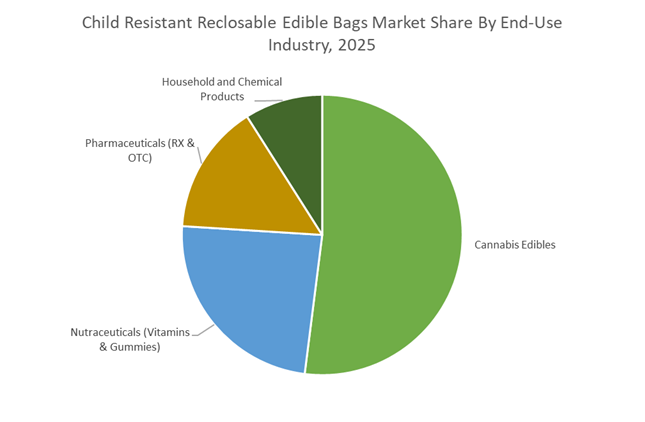
Cannabis edibles command 52% of overall market share, supported by strict regulatory frameworks in the US and Canada that mandate child-resistant, reclosable packaging for all ingestible cannabis products. Rapid expansion of gummy-based cannabis formats is significantly accelerating demand for compliant edible pouch solutions. Nutraceuticals represent the second-largest segment, fueled by rising global consumption of vitamin, melatonin, CBD, and multivitamin gummies, prompting brands to voluntarily adopt child-resistant packaging as a standard safety feature. The pharmaceutical segment maintains steady demand, particularly for sample packs, clinical trial materials, and powdered or granulated medications, although bottles and blister packs remain dominant for tablets. Household and chemical products account for the smallest share, as CR reclosable bags are primarily used for solid formats like powders or tablets, while liquid cleaners continue to rely on rigid bottles with child-resistant caps.
United States Child-Resistant (CR) Reclosable Edible Bags Market: PPPA Enforcement, Smart Packaging, and State-Level Cannabis Mandates Driving Innovation
The United States remains the global benchmark for Child-Resistant reclosable edible bags market growth, underpinned by stringent federal Poison Prevention Packaging Act compliance and evolving state cannabis packaging mandates. In 2025, the U.S. Consumer Product Safety Commission intensified enforcement under 16 CFR 1700.15, specifically targeting look-alike edible packaging that mimics traditional snack formats without certified push-and-press or dual-action CR slider mechanisms. This regulatory tightening is accelerating demand for ASTM D3475 certified reclosable CR pouches featuring advanced zipper systems and tamper-evident structures.
Industry leaders such as Amcor and Berry Global have expanded U.S.-based R&D centers to commercialize mono-material polyethylene CR bags that are fully recyclable while maintaining PPPA certification standards. Approximately 32% of all flexible CR packaging sold in North America in 2024 transitioned to reclosable formats, reflecting a structural pivot from single-use tear-and-toss sachets to consumer-convenient resealable pouches. Maryland and California updated their COMAR and DCC frameworks in late 2025 to mandate opaque, child-resistant, and resealable packaging for intoxicating hemp-derived and cannabis products, reinforcing regulatory-driven demand. Additionally, the commercial rollout of NFC-enabled CR bags for medical edibles has introduced digital authentication and dosage tracking, positioning the U.S. as a high-tech innovation hub in the global child-resistant edible packaging market.
Canada’s Child-Resistant reclosable edible bags market is shaped by the strict regulatory architecture of the Cannabis Act and subsequent updates such as SOR/2025-43 under Health Canada. Effective 2025, packaging rules permit limited color differentiation between container and lid while preserving the legally mandated smooth texture and 100% opacity requirements that prevent youth-oriented branding. All CR reclosable edible pouches must comply with both child-resistant certification standards and the Safe Food for Canadians Regulations for direct food contact, significantly elevating material and compliance benchmarks.
Edibles remain capped at 10 mg THC per package, driving growth in small-format, high-barrier CR reclosable pouches engineered to preserve freshness for single-serve consumption over time. New mandates require visible tamper-evident seals, typically heat-sealed headers, that must be removed before first access to the CR zipper, reinforcing layered safety logic. Canadian firms such as MedLock are investing in compostable PLA and sugarcane ethanol-based CR zipper technologies to align with federal single-use plastic reduction policies. Matte-finish laminated films delivering complete opacity have become the industry standard, positioning Canada as the global pioneer in plain, high-barrier, food-grade certified child-resistant edible packaging.
Germany Child-Resistant (CR) Reclosable Edible Bags Market: ISO 8317 Alignment and Pharmaceutical-Grade CR Demand Under CanG
Germany has rapidly emerged as the European growth engine for the Child-Resistant reclosable edible bags market following the implementation of the Cannabis Act (CanG) and the Pillar 2 pilot commercialization framework. In 2025, the Federal Office for Agriculture and Food processed nearly 50 pilot project applications for commercial cannabis sales, all requiring pharmaceutical-grade child-resistant and resealable packaging. Germany is leveraging ISO 8317 as the core compliance benchmark for reclosable CR packaging, setting a harmonized European standard for edible-adjacent cannabis products entering pilot markets in 2026.
Manufacturers are emphasizing senior-friendly CR mechanisms that balance child safety with accessibility for aging consumers, a critical demographic under Pillar 2. Proposed neutral packaging mandates discourage lifestyle branding, mirroring Canadian plain packaging principles and reinforcing demand for standardized, high-performance CR reclosable pouches. Market entry requires a General Certificate of Conformity and batch-level laboratory verification before retail distribution, raising compliance barriers. Industrial production hubs in the Rhineland are expanding multi-layer aluminum-barrier CR pouch manufacturing to support medical and pilot-retail supply chains, positioning Germany as Europe’s compliance-intensive frontier in child-resistant edible packaging.
Thailand’s Child-Resistant reclosable edible bags market is undergoing rapid regulatory recalibration under the 2025 Notification on Controlled Herbs. Since June 2025, all cannabis flower and edible-category products sold via prescription must be dispensed in certified child-safe packaging, significantly increasing demand for compliant reclosable CR pouches and rigid containers. The Ministry of Public Health now mandates QR codes on CR bags linking directly to Certificates of Analysis, enhancing traceability and eliminating grey market distribution.
A transition period allowed legacy products manufactured before August 2025 to circulate temporarily, but all new production must utilize certified CR packaging systems. Dispensaries must maintain identity verification and prescription records, fueling demand for pre-labeled, serialized child-resistant edible bags that integrate tamper-evident features and regulatory labeling. Thai packaging firms are forming joint ventures with U.S. and Chinese manufacturers to localize squeeze-to-open CR technologies. As Thailand positions itself as a GACP-aligned cultivation and export hub for Southeast Asia, demand for high-barrier, export-ready child-resistant reclosable edible packaging is expected to accelerate.
China Child-Resistant (CR) Reclosable Edible Bags Market: Global Manufacturing Backbone and Automation-Driven Scale
China plays a strategic upstream role in the global Child-Resistant reclosable edible bags market as the primary supplier of CR hardware, barrier films, and automated pouch-making machinery. Industrial clusters in Nantong and Shenzhen specialize in high-speed zipper-insertion technology and fully automated CR pouch production lines, enabling mass-scale manufacturing of certified child-resistant zipper components. China currently commands an estimated 17.6% share of the global child-resistant packaging market, supported by export-oriented production serving North American and European cannabis brands.
Companies such as MST Packaging are advancing high-barrier odor-lock films that reduce plastic weight by 50% while maintaining structural integrity for CR certification testing. To mitigate rising labor costs, manufacturers are deploying AI-driven quality inspection systems to ensure 100% functionality of CR zippers across production batches, improving compliance reliability. Following 2025 trade realignments, Chinese firms are establishing satellite finishing facilities in Southeast Asia to address tariff exposure on finished flexible packaging. Simultaneously, strong R&D investment in mono-material all-PE laminates aligns Chinese exports with forthcoming EU Packaging and Packaging Waste Regulation requirements, strengthening the country’s position as the scalable manufacturing engine of the global child-resistant edible bags market.
By Closure Type (Zipper-Based Closures, Spout-Based Closures, Specialized Child-Resistant Closures), By Material Composition (Multi-Layer Laminates, Mono-Material Structures, Sustainable and Compostable Materials), By Pouch Format (Stand-Up Pouches, Flat Pouches, Gusseted Bags, Exit Bags), By Compliance Standard (ASTM Standards, Consumer Product Safety Standards, ISO Standards), By End-Use Industry (Cannabis Edibles, Nutraceuticals, Pharmaceuticals, Household and Chemical Products)
Study Period
2019- 2025 and 2026-2034
Units
Revenue (USD)
Qualitative Analysis
Porter’s Five Forces, SWOT Profile, Market Share, Scenario Forecasts, Market Ecosystem, Company Ranking, Market Dynamics, Industry Benchmarking
US, Canada, Mexico, Germany, France, Spain, Italy, UK, Russia, China, India, Japan, South Korea, Australia, South East Asia, Brazil, Argentina, Middle East, Africa
2. Child Resistant Reclosable Edible Bags Market Landscape & Outlook (2026 to 2034)
2.1. Introduction to Child Resistant Reclosable Edible Bags Market
2.2. Market Valuation and Growth Projections (2026 to 2034)
2.3. Regulatory Framework: PPPA, 16 CFR 1700.20, ISO 8317 and ASTM Standards
2.4. State-Level Cannabis and Hemp Packaging Mandates
2.5. Sustainability Transition: Mono-Material Laminates and PCR Integration
3. Innovations Reshaping the Child Resistant Reclosable Edible Bags Market
3.1. Trend: User-Centric Multi-Step Child-Resistance Mechanisms
3.2. Trend: PCR-Rich and Recyclable Mono-Material CR Pouch Systems
3.3. Opportunity: Regulated Nicotine and OTC Pharmaceutical Gummy Packaging
3.4. Opportunity: High-Barrier CRR Bags for Premium Functional Foods and Nutraceuticals
4. Competitive Landscape and Strategic Initiatives
4.1. Mergers, Acquisitions and Strategic Partnerships
4.2. R&D in Closure Engineering and Smart Packaging Technologies
4.3. Sustainability and Circular Economy Strategies
4.4. Geographic Expansion and Regulatory-Driven Market Entry
5. Market Share and Segmentation Insights: Child Resistant Reclosable Edible Bags Market
5.1. By Closure Type
5.1.1. Zipper-Based Closures
5.1.2. Spout-Based Closures
5.1.3. Specialized Child-Resistant Closures
5.2. By Material Composition
5.2.1. Multi-Layer Laminates
5.2.2. Mono-Material Structures
5.2.3. Sustainable and Compostable Materials
5.3. By Pouch Format
5.3.1. Stand-Up Pouches
5.3.2. Flat Pouches
5.3.3. Gusseted Bags
5.3.4. Exit Bags
5.4. By Compliance Standard
5.4.1. ASTM Standards
5.4.2. Consumer Product Safety Standards
5.4.3. ISO Standards
5.5. By End-Use Industry
5.5.1. Cannabis Edibles
5.5.2. Nutraceuticals
5.5.3. Pharmaceuticals
5.5.4. Household and Chemical Products
6. Country Analysis and Outlook of Child Resistant Reclosable Edible Bags Market
6.1. United States
6.2. Canada
6.3. Mexico
6.4. Germany
6.5. France
6.6. Spain
6.7. Italy
6.8. United Kingdom
6.9. Russia
6.10. China
6.11. India
6.12. Japan
6.13. South Korea
6.14. Australia
6.15. South East Asia
6.16. Brazil
6.17. Argentina
6.18. Middle East
6.19. Africa
7. Child Resistant Reclosable Edible Bags Market Size Outlook by Region (2026 to 2034)
7.1. North America Child Resistant Reclosable Edible Bags Market Size Outlook to 2034
7.1.1. By Closure Type
7.1.2. By Material Composition
7.1.3. By Pouch Format
7.1.4. By Compliance Standard
7.1.5. By End-Use Industry
7.2. Europe Child Resistant Reclosable Edible Bags Market Size Outlook to 2034
7.2.1. By Closure Type
7.2.2. By Material Composition
7.2.3. By Pouch Format
7.2.4. By Compliance Standard
7.2.5. By End-Use Industry
7.3. Asia Pacific Child Resistant Reclosable Edible Bags Market Size Outlook to 2034
7.3.1. By Closure Type
7.3.2. By Material Composition
7.3.3. By Pouch Format
7.3.4. By Compliance Standard
7.3.5. By End-Use Industry
7.4. South America Child Resistant Reclosable Edible Bags Market Size Outlook to 2034
7.4.1. By Closure Type
7.4.2. By Material Composition
7.4.3. By Pouch Format
7.4.4. By Compliance Standard
7.4.5. By End-Use Industry
7.5. Middle East and Africa Child Resistant Reclosable Edible Bags Market Size Outlook to 2034
7.5.1. By Closure Type
7.5.2. By Material Composition
7.5.3. By Pouch Format
7.5.4. By Compliance Standard
7.5.5. By End-Use Industry
8. Company Profiles: Leading Players in the Child Resistant Reclosable Edible Bags Market
8.1. Amcor plc
8.2. Berry Global Group, Inc.
8.3. ProAmpac Holdings, LLC
8.4. Dymapak, Inc.
8.5. Winpak Ltd.
8.6. AptarGroup, Inc.
8.7. Mondi Group
8.8. Constantia Flexibles Group GmbH
8.9. Huhtamaki Oyj
8.10. Gerresheimer AG
8.11. Gizeh Verpackungen GmbH
8.12. Sonoco Products Company
8.13. Smurfit Kappa Group plc
8.14. Presto Products Company
8.15. ClearBags LLC
9. Methodology
9.1. Research Scope
9.2. Market Research Approach
9.3. Market Sizing and Forecasting Model
9.4. Research Coverage
9.5. Data Horizon
9.6. Deliverables
10. Appendix
10.1. Acronyms and Abbreviations
10.2. List of Tables
10.3. List of Figures
The market is valued at $1.8 billion in 2025 and is forecast to reach $3.1 billion by 2034, expanding at a CAGR of 6.1%. Growth is structurally supported by mandatory compliance under 16 CFR §1700.20 and ISO 8317 testing standards. Rising adoption across cannabis, nicotine pouches, and OTC gummies is converting CR reclosable formats into a regulatory requirement rather than a premium add-on.
Cannabis edibles account for approximately 52% of total market share in 2025, driven by state-level mandates requiring opaque, resealable, and certified CR packaging. Nutraceutical gummies and melatonin supplements are the second-largest segment, benefiting from increased CPSC enforcement under the Poison Prevention Packaging Act. Pharmaceutical sample packs and powdered ingestibles further support steady institutional demand.
Multi-layer laminates currently hold about 58% share due to superior oxygen and moisture barrier performance. However, mono-material PE and PP structures are the fastest-growing segment, aligning with EU recyclability targets and North American store drop-off streams. Leading suppliers are integrating 25–30% post-consumer recycled content while maintaining child-resistant certification integrity and zipper performance.
Key players include Amcor plc, Berry Global Group, Inc., ProAmpac Holdings, LLC, Dymapak, Inc., and Mondi Group. These companies are investing in lab-certified CR zipper systems, mono-material recyclable films, NFC-enabled smart pouches, and AI-based defect detection. Strategic expansion into Europe and pharmaceutical-grade formats is strengthening long-term contract visibility.
The United States leads global demand due to intensified PPPA and CPSC enforcement, along with state cannabis mandates. Canada sets the benchmark for plain, opaque CR packaging under Cannabis Act regulations. Germany is emerging as Europe’s compliance-intensive hub under ISO 8317 alignment, while Thailand and China present high-growth opportunities linked to prescription packaging and scalable CR hardware manufacturing.