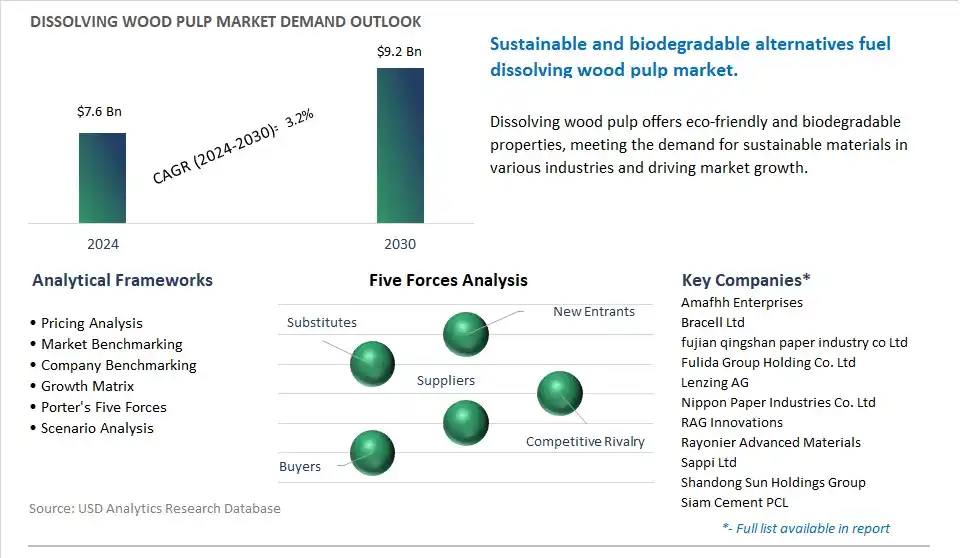
The global Dissolving Wood Pulp Market is poised to register a 3.2% CAGR from $7.6 Billion in 2024 to $9.2 Billion in 2030.
The global Dissolving Wood Pulp Market Study analyzes and forecasts the market size across 6 regions and 24 countries for diverse segments -By Type (Rayon Grade, Specialty Grade), By Raw Material (Hardwood, Softwood).
An Introduction to Global Dissolving Wood Pulp Market in 2024
The market for dissolving wood pulp (DWP) is experiencing growth, driven by its versatile applications in the production of viscose staple fiber, cellulose derivatives, and specialty papers used in textiles, pharmaceuticals, food, and personal care products. Key trends shaping the future of the industry include advancements in pulp processing technology, sustainable forestry practices, and product innovation to meet the evolving demands of end-users for high-quality, sustainable, and biodegradable cellulose products. Manufacturers of dissolving wood pulp are focusing on developing products with consistent quality, purity, and chemical composition to meet the stringent requirements of downstream processes such as viscose fiber spinning, cellulose acetate production, and specialty papermaking. Additionally, there is a growing emphasis on sustainability, environmental stewardship, and certification programs in DWP production, driven by regulatory mandates, consumer preferences, and corporate sustainability goals. Moreover, advancements in biorefinery processes, biomass utilization, and closed-loop manufacturing are driving innovation in DWP production, enabling the efficient use of wood resources, energy recovery, and waste minimization in pulp and paper mills. Furthermore, collaborations between DWP producers, textile manufacturers, and brand owners are shaping the development of sustainable supply chains, product labeling initiatives, and traceability systems that ensure the responsible sourcing and ethical production of dissolving wood pulp-based products. Overall, the future of dissolving wood pulp lies in continuous innovation, collaboration, and sustainability initiatives to address emerging market trends, regulatory requirements, and environmental concerns while providing versatile, renewable, and eco-friendly cellulose solutions for a wide range of applications in the global bioeconomy.
Dissolving Wood Pulp Market Competitive Landscape
The market report analyses the leading companies in the industry including Amafhh Enterprises, Bracell Ltd, fujian qingshan paper industry co Ltd, Fulida Group Holding Co. Ltd, Lenzing AG, Nippon Paper Industries Co. Ltd, RAG Innovations, Rayonier Advanced Materials, Sappi Ltd, Shandong Sun Holdings Group, Siam Cement PCL, Yueyang Forest and Paper Co. Ltd.
Dissolving Wood Pulp Market Dynamics
Dissolving Wood Pulp Market Trend: Growing Demand for Sustainable and Renewable Materials
A prominent trend in the Dissolving Wood Pulp market is the growing demand for sustainable and renewable materials. With increasing environmental awareness and concerns about the ecological impact of traditional manufacturing processes, there's a rising preference for products derived from renewable sources. Dissolving wood pulp, obtained from sustainably managed forests, is favored for its eco-friendly properties and biodegradability. This trend is driven by regulatory initiatives promoting sustainable forestry practices, as well as consumer preferences for products with minimal environmental footprint. As a result, industries such as textiles, pharmaceuticals, and food additives are increasingly turning to dissolving wood pulp as a sustainable alternative to synthetic materials, driving market growth.
Dissolving Wood Pulp Market Driver: Expansion of Textile and Nonwoven Industries
A significant driver in the Dissolving Wood Pulp market is the expansion of the textile and nonwoven industries. Dissolving wood pulp is a key raw material used in the production of viscose rayon, a versatile fiber widely used in textile and apparel manufacturing. With the growing global population and rising disposable incomes, there's an increasing demand for textiles and nonwoven products across various applications, including clothing, home furnishings, hygiene products, and medical supplies. The versatility, softness, and absorbency of viscose fibers make them highly desirable for producing a wide range of textile products. Furthermore, the emergence of sustainable fashion trends and the shift towards environmentally friendly textiles have further boosted the demand for dissolving wood pulp. As the textile and nonwoven industries continue to expand, the demand for dissolving wood pulp is expected to remain robust, driving market growth.
Dissolving Wood Pulp Market Opportunity: Innovation in Biodegradable Packaging Solutions
A promising opportunity within the Dissolving Wood Pulp market lies in innovation in biodegradable packaging solutions. With increasing regulations and consumer demand for sustainable packaging alternatives, there's a growing need for biodegradable materials that can replace conventional plastics in packaging applications. Dissolving wood pulp, with its renewable and biodegradable properties, presents an attractive opportunity for the development of eco-friendly packaging solutions. By leveraging the versatility of dissolving wood pulp fibers, manufacturers can create biodegradable packaging materials that offer comparable performance to traditional plastics while minimizing environmental impact. These innovative packaging solutions can cater to a wide range of industries, including food and beverage, cosmetics, and consumer goods, seeking to reduce their carbon footprint and meet sustainability goals. By investing in research and development to develop advanced packaging materials and collaborating with brands looking to enhance their environmental credentials, suppliers of dissolving wood pulp can capitalize on this growing market opportunity and drive industry innovation.
Dissolving Wood Pulp (DWP) Market Share Analysis: The Rayon Grade generated the highest revenue in 2024
The largest segment in the Dissolving Wood Pulp (DWP) Market is the Rayon Grade type category. Rayon grade DWP is widely used in the production of viscose staple fibers, which are essential raw materials for the textile and apparel industry. Rayon fibers derived from dissolving wood pulp exhibit properties such as softness, breathability, and absorbency, making them ideal for manufacturing a wide range of textile products, including clothing, home furnishings, and non-woven fabrics. Further, rayon fibers offer versatility in terms of dyeing, printing, and finishing processes, allowing for the creation of a variety of colors, patterns, and textures in finished textile products. Additionally, rayon fibers derived from dissolving wood pulp are biodegradable and renewable, aligning with sustainability initiatives and environmental regulations in the textile industry. Furthermore, the global demand for rayon fibers is driven by factors such as population growth, urbanization, and changing consumer preferences for comfortable and eco-friendly clothing materials. As a result of these factors, rayon grade DWP is the largest segment in the Dissolving Wood Pulp Market, due to its significant contribution to the textile and apparel value chain.
Dissolving Wood Pulp (DWP) Market Share Analysis: The Softwood raw material segment is poised to register the fastest growth rate (CAGR) over the forecast period to 2030
The fastest-growing segment in the Dissolving Wood Pulp (DWP) Market is the Softwood raw material category. Diverse factors contribute to the rapid growth of softwood-based dissolving wood pulp production. softwood fibers generally have longer and thicker cellulose fibers compared to hardwood fibers, resulting in higher pulp yield and superior pulp quality for dissolving wood pulp applications. Softwood-derived dissolving wood pulp is particularly prized for its strength, purity, and uniformity, making it suitable for demanding end-uses such as textile fibers, viscose staple fibers, and cellulose derivatives. Additionally, advancements in pulp processing technology and biorefinery processes have improved the efficiency and sustainability of softwood-based dissolving wood pulp production, leading to increased production capacity and cost competitiveness. Further, the availability of sustainably managed softwood plantations in regions such as Scandinavia, North America, and Chile ensures a reliable and renewable supply of raw materials for dissolving wood pulp production. Furthermore, growing consumer awareness and regulatory initiatives promoting sustainable sourcing and production practices drive the demand for softwood-derived dissolving wood pulp, as it aligns with environmental and social responsibility goals. As a result of these factors, the softwood segment is experiencing rapid growth in the Dissolving Wood Pulp Market, surpassing the growth rates of the hardwood segment.
Dissolving Wood Pulp Market Report Segmentation
By Type
Rayon Grade
Specialty Grade
By Raw Material
Hardwood
Softwood
Regions Included
North America (US, Canada, Mexico)
Europe (Germany, UK, France, Spain, Italy, Russia, Rest of Europe)
Asia Pacific (China, India, Japan, South Korea, Australia, South East Asia, Rest of Asia)
South America (Brazil, Argentina, Rest of South America)
Middle East and Africa (Saudi Arabia, UAE, Rest of Middle East, South Africa, Egypt, Rest of Africa)
Dissolving Wood Pulp Companies Profiled in the Market Study
Amafhh Enterprises
Bracell Ltd
fujian qingshan paper industry co Ltd
Fulida Group Holding Co. Ltd
Lenzing AG
Nippon Paper Industries Co. Ltd
RAG Innovations
Rayonier Advanced Materials
Sappi Ltd
Shandong Sun Holdings Group
Siam Cement PCL
Yueyang Forest and Paper Co. Ltd
*- List Not Exhaustive
TABLE OF CONTENTS
1 Introduction to 2024 Dissolving Wood Pulp Market
1.1 Market Overview
1.2 Quick Facts
1.3 Scope/Objective of the Study
1.4 Market Definition
1.5 Countries and Regions Covered
1.6 Units, Currency, and Conversions
1.7 Industry Value Chain
2 Research Methodology
2.1 Market Size Estimation
2.2 Sources and Research Methodology
2.3 Data Triangulation
2.4 Assumptions and Limitations
3 Executive Summary
3.1 Global Dissolving Wood Pulp Market Size Outlook, $ Million, 2021 to 2030
3.2 Dissolving Wood Pulp Market Outlook by Type, $ Million, 2021 to 2030
3.3 Dissolving Wood Pulp Market Outlook by Product, $ Million, 2021 to 2030
3.4 Dissolving Wood Pulp Market Outlook by Application, $ Million, 2021 to 2030
3.5 Dissolving Wood Pulp Market Outlook by Key Countries, $ Million, 2021 to 2030
4 Market Dynamics
4.1 Key Driving Forces of Dissolving Wood Pulp Industry
4.2 Key Market Trends in Dissolving Wood Pulp Industry
4.3 Potential Opportunities in Dissolving Wood Pulp Industry
4.4 Key Challenges in Dissolving Wood Pulp Industry
5 Market Factor Analysis
5.1 Value Chain Analysis
5.2 Competitive Landscape
5.2.1 Global Dissolving Wood Pulp Market Share by Company (%), 2023
5.2.2 Product Offerings by Company
5.3 Porter’s Five Forces Analysis
5.4 Pricing Analysis and Outlook
6 Growth Outlook Across Scenarios
6.1 Growth Analysis-Case Scenario Definitions
6.2 Low Growth Scenario Forecasts
6.3 Reference Growth Scenario Forecasts
6.4 High Growth Scenario Forecasts
7 Global Dissolving Wood Pulp Market Outlook by Segments
7.1 Dissolving Wood Pulp Market Outlook by Segments, $ Million, 2021- 2030
By Type
Rayon Grade
Specialty Grade
By Raw Material
Hardwood
Softwood
8 North America Dissolving Wood Pulp Market Analysis and Outlook To 2030
8.1 Introduction to North America Dissolving Wood Pulp Markets in 2024
8.2 North America Dissolving Wood Pulp Market Size Outlook by Country, 2021-2030
8.2.1 United States
8.2.2 Canada
8.2.3 Mexico
8.3 North America Dissolving Wood Pulp Market size Outlook by Segments, 2021-2030
By Type
Rayon Grade
Specialty Grade
By Raw Material
Hardwood
Softwood
9 Europe Dissolving Wood Pulp Market Analysis and Outlook To 2030
9.1 Introduction to Europe Dissolving Wood Pulp Markets in 2024
9.2 Europe Dissolving Wood Pulp Market Size Outlook by Country, 2021-2030
9.2.1 Germany
9.2.2 France
9.2.3 Spain
9.2.4 United Kingdom
9.2.4 Italy
9.2.5 Russia
9.2.6 Norway
9.2.7 Rest of Europe
9.3 Europe Dissolving Wood Pulp Market Size Outlook by Segments, 2021-2030
By Type
Rayon Grade
Specialty Grade
By Raw Material
Hardwood
Softwood
10 Asia Pacific Dissolving Wood Pulp Market Analysis and Outlook To 2030
10.1 Introduction to Asia Pacific Dissolving Wood Pulp Markets in 2024
10.2 Asia Pacific Dissolving Wood Pulp Market Size Outlook by Country, 2021-2030
10.2.1 China
10.2.2 India
10.2.3 Japan
10.2.4 South Korea
10.2.5 Indonesia
10.2.6 Malaysia
10.2.7 Australia
10.2.8 Rest of Asia Pacific
10.3 Asia Pacific Dissolving Wood Pulp Market size Outlook by Segments, 2021-2030
By Type
Rayon Grade
Specialty Grade
By Raw Material
Hardwood
Softwood
11 South America Dissolving Wood Pulp Market Analysis and Outlook To 2030
11.1 Introduction to South America Dissolving Wood Pulp Markets in 2024
11.2 South America Dissolving Wood Pulp Market Size Outlook by Country, 2021-2030
11.2.1 Brazil
11.2.2 Argentina
11.2.3 Rest of South America
11.3 South America Dissolving Wood Pulp Market size Outlook by Segments, 2021-2030
By Type
Rayon Grade
Specialty Grade
By Raw Material
Hardwood
Softwood
12 Middle East and Africa Dissolving Wood Pulp Market Analysis and Outlook To 2030
12.1 Introduction to Middle East and Africa Dissolving Wood Pulp Markets in 2024
12.2 Middle East and Africa Dissolving Wood Pulp Market Size Outlook by Country, 2021-2030
12.2.1 Saudi Arabia
12.2.2 UAE
12.2.3 Oman
12.2.4 Rest of Middle East
12.2.5 Egypt
12.2.6 Nigeria
12.2.7 South Africa
12.2.8 Rest of Africa
12.3 Middle East and Africa Dissolving Wood Pulp Market size Outlook by Segments, 2021-2030
By Type
Rayon Grade
Specialty Grade
By Raw Material
Hardwood
Softwood
13 Company Profiles
13.1 Company Snapshot
13.2 SWOT Profiles
13.3 Products and Services
13.4 Recent Developments
13.5 Financial Profile
Amafhh Enterprises
Bracell Ltd
fujian qingshan paper industry co Ltd
Fulida Group Holding Co. Ltd
Lenzing AG
Nippon Paper Industries Co. Ltd
RAG Innovations
Rayonier Advanced Materials
Sappi Ltd
Shandong Sun Holdings Group
Siam Cement PCL
Yueyang Forest and Paper Co. Ltd
14 Appendix
14.1 Customization Offerings
14.2 Subscription Services
14.3 Related Reports
14.4 Publisher Expertise
By Type
Rayon Grade
Specialty Grade
By Raw Material
Hardwood
Softwood
Countries Analyzed
North America (US, Canada, Mexico)
Europe (Germany, UK, France, Spain, Italy, Russia, Rest of Europe)
Asia Pacific (China, India, Japan, South Korea, Australia, South East Asia, Rest of Asia)
South America (Brazil, Argentina, Rest of South America)
Middle East and Africa (Saudi Arabia, UAE, Rest of Middle East, South Africa, Egypt, Rest of Africa)
