
The global Esophageal Stents Market Study analyzes and forecasts the market size across 6 regions and 24 countries for diverse segments including By Product (Self-Expandable Metallic Stent, Self-Expanding Plastic Stent), By End-User (Hospitals, Clinics, Ambulatory Surgical Centers).
The Esophageal Stents Market comprises medical devices used for the management and palliative treatment of esophageal strictures, obstructions, and leaks caused by conditions such as esophageal cancer, benign strictures, and postsurgical complications. Esophageal stents provide luminal support, relieve dysphagia, and maintain patency in the esophagus, facilitating swallowing and oral intake in patients with obstructive lesions. With a focus on self-expandable, biodegradable, and covered stent designs, the esophageal stents market offers minimally invasive solutions for gastrointestinal interventions, endoscopic procedures, and supportive care in esophageal disorders.
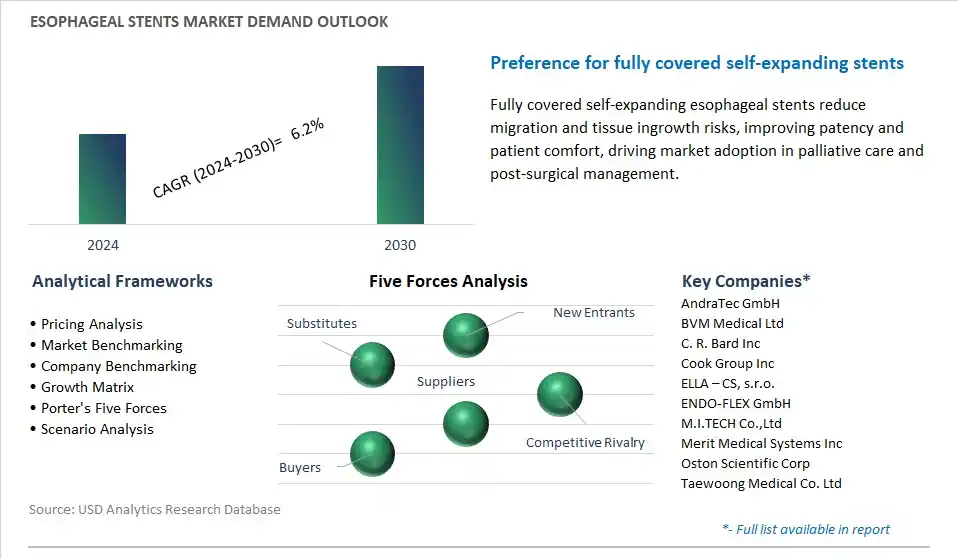
The global Esophageal Stents Industry is highly competitive with a large number of companies focusing on niche market segments. Amidst intense competitive conditions, Esophageal Stents Companies are investing in new product launches and strengthening distribution channels. Key companies operating in the Esophageal Stents Industry include- AndraTec GmbH, BVM Medical Ltd, C. R. Bard Inc, Cook Group Inc, ELLA – CS, s.r.o., ENDO-FLEX GmbH, M.I.TECH Co.,Ltd, Merit Medical Systems Inc, Oston Scientific Corp, Taewoong Medical Co. Ltd.
A prominent trend in the Esophageal Stents market is the adoption of minimally invasive procedures and advancements in stent technology for the management of esophageal strictures and tumors. Esophageal stents are commonly used to alleviate dysphagia and improve quality of life in patients with malignant or benign strictures, as well as to prevent complications such as perforation or bleeding in patients undergoing endoscopic resection or ablation therapy for esophageal tumors. Recent advancements in stent design, materials, and deployment techniques have led to the development of self-expandable metal stents (SEMS) and biodegradable stents that offer improved conformability, patency, and safety profiles compared to traditional plastic stents. Additionally, minimally invasive endoscopic procedures such as endoscopic ultrasound-guided stent placement and stent-in-stent techniques allow for precise positioning and deployment of esophageal stents with reduced risk of complications and shorter recovery times. This trend reflects the growing preference for minimally invasive treatment options and the continuous evolution of stent technology to meet the diverse clinical needs of patients with esophageal disorders.
The primary driver for the Esophageal Stents market is the increasing incidence of esophageal diseases and cancers worldwide. Esophageal strictures, tumors, and other benign or malignant lesions can cause significant morbidity and mortality, leading to dysphagia, malnutrition, and impaired quality of life in affected individuals. Esophageal cancer, in particular, remains a major global health concern, with high mortality rates and limited treatment options, especially in advanced stages of the disease. As the incidence of esophageal diseases and cancers continues to rise due to factors such as aging populations, changing dietary habits, and increasing prevalence of risk factors such as gastroesophageal reflux disease (GERD) and obesity, there is a corresponding increase in the demand for interventional therapies such as esophageal stent placement to alleviate symptoms, improve nutritional status, and prolong survival. This drives the growth of the Esophageal Stents market as healthcare providers seek effective and minimally invasive solutions for managing esophageal disorders and improving patient outcomes.
An opportunity exists in the expansion into emerging markets and the development of patient-tailored solutions for esophageal stent placement. While esophageal stents are widely used in Western countries for the management of esophageal strictures and tumors, there is potential for market growth in developing regions with rising incidences of esophageal diseases and cancers. Companies can capitalize on this opportunity by partnering with local healthcare providers, government agencies, and non-profit organizations to raise awareness about esophageal disorders, train medical professionals in endoscopic techniques, and improve access to advanced interventional therapies such as esophageal stent placement. Additionally, there is potential for innovation in stent design and customization to address the anatomical variations and clinical challenges encountered in esophageal stenting procedures. By offering patient-tailored solutions that accommodate individual patient needs, anatomical considerations, and disease characteristics, companies can enhance the efficacy, safety, and long-term outcomes of esophageal stent placement and expand their market presence in both established and emerging markets.
Among the various types of esophageal stents, the self-expandable metallic stent (SEMS) for hospitals emerges as the fastest-growing segment. This growth is driven by several factors, including the rising incidence of esophageal disorders such as strictures, tumors, and perforations, the increasing preference for minimally invasive treatment options, and the superior performance and durability of metallic stents compared to plastic alternatives. Self-expandable metallic stents are made of materials such as nitinol or stainless steel and can be deployed with precision to provide immediate relief of dysphagia and other symptoms associated with esophageal obstruction. Furthermore, SEMS offer advantages such as greater radial force, better resistance to migration, and longer patency compared to plastic stents, making them the preferred choice for many clinicians and patients. As hospitals continue to invest in advanced endoscopic procedures and interventional techniques, the demand for self-expandable metallic stents for esophageal interventions is experiencing rapid growth. Additionally, the expanding application of SEMS in the management of complex esophageal conditions further contributes to its increasing adoption in hospital settings, driving innovation and market expansion in this segment.
By Product
Self-Expandable Metallic Stent
Self-Expanding Plastic Stent
By End-User
Hospitals
Clinics
Ambulatory Surgical Centers
Geographical Analysis
North America (United States, Canada, Mexico)
Europe (Germany, France, United Kingdom, Spain, Italy, Rest of Europe)
Asia Pacific (China, India, Japan, South Korea, Rest of Asia Pacific)
South America (Brazil, Argentina, Rest of South America)
Middle East and Africa (Saudi Arabia, UAE, Rest of Middle East, South Africa, Egypt, Rest of Africa)
AndraTec GmbH
BVM Medical Ltd
C. R. Bard Inc
Cook Group Inc
ELLA – CS, s.r.o.
ENDO-FLEX GmbH
M.I.TECH Co.,Ltd
Merit Medical Systems Inc
Oston Scientific Corp
Taewoong Medical Co. Ltd
* List not Exhaustive
• Deepen your industry insights and navigate uncertainties for strategy formulation, CAPEX, and Operational decisions
• Gain access to detailed insights on the Esophageal Stents Market, encompassing current market size, growth trends, and forecasts till 2030.
• Access detailed competitor analysis, enabling competitive advantage through a thorough understanding of market players, strategies, and potential differentiation opportunities
• Stay ahead of the curve with insights on technological advancements, innovations, and upcoming trends
• Identify lucrative investment avenues and expansion opportunities within the Esophageal Stents Industry, guided by robust, data-backed analysis.
• Understand regional and global markets through country-wise analysis, regional market potential, regulatory nuances, and dynamics
• Execute strategies with confidence and speed through information, analytics, and insights on the industry value chain
• Corporate leaders, strategists, financial experts, shareholders, asset managers, and governmental representatives can make long-term planning scenarios and build an integrated and timely understanding of market dynamics
• Benefit from tailored solutions and expert consultation based on report insights, providing personalized strategies aligned with specific business needs.
TABLE OF CONTENTS
1 Introduction to 2024 Esophageal Stents Market
1.1 Market Overview
1.2 Quick Facts
1.3 Scope/Objective of the Study
1.4 Market Definition
1.5 Countries and Regions Analyzed
1.6 Units, Currency, and Conversions
1.7 Industry Value Chain
2 Research Methodology
2.1 Market Size Estimation
2.2 Sources and Research Methodology
2.3 Data Triangulation
2.4 Assumptions and Limitations
3 Executive Summary
3.1 Global Esophageal Stents Market Size Outlook, $ Million, 2021 to 2030
3.2 Esophageal Stents Market Outlook by Type, $ Million, 2021 to 2030
3.3 Esophageal Stents Market Outlook by Product, $ Million, 2021 to 2030
3.4 Esophageal Stents Market Outlook by Application, $ Million, 2021 to 2030
3.5 Esophageal Stents Market Outlook by Key Countries, $ Million, 2021 to 2030
4 Market Dynamics
4.1 Key Driving Forces of Esophageal Stents Industry
4.2 Key Market Trends in Esophageal Stents Industry
4.3 Potential Opportunities in Esophageal Stents Industry
4.4 Key Challenges in Esophageal Stents Industry
5 Market Factor Analysis
5.1 Value Chain Analysis
5.2 Competitive Landscape
5.2.1 Global Esophageal Stents Market Share by Company (%), 2023
5.2.2 Product Offerings by Company
5.3 Porter’s Five Forces Analysis
5.4 Pricing Analysis and Outlook
6 Growth Outlook Across Scenarios
6.1 Growth Analysis-Case Scenario Definitions
6.2 Low Growth Scenario Forecasts
6.3 Reference Growth Scenario Forecasts
6.4 High Growth Scenario Forecasts
7 Global Esophageal Stents Market Outlook by Segments
7.1 Esophageal Stents Market Outlook by Segments, $ Million, 2021- 2030
By Product
Self-Expandable Metallic Stent
Self-Expanding Plastic Stent
By End-User
Hospitals
Clinics
Ambulatory Surgical Centers
8 North America Esophageal Stents Market Analysis and Outlook To 2030
8.1 Introduction to North America Esophageal Stents Markets in 2024
8.2 North America Esophageal Stents Market Size Outlook by Country, 2021-2030
8.2.1 United States
8.2.2 Canada
8.2.3 Mexico
8.3 North America Esophageal Stents Market size Outlook by Segments, 2021-2030
By Product
Self-Expandable Metallic Stent
Self-Expanding Plastic Stent
By End-User
Hospitals
Clinics
Ambulatory Surgical Centers
9 Europe Esophageal Stents Market Analysis and Outlook To 2030
9.1 Introduction to Europe Esophageal Stents Markets in 2024
9.2 Europe Esophageal Stents Market Size Outlook by Country, 2021-2030
9.2.1 Germany
9.2.2 France
9.2.3 Spain
9.2.4 United Kingdom
9.2.4 Italy
9.2.5 Russia
9.2.6 Norway
9.2.7 Rest of Europe
9.3 Europe Esophageal Stents Market Size Outlook by Segments, 2021-2030
By Product
Self-Expandable Metallic Stent
Self-Expanding Plastic Stent
By End-User
Hospitals
Clinics
Ambulatory Surgical Centers
10 Asia Pacific Esophageal Stents Market Analysis and Outlook To 2030
10.1 Introduction to Asia Pacific Esophageal Stents Markets in 2024
10.2 Asia Pacific Esophageal Stents Market Size Outlook by Country, 2021-2030
10.2.1 China
10.2.2 India
10.2.3 Japan
10.2.4 South Korea
10.2.5 Indonesia
10.2.6 Malaysia
10.2.7 Australia
10.2.8 Rest of Asia Pacific
10.3 Asia Pacific Esophageal Stents Market size Outlook by Segments, 2021-2030
By Product
Self-Expandable Metallic Stent
Self-Expanding Plastic Stent
By End-User
Hospitals
Clinics
Ambulatory Surgical Centers
11 South America Esophageal Stents Market Analysis and Outlook To 2030
11.1 Introduction to South America Esophageal Stents Markets in 2024
11.2 South America Esophageal Stents Market Size Outlook by Country, 2021-2030
11.2.1 Brazil
11.2.2 Argentina
11.2.3 Rest of South America
11.3 South America Esophageal Stents Market size Outlook by Segments, 2021-2030
By Product
Self-Expandable Metallic Stent
Self-Expanding Plastic Stent
By End-User
Hospitals
Clinics
Ambulatory Surgical Centers
12 Middle East and Africa Esophageal Stents Market Analysis and Outlook To 2030
12.1 Introduction to Middle East and Africa Esophageal Stents Markets in 2024
12.2 Middle East and Africa Esophageal Stents Market Size Outlook by Country, 2021-2030
12.2.1 Saudi Arabia
12.2.2 UAE
12.2.3 Oman
12.2.4 Rest of Middle East
12.2.5 Egypt
12.2.6 Nigeria
12.2.7 South Africa
12.2.8 Rest of Africa
12.3 Middle East and Africa Esophageal Stents Market size Outlook by Segments, 2021-2030
By Product
Self-Expandable Metallic Stent
Self-Expanding Plastic Stent
By End-User
Hospitals
Clinics
Ambulatory Surgical Centers
13 Company Profiles
13.1 Company Snapshot
13.2 SWOT Profiles
13.3 Products and Services
13.4 Recent Developments
13.5 Financial Profile
List of Companies
AndraTec GmbH
BVM Medical Ltd
C. R. Bard Inc
Cook Group Inc
ELLA – CS, s.r.o.
ENDO-FLEX GmbH
M.I.TECH Co.,Ltd
Merit Medical Systems Inc
Oston Scientific Corp
Taewoong Medical Co. Ltd
14 Appendix
14.1 Customization Offerings
14.2 Subscription Services
14.3 Related Reports
14.4 Publisher Expertise
By Product
Self-Expandable Metallic Stent
Self-Expanding Plastic Stent
By End-User
Hospitals
Clinics
Ambulatory Surgical Centers
The global Esophageal Stents Market is one of the lucrative growth markets, poised to register a 6.2% growth (CAGR) between 2024 and 2030.
Emerging Markets across Asia Pacific, Europe, and Americas present robust growth prospects.
AndraTec GmbH, BVM Medical Ltd, C. R. Bard Inc, Cook Group Inc, ELLA – CS, s.r.o., ENDO-FLEX GmbH, M.I.TECH Co.,Ltd, Merit Medical Systems Inc, Oston Scientific Corp, Taewoong Medical Co. Ltd
Base Year- 2023; Estimated Year- 2024; Historic Period- 2018-2023; Forecast period- 2024 to 2030; Currency: USD; Volume