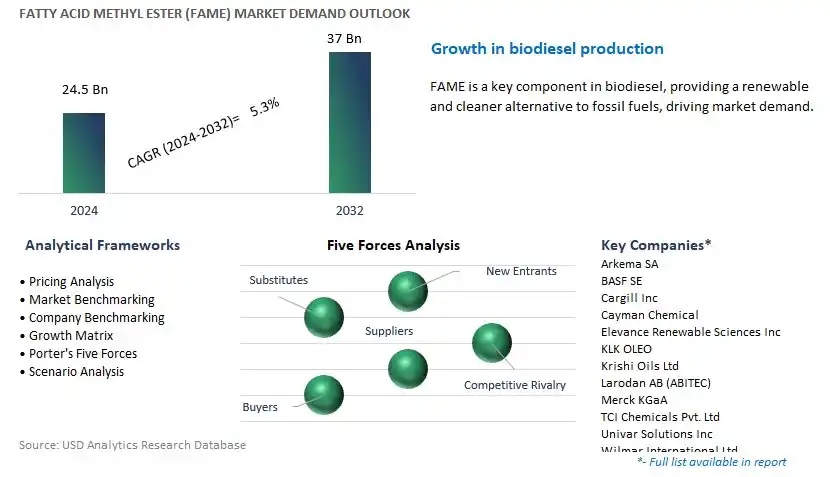
Global Fatty Acid Methyl Ester (FAME) Market Size is valued at $24.5 Billion in 2024 and is forecast to register a growth rate (CAGR) of 5.3% to reach $37 Billion by 2032.
The global Fatty Acid Methyl Ester (FAME) Market Study analyzes and forecasts the market size across 6 regions and 24 countries for diverse segments -By Type (Rapeseed methyl ester, Soy methyl ester, Palm oil methyl ester, Others), By Application (Fuels, Lubricants, Coatings, Metal Working Fluids, Food & Agriculture, Others).
An Introduction to Fatty Acid Methyl Ester (FAME) Market in 2024
Fatty Acid Methyl Esters (FAMEs) represent a key class of biodiesel derived from renewable feedstocks such as vegetable oils and animal fats. In 2024, the FAMEs market is witnessing steady growth propelled by the global transition towards sustainable energy sources and reduced greenhouse gas emissions. FAMEs serve as environmentally friendly alternatives to conventional diesel fuel, offering comparable performance while significantly reducing carbon footprint. With supportive regulatory frameworks and incentives promoting biofuel adoption, the demand for FAMEs is expected to surge across transportation, industrial, and agricultural sectors. Further, ongoing research and development efforts aimed at improving FAME production efficiency and feedstock utilization are poised to further bolster market expansion in the coming years.
Fatty Acid Methyl Ester (FAME) Market Competitive Landscape
The market report analyses the leading companies in the industry including Arkema SA, BASF SE, Cargill Inc, Cayman Chemical, Elevance Renewable Sciences Inc, KLK OLEO, Krishi Oils Ltd, Larodan AB (ABITEC), Merck KGaA, TCI Chemicals Pvt. Ltd, Univar Solutions Inc, Wilmar International Ltd, and others.
Fatty Acid Methyl Ester (FAME) Market Dynamics
Market Trend: Shift Towards Sustainable and Renewable Fuel Sources
A prominent trend in the fatty acid methyl ester (FAME) market is the increasing adoption of FAME as a sustainable and renewable fuel source. FAME, derived from vegetable oils or animal fats through a transesterification process, serves as a key component in biodiesel production. With growing concerns over climate change, air pollution, and dependence on fossil fuels, there is a rising demand for alternative fuels that offer lower greenhouse gas emissions and reduced environmental impact. FAME, as a biofuel, aligns with sustainability objectives and regulatory mandates aimed at promoting renewable energy sources and reducing carbon emissions in transportation and industrial sectors. This trend reflects the industry's response to the global imperative for transitioning towards cleaner and more sustainable energy solutions.
Market Driver: Government Policies and Renewable Energy Initiatives
A key driver fueling the demand for fatty acid methyl ester is the implementation of government policies and renewable energy initiatives aimed at promoting biodiesel production and consumption. Governments worldwide are incentivizing the use of biofuels through mandates, tax incentives, and subsidies to reduce reliance on fossil fuels, enhance energy security, and mitigate climate change. Renewable energy targets, emission reduction goals, and carbon pricing mechanisms drive investments in biofuel infrastructure and stimulate market growth for fatty acid methyl ester. Additionally, regulatory frameworks such as renewable fuel standards (RFS) and renewable energy directives (RED) create market certainty and encourage the adoption of biofuels like FAME, driving market expansion and investment in biodiesel production capacity.
Market Opportunity: Expansion into Non-Fuel Applications and Specialty Markets
Amidst the evolving landscape of the fatty acid methyl ester market, there exists a significant opportunity for expansion into non-fuel applications and specialty markets. Manufacturers can capitalize on this opportunity by exploring alternative uses for FAME in sectors such as lubricants, surfactants, solvents, and plasticizers. FAME's chemical properties, biodegradability, and low toxicity make it suitable for various industrial applications beyond biodiesel production. Additionally, targeting niche markets such as personal care products, pharmaceuticals, and food additives presents opportunities for diversification and value creation in the FAME market. By leveraging FAME's versatility and compatibility with diverse applications, companies can unlock new revenue streams and broaden their market presence beyond traditional fuel markets.
Fatty Acid Methyl Ester (FAME) Market Share Analysis: Palm Oil Methyl Ester (PME) segment generated the highest revenue in 2024
The Palm Oil Methyl Ester (PME) segment stands out as the largest segment in the Fatty Acid Methyl Ester (FAME) market. PME, derived from palm oil, holds a significant share of the FAME market due to the abundance and cost-effectiveness of palm oil as a feedstock for biodiesel production. Palm oil is one of the most widely produced and traded vegetable oils globally, with large-scale cultivation in regions such as Southeast Asia and Africa. Its versatility as a biodiesel feedstock, coupled with favorable characteristics such as high energy content and low emissions, makes PME a preferred choice for blending with diesel fuel to reduce greenhouse gas emissions and enhance fuel sustainability. Moreover, government policies and regulations promoting renewable energy sources and biofuel mandates further stimulate the demand for PME as a key component in biodiesel formulations. Additionally, the versatility of palm oil methyl ester extends beyond transportation fuels to various industrial applications such as lubricants, surfactants, and solvents, contributing to its market dominance. However, environmental and social concerns surrounding palm oil production, including deforestation, biodiversity loss, and labor rights issues, pose challenges to the sustainable growth of the PME market, necessitating efforts towards responsible sourcing and sustainable practices in the palm oil industry. Over the forecast period, the Palm Oil Methyl Ester segment holds a prominent position in the FAME market, driven by its widespread availability, cost competitiveness, and diverse applications in the biofuels and industrial sectors.
Fatty Acid Methyl Ester (FAME) Market Share Analysis: Fuels is poised to register the fastest CAGR over the forecast period
The Fuels segment is the fastest-growing segment in the Fatty Acid Methyl Ester (FAME) market. FAME, particularly derived from vegetable oils like rapeseed, soy, and palm, serves as a vital component in the production of biodiesel fuels. The global push towards reducing greenhouse gas emissions and mitigating climate change has led to increased adoption of renewable energy sources, including biodiesel, as a sustainable alternative to conventional fossil fuels. Government mandates, environmental regulations, and incentives promoting biofuel blending into diesel fuel further accelerate the demand for FAME in the transportation sector. Additionally, the growing emphasis on energy security, coupled with volatility in crude oil prices, drives the shift towards domestically produced and renewable fuels, driving the expansion of the FAME market. Moreover, the versatility of FAME extends beyond transportation fuels to other applications such as lubricants, coatings, and metalworking fluids, contributing to its overall growth. However, challenges related to feedstock availability, sustainability concerns, and competition with alternative biofuels pose potential hurdles to the sustained growth of the FAME market in the fuels segment. Nonetheless, the Fuels segment presents significant growth opportunities driven by the increasing demand for renewable and environmentally friendly fuel solutions in the global energy landscape.
Fatty Acid Methyl Ester (FAME) Market
By Type
Rapeseed methyl ester
Soy methyl ester
Palm oil methyl ester
Others
By Application
Fuels
Lubricants
Coatings
Metal Working Fluids
Food & Agriculture
Others
Countries Analyzed
North America (US, Canada, Mexico)
Europe (Germany, UK, France, Spain, Italy, Russia, Rest of Europe)
Asia Pacific (China, India, Japan, South Korea, Australia, South East Asia, Rest of Asia)
South America (Brazil, Argentina, Rest of South America)
Middle East and Africa (Saudi Arabia, UAE, Rest of Middle East, South Africa, Egypt, Rest of Africa)
Fatty Acid Methyl Ester Companies Profiled in the Study
Arkema SA
BASF SE
Cargill Inc
Cayman Chemical
Elevance Renewable Sciences Inc
KLK OLEO
Krishi Oils Ltd
Larodan AB (ABITEC)
Merck KGaA
TCI Chemicals Pvt. Ltd
Univar Solutions Inc
Wilmar International Ltd
*- List Not Exhaustive
TABLE OF CONTENTS
1 Introduction to 2024 Fatty Acid Methyl Ester Market
1.1 Market Overview
1.2 Quick Facts
1.3 Scope/Objective of the Study
1.4 Market Definition
1.5 Countries and Regions Covered
1.6 Units, Currency, and Conversions
1.7 Industry Value Chain
2 Research Methodology
2.1 Market Size Estimation
2.2 Sources and Research Methodology
2.3 Data Triangulation
2.4 Assumptions and Limitations
3 Executive Summary
3.1 Global Fatty Acid Methyl Ester Market Size Outlook, $ Million, 2021 to 2032
3.2 Fatty Acid Methyl Ester Market Outlook by Type, $ Million, 2021 to 2032
3.3 Fatty Acid Methyl Ester Market Outlook by Product, $ Million, 2021 to 2032
3.4 Fatty Acid Methyl Ester Market Outlook by Application, $ Million, 2021 to 2032
3.5 Fatty Acid Methyl Ester Market Outlook by Key Countries, $ Million, 2021 to 2032
4 Market Dynamics
4.1 Key Driving Forces of Fatty Acid Methyl Ester Industry
4.2 Key Market Trends in Fatty Acid Methyl Ester Industry
4.3 Potential Opportunities in Fatty Acid Methyl Ester Industry
4.4 Key Challenges in Fatty Acid Methyl Ester Industry
5 Market Factor Analysis
5.1 Value Chain Analysis
5.2 Competitive Landscape
5.2.1 Global Fatty Acid Methyl Ester Market Share by Company (%), 2023
5.2.2 Product Offerings by Company
5.3 Porter’s Five Forces Analysis
5.4 Pricing Analysis and Outlook
6 Growth Outlook Across Scenarios
6.1 Growth Analysis-Case Scenario Definitions
6.2 Low Growth Scenario Forecasts
6.3 Reference Growth Scenario Forecasts
6.4 High Growth Scenario Forecasts
7 Global Fatty Acid Methyl Ester Market Outlook by Segments
7.1 Fatty Acid Methyl Ester Market Outlook by Segments, $ Million, 2021- 2032
By Type
Rapeseed methyl ester
Soy methyl ester
Palm oil methyl ester
Others
By Application
Fuels
Lubricants
Coatings
Metal Working Fluids
Food & Agriculture
Others
8 North America Fatty Acid Methyl Ester Market Analysis and Outlook To 2032
8.1 Introduction to North America Fatty Acid Methyl Ester Markets in 2024
8.2 North America Fatty Acid Methyl Ester Market Size Outlook by Country, 2021-2032
8.2.1 United States
8.2.2 Canada
8.2.3 Mexico
8.3 North America Fatty Acid Methyl Ester Market size Outlook by Segments, 2021-2032
By Type
Rapeseed methyl ester
Soy methyl ester
Palm oil methyl ester
Others
By Application
Fuels
Lubricants
Coatings
Metal Working Fluids
Food & Agriculture
Others
9 Europe Fatty Acid Methyl Ester Market Analysis and Outlook To 2032
9.1 Introduction to Europe Fatty Acid Methyl Ester Markets in 2024
9.2 Europe Fatty Acid Methyl Ester Market Size Outlook by Country, 2021-2032
9.2.1 Germany
9.2.2 France
9.2.3 Spain
9.2.4 United Kingdom
9.2.4 Italy
9.2.5 Russia
9.2.6 Norway
9.2.7 Rest of Europe
9.3 Europe Fatty Acid Methyl Ester Market Size Outlook by Segments, 2021-2032
By Type
Rapeseed methyl ester
Soy methyl ester
Palm oil methyl ester
Others
By Application
Fuels
Lubricants
Coatings
Metal Working Fluids
Food & Agriculture
Others
10 Asia Pacific Fatty Acid Methyl Ester Market Analysis and Outlook To 2032
10.1 Introduction to Asia Pacific Fatty Acid Methyl Ester Markets in 2024
10.2 Asia Pacific Fatty Acid Methyl Ester Market Size Outlook by Country, 2021-2032
10.2.1 China
10.2.2 India
10.2.3 Japan
10.2.4 South Korea
10.2.5 Indonesia
10.2.6 Malaysia
10.2.7 Australia
10.2.8 Rest of Asia Pacific
10.3 Asia Pacific Fatty Acid Methyl Ester Market size Outlook by Segments, 2021-2032
By Type
Rapeseed methyl ester
Soy methyl ester
Palm oil methyl ester
Others
By Application
Fuels
Lubricants
Coatings
Metal Working Fluids
Food & Agriculture
Others
11 South America Fatty Acid Methyl Ester Market Analysis and Outlook To 2032
11.1 Introduction to South America Fatty Acid Methyl Ester Markets in 2024
11.2 South America Fatty Acid Methyl Ester Market Size Outlook by Country, 2021-2032
11.2.1 Brazil
11.2.2 Argentina
11.2.3 Rest of South America
11.3 South America Fatty Acid Methyl Ester Market size Outlook by Segments, 2021-2032
By Type
Rapeseed methyl ester
Soy methyl ester
Palm oil methyl ester
Others
By Application
Fuels
Lubricants
Coatings
Metal Working Fluids
Food & Agriculture
Others
12 Middle East and Africa Fatty Acid Methyl Ester Market Analysis and Outlook To 2032
12.1 Introduction to Middle East and Africa Fatty Acid Methyl Ester Markets in 2024
12.2 Middle East and Africa Fatty Acid Methyl Ester Market Size Outlook by Country, 2021-2032
12.2.1 Saudi Arabia
12.2.2 UAE
12.2.3 Oman
12.2.4 Rest of Middle East
12.2.5 Egypt
12.2.6 Nigeria
12.2.7 South Africa
12.2.8 Rest of Africa
12.3 Middle East and Africa Fatty Acid Methyl Ester Market size Outlook by Segments, 2021-2032
By Type
Rapeseed methyl ester
Soy methyl ester
Palm oil methyl ester
Others
By Application
Fuels
Lubricants
Coatings
Metal Working Fluids
Food & Agriculture
Others
13 Company Profiles
13.1 Company Snapshot
13.2 SWOT Profiles
13.3 Products and Services
13.4 Recent Developments
13.5 Financial Profile
Arkema SA
BASF SE
Cargill Inc
Cayman Chemical
Elevance Renewable Sciences Inc
KLK OLEO
Krishi Oils Ltd
Larodan AB (ABITEC)
Merck KGaA
TCI Chemicals Pvt. Ltd
Univar Solutions Inc
Wilmar International Ltd
14 Appendix
14.1 Customization Offerings
14.2 Subscription Services
14.3 Related Reports
14.4 Publisher Expertise
By Type
Rapeseed methyl ester
Soy methyl ester
Palm oil methyl ester
Others
By Application
Fuels
Lubricants
Coatings
Metal Working Fluids
Food & Agriculture
Others
Countries Analyzed
North America (US, Canada, Mexico)
Europe (Germany, UK, France, Spain, Italy, Russia, Rest of Europe)
Asia Pacific (China, India, Japan, South Korea, Australia, South East Asia, Rest of Asia)
South America (Brazil, Argentina, Rest of South America)
Middle East and Africa (Saudi Arabia, UAE, Rest of Middle East, South Africa, Egypt, Rest of Africa)
