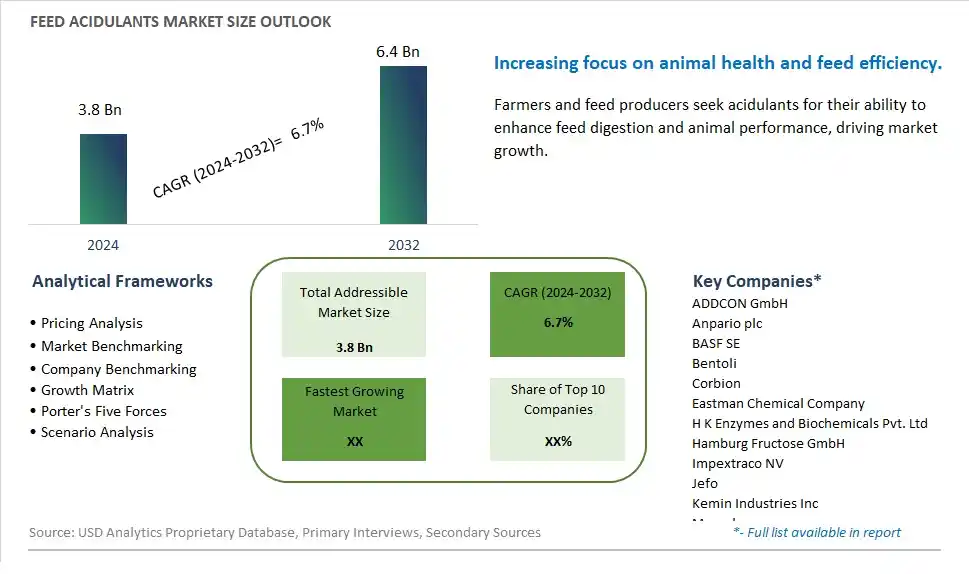
Global Feed Acidulants Market Size is valued at $3.8 Billion in 2024 and is forecast to register a growth rate (CAGR) of 6.7% to reach $6.4 Billion by 2032.
The global Feed Acidulants Market Comprehensive Study analyzes and forecasts the market size across 6 regions and 24 countries for diverse segments -By Type (Propionic acid, Formic acid, Citric acid, Lactic acid, Sorbic acid, Malic acid, Acetic acid, Others), By Compound (Blended Compound, Single Compound), By Form (Dry, Liquid), By Function (pH Control, Feed efficiency, Flavor), By Animal (Poultry, Swine, Ruminants, Pets, Aquaculture, Equine)
An Introduction to Feed Acidulants Market
The feed acidulants market is experiencing robust growth in 2024, driven by the increasing focus on animal health, performance optimization, and feed quality enhancement in the livestock and poultry industry. Feed acidulants, comprising organic acids, salts, and acidifying agents, play a crucial role in improving nutrient utilization, maintaining gut health, and mitigating the risk of microbial contamination in animal feed. With the growing demand for sustainable and cost-effective feed additives, feed acidulants are gaining traction as an effective alternative to antibiotics and growth promoters, aligning with evolving regulatory trends and consumer preferences for antibiotic-free meat products. Moreover, the aquaculture and pet food sectors are adopting feed acidulants to enhance digestibility, immune function, and overall well-being in aquatic species and companion animals, further driving market growth. As the livestock industry continues to evolve, manufacturers are focusing on product innovation, strategic partnerships, and expansion strategies to capitalize on emerging market opportunities and meet the evolving demands of animal producers worldwide.
Feed Acidulants Competitive Landscape
The market report analyses the leading companies in the industry including ADDCON GmbH, Anpario plc, BASF SE, Bentoli, Corbion, Eastman Chemical Company, H K Enzymes and Biochemicals Pvt. Ltd, Hamburg Fructose GmbH, Impextraco NV, Jefo, Kemin Industries Inc, Mosselman, Novus International, Nutrex NV, Oxiris Chemicals S.A., Pancosma, Perstorp, Peterlabs Holdings Berhad, Prakash Chemicals Agencies Private Ltd, Prathista Industries Ltd, Royal DSM N.V., Titan Biotech, Trouw Nutrition, Vizag Chemicals International, Yara, and Others.
Feed Acidulants Market Dynamics
Feed Acidulants Market Trend: Shift Towards Natural and Sustainable Feed Additives
One prominent trend in the feed acidulants market is the shift towards natural and sustainable feed additives. As consumers and regulatory bodies increasingly prioritize sustainability and animal welfare in livestock production, there's a growing demand for feed additives derived from natural sources. Acidulants, such as organic acids and their salts, are gaining popularity as alternatives to synthetic additives due to their efficacy in improving feed hygiene, digestion, and nutrient utilization without compromising animal health or environmental sustainability. This trend is driving the adoption of natural feed acidulants in animal nutrition as producers seek solutions that align with evolving consumer preferences and regulatory standards.
Market Driver: Focus on Livestock Health and Performance Optimization
A key driver in the feed acidulants market is the focus on livestock health and performance optimization. With growing concerns about antibiotic resistance and the need for sustainable livestock production, there's an increased emphasis on improving animal health and performance through nutrition-based approaches. Feed acidulants play a crucial role in promoting gastrointestinal health, reducing pathogen colonization, and enhancing nutrient absorption in livestock, leading to improved feed efficiency, growth rates, and overall performance. This driver fuels market growth as livestock producers and feed manufacturers recognize the benefits of incorporating acidulants into animal diets to optimize health outcomes, reduce reliance on antibiotics, and enhance productivity in a sustainable manner.
Market Opportunity: Expansion into Aquaculture and Poultry Feed Applications
An emerging opportunity in the feed acidulants market is the expansion into aquaculture and poultry feed applications. While feed acidulants have traditionally been used in livestock diets for ruminants and monogastric animals such as pigs and poultry, there's potential to explore new market segments such as aquaculture feed. Acidulants have demonstrated efficacy in improving feed quality, water quality, and disease resistance in aquatic species, making them suitable additives for aquafeed formulations. Additionally, there's an opportunity to develop specialized acidulant blends tailored to the unique nutritional requirements and digestive physiology of poultry species, offering targeted solutions for gut health management, immune support, and performance optimization. By expanding product offerings and targeting diverse animal species, feed acidulant manufacturers can capitalize on the growing demand for sustainable and effective feed additives across the global livestock and aquaculture industries.
Feed Acidulants Market Share Analysis: Blended Compound market is poised to register the fastest growth rae over the forecast period to 2032
In the Feed Acidulants Market segmented by compound, the blended compound segment is experiencing rapid growth, driven by several factors. Blended compound acidulants offer a synergistic combination of multiple acids, providing a more comprehensive solution to address various challenges in animal feed, such as improving feed efficiency, enhancing nutrient absorption, and maintaining gut health. The combination of different acids allows for a tailored approach to meet specific dietary requirements and address the complex needs of livestock and poultry. Further, blended compound acidulants often offer advantages such as improved stability, efficacy, and cost-effectiveness compared to single compound acidulants. As livestock producers seek to optimize animal performance, reduce the use of antibiotics, and ensure food safety and quality, the demand for blended compound acidulants in animal feed formulations is expected to continue growing. Additionally, regulatory pressure to reduce the use of antibiotics in animal agriculture and the increasing focus on sustainable and natural feed additives further drive the adoption of blended compound acidulants as alternatives for enhancing animal health and productivity.
Feed Acidulants Market Share Analysis: Dry held the dominant market share in 2024
In the Feed Acidulants Market segmented by form, the dry segment is the largest, driven by its convenience, stability, and versatility in animal feed applications. Dry feed acidulants are typically available in powdered or granular form, making them easy to handle, store, and mix into feed formulations. Their extended shelf life and resistance to microbial degradation contribute to their popularity among feed manufacturers and livestock producers. Additionally, dry acidulants offer precise dosing and blending capabilities, allowing for accurate formulation of feed rations to meet the specific nutritional needs of different animal species and production stages. Further, the dry form provides flexibility in feed processing methods, including pelleting, extrusion, and mixing, without compromising the efficacy of the acidulant additives. As the demand for feed additives that support animal health, growth, and performance continues to rise, the dry segment maintains its dominance in the Feed Acidulants Market due to its practicality and reliability in feed manufacturing operations.
Feed Acidulants Market Segmentation
By Type
Propionic acid
Formic acid
Citric acid
Lactic acid
Sorbic acid
Malic acid
Acetic acid
Others
By Compound
Blended Compound
Single Compound
By Form
Dry
Liquid
By Function
pH Control
Feed efficiency
Flavor
By Animal
Poultry
-Broilers
-Layers
-Breeders
Swine
-Starters
-Growers
-Sows
Ruminants
-Dairy Cattle
-Beef Cattle
-Others
Pets
-Dogs
-Cats
-Others
Aquaculture
Equine
Countries Analyzed
North America (US, Canada, Mexico)
Europe (Germany, UK, France, Spain, Italy, Russia, Rest of Europe)
Asia Pacific (China, India, Japan, South Korea, Australia, South East Asia, Rest of Asia)
South America (Brazil, Argentina, Rest of South America)
Middle East and Africa (Saudi Arabia, UAE, Rest of Middle East, South Africa, Egypt, Rest of Africa)
Feed Acidulants Companies Profiled in the Study
ADDCON GmbH
Anpario plc
BASF SE
Bentoli
Corbion
Eastman Chemical Company
H K Enzymes and Biochemicals Pvt. Ltd
Hamburg Fructose GmbH
Impextraco NV
Jefo
Kemin Industries Inc
Mosselman
Novus International
Nutrex NV
Oxiris Chemicals S.A.
Pancosma
Perstorp
Peterlabs Holdings Berhad
Prakash Chemicals Agencies Private Ltd
Prathista Industries Ltd
Royal DSM N.V.
Titan Biotech
Trouw Nutrition
Vizag Chemicals International
Yara
*- List Not Exhaustive
Chapter 1. TABLE OF CONTENTS
Chapter 2. Introduction to Feed Acidulants Market
2.1. Market Overview
2.2. Key Statistics and Report Highlights
2.3. Scope of the Comprehensive Study
2.3.1. Market Definition
2.3.2 Countries and Regions Covered
2.3.3 Research Objective
2.3.4 Units, Currency, and Conversions
2.3.5 Industry Value Chain
2.4. Key Market Segments
2.5. Key Companies
2.6. Study Period
Chapter 3. Strategic Analysis Review
3.1. Feed Acidulants Pricing Analysis and Forecast
3.2. Porter’s Five Forces
3.3. Market Ecosystem
3.4. SWOT Analysis
3.5. Regulatory Scenario
3.3. Effects of Inflation, Russia-Ukraine War, moderating economic growth, and other macroeconomic factors
Chapter 4. Competitive Landscape
4.1. Market Share Analysis
4.1.1. Global Feed Acidulants Market Share by Company, 2023
4.1.2. Product Offerings of Leading Feed Acidulants Companies
4.2. Market Entropy
4.2.1. New Product Launches in the Industry
4.2.2. Mergers, Acquisitions, Joint ventures, and Partnerships
4.3. Key Strategies and Best Practices
Chapter 5. Global Market Projections: Best, Reference, and Low Case Scenarios
5.1. Growth Analysis- Case Scenario Definitions
5.2. Low Growth Case Scenario Forecasts
5.3. Reference Growth Case Scenario Forecasts
5.4. High Growth Case Scenario Forecasts
Chapter 6. Market Dynamics
6.1. Feed Acidulants Market Drivers
6.2. Feed Acidulants Market Challenges
6.6. Feed Acidulants Market Opportunities
6.4. Feed Acidulants Market Trends
Chapter 7. Global Feed Acidulants Market Outlook Trends
7.1. Global Feed Acidulants Revenue (USD Million) and CAGR (%) by Type (2021-2032)
7.2. Global Feed Acidulants Revenue (USD Million) and CAGR (%) by Application (2021-2032)
7.3. Global Feed Acidulants Revenue (USD Million) and CAGR (%) by Product (2021-2032)
By Type
Propionic acid
Formic acid
Citric acid
Lactic acid
Sorbic acid
Malic acid
Acetic acid
Others
By Compound
Blended Compound
Single Compound
By Form
Dry
Liquid
By Function
pH Control
Feed efficiency
Flavor
By Animal
Poultry
-Broilers
-Layers
-Breeders
Swine
-Starters
-Growers
-Sows
Ruminants
-Dairy Cattle
-Beef Cattle
-Others
Pets
-Dogs
-Cats
-Others
Aquaculture
Equine
Chapter 8. Global Feed Acidulants Regional Analysis and Outlook
8.1. Global Feed Acidulants Revenue (USD Million) By Regions (2021- 2032)
8.2. North America Feed Acidulants Revenue (USD Million) by Country (2021-2032)
8.2.1. United States Feed Acidulants Regional Analysis and Outlook
8.2.2. Canada Feed Acidulants Regional Analysis and Outlook
8.2.3. Mexico Feed Acidulants Regional Analysis and Outlook
8.3. Europe Feed Acidulants Revenue (USD Million), by Country (2021-2032)
8.3.1. Germany Feed Acidulants Regional Analysis and Outlook
8.3.2. France Feed Acidulants Regional Analysis and Outlook
8.3.3. United Kingdom Feed Acidulants Regional Analysis and Outlook
8.3.4. Spain Feed Acidulants Regional Analysis and Outlook
8.3.5. Italy Feed Acidulants Regional Analysis and Outlook
8.3.6. Russia Feed Acidulants Regional Analysis and Outlook
8.3.7. Rest of Europe Feed Acidulants Regional Analysis and Outlook
8.4. Asia Pacific Feed Acidulants Revenue (USD Million) by Country (2021-2032)
8.4.1. China Feed Acidulants Regional Analysis and Outlook
8.4.2. Japan Feed Acidulants Regional Analysis and Outlook
8.4.3. India Feed Acidulants Regional Analysis and Outlook
8.4.4. South Korea Feed Acidulants Regional Analysis and Outlook
8.4.5. Australia Feed Acidulants Regional Analysis and Outlook
8.4.6. South East Asia Feed Acidulants Regional Analysis and Outlook
8.4.7. Rest of Asia Pacific Feed Acidulants Regional Analysis and Outlook
8.5. South America Feed Acidulants Revenue (USD Million), by Country (2021-2032)
8.5.1. Brazil Feed Acidulants Regional Analysis and Outlook
8.5.2. Argentina Feed Acidulants Regional Analysis and Outlook
8.5.3. Rest of South America Feed Acidulants Regional Analysis and Outlook
8.6. Middle East and Africa Feed Acidulants Revenue (USD Million) by Country (2021-2032)
8.6.1. Middle East Feed Acidulants Regional Analysis and Outlook
8.6.2. Africa Feed Acidulants Regional Analysis and Outlook
Chapter 9. North America Feed Acidulants Analysis and Outlook
9.1. North America Feed Acidulants Revenue (USD Million) by Segments (2021-2032)
9.1.1. North America Feed Acidulants Revenue (USD Million) by Type (2021-2032)
9.1.2. North America Feed Acidulants Revenue (USD Million) by Application (2021-2032)
9.1.3. North America Feed Acidulants Revenue (USD Million) by Product (2021-2032)
By Type
Propionic acid
Formic acid
Citric acid
Lactic acid
Sorbic acid
Malic acid
Acetic acid
Others
By Compound
Blended Compound
Single Compound
By Form
Dry
Liquid
By Function
pH Control
Feed efficiency
Flavor
By Animal
Poultry
-Broilers
-Layers
-Breeders
Swine
-Starters
-Growers
-Sows
Ruminants
-Dairy Cattle
-Beef Cattle
-Others
Pets
-Dogs
-Cats
-Others
Aquaculture
Equine
Chapter 10. Europe Feed Acidulants Analysis and Outlook
10.1. Europe Feed Acidulants Revenue (USD Million), by Segments (USD Million) (2021-2032)
10.1.1. Europe Feed Acidulants Revenue (USD Million) by Type (2021-2032)
10.1.2. Europe Feed Acidulants Revenue (USD Million) by Application (2021-2032)
10.1.3. Europe Feed Acidulants Revenue (USD Million) by Product (2021-2032)
By Type
Propionic acid
Formic acid
Citric acid
Lactic acid
Sorbic acid
Malic acid
Acetic acid
Others
By Compound
Blended Compound
Single Compound
By Form
Dry
Liquid
By Function
pH Control
Feed efficiency
Flavor
By Animal
Poultry
-Broilers
-Layers
-Breeders
Swine
-Starters
-Growers
-Sows
Ruminants
-Dairy Cattle
-Beef Cattle
-Others
Pets
-Dogs
-Cats
-Others
Aquaculture
Equine
Chapter 11. Asia Pacific Feed Acidulants Analysis and Outlook
11.1. Asia Pacific Feed Acidulants Revenue (USD Million), and Revenue (USD Million) by Segments (2021-2032)
11.1.1. Asia Pacific Feed Acidulants Revenue (USD Million) by Type (2021-2032)
11.1.2. Asia Pacific Feed Acidulants Revenue (USD Million) by Application (2021-2032)
11.1.3. Asia Pacific Feed Acidulants Revenue (USD Million) by Product (2021-2032)
By Type
Propionic acid
Formic acid
Citric acid
Lactic acid
Sorbic acid
Malic acid
Acetic acid
Others
By Compound
Blended Compound
Single Compound
By Form
Dry
Liquid
By Function
pH Control
Feed efficiency
Flavor
By Animal
Poultry
-Broilers
-Layers
-Breeders
Swine
-Starters
-Growers
-Sows
Ruminants
-Dairy Cattle
-Beef Cattle
-Others
Pets
-Dogs
-Cats
-Others
Aquaculture
Equine
Chapter 12. South America Feed Acidulants Analysis and Outlook
12.1. South America Feed Acidulants Revenue (USD Million), by Segments (2021-2032)
12.1.1. South America Feed Acidulants Revenue (USD Million) by Type (2021-2032)
12.1.2. South America Feed Acidulants Revenue (USD Million) by Application (2021-2032)
12.1.3. South America Feed Acidulants Revenue (USD Million) by Product (2021-2032)
By Type
Propionic acid
Formic acid
Citric acid
Lactic acid
Sorbic acid
Malic acid
Acetic acid
Others
By Compound
Blended Compound
Single Compound
By Form
Dry
Liquid
By Function
pH Control
Feed efficiency
Flavor
By Animal
Poultry
-Broilers
-Layers
-Breeders
Swine
-Starters
-Growers
-Sows
Ruminants
-Dairy Cattle
-Beef Cattle
-Others
Pets
-Dogs
-Cats
-Others
Aquaculture
Equine
Chapter 13. Middle East and Africa Feed Acidulants Analysis and Outlook
13.1. Middle East and Africa Feed Acidulants Revenue (USD Million), by Segments (2021-2032)
13.1.1. Middle East and Africa Feed Acidulants Revenue (USD Million) by Type (2021-2032)
13.1.2. Middle East and Africa Feed Acidulants Revenue (USD Million) by Application (2021-2032)
13.1.3. Middle East and Africa Feed Acidulants Revenue (USD Million) by Product (2021-2032)
By Type
Propionic acid
Formic acid
Citric acid
Lactic acid
Sorbic acid
Malic acid
Acetic acid
Others
By Compound
Blended Compound
Single Compound
By Form
Dry
Liquid
By Function
pH Control
Feed efficiency
Flavor
By Animal
Poultry
-Broilers
-Layers
-Breeders
Swine
-Starters
-Growers
-Sows
Ruminants
-Dairy Cattle
-Beef Cattle
-Others
Pets
-Dogs
-Cats
-Others
Aquaculture
Equine
Chapter 14. Feed Acidulants Company Profiles
14.1 Business Overview
14.2 Product Profiles
14.3 SWOT Profiles
14.5 Recent Developments
14.6 Financial Profile
List of Companies
ADDCON GmbH
Anpario plc
BASF SE
Bentoli
Corbion
Eastman Chemical Company
H K Enzymes and Biochemicals Pvt. Ltd
Hamburg Fructose GmbH
Impextraco NV
Jefo
Kemin Industries Inc
Mosselman
Novus International
Nutrex NV
Oxiris Chemicals S.A.
Pancosma
Perstorp
Peterlabs Holdings Berhad
Prakash Chemicals Agencies Private Ltd
Prathista Industries Ltd
Royal DSM N.V.
Titan Biotech
Trouw Nutrition
Vizag Chemicals International
Yara
15. Methodology and Data Sources
15.1 Customization Offerings
15.2 Subscription Services
15.3 Related Reports
15.4 Publisher Expertise
LIST OF TABLES
Table 1 Market Segmentation Analysis
Table 2 Global Feed Acidulants Market Share of Leading Companies, 2023
Table 3 Product Offerings of Leading Companies
Table 4 Low Growth Scenario Forecasts
Table 5 Reference Case Growth Scenario
Table 6 High Growth Case Scenario
Table 7 Global Feed Acidulants Revenue (USD Million) And CAGR (%) By Type (2021-2032)
Table 8 Global Feed Acidulants Revenue (USD Million) And CAGR (%) By Application (2021-2032)
Table 9 Global Feed Acidulants Revenue (USD Million) And CAGR (%) By Product (2021-2032)
Table 10 Global Feed Acidulants Market Revenue (USD Million) By Regions (2021-2032)
Table 11 Global Feed Acidulants Market Share (%) By Regions (2021-2032)
Table 12 North America Feed Acidulants Revenue (USD Million) By Country (2021-2032)
Table 13 Europe Feed Acidulants Revenue (USD Million) By Country (2021-2032)
Table 14 Asia Pacific Feed Acidulants Revenue (USD Million) By Country (2021-2032)
Table 15 South America Feed Acidulants Revenue (USD Million) By Country (2021-2032)
Table 16 Middle East and Africa Feed Acidulants Revenue (USD Million) By Region (2021-2032)
Table 17 North America Feed Acidulants Revenue (USD Million) By Type (2021-2032)
Table 18 North America Feed Acidulants Revenue (USD Million) By Application (2021-2032)
Table 19 North America Feed Acidulants Revenue (USD Million) By Product (2021-2032)
Table 20 Europe Feed Acidulants Revenue (USD Million) By Type (2021-2032)
Table 21 Europe Feed Acidulants Revenue (USD Million) By Application (2021-2032)
Table 22 Europe Feed Acidulants Revenue (USD Million) By Product (2021-2032)
Table 23 Asia Pacific Feed Acidulants Revenue (USD Million) By Type (2021-2032)
Table 24 Asia Pacific Feed Acidulants Revenue (USD Million) By Application (2021-2032)
Table 25 Asia Pacific Feed Acidulants Revenue (USD Million) By Product (2021-2032)
Table 26 South America Feed Acidulants Revenue (USD Million) By Type (2021-2032)
Table 27 South America Feed Acidulants Revenue (USD Million) By Application (2021-2032)
Table 28 South America Feed Acidulants Revenue (USD Million) By Product (2021-2032)
Table 29 Middle East and Africa Feed Acidulants Revenue (USD Million) By Type (2021-2032)
Table 30 Middle East and Africa Feed Acidulants Revenue (USD Million) By Application (2021-2032)
Table 31 Middle East and Africa Feed Acidulants Revenue (USD Million) By Product (2021-2032)
LIST OF FIGURES
Figure 1. Market Scope
Figure 2. Pricing Forecasts Per Unit, 2023- 2032
Figure 3. Porter’s Five Forces
Figure 4. Global Feed Acidulants Market Revenue (USD Million) By Regions (2021-2032)
Figure 5. Global Feed Acidulants Market Share (%) By Regions (2023)
Figure 6. North America Feed Acidulants Revenue (USD Million) By Country (2021-2032)
Figure 7. United States Feed Acidulants Revenue (USD Million) By Country (2021-2032)
Figure 8. Canada Feed Acidulants Revenue (USD Million) By Country (2021-2032)
Figure 9. Mexico Feed Acidulants Revenue (USD Million) By Country (2021-2032)
Figure 10. Europe Feed Acidulants Revenue (USD Million) By Country (2021-2032)
Figure 11. Germany Feed Acidulants Revenue (USD Million) By Country (2021-2032)
Figure 12. France Feed Acidulants Revenue (USD Million) By Country (2021-2032)
Figure 13. United Kingdom Feed Acidulants Revenue (USD Million) By Country (2021-2032)
Figure 14. Spain Feed Acidulants Revenue (USD Million) By Country (2021-2032)
Figure 15. Italy Feed Acidulants Revenue (USD Million) By Country (2021-2032)
Figure 16. Russia Feed Acidulants Revenue (USD Million) By Country (2021-2032)
Figure 17. Rest of Europe Feed Acidulants Revenue (USD Million) By Country (2021-2032)
Figure 11. Asia Pacific Feed Acidulants Revenue (USD Million) By Country (2021-2032)
Figure 12. China Feed Acidulants Revenue (USD Million) By Country (2021-2032)
Figure 13. Japan Feed Acidulants Revenue (USD Million) By Country (2021-2032)
Figure 14. India Feed Acidulants Revenue (USD Million) By Country (2021-2032)
Figure 15. South Korea Feed Acidulants Revenue (USD Million) By Country (2021-2032)
Figure 16. Australia Feed Acidulants Revenue (USD Million) By Country (2021-2032)
Figure 17. South East Asia Feed Acidulants Revenue (USD Million) By Country (2021-2032)
Figure 18. South America Feed Acidulants Revenue (USD Million) By Country (2021-2032)
Figure 19. Brazil Feed Acidulants Revenue (USD Million) By Country (2021-2032)
Figure 20. Argentina Feed Acidulants Revenue (USD Million) By Country (2021-2032)
Figure 21. Rest of Asia Pacific Feed Acidulants Revenue (USD Million) By Country (2021-2032)
Figure 22. Middle East and Africa Feed Acidulants Revenue (USD Million) By Region (2021-2032)
Figure 23. Saudi Arabia Feed Acidulants Revenue (USD Million) By Region (2021-2032)
Figure 24. The UAE Feed Acidulants Revenue (USD Million) By Region (2021-2032)
Figure 25. Rest of Middle East Feed Acidulants Revenue (USD Million) By Region (2021-2032)
Figure 26. South Africa Feed Acidulants Revenue (USD Million) By Region (2021-2032)
Figure 27. Africa Feed Acidulants Revenue (USD Million) By Region (2021-2032)
Figure 28. North America Feed Acidulants Revenue (USD Million) By Type (2021-2032)
Figure 29. North America Feed Acidulants Revenue (USD Million) By Application (2021-2032)
Figure 30. North America Feed Acidulants Revenue (USD Million) By Product (2021-2032)
Figure 31. Europe Feed Acidulants Revenue (USD Million) By Type (2021-2032)
Figure 32. Europe Feed Acidulants Revenue (USD Million) By Application (2021-2032)
Figure 33. Europe Feed Acidulants Revenue (USD Million) By Product (2021-2032)
Figure 34. Asia Pacific Feed Acidulants Revenue (USD Million) By Type (2021-2032)
Figure 35. Asia Pacific Feed Acidulants Revenue (USD Million) By Application (2021-2032)
Figure 36. Asia Pacific Feed Acidulants Revenue (USD Million) By Product (2021-2032)
Figure 37. South America Feed Acidulants Revenue (USD Million) By Type (2021-2032)
Figure 38. South America Feed Acidulants Revenue (USD Million) By Application (2021-2032)
Figure 39. South America Feed Acidulants Revenue (USD Million) By Product (2021-2032)
Figure 40. Middle East and Africa Feed Acidulants Revenue (USD Million) By Type (2021-2032)
Figure 41. Middle East and Africa Feed Acidulants Revenue (USD Million) By Application (2021-2032)
Figure 42. Middle East and Africa Feed Acidulants Revenue (USD Million) By Product (2021-2032)
By Type
Propionic acid
Formic acid
Citric acid
Lactic acid
Sorbic acid
Malic acid
Acetic acid
Others
By Compound
Blended Compound
Single Compound
By Form
Dry
Liquid
By Function
pH Control
Feed efficiency
Flavor
By Animal
Poultry
-Broilers
-Layers
-Breeders
Swine
-Starters
-Growers
-Sows
Ruminants
-Dairy Cattle
-Beef Cattle
-Others
Pets
-Dogs
-Cats
-Others
Aquaculture
Equine
Countries Analyzed
North America (US, Canada, Mexico)
Europe (Germany, UK, France, Spain, Italy, Russia, Rest of Europe)
Asia Pacific (China, India, Japan, South Korea, Australia, South East Asia, Rest of Asia)
South America (Brazil, Argentina, Rest of South America)
Middle East and Africa (Saudi Arabia, UAE, Rest of Middle East, South Africa, Egypt, Rest of Africa)
