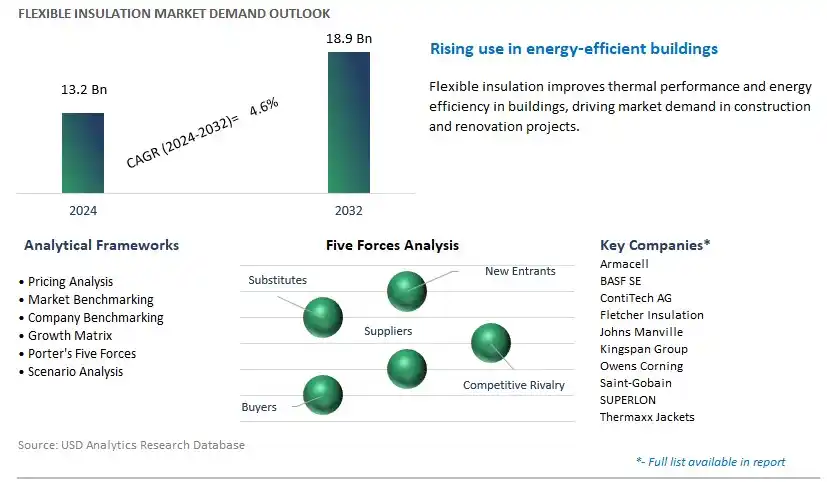
Global Flexible Insulation Market Size is valued at $13.2 Billion in 2024 and is forecast to register a growth rate (CAGR) of 4.6% to reach $18.9 Billion by 2032.
The global Flexible Insulation Market Study analyzes and forecasts the market size across 6 regions and 24 countries for diverse segments -By Material (Fiberglass, Elastomer, Others), By Type (Thermal Insulation, Acoustic Insulation, Electrical Insulation).
An Introduction to Flexible Insulation Market in 2024
Flexible insulation materials play a crucial role in thermal management and energy efficiency across various industrial and commercial applications. In 2024, the market for flexible insulation is witnessing robust growth driven by stringent building codes, increasing emphasis on sustainability, and the need for superior thermal performance in diverse environments. These materials, including fiberglass, mineral wool, and foam insulation, offer excellent thermal resistance, moisture control, and acoustic properties, enhancing occupant comfort and reducing energy consumption. Further, advancements in insulation technologies, such as aerogels and vacuum insulation panels, enable thinner and more lightweight solutions without compromising performance. As industries seek cost-effective and sustainable solutions to mitigate heat loss and gain, the demand for flexible insulation is expected to soar, driving further innovation and market expansion.
Flexible Insulation Market Competitive Landscape
The market report analyses the leading companies in the industry including Armacell, BASF SE, ContiTech AG, Fletcher Insulation, Johns Manville, Kingspan Group, Owens Corning, Saint-Gobain, SUPERLON, Thermaxx Jackets, and others.
Flexible Insulation Market Dynamics
Market Trend: Growing Adoption of Sustainable and Eco-Friendly Insulation Materials
A prominent trend in the flexible insulation market is the growing adoption of sustainable and eco-friendly insulation materials. Flexible insulation products, such as fiberglass, mineral wool, and natural fiber insulation, are increasingly preferred over traditional insulation materials due to their environmentally friendly properties. With rising awareness of climate change, energy conservation, and green building practices, there is a shift towards insulation materials that are manufactured using recycled content, renewable resources, and low-emission processes. Flexible insulation materials offer benefits such as thermal efficiency, acoustic performance, and indoor air quality improvement while aligning with sustainability goals and regulatory requirements. This trend reflects the industry's response to the demand for insulation solutions that reduce environmental impact, promote energy efficiency, and support sustainable building practices.
Market Driver: Energy Efficiency Regulations and Building Performance Standards
A key driver fueling the demand for flexible insulation is the implementation of energy efficiency regulations and building performance standards worldwide. Governments, building codes, and energy efficiency programs impose stringent requirements for thermal insulation in residential, commercial, and industrial buildings to reduce energy consumption, lower carbon emissions, and enhance building performance. Flexible insulation materials play a crucial role in meeting these regulations by providing effective thermal barriers, air sealing, and moisture control solutions. Additionally, the adoption of green building certification programs, such as LEED (Leadership in Energy and Environmental Design), drives market demand for flexible insulation as builders, architects, and developers seek to achieve certification and meet sustainability targets. The imperative for energy efficiency and compliance with building codes stimulates market growth for flexible insulation products and supports innovation in insulation technologies.
Market Opportunity: Innovation in High-Performance and Multi-Functional Insulation Solutions
Amidst the evolving landscape of the flexible insulation market, there exists a significant opportunity for innovation in high-performance and multi-functional insulation solutions. Manufacturers can capitalize on this opportunity by developing flexible insulation products that offer enhanced thermal performance, acoustic insulation, fire resistance, and moisture management capabilities. For example, advancements in aerogel-based insulation technology enable the development of ultra-thin, lightweight flexible insulation materials with superior thermal conductivity properties. Additionally, integrating smart technologies, phase change materials, and nanotechnology into flexible insulation products presents opportunities for enhancing energy efficiency and optimizing building comfort levels. By investing in research and development to innovate high-performance and multi-functional insulation solutions, companies can differentiate their products, address evolving market needs, and capture a larger share of the global flexible insulation market.
Flexible Insulation Market Share Analysis: Elastomer is poised to register the fastest CAGR over the forecast period
The Elastomer segment is the fastest-growing segment in the Flexible Insulation Market. Elastomeric insulation materials, such as rubber-based compounds and foam, offer excellent flexibility, durability, and thermal performance, making them increasingly favored across various industries. Elastomeric insulation is widely used in HVAC systems, plumbing, automotive, and industrial applications due to its superior resistance to moisture, chemicals, and environmental factors. Moreover, the growing emphasis on energy efficiency, sustainability, and indoor air quality drives the demand for high-performance insulation materials like elastomers. Additionally, advancements in elastomeric insulation technology, such as the development of innovative formulations and manufacturing processes, contribute to the segment's accelerated growth. As industries prioritize solutions that offer durability, thermal efficiency, and ease of installation, the demand for elastomeric insulation materials is expected to continue rising, positioning the Elastomer segment for sustained growth in the Flexible Insulation Market.
Flexible Insulation Market Share Analysis: Acoustic Insulation is poised to register the fastest CAGR over the forecast period
The Acoustic Insulation segment is the fastest-growing segment in the Flexible Insulation Market. Acoustic insulation plays a crucial role in dampening sound and reducing noise transmission in various applications, including residential, commercial, industrial, and automotive settings. With increasing urbanization, industrialization, and population density, there is a growing awareness of the adverse effects of noise pollution on health and well-being, driving the demand for effective acoustic insulation solutions. Moreover, stringent regulations and standards mandating noise control measures in buildings, transportation vehicles, and industrial facilities further fuel the adoption of acoustic insulation materials. Additionally, advancements in acoustic insulation technologies, such as the development of innovative materials and construction techniques designed for superior sound absorption and attenuation, contribute to the segment's accelerated growth. As industries and consumers prioritize comfort, safety, and environmental sustainability, the demand for acoustic insulation solutions is expected to continue rising, positioning the Acoustic Insulation segment for sustained growth in the Flexible Insulation Market.
Flexible Insulation Market
By Material
Fiberglass
Elastomer
Others
By Type
Thermal Insulation
Acoustic Insulation
Electrical InsulationCountries Analyzed
North America (US, Canada, Mexico)
Europe (Germany, UK, France, Spain, Italy, Russia, Rest of Europe)
Asia Pacific (China, India, Japan, South Korea, Australia, South East Asia, Rest of Asia)
South America (Brazil, Argentina, Rest of South America)
Middle East and Africa (Saudi Arabia, UAE, Rest of Middle East, South Africa, Egypt, Rest of Africa)
Flexible Insulation Companies Profiled in the Study
Armacell
BASF SE
ContiTech AG
Fletcher Insulation
Johns Manville
Kingspan Group
Owens Corning
Saint-Gobain
SUPERLON
Thermaxx Jackets
*- List Not Exhaustive
TABLE OF CONTENTS
1 Introduction to 2024 Flexible Insulation Market
1.1 Market Overview
1.2 Quick Facts
1.3 Scope/Objective of the Study
1.4 Market Definition
1.5 Countries and Regions Covered
1.6 Units, Currency, and Conversions
1.7 Industry Value Chain
2 Research Methodology
2.1 Market Size Estimation
2.2 Sources and Research Methodology
2.3 Data Triangulation
2.4 Assumptions and Limitations
3 Executive Summary
3.1 Global Flexible Insulation Market Size Outlook, $ Million, 2021 to 2032
3.2 Flexible Insulation Market Outlook by Type, $ Million, 2021 to 2032
3.3 Flexible Insulation Market Outlook by Product, $ Million, 2021 to 2032
3.4 Flexible Insulation Market Outlook by Application, $ Million, 2021 to 2032
3.5 Flexible Insulation Market Outlook by Key Countries, $ Million, 2021 to 2032
4 Market Dynamics
4.1 Key Driving Forces of Flexible Insulation Industry
4.2 Key Market Trends in Flexible Insulation Industry
4.3 Potential Opportunities in Flexible Insulation Industry
4.4 Key Challenges in Flexible Insulation Industry
5 Market Factor Analysis
5.1 Value Chain Analysis
5.2 Competitive Landscape
5.2.1 Global Flexible Insulation Market Share by Company (%), 2023
5.2.2 Product Offerings by Company
5.3 Porter’s Five Forces Analysis
5.4 Pricing Analysis and Outlook
6 Growth Outlook Across Scenarios
6.1 Growth Analysis-Case Scenario Definitions
6.2 Low Growth Scenario Forecasts
6.3 Reference Growth Scenario Forecasts
6.4 High Growth Scenario Forecasts
7 Global Flexible Insulation Market Outlook by Segments
7.1 Flexible Insulation Market Outlook by Segments, $ Million, 2021- 2032
By Material
Fiberglass
Elastomer
Others
By Type
Thermal Insulation
Acoustic Insulation
Electrical Insulation
8 North America Flexible Insulation Market Analysis and Outlook To 2032
8.1 Introduction to North America Flexible Insulation Markets in 2024
8.2 North America Flexible Insulation Market Size Outlook by Country, 2021-2032
8.2.1 United States
8.2.2 Canada
8.2.3 Mexico
8.3 North America Flexible Insulation Market size Outlook by Segments, 2021-2032
By Material
Fiberglass
Elastomer
Others
By Type
Thermal Insulation
Acoustic Insulation
Electrical Insulation
9 Europe Flexible Insulation Market Analysis and Outlook To 2032
9.1 Introduction to Europe Flexible Insulation Markets in 2024
9.2 Europe Flexible Insulation Market Size Outlook by Country, 2021-2032
9.2.1 Germany
9.2.2 France
9.2.3 Spain
9.2.4 United Kingdom
9.2.4 Italy
9.2.5 Russia
9.2.6 Norway
9.2.7 Rest of Europe
9.3 Europe Flexible Insulation Market Size Outlook by Segments, 2021-2032
By Material
Fiberglass
Elastomer
Others
By Type
Thermal Insulation
Acoustic Insulation
Electrical Insulation
10 Asia Pacific Flexible Insulation Market Analysis and Outlook To 2032
10.1 Introduction to Asia Pacific Flexible Insulation Markets in 2024
10.2 Asia Pacific Flexible Insulation Market Size Outlook by Country, 2021-2032
10.2.1 China
10.2.2 India
10.2.3 Japan
10.2.4 South Korea
10.2.5 Indonesia
10.2.6 Malaysia
10.2.7 Australia
10.2.8 Rest of Asia Pacific
10.3 Asia Pacific Flexible Insulation Market size Outlook by Segments, 2021-2032
By Material
Fiberglass
Elastomer
Others
By Type
Thermal Insulation
Acoustic Insulation
Electrical Insulation
11 South America Flexible Insulation Market Analysis and Outlook To 2032
11.1 Introduction to South America Flexible Insulation Markets in 2024
11.2 South America Flexible Insulation Market Size Outlook by Country, 2021-2032
11.2.1 Brazil
11.2.2 Argentina
11.2.3 Rest of South America
11.3 South America Flexible Insulation Market size Outlook by Segments, 2021-2032
By Material
Fiberglass
Elastomer
Others
By Type
Thermal Insulation
Acoustic Insulation
Electrical Insulation
12 Middle East and Africa Flexible Insulation Market Analysis and Outlook To 2032
12.1 Introduction to Middle East and Africa Flexible Insulation Markets in 2024
12.2 Middle East and Africa Flexible Insulation Market Size Outlook by Country, 2021-2032
12.2.1 Saudi Arabia
12.2.2 UAE
12.2.3 Oman
12.2.4 Rest of Middle East
12.2.5 Egypt
12.2.6 Nigeria
12.2.7 South Africa
12.2.8 Rest of Africa
12.3 Middle East and Africa Flexible Insulation Market size Outlook by Segments, 2021-2032
By Material
Fiberglass
Elastomer
Others
By Type
Thermal Insulation
Acoustic Insulation
Electrical Insulation
13 Company Profiles
13.1 Company Snapshot
13.2 SWOT Profiles
13.3 Products and Services
13.4 Recent Developments
13.5 Financial Profile
Armacell
BASF SE
ContiTech AG
Fletcher Insulation
Johns Manville
Kingspan Group
Owens Corning
Saint-Gobain
SUPERLON
Thermaxx Jackets
14 Appendix
14.1 Customization Offerings
14.2 Subscription Services
14.3 Related Reports
14.4 Publisher Expertise
By Material
Fiberglass
Elastomer
Others
By Type
Thermal Insulation
Acoustic Insulation
Electrical Insulation
Countries Analyzed
North America (US, Canada, Mexico)
Europe (Germany, UK, France, Spain, Italy, Russia, Rest of Europe)
Asia Pacific (China, India, Japan, South Korea, Australia, South East Asia, Rest of Asia)
South America (Brazil, Argentina, Rest of South America)
Middle East and Africa (Saudi Arabia, UAE, Rest of Middle East, South Africa, Egypt, Rest of Africa)
