Fragrance Ingredients Market Size 2025–2034: $12 Billion to $19.3 Billion at 5.4% CAGR Accelerated by Biotech Molecules, AI Formulation and Premium Brand Expansion
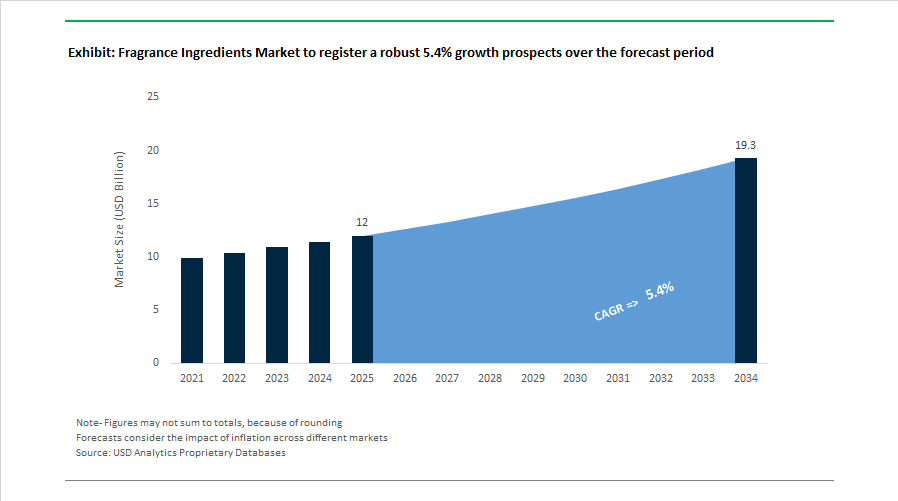
The Fragrance Ingredients Market is projected to grow from $12 billion in 2025 to $19.3 billion by 2034, registering a CAGR of 5.4%. Growth is driven by biotechnology-derived aroma chemicals, captive high-performance molecules, AI-assisted formulation tools, and premiumization across fine fragrance, personal care, and home care categories. Natural isolates, fermentation-based terpenes, green chemistry derivatives, and proprietary sillage-enhancing compounds are increasingly central to competitive positioning. Regulatory clarity, renewable feedstocks, solvent-free extraction, and digital consumer engagement platforms are reshaping the global fragrance ingredient supply chain.
In February 2026, International Flavors & Fragrances reported that its Scent division led corporate recovery in 2025, delivering double-digit growth within fragrance ingredients and a 7% increase in the fourth quarter of 2025. In January 2026, L’Oréal and Kering Beauté formed a strategic partnership to co-develop premium fragrance brands, signaling increased demand for proprietary, science-backed molecules offering superior longevity and diffusion. Early 2026 also witnessed ingredient-focused perfume launches such as The 7 Virtues’ Strawberry Jam and Escentric Molecules’ Molecule 01 + Champaca, highlighting the growing consumer focus on hero ingredients and rare botanicals as central olfactory drivers.
In November 2025, the Fragrance Creators Association designated 2026 as the “Year of Activation,” mobilizing ingredient suppliers and fragrance houses to advocate for greener chemistries and regulatory certainty in North America. In November 2025, Kimberly-Clark announced a $48.7 billion acquisition of Kenvue, consolidating one of the world’s largest purchasers of fragrance materials for home and personal wellness applications, significantly influencing global aroma chemical procurement volumes. Throughout 2025, India strengthened its position as a global hub for sustainable aroma chemicals, with suppliers investing in solvent-free extraction and green catalytic systems for ethically sourced isolates such as Linalool and Geraniol targeted at European buyers. In March 2025, BASF’s Isobionics launched fermentation-based Natural beta-Sinensal 20 and Natural alpha-Humulene 90, ensuring consistent citrus and woody profiles through biotech production pathways.
Earlier innovation momentum accelerated during 2024 and early 2025. Symrise introduced L-Carvone in 2024 using a green chemistry process derived from D-Limonene, significantly reducing wastewater and supporting renewable feedstock targets. During 2024 and into 2025, Symrise completed integration of its ONE CARE initiative, merging cosmetic ingredients and health actives to leverage synergies between scent molecules and wellness-driven functional additives. In early 2025, dsm-firmenich reported €12.8 billion in 2024 revenue, underscoring the success of post-merger integration and the resilience of biotechnology-derived fragrance ingredients amid supply chain volatility. Between 2024 and 2025, IFF expanded its AI-powered ScentChat™ platform globally, enabling real-time consumer feedback to inform ingredient selection and significantly reduce time-to-market for region-specific fragrance launches.
Trends and Opportunities Reshaping the Fragrance Ingredients Market
Commercialization of Precision-Fermented Natural-Identical Ingredients at Industrial Scale
Biotechnology is becoming a core pillar of fragrance ingredient manufacturing as producers seek to eliminate the volatility associated with traditional botanical sourcing such as patchouli, citrus oils, and sandalwood. In July 2025, Givaudan disclosed a strategic expansion of its fermentation-derived portfolio, targeting high-naturals and health-centric fragrance ingredients. These initiatives are designed to reduce dependence on climate-sensitive agriculture while lowering greenhouse gas emissions and land intensity across the value chain.
Infrastructure investment is reinforcing this transition. International Flavors & Fragrances highlighted in its February 2025 10-K filing that its Enzymes and Cultures platform remains central to next-generation aroma molecule development. With total 2024 sales of USD 11.48 billion, IFF is scaling microbial host technologies to commercialize fragrance ingredients that were previously constrained by cost, yield variability, or sustainability concerns.
From an economic standpoint, precision fermentation is gaining traction because it neutralizes seasonal price swings. According to the Good Food Institute in March 2025, precision fermentation is increasingly viewed as the default pathway for ingredient innovation. Several startups launched in 2024 reached commercial production in 2025, focusing on high-value aroma chemicals that deliver consistent olfactive performance with predictable cost structures.
Regulatory-Driven Reformulation Under the EU 80-Allergen Framework
The regulatory environment for fragrance ingredients has entered a compliance-intensive phase, driving widespread reformulation activity. Under Commission Regulation (EU) 2023/1545, which entered its critical transition period in 2025, the number of fragrance allergens requiring individual labeling expanded from 26 to 80. Mandatory compliance for new cosmetic products by July 30, 2026 has triggered a surge in demand for low-sensitization replacement molecules.
This regulatory influence is extending beyond Europe. By mid-2025, regulatory authorities in China, Indonesia, and Taiwan signaled alignment with EU-style allergen disclosure and safety dossier requirements. As a result, ingredient suppliers are prioritizing aroma chemicals that remain below restrictive labeling thresholds, particularly 0.001% for leave-on products, while maintaining performance parity.
In parallel, the EU tightened restrictions on CMR substances and implemented bans on 12 nano-ingredients in February 2025. These measures are accelerating the phase-out of legacy molecules such as Lilial and creating commercial white space for safer synthetic captives and bio-based alternatives engineered for compliance-by-design.
Functional and Mood-Enhancing Fragrance Ingredients for Wellness Applications
Fragrance ingredients are increasingly positioned as wellness enablers rather than purely aesthetic components. Research cited by dsm‑firmenich in May 2025 showed that 75% of female consumers in Asia-Pacific believe fragrance can positively influence mood. This insight has accelerated the development of functional aroma chemicals marketed for emotional and cognitive benefits.
Suppliers are collaborating with neuroscience institutions, including the University of Geneva’s Brain and Behavior Laboratory, to validate mood-boosting claims. By late 2025, more than 58% of new personal care launches incorporated functional scent positioning, particularly lavender and sandalwood profiles associated with stress reduction. These ingredients are increasingly supported by data linking aroma exposure to measurable physiological outcomes such as reduced cortisol response.
Beyond consumer products, professional wellness environments represent an emerging opportunity. According to THG Labs in March 2025, hospitals and corporate workplaces are adopting citrus- and peppermint-based fragrance systems to support patient calm and employee focus. This is creating demand for stable, low-sensitization fragrance ingredients suitable for continuous ambient diffusion.
High-Performance Ingredients for Alcohol-Free and Water-Based Fragrance Formats
The clean beauty movement and rising demand for halal-certified cosmetics are accelerating the shift toward alcohol-free fragrance systems. Water-based perfumes are gaining traction in markets such as India and the Middle East, where the segment was valued at USD 51.4 million in 2024. These formats require advanced water-soluble solubilizers and polymeric fixatives to prevent phase separation and preserve scent longevity.
Innovation is also extending into solid and hybrid formats. Travel-friendly solid fragrances are driving demand for high-load fragrance waxes and silica-based carriers that can hold concentrated aroma chemicals without compromising texture or melt-on-skin performance. These ingredient systems must balance structural integrity with sensory release, creating a premium niche for formulation-ready fragrance bases.
Sustainability considerations are reinforcing this opportunity. In December 2024, Givaudan confirmed plans for a 100,000-square-foot liquid compounding facility in Ohio. The site is positioned as a hub for hybrid ingredient delivery systems that support alcohol-free formulations, reduced packaging intensity, and regional supply security in North America.
Fragrance Ingredients Market Share and Segmentation Insights
Synthetic Fragrance Ingredients Dominate Global Aroma Formulation with Scalable and Innovative Molecule Development
Synthetic Ingredients accounted for 68.40% of the Fragrance Ingredients Market share in 2025, making them the dominant category used in modern fragrance formulation across consumer and industrial applications. Synthetic fragrance ingredients provide consistent chemical composition, scalable manufacturing capacity, and stable pricing, allowing fragrance houses and consumer product manufacturers to produce large volumes of fragranced goods with predictable scent performance. Additionally, synthetic chemistry enables the creation of unique aroma molecules that do not occur naturally or are extremely rare in nature, such as Calone, Amber Xtreme, Timbersilk, and other advanced aroma chemicals used in contemporary fragrance design. These compounds allow perfumers to develop distinctive scent profiles that cannot be replicated using natural extracts alone. In 2025, a major development shaping the fragrance ingredients industry is the rise of eco-synthetic production technologies. Chemical manufacturers are increasingly adopting green chemistry synthesis routes, renewable feedstocks, and low-emission manufacturing processes to reduce environmental impact while maintaining the performance advantages of synthetic ingredients. These eco-synthetic molecules combine the reliability and scalability of traditional synthetics with improved sustainability credentials, allowing brands to address regulatory pressure and consumer demand for environmentally responsible fragrance ingredients. As a result, eco-synthetic fragrance ingredients are capturing market share across both traditional synthetic and natural ingredient segments.
Personal Care Products Drive the Largest Demand for Fragrance Ingredients Worldwide
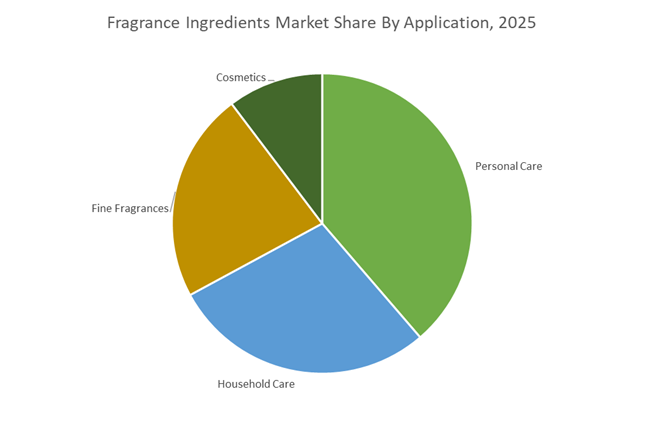
Personal Care represented 38.70% of the Fragrance Ingredients Market share in 2025, making it the leading application segment for fragrance formulation technologies. Personal care products—including shampoos, soaps, deodorants, lotions, body washes, and hair care products—are used daily by billions of consumers, creating continuous global demand for fragrance ingredients that deliver pleasant scent profiles, long-lasting freshness, and malodor masking properties. Fragrance plays a critical role in enhancing the consumer experience of personal care products, often influencing purchasing decisions and brand loyalty. Beyond simple scenting, fragrance ingredients also perform important functional roles in personal care formulations, including masking unpleasant odors from active ingredients and maintaining product freshness throughout use. In 2025, the personal care sector is witnessing a strong trend toward premiumization of mass-market products, where brands incorporate higher-quality fragrance compositions typically associated with luxury perfumes into everyday personal care formulations. Consumers increasingly seek spa-like sensory experiences and premium fragrance profiles in routine grooming products, encouraging manufacturers to use higher concentrations of fine fragrance ingredients and complex fragrance accords in shampoos, body washes, and deodorants. This trend is driving both volume growth and ingredient upgrading across the personal care segment, reinforcing its leadership position in the global fragrance ingredients market.
Competitive Landscape in Fragrance Ingredients Market
Givaudan Expands Regional Manufacturing and High-Precision Biotech Ingredients
Givaudan S.A. maintains leadership in the fragrance ingredients market across fragrance and beauty segments. In February 2026, the company announced a $110 million investment to construct a new 25,000-ton fragrance manufacturing facility in Mexico under its regionalized production strategy. This expansion strengthens supply resilience for North American consumer goods and fine fragrance brands. In 2025, 61% of revenue originated from consumer products such as laundry and home care, while 23% was generated from fine fragrance ingredients, highlighting a balanced exposure across mass and prestige categories. Givaudan’s portfolio emphasizes high-precision biotech ingredients and captive molecules engineered for enhanced scent bloom and long-lasting performance. AI-driven automation across production and formulation workflows supports lead time reduction and environmental footprint minimization, reinforcing Givaudan’s technological leadership in premium fragrance ingredient manufacturing.
IFF Reallocates Capital Toward High-Margin Scent and Bioscience Segments
International Flavors & Fragrances is executing a strategic portfolio reshaping initiative to strengthen margins and prioritize growth in scent and bioscience divisions. In February 2026, IFF issued sales guidance of $10.5 billion to $10.8 billion and initiated a sale process for its Food Ingredients business to redeploy capital into higher-margin fragrance and health technologies. The 2026 Dairy & Flavor Trends Report introduced the concept of Regenerative Resilience, emphasizing ecosystem restoration through sustainable ingredient sourcing. IFF is investing heavily in Human plus AI collaboration, using advanced algorithms to balance molecular efficiency with artistic authenticity in fragrance creation. Its ingredient portfolio supports both fine fragrance houses and functional household applications, reinforcing cross-category integration. This financial restructuring and digital transformation strategy positions IFF for margin expansion within the global fragrance ingredients value chain.
dsm-firmenich Integrates Neuroscience and Biotech-Derived Aroma Molecules
dsm-firmenich continues to merge nutritional science and premium fragrance innovation through biotech-derived ingredients and neuroscientific design principles. The company’s 2026 Scent of the Year, Frosted Star Anise, developed alongside Pantone’s Cloud Dancer theme, reflects consumer demand for calm and revitalization in fragrance experiences. Its emotiOn neuroscience platform and emotiCode formulation framework guide perfumers in selecting ingredients linked to mental clarity and emotional balance. Clearwood Prisma remains a flagship biotech-derived patchouli alternative that delivers sustainable sourcing and strong olfactive brightness. The launch of the Cloud Dancer collection across multiple formats in late 2025 demonstrated multi-category ingredient integration spanning EDPs, body care, and home fragrance. This integration of biotechnology, sensory science, and premium positioning strengthens dsm-firmenich’s competitiveness in high-value fragrance ingredients.
Symrise Advances Circular Raw Materials and Portfolio Optimization
Symrise AG differentiates itself through circular economy leadership and upcycling of industrial side-streams into fragrance raw materials. The company targets an EBITDA margin of 21.5% in 2026 under its ONE Symrise transformation program, which aims to deliver €40 million in recurring cost savings. In late 2025 and early 2026, Symrise began evaluating strategic alternatives for its terpene ingredients business to focus on higher-margin cosmetic actives and fine fragrance compounds. It holds the number one global position in premium active cosmetic ingredients and remains a top producer of fragrance materials derived from sulfate turpentine, a paper industry byproduct. As of early 2026, over 92% of strategic biological raw materials are sourced sustainably. This focus on sustainable sourcing and portfolio refinement reinforces Symrise’s resilience in the evolving fragrance ingredients market.
Takasago Strengthens Sustainable Sourcing and High-Purity Aroma Chemistry
Takasago International Corporation continues to lead the Asian fragrance ingredients market through precision aroma chemistry and multicultural consumer insight. In February 2026, Takasago joined the Together for Sustainability initiative, enhancing transparency and sustainability auditing across its chemical supply chain. Its Global Pulse TrendSeeds 2026 Forecast identifies Eco Resilience and AI-novation as primary drivers shaping fragrance and flavor development. The company is developing story-driven scents designed to evoke defined mood states, targeting younger Asia-Pacific consumers seeking emotional engagement. Takasago’s expertise in headspace technology and asymmetric synthesis enables production of nature-identical molecules with exceptionally high purity and performance consistency. This integration of sustainability, advanced synthesis, and consumer-driven storytelling positions Takasago as a key innovator within the global fragrance ingredients market.
France: Bio-Sourced Scale-Up and Regulatory Leadership Redefining Perfumery Inputs
France continues to function as the global reference market for high-value fragrance ingredients, with 2025 marking a decisive shift toward bio-sourced and regulation-ready production. In Castets, dsm-firmenich brought two advanced production facilities to full operational capacity, enabling industrial-scale output of pine-based, bio-sourced aroma ingredients and the biodegradable musk Habanolide. This investment has strengthened France’s upstream position in sustainable perfumery components, particularly for fine fragrances and premium personal care formulations that demand high purity and traceability. The move reflects a broader industry transition away from petrochemical musks toward renewable, biodegradable fragrance ingredients.
Regulatory pressure is reinforcing this trajectory. French fragrance houses are leading compliance preparations for Regulation (EU) 2023/1545, which mandates expanded allergen labeling by July 31, 2026. The requirement to individually disclose 56 additional allergens above defined thresholds is forcing reformulation strategies that prioritize low-allergen, well-characterized ingredients. In parallel, France’s implementation of a national PFAS ban in cosmetics from January 1, 2026 is accelerating the phase-out of fluorinated fixatives in favor of silicon-free and biodegradable alternatives. Strategic R&D expansion by Mane in Grasse, following its Avoca acquisition, underscores this shift, with increased focus on sclareolide production as a sustainable replacement for ambergris-derived notes.
United States: Regulatory Modernization and AI-Driven Molecule Discovery
The United States fragrance ingredients market is being reshaped by federal regulatory modernization and rapid adoption of digital innovation. Under the Modernization of Cosmetics Regulation Act, the U.S. Food and Drug Administration has scheduled a Notice of Proposed Rulemaking for May 2026 to define a mandatory list of fragrance allergens requiring label disclosure. This upcoming milestone is already influencing procurement strategies, with ingredient suppliers prioritizing transparency-ready molecules supported by robust safety dossiers.
Innovation dynamics are equally transformative. Between late 2024 and 2025, Osmo introduced AI-designed scent molecules including Glossine, Fractaline, and Quasarine, which entered pilot consumer products as the first AI-native fragrance ingredients. Traditional industry leaders are also advancing specialty molecule development. At the 2024 World Perfumery Congress, International Flavors & Fragrances launched Ylanganate alongside high-fidelity citrus oils through its LMR Naturals division. Concurrently, the FDA’s final rule on asbestos testing in talc-containing cosmetics, effective March 2026, is reshaping sourcing of mineral-based carriers and textured fragrance delivery systems across the U.S. personal care sector.
China: Regulatory Acceleration and Demographic-Driven Ingredient Design
China’s fragrance ingredients market is entering a faster regulatory and innovation cycle, driven by cosmetics reform and shifting consumer demographics. In November 2025, the National Medical Products Administration issued 24 measures to deepen regulatory reform, including an immediate review pathway for novel efficacy claims and removal of overseas sales record requirements for imported cosmetics. These changes are accelerating the market entry of global fragrance ingredients while raising expectations for efficacy substantiation and ingredient safety.
Digital transparency is emerging as a structural enabler. The Shanghai Municipal Medical Products Administration will launch an electronic labeling pilot in February 2026, allowing fragrance brands to disclose detailed ingredient information via QR codes. This is particularly relevant for long allergen lists and complex fragrance compositions. At the same time, China’s regulatory focus on the “silver economy” is shaping R&D priorities, with new guidelines encouraging fragrance ingredients tailored to elderly consumers. This includes soothing aromatic profiles and ingredients aligned with skin-aging mechanisms, creating a differentiated demand segment within the broader fragrance ingredients landscape.
India: Manufacturing Scale and Bio-Based Transition
India is strengthening its role as a global manufacturing and innovation hub for fragrance ingredients through joint ventures and biotechnology policy support. Operations at the Prigiv facility in Mahad, developed by Givaudan in partnership with Privi Speciality Chemicals, have reached commercial scale, supplying high-volume synthetic fragrance molecules to domestic and export markets. This facility enhances India’s position in cost-efficient, large-scale aroma chemical production while meeting international quality benchmarks.
Policy support is accelerating bio-based innovation. India’s BioE3 Policy, approved in 2024 and actively funding projects through 2025, is enabling biomanufacturing hubs focused on bio-based aroma chemicals and enzymatic synthesis routes. These initiatives align fragrance ingredient development with regenerative principles and sustainability mandates. In parallel, the extension of the OALP-X licensing round to February 2026 is expected to stabilize domestic availability of petrochemical feedstocks essential for synthetic fragrance synthesis, reducing volatility in upstream supply chains.
Japan: Precision Synthesis and Functional Fragrance Delivery
Japan’s fragrance ingredients market is defined by precision chemistry and functionality-driven innovation. In 2025, Takasago International Corporation expanded its green chemistry portfolio, emphasizing carbon-neutral aromatic ethers produced through proprietary asymmetric synthesis. This approach enables the production of nature-identical menthol and cooling agents with a reduced environmental footprint, aligning with sustainability expectations in Japan’s premium fragrance and personal care segments.
Looking forward, Japanese firms are pioneering nano-encapsulation technologies scheduled for broader commercialization in 2026. These delivery systems are engineered to respond to skin pH and temperature, enabling controlled fragrance release for active beauty and functional skincare applications. This innovation positions fragrance ingredients not only as sensory components but also as performance-enhancing elements within advanced cosmetic formulations.
Summary of Country-Level Strategic Drivers in the Fragrance Ingredients Market
Fragrance Ingredients Market County Level Snapshot
Country
Primary Strategic Focus
Implications for Fragrance Ingredients
France
Bio-sourced production and EU compliance
Growth in biodegradable musks and low-allergen ingredients
United States
MoCRA implementation and AI innovation
Demand for traceable, digitally designed fragrance molecules
China
Regulatory reform and aging population focus
Faster entry of global ingredients and elderly-oriented profiles
India
Joint ventures and biotechnology policy
Expansion of synthetic scale and bio-based aroma chemicals
By Ingredient Type (Natural Ingredients, Synthetic Ingredients), By Product Form (Liquid Dispersions, Powders and Crystals, Essential Oils and Resins), By Application (Fine Fragrances, Personal Care, Household Care, Cosmetics), By Synthesis Method (Chemical Synthesis, Natural Extraction, Biotechnology)
Study Period
2019- 2025 and 2026-2034
Units
Revenue (USD)
Qualitative Analysis
Porter’s Five Forces, SWOT Profile, Market Share, Scenario Forecasts, Market Ecosystem, Company Ranking, Market Dynamics, Industry Benchmarking
Companies
Givaudan SA, DSM-Firmenich AG, International Flavors & Fragrances Inc., Symrise AG, Mane SA, Takasago International Corporation, Robertet Group, Sensient Technologies Corporation, T. Hasegawa Co., Ltd., BASF SE, Privi Speciality Chemicals Limited, Solvay S.A., Zhejiang Juhua Co., Ltd., Innospec Inc., Bell Flavors & Fragrances
Countries
US, Canada, Mexico, Germany, France, Spain, Italy, UK, Russia, China, India, Japan, South Korea, Australia, South East Asia, Brazil, Argentina, Middle East, Africa
Fragrance Ingredients Market Segmentation
By Ingredient Type
Natural Ingredients
Synthetic Ingredients
By Product Form
Liquid Dispersions
Powders and Crystals
Essential Oils and Resins
By Application
Fine Fragrances
Personal Care
Household Care
Cosmetics
By Synthesis Method
Chemical Synthesis
Natural Extraction
Biotechnology
By Region
North America (United States, Canada, Mexico)
Europe (Germany, France, United Kingdom, Spain, Italy, Rest of Europe)
Asia Pacific (China, India, Japan, South Korea, Australia, Rest of APAC)
South and Central America (Brazil, Argentina, Rest of SCA)
Middle East and Africa (Saudi Arabia, UAE, South Africa, Rest of Middle East, Rest of Africa)
Top Companies in the Fragrance Ingredients Industry
2. Fragrance Ingredients Market Landscape & Outlook (2026–2034)
2.1. Introduction to Fragrance Ingredients Market
2.2. Market Valuation and Growth Projections (2026–2034)
2.3. Premiumization in Fine Fragrance, Personal Care, and Home Care Applications
2.4. Biotechnology-Derived Aroma Molecules and Green Chemistry Production Pathways
2.5. Digital Consumer Engagement and AI-Assisted Fragrance Formulation Platforms
3. Innovations Reshaping the Fragrance Ingredients Market
3.1. Trend: Commercialization of Precision-Fermented Natural-Identical Aroma Ingredients
3.2. Trend: Regulatory-Driven Reformulation Under the EU 80-Allergen Framework
3.3. Opportunity: Functional and Mood-Enhancing Fragrance Ingredients for Wellness Applications
3.4. Opportunity: High-Performance Ingredients for Alcohol-Free and Water-Based Fragrance Formats
4. Competitive Landscape and Strategic Initiatives
4.1. Mergers and Acquisitions
4.2. R&D and Material Innovation
4.3. Sustainability and ESG Strategies
4.4. Market Expansion and Regional Focus
5. Market Share and Segmentation Insights: Fragrance Ingredients Market
5.1. By Ingredient Type
5.1.1. Natural Ingredients
5.1.2. Synthetic Ingredients
5.2. By Product Form
5.2.1. Liquid Dispersions
5.2.2. Powders and Crystals
5.2.3. Essential Oils and Resins
5.3. By Application
5.3.1. Fine Fragrances
5.3.2. Personal Care
5.3.3. Household Care
5.3.4. Cosmetics
5.4. By Synthesis Method
5.4.1. Chemical Synthesis
5.4.2. Natural Extraction
5.4.3. Biotechnology
5.5. By Region
5.5.1. North America
5.5.2. Europe
5.5.3. Asia Pacific
5.5.4. South and Central America
5.5.5. Middle East and Africa
6. Country Analysis and Outlook of Fragrance Ingredients Market
6.1. United States
6.2. Canada
6.3. Mexico
6.4. Germany
6.5. France
6.6. Spain
6.7. Italy
6.8. UK
6.9. Russia
6.10. China
6.11. India
6.12. Japan
6.13. South Korea
6.14. Australia
6.15. South East Asia
6.16. Brazil
6.17. Argentina
6.18. Middle East
6.19. Africa
7. Fragrance Ingredients Market Size Outlook by Region (2026–2034)
7.1. North America Fragrance Ingredients Market Size Outlook to 2034
7.1.1. By Ingredient Type
7.1.2. By Product Form
7.1.3. By Application
7.1.4. By Synthesis Method
7.1.5. By Region
7.2. Europe Fragrance Ingredients Market Size Outlook to 2034
7.2.1. By Ingredient Type
7.2.2. By Product Form
7.2.3. By Application
7.2.4. By Synthesis Method
7.2.5. By Region
7.3. Asia Pacific Fragrance Ingredients Market Size Outlook to 2034
7.3.1. By Ingredient Type
7.3.2. By Product Form
7.3.3. By Application
7.3.4. By Synthesis Method
7.3.5. By Region
7.4. South America Fragrance Ingredients Market Size Outlook to 2034
7.4.1. By Ingredient Type
7.4.2. By Product Form
7.4.3. By Application
7.4.4. By Synthesis Method
7.4.5. By Region
7.5. Middle East and Africa Fragrance Ingredients Market Size Outlook to 2034
7.5.1. By Ingredient Type
7.5.2. By Product Form
7.5.3. By Application
7.5.4. By Synthesis Method
7.5.5. By Region
8. Company Profiles: Leading Players in the Fragrance Ingredients Market
8.1. Givaudan SA
8.2. DSM-Firmenich AG
8.3. International Flavors & Fragrances Inc.
8.4. Symrise AG
8.5. Mane SA
8.6. Takasago International Corporation
8.7. Robertet Group
8.8. Sensient Technologies Corporation
8.9. T. Hasegawa Co., Ltd.
8.10. BASF SE
8.11. Privi Speciality Chemicals Limited
8.12. Solvay S.A.
8.13. Zhejiang Juhua Co., Ltd.
8.14. Innospec Inc.
8.15. Bell Flavors & Fragrances
9. Methodology
9.1. Research Scope
9.2. Market Research Approach
9.3. Market Sizing and Forecasting Model
9.4. Research Coverage
9.5. Data Horizon
9.6. Deliverables
10. Appendix
10.1. Acronyms and Abbreviations
10.2. List of Tables
10.3. List of Figures
Fragrance Ingredients Market Segmentation
By Ingredient Type
Natural Ingredients
Synthetic Ingredients
By Product Form
Liquid Dispersions
Powders and Crystals
Essential Oils and Resins
By Application
Fine Fragrances
Personal Care
Household Care
Cosmetics
By Synthesis Method
Chemical Synthesis
Natural Extraction
Biotechnology
By Region
North America (United States, Canada, Mexico)
Europe (Germany, France, United Kingdom, Spain, Italy, Rest of Europe)
Asia Pacific (China, India, Japan, South Korea, Australia, Rest of APAC)
South and Central America (Brazil, Argentina, Rest of SCA)
Middle East and Africa (Saudi Arabia, UAE, South Africa, Rest of Middle East, Rest of Africa)
The Fragrance Ingredients Market is projected to expand from $12 billion in 2025 to $19.3 billion by 2034, registering a CAGR of 5.4%. Growth is supported by the increasing use of biotechnology-derived aroma chemicals, fermentation-based terpenes, and AI-assisted fragrance formulation tools. Premiumization across personal care, fine fragrances, and home care categories is also accelerating demand for high-performance scent molecules.
Biotechnology is transforming fragrance ingredient manufacturing by enabling precision fermentation of natural-identical aroma molecules such as beta-sinensal, humulene, and sustainable patchouli alternatives. These ingredients reduce dependence on climate-sensitive botanical crops while providing consistent olfactory quality and stable pricing. Major fragrance houses are scaling microbial fermentation platforms to deliver renewable, traceable, and low-carbon fragrance molecules.
The personal care segment accounted for 38.7% of the market share in 2025, making it the leading application for fragrance ingredients. Products such as shampoos, body washes, deodorants, lotions, and hair care formulations require fragrance compounds that deliver long-lasting freshness and malodor masking. Increasing premiumization of mass-market personal care products is encouraging manufacturers to incorporate fine fragrance-grade aroma ingredients.
Regulatory developments are significantly reshaping the fragrance ingredient landscape. EU Regulation 2023/1545 expanded allergen labeling requirements from 26 to 80 substances, forcing widespread reformulation across cosmetic products. Additionally, restrictions on CMR substances and emerging PFAS bans are accelerating the shift toward low-allergen synthetic captives, biodegradable aroma molecules, and safer bio-based ingredients.
Key companies in the Fragrance Ingredients Market include Givaudan, DSM-Firmenich, International Flavors & Fragrances (IFF), Symrise, Mane, Takasago International, BASF, Robertet Group, Sensient Technologies, and Privi Speciality Chemicals. These companies are investing heavily in biotechnology platforms, AI-driven fragrance formulation, sustainable sourcing, and captive aroma molecule development to maintain competitive advantage in premium fragrance ingredient innovation.
More Fragrance and Essential Oil Ingredients Reports