Citrus Oil Market Outlook 2025–2034: $9.1 Billion to $17.9 Billion at 7.8% CAGR Amid Supply Volatility and Value-Added Diversification
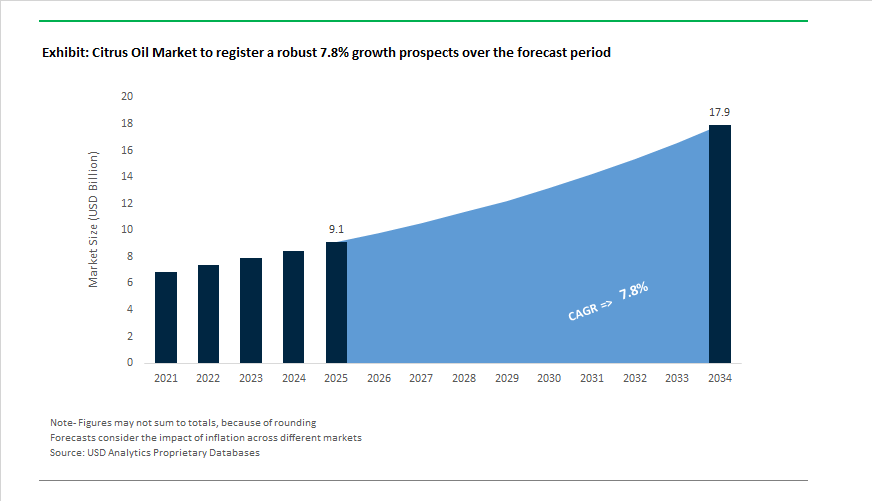
The global Citrus Oil Market is projected to grow from $9.1 billion in 2025 to $17.9 billion by 2034, registering a CAGR of 7.8%. Growth is being shaped by volatile raw material availability, expanding applications in flavors, fragrances, biocides, and wellness formulations, and increasing emphasis on sustainable extraction and circular processing. Citrus essential oils including orange oil, lemon oil, lime oil, and bergamot oil remain critical inputs for food and beverage flavoring, personal care formulations, aromatherapy, industrial cleaners, and green pesticides. Supply-side disruptions in major producing regions during 2024–2025 significantly altered pricing structures and sourcing strategies, intensifying investment in vertical integration and alternative origins.
Severe production declines in key geographies triggered structural shifts in global citrus oil trade flows. USDA data for the 2024–2025 season confirmed Florida’s orange production fell by 32.7%, the lowest level in a century, forcing U.S. fragrance and flavor manufacturers to pivot toward Brazilian and Mexican suppliers for limonene and cold-pressed orange oil. Simultaneously, Argentina’s 2024–2025 lemon season recorded a 10% decline in fresh lemon output, with approximately 11,000 hectares of groves abandoned due to unfavorable rainfall and economic pressures. Lemon oil prices reached multi-year highs as peel availability tightened. In contrast, Fundecitrus projected in 2025 a 36% recovery in Brazil’s orange crop for the 2025–2026 season, signaling potential stabilization in global orange terpene supply. Mexico strengthened its strategic role in June 2024 when the World Citrus Organisation expanded membership to include Citrojugo, reinforcing Mexico as a key lime and lemon oil exporter to North America.
Vertical integration and sourcing security became priority themes. In April 2024, Berjé Inc. acquired Global Citrus International and Acelim del Peru, gaining direct control over lime cultivation and essential oil extraction assets in Peru. This acquisition mitigates exposure to global citrus shortages and improves supply continuity for lime peel oil derivatives. In June 2024, Rovensa Next entered a 10-year exclusive supply agreement with Limaru NV focused on orange oil for biocide applications, reflecting expanding demand for citrus oils as active ingredients in green pesticides and disinfectants. India’s Shreeji Global FMCG launched an ₹85 crore IPO in October 2025, allocating capital toward cold storage and citrus processing expansion to strengthen India’s export competitiveness in value-added citrus derivatives.
Innovation in substitution, sustainability, and functional applications further diversified the citrus oil market landscape. In September 2024, Flavorchem introduced engineered orange oil replacers designed to replicate the organoleptic profile of natural cold-pressed oil while meeting clean-label food standards amid raw material shortages. Symrise launched a sustainability-focused citrus ingredient collection in 2024, utilizing upcycling processes to extract high-purity oils from juice industry side-streams aligned with circular economy targets. Olixir Oils debuted a bergamot-based wellness portfolio in October 2024, capitalizing on functional fragrance demand in premium personal care. In February 2025, ICAR-CCRI and Hindustan Petroleum Corporation Limited signed an MoU to study horticulture mineral oils as sustainable pest control alternatives for Mandarin and Acid Lime crops, supporting long-term fruit health and oil yield stability. By late 2025, China expanded domestic orange oil processing capacity in Guangxi and Yunnan, reducing reliance on high-cost imports by early 2026. These developments position the citrus oil market for sustained mid-to-high single-digit growth through 2034, supported by diversified sourcing, circular processing, and expanding application breadth across food, fragrance, wellness, and biocidal segments.
Citrus Oil Market Trends and Drivers
Geographic Diversification and Genomic Rootstock Innovation to Stabilize Global Citrus Oil Supply
Supply volatility in traditional citrus oil hubs—particularly the United States—has triggered structural changes in sourcing strategy and agronomic innovation. The USDA’s February 2025 Citrus Forecast reports that Florida’s orange output has fallen to 11.5 million boxes, marking one of the most significant declines in decades and threatening terpene and citrus essential oil supply stability. As a direct policy response, the Florida Governor’s 2025–2026 Budget allocates US$20 million to the Citrus Health Response Program, including US$7 million designated for R&D into HLB-resistant genomic technologies and advanced rootstock engineering. Parallel advances in rhizosphere engineering—highlighted in Frontiers (2025)—show that rootstock species such as Citrus junos and Poncirus trifoliata can be metabolically reprogrammed to increase oil yield, terpene concentration, and tree resilience under abiotic stress. This is accelerating a procurement shift in large-scale plantings toward high-auxin-producing strains to counter drought and replant disease, signaling that agronomic science—not land availability—will determine long-term global citrus oil competitiveness.
Precision Fractionation and High-Value Bioactive Isolation Transforming Profit Pools
Citrus oil producers are moving away from bulk commodity extraction toward fractionated, high-purity isolates for pharmaceutical, nutraceutical, fragrance, and advanced flavor markets. According to Global Growth Insights (November 2025), the Supercritical CO₂ Extraction market is expected to grow 18.6% between 2025–2033, with 25% of new citrus oil extraction assets now integrating multi-stage fractionation and inline NIR analytics. These systems can isolate d-limonene, citral, and nootkatone at solvent-free purity grades, opening premium pricing tiers and IP-protected ingredient formulations. Strategic consolidation from players like Givaudan, leveraging Naturex’s extraction capabilities, demonstrates a global race to secure exclusive bioactive profiles and GRAS-certified isolates—especially nootkatone, used both as a natural insect repellent and as a high-margin flavor modifier in functional beverages.
Circular Economy Zero-Waste Biorefinery Models to Monetize Peel, Pulp, and Seed Byproducts
Citrus processing byproducts—historically treated as waste—are becoming high-value feedstocks for recovery of secondary citrus oils, pectin, polyphenols, and dietary fiber.
Research published in MDPI Foods (2025) confirms that Orange Peel valorization is shifting to integrated green-extraction frameworks, producing citrus oil first, followed by polyphenol concentrates and pectin-based moisturizer films, aligning with UN SDGs for industrial waste minimization. In October 2025, Ingredion reported that citrus fiber now appears in ~85% of clean-label product formulations as an emulsifier, proving that dual-use processing of peel into fiber—and oil—materially improves plant economics for leading processors such as Fresh Del Monte and Sunkist.
For processors, zero-waste operating models are becoming a financial efficiency imperative, not simply ESG signaling.
Specialty-Grade Oils for High-Growth CPG, Fragrance, and Pharmaceutical Demand
Fast-scaling markets—such as clean-label personal care, functional F&B, nutraceuticals, and natural insecticides—require ingredients that meet residue-free, GRAS-certified, and traceable-origin standards. This opens a premium opportunity for lot-segmented, terroir-labeled citrus oils positioned similarly to botanicals and wine appellations, where origin influences terpene ratios, sensory signatures, and medicinal value. Producers that commercialize fractionation-ready oils, pre-validated for functional use cases (e.g., oral nutraceutical supplements, stress-relief aromatherapy oils, or shelf-life-extending preservatives), will command double-digit pricing premiums and secure multi-year supply contracts with CPG and pharma formulators.
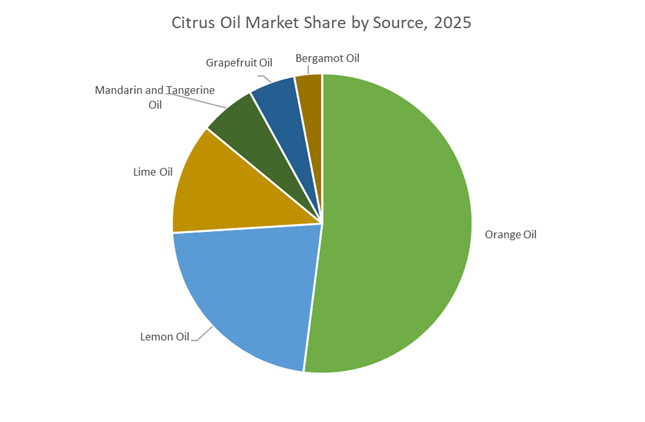
Orange oil holds 52% of the citrus oil market in 2025, supported by the massive global production of oranges primarily for juice processing. The abundance of orange peel as a byproduct ensures cost-effective raw material availability for essential oil extraction, particularly d-limonene, which drives industrial and flavoring applications. Lemon oil ranks as the second-largest segment, valued for its universally recognized aroma and versatility across food and beverage formulations, household cleaning products, and personal care applications. Lime and grapefruit oils maintain steady demand, with lime oil benefiting from mixology, beverage innovation, and ethnic cuisine applications, while grapefruit oil gains traction in natural cleaning solutions and wellness-focused aromatherapy. Bergamot oil represents the smallest share by volume but commands premium pricing due to its indispensable fragrance profile in fine perfumery and specialty teas such as Earl Grey, reinforcing its high-value niche positioning.
Application Segmentation: Food and Beverage Leads While Green Solvent Demand Expands Industrial Usage
The food and beverage sector accounts for 40% of citrus oil consumption, leveraging natural citrus extracts as flavor enhancers in carbonated drinks, confectionery, baked goods, and alcoholic beverages amid growing preference for natural over synthetic flavoring agents. Personal care and cosmetics represent a significant segment, utilizing citrus oils for fragrance, astringent properties, and skin-brightening formulations in soaps, shampoos, and skincare products. Industrial cleaning and solvents form a rapidly expanding category, driven by the transition toward bio-based degreasers and environmentally friendly alternatives to petrochemical solvents, particularly through the use of orange-derived d-limonene. Aromatherapy and wellness applications continue to grow as consumers adopt citrus essential oils for mood enhancement and stress relief. Pharmaceutical applications remain specialized, primarily using citrus oils for flavor masking in syrups, chewable tablets, and pediatric formulations to improve patient compliance.
Competitive Landscape of the Citrus Oil Market
The Citrus Oil Market is led by flavor and fragrance majors and vertically integrated agribusiness players leveraging AI-driven flavor design, biotechnology, and at-the-source sourcing models. Competitive differentiation centers on deterpenated citrus oils, bio-identical molecules, sustainable sourcing certifications, and sensory analytics platforms supporting beverages, wellness, fine fragrances, and industrial applications. Market leaders are accelerating APAC expansion, investing in cold-pressed extraction capacity, and adopting side-stream valorization to improve margins and ESG performance. Strategic priorities increasingly include traceability, fermentation-based citrus alternatives, and resilient supply chains amid citrus greening pressure.
Givaudan scales AI-powered citrus profiling with vertically integrated Mexican sourcing
Givaudan leads the citrus oil segment through aggressive R&D and digital scent innovation, supplying high-purity citrus extracts and deterpenated oils for premium beverages and fine fragrances. The company recently accelerated its AI-driven Scent-Tech platforms to predict consumer preferences for emerging citrus notes such as yuzu and finger lime across APAC markets. In late 2025, Givaudan expanded its natural flavor facility in Mexico to vertically integrate cold-pressed lime and grapefruit oil supply. Its strategic focus on Naturality and Traceability targets 100% sustainably sourced citrus raw materials by end-2026, reinforcing leadership in certified, premium citrus ingredients.
DSM-Firmenich blends biotechnology and AI to redefine organic citrus ingredients
Following its landmark merger, DSM-Firmenich has emerged as a powerhouse in nutrition, health, and beauty, with a strong footprint in citrus-derived ingredients. Its portfolio spans bio-identical citrus molecules and sustainably sourced organic lemon, bergamot, and orange oils. In 2025, the company deployed a proprietary AI machine-learning model to optimize citrus flavors for adult soft drinks, supporting low-sugar, botanical beverage innovation. DSM-Firmenich’s core strength lies in fermentation and biotechnology, enabling crop-independent citrus-like molecules. In early 2026, it launched a new certified organic citrus oil line targeting Europe’s premium aromatherapy and wellness markets.
Symrise dominates specialized citrus oils through side-stream valorization strategies
Symrise is recognized for backward integration and sustainable side-stream valorization, holding an estimated 32% share of the specialized citrus oil segment in 2026. The company’s inspiring citrus™ portfolio ranges from standard extracts to cost-effective nature-identical countertypes. In late 2025, Symrise published its Full Side-Stream Valorization white paper, detailing extraction of high-value oils from citrus peels previously treated as waste. Integration capabilities are reinforced through Symscript, a proprietary sensory language standardizing citrus profiles across global labs. This approach strengthens supply efficiency while supporting sustainability-driven citrus flavor development.
ADM captures citrus top notes while expanding provenance-driven APAC offerings
ADM has evolved into a nutrition-focused flavor innovator with strong citrus oil capabilities. In 2025, it introduced Corefold™, a proprietary separation technology that captures volatile citrus top notes while enhancing beverage mouthfeel. ADM is targeting APAC growth, projected at 4.21% CAGR, using Provenance Citrus storytelling around regional fruits such as calamansi, kumquat, and Assam lemon. Business expansion includes a new citrus center of excellence in Brazil, improving access to orange and mandarin oils at origin. ADM also leads the Authentic Wellbeing trend by incorporating citrus-oil-based immunity boosters into functional gummies and beverages.
Treatt engineers stable deterpenated citrus oils to offset supply volatility
Treatt specializes in natural citrus extracts, distinguished by advanced distillation and rectification expertise that produces highly stable, cloud-free deterpenated oils. Its Treattarome® range delivers true-to-fruit citrus distillates used across beverages and flavor systems. In 2026, Treatt secured major supply partnerships with growers in Florida and Brazil to mitigate citrus greening impacts on raw material pricing. The company’s Value for Money engineering strategy focuses on high-impact flavor solutions that enable lower dosage rates of expensive natural oils, helping manufacturers balance cost pressures while maintaining authentic citrus sensory profiles.
Citrosuco anchors global citrus oil supply through fully integrated Brazilian operations
Citrosuco is one of the world’s largest orange juice producers and a critical at-the-source supplier of citrus oils, including cold-pressed orange oil, D-limonene, tangerine, and Persian lime oils. Fully vertically integrated from grove to oil drum, Citrosuco offers superior quality control and pricing stability versus broker-based supply chains. The company is investing heavily in precision agriculture and drone monitoring to combat citrus greening in Brazilian orchards, safeguarding peel availability for 2026 processing. Citrosuco serves as a primary raw material partner for global flavor houses and supplies natural solvents to the industrial cleaning sector.
Brazil: Feedstock Abundance and By-Product–Led Supply Expansion
Brazil remains the structural backbone of the global citrus oil industry, with scale, by-product integration, and biosecurity shaping its 2025 to 2026 trajectory. According to 2025/26 projections referenced by the United States Department of Agriculture, Brazil’s orange harvest is expected to reach 320 million boxes of 40.8 kg each, reinforcing the country’s role as the most reliable source of crude orange oil for global terpene, flavor, and fragrance pipelines. This volume stability is closely linked to intensified Frozen Concentrated Orange Juice processing, with output projected to rise by 8.8% in 2025. As juice extraction volumes increase, the availability of cold-pressed orange oil derived from peel streams has expanded, improving feedstock predictability for downstream citrus oil processors.
Export momentum is reinforcing this position. Brazilian orange oil shipments are forecast to grow by over nine% in the 2025/26 season, with the United States and Europe reaching near parity as destination markets for the first time in several years. This balanced demand profile is encouraging investments in oil quality preservation rather than volume alone. Large cooperatives in São Paulo and Bahia adopted AI-driven moisture sensing technologies in late 2024 to optimize peel processing windows, enabling higher aldehyde retention and improved aromatic profiles in extracted oils. On the risk-management front, the Brazilian Confederation of Agriculture launched the 2025 Greening-Free Zone initiative to protect high-yield groves. This program is particularly critical for stabilizing the supply of Pera Orange oil, which underpins many global juice flavor formulations and blended citrus oil profiles.
United States: Recovery-Linked Supply and Demand-Side Program Innovation
The United States citrus oil industry is navigating constrained domestic supply while simultaneously innovating on the demand and formulation side. Early 2025 estimates indicate a 4.53% year-on-year increase in Florida citrus production, reaching approximately 4.85 million tons. While volumes remain structurally below historical levels, this incremental recovery is strategically important for domestic orange and grapefruit oil availability. Quality preservation has become a priority, reflected in the 2025–2026 Florida Citrus Production Guide, which mandates cold-protection infrastructure such as microsprinklers and wind machines in frost-prone zones. These measures are designed to protect oil-rich rinds from freeze damage that directly degrades volatile aromatic compounds.
On the demand side, U.S. flavor and fragrance buyers are increasingly seeking supply stability rather than spot procurement. In response, Givaudan launched Orange SunThesis® in late 2025, a vertically integrated program that offers beverage manufacturers long-term access to orange oil with reduced price volatility. Parallel growth is visible in non-food applications. The U.S. personal care and wellness segment has seen a sharp rise in the use of lemon and bergamot oils for aromatherapy and stress-management formulations, reflecting broader consumer shifts toward holistic wellness. Supporting technical innovation, dsm-firmenich opened a Baking Innovation Center in New Jersey in May 2025, focusing on the thermal stability of citrus-derived flavors in commercial food systems. This facility strengthens domestic expertise in adapting citrus oils to high-temperature processing environments.
Spain: Extraction Precision and Zero-Waste Optimization
Spain’s citrus oil industry is responding to tightening raw material availability by maximizing extraction efficiency and diversifying varietal outputs. Following a projected 9.72% decline in citrus production for the 2025/26 season, processors have accelerated the adoption of zero-waste processing models to offset lower juice volumes. This strategic pivot emphasizes higher recovery rates of essential oils from lemons and clementines, positioning citrus oil extraction as a value-retention mechanism rather than a secondary by-product activity.
Technological upgrades are central to this shift. In 2025, Fruit Tech Natural deployed the Alfa Laval CR750 disc stack separation system, achieving first-stage oil concentrations between 65 and 80% while reducing oil loss in the heavy phase to below 0.1%. Regulatory compliance is also shaping process design. Spanish producers are increasingly utilizing Hermetic Design extraction systems to minimize oxygen exposure, ensuring the oxidative stability required under upcoming 2026 European export standards. Contrasting the broader supply contraction, grapefruit production is expected to reach a record high of over 107,000 tons in 2025. This surplus has triggered increased availability of high-purity grapefruit essential oil, strengthening Spain’s position in bitter citrus oil segments used in beverages, fragrances, and functional formulations.
India: Infrastructure-Enabled Emergence of Citrus Oil Valorization
India’s citrus oil industry is transitioning from an incidental by-product activity to an organized value stream supported by national infrastructure and standardization initiatives. The National Mission on Edible Oils has identified more than 600 value chain clusters as of 2025, indirectly strengthening the citrus oil ecosystem through shared post-harvest and processing infrastructure. These facilities enable the aggregation and controlled processing of citrus waste, creating consistent feedstock streams for oil extraction.
Private sector investment is reinforcing this foundation. In August 2025, dsm-firmenich announced a major manufacturing investment in India focused on localized citrus flavor production for the domestic food and beverage sector. Standardization and traceability have also improved with the launch of the SATHI Portal in 2025, which enhances monitoring of biological inputs and supports the certification of organic citrus oils for export markets. Complementing these efforts, the Indian government allocated ₹10,103 crore toward oilseed and secondary oil missions, explicitly encouraging oil extraction from citrus processing waste in Maharashtra and Gujarat.
Italy: Premium Bergamot Oil and Fragrance-Led Demand
Italy occupies a distinct position in the citrus oil industry through its dominance in bergamot oil production. The Calabria region continues to function as the global hub for premium grade bergamot oil, supplying high-value fragrance, perfumery, and aromatherapy markets. Demand growth within Europe is being driven by increasing preference for natural ingredients with complex olfactory profiles, reinforcing bergamot oil’s strategic importance.
End-use concentration remains a defining feature. In 2025, fragrance and perfumery applications accounted for nearly half of Italian bergamot oil utilization, reflecting its irreplaceable role in fine fragrances and luxury scent compositions. Export quality stratification further underscores this positioning. Industry data from late 2025 indicates that premium grade bergamot oil represents the majority share of Italian exports, highlighting Italy’s sustained focus on high-margin segments rather than volume expansion. This quality-led strategy continues to differentiate Italy within the global citrus oil value chain.
Comparative Overview: Country-Level Dynamics in the Citrus Oil Industry
Citrus Oil Market County Level Snapshot
Country
Strategic Focus Area
Key Industry Lever
Citrus Oil Specialization
Brazil
Feedstock security and by-product valorization
FCOJ expansion and biosecurity programs
Cold-pressed orange oil and terpenes
United States
Supply recovery and demand stabilization
Vertical integration and cold protection
Orange, lemon, and bergamot oils
Spain
Efficiency under constrained supply
High-precision separation and zero-waste models
Lemon, clementine, and grapefruit oils
India
Infrastructure-led emergence
Cluster development and traceability portals
Waste-derived citrus oils
Italy
Premium positioning
Fragrance-driven demand
High-grade bergamot oil
Citrus Oil Market Report Scope
Citrus Oil Market
Parameter
Details
Market Size (2025)
$9.1 Billion
Market Size (2034)
$17.9 Billion
Market Growth Rate
7.8%
Segments
By Source (Orange Oil, Lemon Oil, Lime Oil, Bergamot Oil, Grapefruit Oil, Mandarin and Tangerine Oil), By Extraction Method (Cold Pressing, Steam Distillation, Hydro-Distillation, Supercritical CO₂ Extraction), By Product Grade (Food Grade, Cosmetic and Therapeutic Grade, Industrial Grade), By Application (Food and Beverage, Personal Care and Cosmetics, Aromatherapy and Wellness, Pharmaceuticals, Industrial Cleaning and Solvents)
Study Period
2019- 2025 and 2026-2034
Units
Revenue (USD)
Qualitative Analysis
Porter’s Five Forces, SWOT Profile, Market Share, Scenario Forecasts, Market Ecosystem, Company Ranking, Market Dynamics, Industry Benchmarking
Companies
Givaudan SA, DSM-Firmenich AG, Symrise AG, International Flavors & Fragrances Inc., Archer Daniels Midland Company, Takasago International Corporation, Kerry Group plc, Sensient Technologies Corporation, Robertet SA, Citrosuco S.A., Cutrale Ltda., Treatt plc, Fruit Tech Natural S.A., Young Living Essential Oils, LC, doTERRA International LLC
Countries
US, Canada, Mexico, Germany, France, Spain, Italy, UK, Russia, China, India, Japan, South Korea, Australia, South East Asia, Brazil, Argentina, Middle East, Africa
Citrus Oil Market Segmentation
By Source
Orange Oil
Lemon Oil
Lime Oil
Bergamot Oil
Grapefruit Oil
Mandarin and Tangerine Oil
By Extraction Method
Cold Pressing
Steam Distillation
Hydro-Distillation
Supercritical CO₂ Extraction
By Product Grade
Food Grade
Cosmetic and Therapeutic Grade
Industrial Grade
By Application
Food and Beverage
Personal Care and Cosmetics
Aromatherapy and Wellness
Pharmaceuticals
Industrial Cleaning and Solvents
By Region
North America (United States, Canada, Mexico)
Europe (Germany, France, United Kingdom, Spain, Italy, Rest of Europe)
Asia Pacific (China, India, Japan, South Korea, Australia, Rest of APAC)
South and Central America (Brazil, Argentina, Rest of SCA)
Middle East and Africa (Saudi Arabia, UAE, South Africa, Rest of Middle East, Rest of Africa)
2. Citrus Oil Market Landscape & Outlook (2026–2034)
2.1. Introduction to Citrus Oil Market
2.2. Market Valuation and Growth Projections (2026–2034)
2.3. Supply Volatility and Geographic Diversification
2.4. Vertical Integration, Trade Flow Shifts, and Sourcing Security
2.5. Circular Processing and Value-Added Diversification
3. Innovations Reshaping the Citrus Oil Market
3.1. Trend: Genomic Rootstock Innovation and Agronomic Yield Optimization
3.2. Trend: Precision Fractionation and High-Purity Bioactive Isolation
3.3. Opportunity: Zero-Waste Biorefinery and Peel Valorization Models
3.4. Opportunity: Specialty-Grade Oils for Wellness, CPG, and Pharmaceutical Applications
4. Competitive Landscape and Strategic Initiatives
4.1. Mergers and Acquisitions
4.2. R&D and Extraction Technology Innovation
4.3. Sustainability and Circular Economy Strategies
4.4. Market Expansion and Regional Sourcing Focus
5. Market Share and Segmentation Insights: Citrus Oil Market
5.1. By Source
5.1.1. Orange Oil
5.1.2. Lemon Oil
5.1.3. Lime Oil
5.1.4. Bergamot Oil
5.1.5. Grapefruit Oil
5.1.6. Mandarin and Tangerine Oil
5.2. By Extraction Method
5.2.1. Cold Pressing
5.2.2. Steam Distillation
5.2.3. Hydro-Distillation
5.2.4. Supercritical CO₂ Extraction
5.3. By Product Grade
5.3.1. Food Grade
5.3.2. Cosmetic and Therapeutic Grade
5.3.3. Industrial Grade
5.4. By Application
5.4.1. Food and Beverage
5.4.2. Personal Care and Cosmetics
5.4.3. Aromatherapy and Wellness
5.4.4. Pharmaceuticals
5.4.5. Industrial Cleaning and Solvents
5.5. By Region
5.5.1. North America
5.5.2. Europe
5.5.3. Asia Pacific
5.5.4. South and Central America
5.5.5. Middle East and Africa
6. Country Analysis and Outlook of Citrus Oil Market
6.1. United States
6.2. Canada
6.3. Mexico
6.4. Germany
6.5. France
6.6. Spain
6.7. Italy
6.8. UK
6.9. Russia
6.10. China
6.11. India
6.12. Japan
6.13. South Korea
6.14. Australia
6.15. South East Asia
6.16. Brazil
6.17. Argentina
6.18. Middle East
6.19. Africa
7. Citrus Oil Market Size Outlook by Region (2026–2034)
7.1. North America Citrus Oil Market Size Outlook to 2034
7.1.1. By Source
7.1.2. By Extraction Method
7.1.3. By Product Grade
7.1.4. By Application
7.1.5. By Region
7.2. Europe Citrus Oil Market Size Outlook to 2034
7.2.1. By Source
7.2.2. By Extraction Method
7.2.3. By Product Grade
7.2.4. By Application
7.2.5. By Region
7.3. Asia Pacific Citrus Oil Market Size Outlook to 2034
7.3.1. By Source
7.3.2. By Extraction Method
7.3.3. By Product Grade
7.3.4. By Application
7.3.5. By Region
7.4. South America Citrus Oil Market Size Outlook to 2034
7.4.1. By Source
7.4.2. By Extraction Method
7.4.3. By Product Grade
7.4.4. By Application
7.4.5. By Region
7.5. Middle East and Africa Citrus Oil Market Size Outlook to 2034
7.5.1. By Source
7.5.2. By Extraction Method
7.5.3. By Product Grade
7.5.4. By Application
7.5.5. By Region
8. Company Profiles: Leading Players in the Citrus Oil Market
8.1. Givaudan SA
8.2. DSM-Firmenich AG
8.3. Symrise AG
8.4. International Flavors & Fragrances Inc.
8.5. Archer Daniels Midland Company
8.6. Takasago International Corporation
8.7. Kerry Group plc
8.8. Sensient Technologies Corporation
8.9. Robertet SA
8.10. Citrosuco S.A.
8.11. Cutrale Ltda.
8.12. Treatt plc
8.13. Fruit Tech Natural S.A.
8.14. Young Living Essential Oils, LC
8.15. doTERRA International LLC
9. Methodology
9.1. Research Scope
9.2. Market Research Approach
9.3. Market Sizing and Forecasting Model
9.4. Research Coverage
9.5. Data Horizon
9.6. Deliverables
10. Appendix
10.1. Acronyms and Abbreviations
10.2. List of Tables
10.3. List of Figures
Citrus Oil Market Segmentation
By Source
Orange Oil
Lemon Oil
Lime Oil
Bergamot Oil
Grapefruit Oil
Mandarin and Tangerine Oil
By Extraction Method
Cold Pressing
Steam Distillation
Hydro-Distillation
Supercritical CO₂ Extraction
By Product Grade
Food Grade
Cosmetic and Therapeutic Grade
Industrial Grade
By Application
Food and Beverage
Personal Care and Cosmetics
Aromatherapy and Wellness
Pharmaceuticals
Industrial Cleaning and Solvents
By Region
North America (United States, Canada, Mexico)
Europe (Germany, France, United Kingdom, Spain, Italy, Rest of Europe)
Asia Pacific (China, India, Japan, South Korea, Australia, Rest of APAC)
South and Central America (Brazil, Argentina, Rest of SCA)
Middle East and Africa (Saudi Arabia, UAE, South Africa, Rest of Middle East, Rest of Africa)
The Citrus Oil Market is valued at $9.1 billion in 2025 and is forecast to reach $17.9 billion by 2034, expanding at a CAGR of 7.8%. Growth is supported by diversified sourcing, expansion of flavor and fragrance applications, and rising demand for natural bio-based solvents. Supply-side volatility in Florida and Argentina is accelerating vertical integration and alternative origin investments. Brazil’s production recovery is expected to partially stabilize global orange oil supply through 2026.
Severe orange production declines in Florida and lemon crop contraction in Argentina have structurally altered global trade flows. Buyers are increasingly shifting toward Brazilian and Mexican suppliers for limonene and cold-pressed oils. Vertical integration, long-term offtake agreements, and peel valorization models are becoming procurement priorities. Geographic diversification and genomic rootstock innovation are emerging as long-term supply stabilization strategies.
Orange oil continues to command the largest share at approximately 52%, driven by juice by-product availability and industrial limonene demand. However, high-margin growth is concentrated in fractionated bioactives such as nootkatone and citral for nutraceuticals, fragrances, and natural insecticides. Supercritical CO₂ extraction is expanding rapidly, supporting solvent-free premium isolates. Industrial green solvents and wellness formulations are also accelerating application diversity.
Brazil remains the structural backbone due to feedstock scale and FCOJ-linked oil recovery efficiency. The United States is focusing on supply recovery, cold-protection infrastructure, and vertically integrated programs to reduce volatility. Spain is investing in precision separation systems to maximize oil recovery under lower harvest volumes. India is emerging as a waste-derived citrus oil hub supported by infrastructure clusters and traceability programs.
Leading players include Givaudan SA, DSM-Firmenich AG, Symrise AG, Archer Daniels Midland Company, Treatt plc, and Citrosuco S.A.. These companies are advancing AI-driven flavor design, fractionation technologies, circular peel valorization, and origin-secured sourcing to mitigate supply risks and capture premium application segments across food, fragrance, and industrial markets.