Limonene Market 2025–2034: Bio-Based Solvents, Citrus Supply Dynamics, and Circular Chemistry Driving $663.8 Million Outlook at 6.4% CAGR
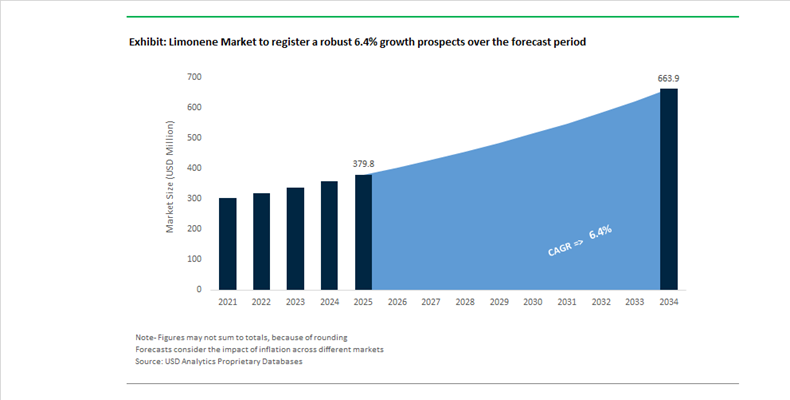
The Limonene Market is projected to grow from $379.8 Million in 2025 to $663.8 Million by 2034, registering a CAGR of 6.4%. Expansion is being driven by rising adoption of d-limonene as a bio-based solvent, citrus terpene intermediate, natural fragrance ingredient, and green degreasing agent across flavors, fragrances, industrial cleaners, agrochemicals, electronics resins, and sustainable packaging. Increasing regulatory pressure to replace chlorinated solvents and aromatic hydrocarbons is accelerating substitution toward renewable citrus-derived chemicals, while volatility in citrus harvests is reshaping procurement and vertical integration strategies across the limonene value chain.
In late 2023 and early 2024, Florida Chemical Company, a subsidiary of Archer Daniels Midland, initiated production expansion to address tightening global supply of natural degreasers as manufacturers transition toward biodegradable solvent systems. In early 2024, Firmenich, now dsm-firmenich, launched a limonene-based fragrance development program utilizing advanced encapsulation technologies to mitigate oxidation and extend product stability in citrus-scented formulations. In April 2024, AIMPLAS initiated the BUILD-LIMONENE project to convert citrus peel waste into high-purity limonene for sustainable building materials integrated with captured CO2, reinforcing circular economy integration. In the same year, Blue Planet Bio secured $6.5 million in Series A funding to commercialize limonene-based bio-resins targeting electronics and high-performance packaging, positioning limonene as a renewable feedstock for advanced polymer systems.
Consolidation and supply-side restructuring intensified in 2025 and 2026. In early 2025, MCI Miritz acquired the Florida Worldwide Citrus Products Group, expanding processing volumes of natural citrus derivatives for U.S. and European markets. In April 2025, Tradebe Life Sciences completed the acquisition of Florachem, strengthening vertical integration in citrus extraction and high-purity limonene supply for flavor, fragrance, and solvent applications. In November 2025, the World Citrus Organisation forecast a 1.5% decline in Northern Hemisphere citrus production for the 2025–2026 season, including a 12.3% reduction in lemon output in Spain and Italy, tightening availability of lemon-derived limonene in early 2026. In late 2025, biotech firms advanced microbial biosynthesis of limonene using engineered yeast and E. coli, aiming to decouple production from agricultural volatility. In February 2026, Citrosuco began testing biomethane-powered logistics fleets to market low-carbon limonene to ESG-driven buyers. In early 2026, IFF progressed toward divesting oilseed assets to concentrate on high-growth botanical extracts, including limonene-based fine fragrance molecules, reinforcing strategic prioritization of renewable citrus terpenes.
Strategic Trends and High-Value Opportunities Transforming the Limonene Market
Trend: Strategic Feedstock Consolidation and Captive Citrus Extraction Models
The limonene market is entering a phase of upstream consolidation as chemical distributors and life science companies move aggressively to secure captive access to citrus-derived feedstocks. This strategy is designed to stabilize the supply of high-purity d-limonene, a critical bio-based solvent used across coatings, pharmaceuticals, fragrances, and specialty cleaning formulations. Given the inherent volatility of citrus harvests driven by climate variability, disease pressure, and regional yield swings, feedstock control has become a decisive competitive advantage rather than a cost optimization lever.
In April 2025, Tradebe Life Sciences acquired Florachem, significantly expanding its captive extraction capacity for pharmaceutical- and coatings-grade limonene in North America. This move enables Tradebe to offer vertically integrated bio-solvent solutions while insulating margins from spot-market citrus oil pricing. A similar strategy emerged in March 2025 when MCI Miritz Citrus Intercontinental took a majority stake in Florida Worldwide Citrus Products Group, strengthening long-term raw material security in the U.S. citrus belt. Technology is amplifying the impact of these integrations. With approximately 15 million tons of citrus waste generated annually, producers are adopting enzymatic and microbial extraction pathways. Technical validations completed in mid-2025 show these methods can raise limonene yields by up to 75%, materially improving the economics of citrus bio-refineries and reinforcing captive extraction as a scalable supply model.
Trend: Premiumization Driven by Botanical Traceability and Terroir Certification
Premiumization is reshaping demand dynamics in the limonene market as fragrance, aromatherapy, and high-spec industrial buyers shift toward identity-preserved extracts with documented botanical origin and processing methods. Buyers increasingly differentiate between limonene derived from blood orange, Valencia orange, or lemon, and between cold-pressed and steam-distilled extraction, treating limonene as a functional botanical ingredient rather than a commoditized solvent. This trend mirrors broader clean-label and provenance-driven purchasing behavior across natural ingredients markets.
Industrial end users are reinforcing this shift. The automotive sector, which accounted for roughly 41% of technical solvent applications in 2024, is now specifying higher-purity limonene grades for conductive coatings and EV battery casing cleaners. These requirements are allowing suppliers to command price premiums of 15 to 20% over standard industrial-grade material. Regulatory pressure is further accelerating premium adoption. Revised volatile organic compound rules enforced in 2025 by the United States Environmental Protection Agency and the California Air Resources Board removed earlier fragrance-related exemptions. As a result, consumer product manufacturers are replacing petroleum-based hydrocarbons with certified bio-based limonene to maintain compliance and clean-label positioning in North America, structurally lifting demand for traceable, high-purity grades.
Opportunity: Limonene-Based Edible Bio-Coatings for Plastic-Free Fresh Produce
The global effort to eliminate single-use plastics from food retail is creating a high-growth opportunity for limonene-based edible coatings in post-harvest applications. These coatings act as breathable moisture and gas barriers, extending shelf life while remaining fully biodegradable and compatible with organic certification standards. For fresh produce exporters and retailers, limonene-enabled coatings offer a functional alternative to synthetic fungicides and plastic wraps without altering taste or appearance.
Scientific validation is strengthening commercial adoption. A 2024 to 2025 study on papaya preservation demonstrated that an edible formulation containing 1% sodium alginate and 0.5% d-limonene significantly reduced respiration and ethylene production. Treated fruit maintained firmness for up to 18 days at 20 degrees Celsius, supporting long-distance transport without plastic packaging. Retail traction is emerging in Europe, where major supermarket chains in Germany have begun stocking produce treated with tasteless bio-coatings. These initiatives are supported by funding from the Circular Bio-based Europe Joint Undertaking, which has allocated more than seven million euros to biomass-derived coating and solvent projects. Beyond shelf-life extension, limonene’s intrinsic antimicrobial properties allow these coatings to act as active ingredient carriers, helping reduce post-harvest losses that currently impact an estimated 30 to 50% of global citrus output.
Opportunity: High-Purity d-Limonene as a Platform Feedstock for Renewable Polymers
The most structurally significant opportunity in the limonene market lies in its emergence as a renewable monomer for advanced polymer synthesis. Using purified d-limonene, researchers are developing biodegradable polycarbonates and polyurethanes capable of competing with fossil-derived plastics in construction, automotive, and specialty packaging applications. These materials align with tightening regulations on plastic sustainability and lifecycle emissions.
The Spanish-led BUILD-LIMONENE initiative exemplifies this shift by combining carbon dioxide utilization with citrus peel waste to produce low-carbon construction additives and sustainable polycarbonates. Parallel research breakthroughs now allow precise control over molecular weight and polymer architecture, enabling limonene-based materials to meet performance requirements for industrial adhesives, biomedical devices, and food-contact packaging. The low toxicity profile of limonene polymers is a decisive advantage in heavily regulated applications. Additional validation emerged in 2024 when research published in MDPI demonstrated d-limonene’s effectiveness as a green solvent for photovoltaic panel recycling, achieving complete component detachment across multiple cycles. This positions limonene not only as a renewable polymer feedstock but also as an enabling solvent in circular economy systems for energy and materials infrastructure.
Limonene Market Share and Segmentation Insights
D-Limonene Leads the Market Through Citrus-Derived Supply and Strong Industrial Solvent Demand
D-limonene accounted for 72.80% of the Limonene Market share in 2025, making it the dominant isomer used across industrial and consumer applications. D-limonene is naturally extracted from citrus peel oils, particularly orange oil, and represents more than 90% of commercially available limonene production. Its strong citrus aroma, excellent solvency for oils and resins, and renewable bio-based origin make it widely used in cleaning formulations, flavor and fragrance products, and industrial solvent systems. The compound dissolves greases, waxes, adhesives, and hydrocarbon residues, making it valuable in industrial degreasers, adhesive removers, and environmentally preferred cleaning chemicals. In 2025, supply dynamics in the limonene market have been influenced by changes in global orange juice consumption patterns, where declining juice demand has increased the availability of citrus byproducts used for essential oil extraction. As a result, greater citrus oil recovery has improved D-limonene availability, supporting its expanded use as a renewable solvent alternative to petroleum-based chemicals in industrial and consumer product formulations.
Solvent and Cleaning Applications Drive the Largest Demand for Limonene
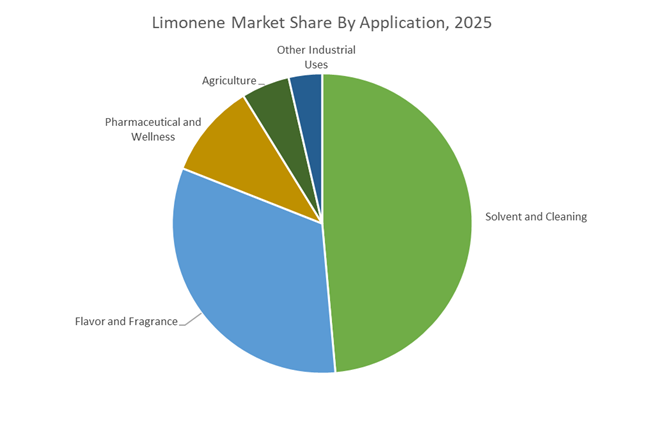
Solvent and cleaning applications accounted for 48.60% of the Limonene Market share in 2025, positioning this segment as the largest end-use category for limonene-based products. D-limonene is widely used as a bio-based solvent in household cleaners, industrial degreasers, adhesive removers, and surface cleaning formulations, where it effectively dissolves oils, greases, and polymer residues. Its renewable citrus origin and biodegradable profile have made limonene increasingly attractive in environmentally responsible cleaning formulations that aim to replace petroleum-derived solvents such as mineral spirits and chlorinated solvents. In addition to its functional solvency properties, limonene offers a distinct natural citrus scent, which enhances consumer perception of cleanliness and freshness in household and institutional cleaning products. In 2025, consumer demand for plant-derived and environmentally friendly cleaning chemicals continues to influence product development strategies within the cleaning products industry. Manufacturers increasingly incorporate limonene into green cleaning formulations and eco-labeled products, leveraging its natural origin and fragrance profile to meet growing consumer preferences for sustainable household and industrial cleaning solutions.
Limonene Market Competitive Landscape
The limonene market in 2026 is transitioning toward high-purity d-limonene, bio-based solvent applications, and circular citrus feedstock utilization. Competitive dynamics are driven by fractional distillation upgrades, enzymatic biosynthesis, and regulatory pressure on VOCs, accelerating adoption across aerospace cleaning, electronics degreasing, pharmaceuticals, and clean-label fragrance formulations.
Givaudan scales premium terpene applications through AI-driven citrus sourcing and fragrance growth
Givaudan SA is consolidating its leadership in high-value limonene derivatives by integrating fragrance chemistry with bioactive delivery systems. Its 6.8% sales growth and strong Fine Fragrance performance (18.3%) reflect rising demand for natural terpene-based formulations. AI-enabled procurement systems optimize citrus feedstock sourcing across global networks, mitigating volatility in raw material supply. By embedding limonene into Active Beauty platforms, Givaudan enhances ingredient penetration and functionality, strengthening its position in clean-label fragrances and high-performance cosmetic applications.
dsm-firmenich pivots to biotech-derived limonene for supply stability and health applications
dsm-firmenich is advancing a pure-play Nutrition, Health, and Beauty strategy by divesting non-core assets and scaling biotech-derived limonene alternatives. The €2.2 billion ANH divestiture and €500 million share buyback reinforce capital allocation toward aroma ingredients and sustainable citrus chemistry. Its Aroma Ingredients division is focused on biosynthetic production to overcome citrus seasonality, ensuring consistent supply for perfumery and dietary supplements. High-purity limonene is increasingly positioned for gastrointestinal health and anti-inflammatory applications within its expanding Health, Nutrition & Care portfolio.
IFF accelerates bio-based solvent transition through enzymatic biomaterials and portfolio restructuring
International Flavors & Fragrances Inc. (IFF) is repositioning toward high-margin scent and biosciences by divesting commodity segments and investing in plant-based innovation. Its Designed Enzymatic Biomaterials™ platform is enabling the replacement of petrochemical solvents with bio-derived limonene alternatives across industrial and fabric care applications. The ENVIROCAP™ biodegradable delivery system highlights its compliance with ECHA standards while enhancing scent performance. Expansion of its Cedar Rapids facility supports increased production of high-quality plant-based ingredients for functional foods and bio-based solvent markets.
Symrise advances circular limonene production through full side-stream valorization
Symrise AG is leveraging its “ONE Symrise” strategy to integrate citrus waste valorization into high-purity limonene production. Strong financial performance, including a 21.9% EBITDA margin, is funding initiatives that convert processing side-streams into premium terpene ingredients. The Beauty+ platform combines fragrance and cosmetic actives, positioning limonene as a multifunctional ingredient in clean-label personal care. Integration of Probi into its Care & Wellness division further strengthens its ability to link functional health ingredients with fragrance chemistry, supported by traceable and resilient raw material sourcing systems.
Florida Chemical Company strengthens industrial d-limonene leadership with high-purity distillation upgrades
Florida Chemical Company (ADM subsidiary) is a dominant supplier of high-purity d-limonene for industrial solvent applications, supported by vertically integrated citrus processing. Process upgrades in fractional distillation and oxidation control enhance product purity for electronics cleaning and aerospace MRO operations. Its Citrus Burst® 1 formulation delivers measurable efficiency gains, including 30% downtime reduction as a trichloroethylene replacement. FCC’s leadership in cold-pressed orange oil and folded oils underpins its strong position in biodegradable solvents for paints, cooling fluids, and industrial degreasers.
T. Hasegawa expands natural citrus flavor systems targeting wellness-driven consumer segments
T. Hasegawa Co., Ltd. is capitalizing on the clean-label movement by developing high-fidelity limonene-rich citrus flavor systems for functional foods and beverages. Its advanced extraction technologies preserve delicate terpene profiles, aligning with demand for natural and minimally processed ingredients. Regional supply chain expansion supports localized production and mitigates logistics volatility in Asia-Pacific markets. By integrating citrus-based stimulants with wellness trends such as “sober curious” consumption, the company is positioning limonene as a key ingredient in next-generation nutraceutical snacks and fermented beverages.
Brazil: Feedstock Scale, Orchard Expansion, and Whole-Fruit Valorization
Brazil occupies a structurally dominant position in the global limonene market due to its control over citrus peel feedstock and vertically integrated processing infrastructure. In December 2025, Citrosuco entered a landmark strategic partnership with PSP Investments, financing one of the largest orchard expansion programs in Brazil’s history. This investment directly secures long-term citrus peel availability, stabilizing d-limonene output amid rising global demand from fragrance, cleaning, and solvent applications.
Brazilian processors are simultaneously moving up the value chain. Companies such as Citrosuco and Cutrale have intensified investments in whole-fruit valorization, deploying advanced distillation systems to recover higher limonene volumes during not-from-concentrate juice processing. Feedstock resilience is further reinforced by public-private investment exceeding USD 1 billion into biotechnology programs targeting Huanglongbing disease. These initiatives are critical for maintaining crop yields in a country that supplies the majority of global orange juice and limonene feedstock. Export readiness has also improved. Upgrades at the Port of Santos in 2025 included dedicated bulk terpene storage terminals, reducing logistics friction for shipments to European and North American fragrance and specialty chemical markets.
United States: Consolidation, Regulatory Pull, and High-Purity Applications
The United States limonene market is characterized by corporate consolidation, regulatory-driven solvent substitution, and growing demand for high-purity grades. A pivotal development was the acquisition of Florida Chemical Company by ADM for USD 175 million. This transaction integrated global flavor distribution capabilities with Florida-based citrus terpene distillation, strengthening domestic supply security and scale efficiencies.
Regulatory frameworks are accelerating adoption. The Environmental Protection Agency Safer Choice Program has materially increased the use of bio-based solvents. By early 2026, more than 65% of newly launched industrial cleaning formulations in the U.S. incorporated d-limonene to replace chlorinated hydrocarbons. Innovation momentum extends into energy services. Flotek Industries entered a long-term supply agreement with ADM in 2025 to develop limonene-based chemistries for oil and gas well-bore cleaning and biodegradable degreasers.
Pharmaceutical and wellness applications are also expanding. U.S. startups are refining limonene to ultra-high purity levels for transdermal drug delivery and aromatherapy, supported by its Generally Recognized As Safe status from the Food and Drug Administration. This focus on pharmaceutical-grade limonene is elevating quality benchmarks and pricing power across the domestic value chain.
Spain: Circular Construction Materials and Fragrance-Led Exports
Spain’s limonene market is increasingly shaped by circular economy innovation and its established fragrance industry. In April 2024, the plastics technology center AIMPLAS launched the BUILD-LIMONENE project, using limonene extracted from citrus waste to formulate bio-based construction materials and coatings. This initiative directly reduces dependence on petroleum-derived solvents within the building sector.
Fragrance and personal care exports remain a core demand driver. Companies such as Ernesto Ventós S.A. and LemonConcentrate S.L.U. expanded cold-pressed lemon oil and isolated limonene capacities in 2025, targeting premium European perfumery and cosmetic brands. These developments align with funding support under the European Union Bioeconomy Strategy, which is incentivizing Spanish manufacturers to substitute synthetic solvents with natural limonene-based degreasers in industrial textile processing.
China: VOC Regulation and Import-Based Refining Integration
China represents the fastest-growing consumer base for limonene, driven by food processing expansion and regulatory pressure on industrial solvents. Stricter volatile organic compound limits introduced by the Ministry of Industry and Information Technology have compelled electronics manufacturers to adopt limonene for precision cleaning of printed circuit boards, replacing high-VOC synthetic solvents.
Domestic supply is increasingly supported through international sourcing. Chinese refiners have scaled imports of crude citrus oils from South America, refining them into high-purity limonene for cosmetics and personal care applications. This import-refine-distribute model allows China to meet rapidly rising domestic demand while maintaining control over quality and formulation consistency.
India: Regulatory Alignment and Wellness-Driven Consumption
India’s limonene market is developing through tighter cosmetic regulation, nutraceutical demand, and targeted distillation investments. In late 2025, the Central Drugs Standard Control Organization updated ingredient standards to align more closely with European fragrance allergen norms. This change prompted companies such as Arora Aromatics to invest in advanced mass spectrometry to ensure precise limonene labeling and compliance.
Demand expansion is particularly visible in health and wellness. Indian brands launched more than 200 limonene-infused nutraceutical products in 2025, integrating antioxidant and anti-inflammatory positioning into Ayurvedic-modern hybrid formulations. On the supply side, Mentha and Allied Products Pvt Ltd commissioned a new fractionation plant in late 2024, increasing output of export-grade d-limonene and strengthening India’s role as a secondary processing and formulation hub.
Comparative Snapshot: Country-Level Strategic Drivers in the Limonene Market
Limonene Market County Level Snapshot
Country
Primary Structural Driver
Key Application Pull
Market Direction
Brazil
Orchard expansion and feedstock security
Fragrances, solvents
Vertically integrated, export-oriented
United States
Consolidation and bio-based regulation
Cleaning, pharma
High-purity and industrial scaling
Spain
Circular economy projects
Construction, perfumery
Bio-based substitution
China
VOC regulation and food processing growth
Electronics, cosmetics
Import-refining integration
India
Cosmetic compliance and wellness demand
Nutraceuticals, exports
Quality-driven capacity build-up
Limonene Market Report Scope
Limonene Market
Parameter
Details
Market Size (2025)
$379.8 Million
Market Size (2034)
$663.8 Million
Market Growth Rate
6.4%
Segments
By Type (D-Limonene, L-Limonene, Dipentene), By Source (Citrus-Based, Non-Citrus Plant-Based, Synthetic), By Grade (Food Grade, Fragrance Grade, Pharmaceutical Grade, Industrial Grade), By Application (Flavor and Fragrance, Solvent and Cleaning, Pharmaceutical and Wellness, Agriculture, Other Industrial Uses)
Study Period
2019- 2025 and 2026-2034
Units
Revenue (USD)
Qualitative Analysis
Porter’s Five Forces, SWOT Profile, Market Share, Scenario Forecasts, Market Ecosystem, Company Ranking, Market Dynamics, Industry Benchmarking
US, Canada, Mexico, Germany, France, Spain, Italy, UK, Russia, China, India, Japan, South Korea, Australia, South East Asia, Brazil, Argentina, Middle East, Africa
Limonene Market Segmentation
By Type
D-Limonene
L-Limonene
Dipentene
By Source
Citrus-Based
Non-Citrus Plant-Based
Synthetic
By Grade
Food Grade
Fragrance Grade
Pharmaceutical Grade
Industrial Grade
By Application
Flavor and Fragrance
Solvent and Cleaning
Pharmaceutical and Wellness
Agriculture
Other Industrial Uses
By Region
North America (United States, Canada, Mexico)
Europe (Germany, France, United Kingdom, Spain, Italy, Rest of Europe)
Asia Pacific (China, India, Japan, South Korea, Australia, Rest of APAC)
South and Central America (Brazil, Argentina, Rest of SCA)
Middle East and Africa (Saudi Arabia, UAE, South Africa, Rest of Middle East, Rest of Africa)
2. Limonene Market Landscape & Outlook (2025–2034)
2.1. Introduction to Limonene Market
2.2. Market Valuation and Growth Projections (2025–2034)
2.3. Feedstock Dynamics and Citrus Supply Volatility
2.4. Regulatory Shift Toward Bio-Based Solvents and VOC Compliance
2.5. Demand Evolution Across Cleaning, Fragrance, Polymer, and Agrochemical Applications
3. Innovations Reshaping the Limonene Market
3.1. Trend: Strategic Feedstock Consolidation and Captive Citrus Extraction Models
3.2. Trend: Premiumization Through Botanical Traceability and Terroir Certification
3.3. Opportunity: Limonene-Based Edible Bio-Coatings for Plastic-Free Produce
3.4. Opportunity: Renewable Polymer Feedstocks from High-Purity d-Limonene
4. Competitive Landscape and Strategic Initiatives
4.1. Mergers and Acquisitions
4.2. R&D in Bio-Based Solvents, Terpenes, and Polymer Chemistry
4.3. Sustainability and Circular Feedstock Utilization Strategies
4.4. Market Expansion and Regional Processing Integration
5. Market Share and Segmentation Insights: Limonene Market
5.1. By Type
5.1.1. D-Limonene
5.1.2. L-Limonene
5.1.3. Dipentene
5.2. By Source
5.2.1. Citrus-Based
5.2.2. Non-Citrus Plant-Based
5.2.3. Synthetic
5.3. By Grade
5.3.1. Food Grade
5.3.2. Fragrance Grade
5.3.3. Pharmaceutical Grade
5.3.4. Industrial Grade
5.4. By Application
5.4.1. Flavor and Fragrance
5.4.2. Solvent and Cleaning
5.4.3. Pharmaceutical and Wellness
5.4.4. Agriculture
5.4.5. Other Industrial Uses
5.5. By Region
5.5.1. North America
5.5.2. Europe
5.5.3. Asia Pacific
5.5.4. South and Central America
5.5.5. Middle East and Africa
6. Country Analysis and Outlook of Limonene Market
6.1. United States
6.2. Canada
6.3. Mexico
6.4. Germany
6.5. France
6.6. Spain
6.7. Italy
6.8. UK
6.9. Russia
6.10. China
6.11. India
6.12. Japan
6.13. South Korea
6.14. Australia
6.15. South East Asia
6.16. Brazil
6.17. Argentina
6.18. Middle East
6.19. Africa
7. Limonene Market Size Outlook by Region (2025–2034)
7.1. North America Limonene Market Size Outlook to 2034
7.1.1. By Type
7.1.2. By Source
7.1.3. By Grade
7.1.4. By Application
7.1.5. By Region
7.2. Europe Limonene Market Size Outlook to 2034
7.2.1. By Type
7.2.2. By Source
7.2.3. By Grade
7.2.4. By Application
7.2.5. By Region
7.3. Asia Pacific Limonene Market Size Outlook to 2034
7.3.1. By Type
7.3.2. By Source
7.3.3. By Grade
7.3.4. By Application
7.3.5. By Region
7.4. South America Limonene Market Size Outlook to 2034
7.4.1. By Type
7.4.2. By Source
7.4.3. By Grade
7.4.4. By Application
7.4.5. By Region
7.5. Middle East and Africa Limonene Market Size Outlook to 2034
7.5.1. By Type
7.5.2. By Source
7.5.3. By Grade
7.5.4. By Application
7.5.5. By Region
8. Company Profiles: Leading Players in the Limonene Market
8.1. Archer Daniels Midland Company
8.2. Citrosuco
8.3. Borregaard ASA
8.4. Louis Dreyfus Company
8.5. Cutrale
8.6. Symrise AG
8.7. Givaudan
8.8. Ernesto Ventós S.A.
8.9. Arora Aromatics Private Limited
8.10. Citrus Oleo
8.11. LemonConcentrate S.L.U.
8.12. Norex Flavours Private Limited
8.13. Astrra Chemicals
8.14. Mentha and Allied Products Pvt. Ltd.
8.15. Spectrum Laboratory Products, Inc.
9. Methodology
9.1. Research Scope
9.2. Market Research Approach
9.3. Market Sizing and Forecasting Model
9.4. Research Coverage
9.5. Data Horizon
9.6. Deliverables
10. Appendix
10.1. Acronyms and Abbreviations
10.2. List of Tables
10.3. List of Figures
Limonene Market Segmentation
By Type
D-Limonene
L-Limonene
Dipentene
By Source
Citrus-Based
Non-Citrus Plant-Based
Synthetic
By Grade
Food Grade
Fragrance Grade
Pharmaceutical Grade
Industrial Grade
By Application
Flavor and Fragrance
Solvent and Cleaning
Pharmaceutical and Wellness
Agriculture
Other Industrial Uses
By Region
North America (United States, Canada, Mexico)
Europe (Germany, France, United Kingdom, Spain, Italy, Rest of Europe)
Asia Pacific (China, India, Japan, South Korea, Australia, Rest of APAC)
South and Central America (Brazil, Argentina, Rest of SCA)
Middle East and Africa (Saudi Arabia, UAE, South Africa, Rest of Middle East, Rest of Africa)
The Limonene Market was valued at $379.8 million in 2025 and is projected to reach $663.8 million by 2034, expanding at a CAGR of 6.4%. Growth is driven by increasing adoption of bio-based solvents and regulatory pressure on petrochemical alternatives. Expanding applications in cleaning, fragrance, and polymers are strengthening demand. Supply dynamics linked to citrus production continue to influence market stability.
The market is witnessing strong upstream integration with companies securing captive citrus feedstock to manage supply volatility. Premiumization is increasing with demand for traceable, high-purity limonene grades. Clean-label and VOC-compliant formulations are accelerating substitution of petroleum solvents. Additionally, biosynthesis using engineered microbes is emerging to reduce dependence on citrus harvest cycles.
Stringent VOC regulations in regions such as North America and Europe are driving replacement of chlorinated and aromatic solvents with limonene. Programs like EPA Safer Choice are accelerating adoption in cleaning and industrial applications. Regulatory alignment in cosmetics and food sectors is also promoting natural, bio-based ingredients. This is expanding limonene usage across multiple regulated industries.
Key opportunities include limonene-based edible coatings for plastic-free food packaging and post-harvest preservation. Limonene is also gaining traction as a renewable monomer for biodegradable polymers and specialty materials. Advanced applications in electronics cleaning and photovoltaic recycling are expanding its industrial relevance. These innovations position limonene as a critical feedstock in circular chemistry systems.
Major players include ADM, Citrosuco, Symrise, Givaudan, and dsm-firmenich. These companies focus on vertical integration, high-purity distillation, and circular citrus waste utilization. Strategic investments in biotech-based limonene production and advanced extraction technologies are improving supply resilience. Expansion into bio-based solvents, fragrances, and renewable polymers is strengthening their competitive positioning.