Glutaraldehyde Market to Reach $1,317.9 Million by 2034 at 5.1% CAGR Driven by Biocide Regulation, Oil & Gas Demand, and Digital Water Treatment Systems
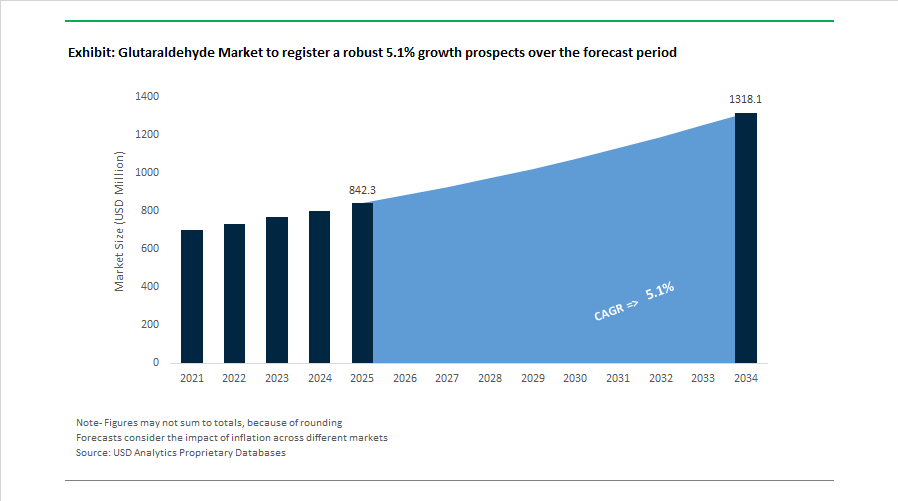
The Glutaraldehyde Market is projected to expand from $842.3 Million in 2025 to $1,317.9 Million by 2034, registering a CAGR of 5.1%. Market growth is supported by sustained demand for high-performance biocides in oil and gas production, industrial water treatment, medical cold sterilization, veterinary hygiene, and specialty preservation systems. Increasing regulatory scrutiny under EU REACH, the shift toward low-VOC and bio-based intermediates, and digitalized dosing technologies are reshaping competitive positioning across the global glutaraldehyde value chain.
In April 2024, 3M Company completed the spin-off of its healthcare division into Solventum Corporation, creating an independent entity overseeing sterilization indicators and medical device reprocessing systems that integrate glutaraldehyde-based cold sterilants. Throughout 2024, Solenis LLC increased glutaraldehyde capacity at its North American facilities to address rising oilfield demand, particularly for controlling sulfate-reducing bacteria in upstream pipelines and reservoirs. In late 2024, BASF SE initiated pilot programs to integrate bio-based feedstocks into biocide intermediate production, targeting lower-carbon glutaraldehyde precursors for pharmaceutical and cosmetic preservation markets by 2026. During 2024–2025, LANXESS AG completed its transformation into a specialty biocides-focused portfolio following divestment of its Urethane Systems business to UBE Corporation, consolidating glutaraldehyde assets within its Consumer Protection segment.
Regulatory developments intensified in 2025. In early 2025, the European Chemicals Agency advanced recommendations to include glutaraldehyde under REACH Annex XIV, requiring authorization for continued EU usage and encouraging adoption of closed-loop disinfection systems to minimize operator exposure. In May 2025, the European Commission granted Union Authorisation for specific glutaraldehyde-containing biocidal product families valid through 2030, harmonizing compliance requirements across Member States for industrial water treatment and veterinary hygiene providers. In 2025, ASP Global Manufacturing introduced pH-stabilized glutaraldehyde formulations engineered to extend disinfectant bath life in hospital environments, reducing chemical waste and improving compatibility with delicate endoscopic equipment. The same year, innovators including NanoSterile GmbH unveiled glutaraldehyde-nanosilver hybrid systems offering extended antimicrobial efficacy and reduced corrosion rates for ambulatory surgical centers.
Digitalization and pricing dynamics shaped 2025–2026 market conditions. Throughout 2025, Dow Inc. and Solenis deployed AI-enabled digital dosing platforms in industrial cooling towers, enabling real-time microbial monitoring and automated glutaraldehyde injection to reduce chemical consumption by up to 20%. In November 2025, Arkema S.A. announced a selectively sustainable capital expenditure strategy for 2026, prioritizing specialty materials including low-VOC biocide streams. In February 2026, BASF increased prices for chemical intermediates used in glutaraldehyde synthesis, citing elevated transportation, energy, and regulatory compliance costs impacting Asia-Pacific and MEAF customers. The same month, BASF expanded production infrastructure at its Mangalore, India site, strengthening distribution capabilities for glutaraldehyde-based industrial solutions in South Asia.
The Glutaraldehyde Market outlook reflects tightening European regulatory oversight, rising oilfield biocide demand, healthcare sterilization innovation, hybrid antimicrobial formulation development, digital dosing adoption, and bio-based feedstock pilots. Competitive differentiation increasingly depends on regulatory compliance expertise, corrosion mitigation performance, low-VOC chemistry, AI-driven dosing efficiency, and regional manufacturing expansion aligned with evolving environmental and occupational safety standards.
Glutaraldehyde Market Trends and Strategic Growth Opportunities
Proliferation of Ambulatory Surgical Centers Is Reshaping High-Level Disinfection Demand
The rapid migration of complex surgical procedures from large hospitals to outpatient environments is fundamentally altering procurement patterns for high-level disinfectants. Ambulatory Surgical Centers are handling higher patient throughput while relying heavily on reusable, high-risk medical devices such as flexible endoscopes and laparoscopic instruments. This shift is intensifying demand for fast-acting, cold-sterilant glutaraldehyde formulations that can deliver reliable microbial kill without heat or extended dwell times.
By March 2025, Medicare-certified facility data showed that states such as California had reached nearly 900 operational ASCs, illustrating the scale at which outpatient infrastructure is expanding across the United States. Forward-looking healthcare utilization models project that surgical volumes performed in outpatient settings will rise by roughly 25% over the next decade, structurally increasing decentralized demand for high-level disinfection chemicals. Capital deployment trends reinforce this outlook. Tenet Healthcare, through its United Surgical Partners International platform, committed to annual investments of approximately 250 million dollars beginning in early 2025 to acquire and develop new ambulatory centers.
Procedure mix evolution further amplifies glutaraldehyde consumption. Data published in Health at a Glance 2025 by the Organisation for Economic Co-operation and Development indicate a sharp rise in same-day discharge procedures requiring high-level disinfected scopes, including complex endoscopies and minimally invasive surgeries. As these procedures move closer to the point of care, facilities increasingly favor proven, broad-spectrum disinfectants like glutaraldehyde that support rapid turnaround and compliance with infection prevention protocols.
Supply Chain Rationalization and Portfolio Realignments Among Biocide Majors
The global glutaraldehyde supply landscape is tightening as leading chemical producers rationalize portfolios and focus capital on higher-margin, regulation-compliant biocides. Over the past two years, multinational suppliers have divested or consolidated lower-performing microbial control assets to prioritize specialty disinfectants aligned with evolving regulatory frameworks. A major inflection point occurred when LANXESS integrated the microbial control business acquired from International Flavors & Fragrances, strengthening its position as a leading supplier of glutaraldehyde and related antimicrobial actives.
This consolidation trend is contributing to higher market concentration and more disciplined capacity management. Corporate disclosures from BASF and Huntsman Corporation emphasize a strategic pivot toward sustainable, high-performance chemicals that comply with the European Union Biocidal Products Regulation and evolving U.S. Environmental Protection Agency safety standards. Production innovation is also supporting ESG goals. Manufacturers are increasingly offering high-concentration glutaraldehyde formulations above 50% to reduce transportation volumes, packaging requirements, and overall logistics-related emissions. These moves signal a shift away from commodity pricing toward value-based supply models anchored in compliance, performance, and sustainability.
Integration With Automated Endoscope Reprocessors and Closed-Loop Disinfection Systems
Rising scrutiny of infection control and occupational safety is creating a high-value opportunity for glutaraldehyde formulations integrated into automated reprocessing platforms. Manual disinfection processes are increasingly viewed as a risk due to variability in contact time, concentration errors, and staff exposure. Clinical evidence published in 2024 demonstrated that infection rates associated with certain high-risk endoscopes can reach up to 0.8% even under standard protocols, prompting healthcare systems to mandate automated endoscope reprocessors.
Technology adoption is accelerating as AER systems provide consistency, traceability, and worker safety. Companies such as Advanced Sterilization Products and Olympus have introduced automated platforms equipped with minimum recommended concentration monitoring, ensuring glutaraldehyde potency is continuously verified without manual dip-stick testing. Procurement data from the United Kingdom National Health Service indicate that closed-loop automated reprocessing can reduce cycle times by up to 30%, enabling facilities to manage rising diagnostic endoscopy volumes that exceed 17 million procedures annually in the United States. This convergence of safety, efficiency, and compliance positions glutaraldehyde-compatible AER systems as a durable growth engine.
Tailored Biocidal Solutions for Produced Water Reuse in Shale Oil and Gas Operations
Beyond healthcare, glutaraldehyde is gaining strategic importance in the oil and gas sector as operators transition toward circular water management models. The reuse of produced water in hydraulic fracturing requires effective non-oxidizing biocides capable of controlling sulfate-reducing bacteria in high-salinity and high-temperature environments. Glutaraldehyde remains a preferred solution due to its stability under extreme conditions and rapid biodegradation once diluted.
Regulatory developments are reinforcing this opportunity. In March 2025, the Environmental Protection Agency announced plans to modernize effluent limitation guidelines for oil and gas operations, with a specific focus on expanding produced water reuse. Clean Water Act revisions increasingly favor treatment technologies that enable beneficial reuse while minimizing long-term environmental persistence. Production intensity trends further support demand. Data from the U.S. Energy Information Administration show that hydraulically fractured wells now contribute roughly half of total U.S. crude oil output. This high-intensity extraction model depends on large volumes of microbially controlled water, positioning glutaraldehyde as a critical safeguard for asset integrity, reservoir performance, and regulatory compliance in modern shale operations.
Glutaraldehyde Market Share and Segmentation Insights
Technical Grade Glutaraldehyde Leads Industrial Biocide Applications in the Global Glutaraldehyde Market
Technical Grade Glutaraldehyde accounted for 72.80% of the Glutaraldehyde Market share in 2025, establishing it as the most widely used grade across industrial chemical applications. Technical grade material is primarily used in oil and gas biocide programs, industrial water treatment systems, and leather tanning operations, where antimicrobial performance and cost efficiency are more critical than ultra-high purity specifications. In these applications, glutaraldehyde functions as a powerful broad-spectrum biocide capable of controlling bacteria, algae, and sulfate-reducing microorganisms, which can otherwise cause biofouling, corrosion, and operational inefficiencies in industrial systems. Its effectiveness across a wide pH range and compatibility with complex industrial fluids make technical grade glutaraldehyde a preferred chemical in large-scale treatment programs. In 2025, however, the market is experiencing grade migration toward higher-purity formulations for healthcare applications. Pharmaceutical grade and double-distilled glutaraldehyde are increasingly used in medical device sterilization, hospital disinfection systems, and laboratory applications, where strict regulatory standards require extremely consistent chemical purity. Manufacturers are therefore investing in dedicated purification and production lines to meet healthcare sector quality requirements while maintaining large-scale industrial supply.
Oil and Gas Operators Drive the Largest Demand for Glutaraldehyde Biocides in Energy Production
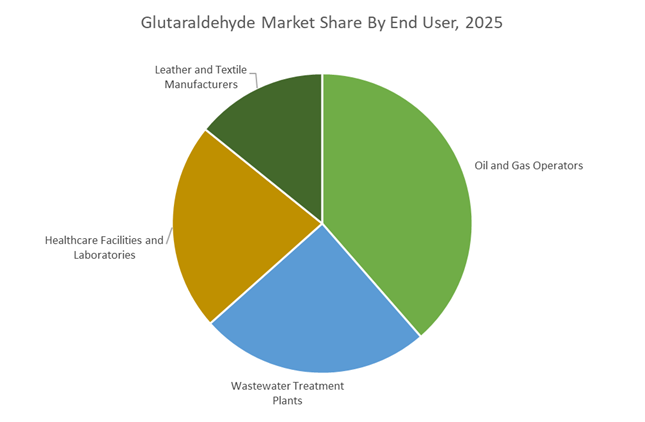
Oil and Gas Operators represented 38.60% of the Glutaraldehyde Market share in 2025, making this sector the largest end-user of glutaraldehyde-based antimicrobial treatments. The oil and gas industry relies on glutaraldehyde as a critical biocide used in waterflood systems, hydraulic fracturing fluids, and produced water treatment operations. Microbial contamination in these systems can lead to biofilm formation, reservoir souring, and corrosion of pipelines and processing equipment, creating operational risks and increased maintenance costs. Continuous injection of glutaraldehyde into production and water handling systems helps maintain microbial control and ensures stable hydrocarbon production. In 2025, demand from the energy sector is influenced by the ongoing productivity optimization of unconventional shale reservoirs. Operators are increasingly implementing refracturing programs and enhanced oil recovery techniques in mature shale basins to extend well life and improve production efficiency. These operations require effective water treatment and microbial control strategies, sustaining strong consumption of glutaraldehyde biocides across oilfield production systems.
Competitive Landscape in Glutaraldehyde Market
Dow Leads Global Industrial and Biocide-Grade Glutaraldehyde Supply
Dow maintains the strongest global position in industrial glutaraldehyde, supported by its integrated asset model and global manufacturing footprint across 29 countries. Under its January 2026 Transform to Outperform initiative, Dow is targeting a $2 billion operational EBITDA uplift through AI-enabled customer service modernization and structural simplification. Its AQUCAR™ and Ucarcide™ brands remain benchmark solutions for cooling tower water treatment, oilfield biocides in hydraulic fracturing, and industrial microbial control. With approximately $40 billion in total 2025 sales, glutaraldehyde forms a core component of its Industrial Intermediates and Infrastructure portfolio. Dow’s large-volume production capability ensures stable supply to municipal water systems and upstream energy operators requiring consistent 25% and 50% active formulations.
BASF Advances High-Purity and Green Disinfection Integration
BASF SE positions itself at the intersection of high-level disinfection chemistry and sustainability-driven process optimization. Through its Winning Ways strategy launched in February 2026, the company is streamlining operations to accelerate market-driven green transformation. The successful startup of the Zhanjiang Verbund site in China enhances regional supply of high-purity glutaraldehyde to the expanding Asia-Pacific healthcare and industrial sterilization markets. BASF’s broader sustainability initiatives, including biodegradable co-formulants such as Trilon® G, reflect a strategy of pairing glutaraldehyde with environmentally optimized additives for lower environmental impact systems. Its Agricultural Solutions and specialty divisions delivered resilient earnings in 2025 and 2026, reinforcing its competitive strength in regulated biocide markets.
LANXESS Strengthens Antimicrobial Portfolio Through Specialty Focus
LANXESS AG has consolidated its position as a major antimicrobial active ingredient supplier following the integration of IFF’s Microbial Control business. In 2026, the FORWARD! cost optimization program is restructuring production sites to improve utilization rates within its Consumer Protection segment. The divestment of its Urethane Systems business in April 2025 sharpened its focus on specialty biocides, including Preventol® glutaraldehyde-based solutions. LANXESS is targeting climate neutrality by 2040, with 2026 process upgrades aimed at lowering energy intensity in disinfection production. The company is ranked among the global top three suppliers in niche antimicrobial markets, particularly animal husbandry sanitation and industrial preservation.
Advanced Sterilization Products Dominates Medical High-Level Disinfection
Advanced Sterilization Products holds a commanding position in the healthcare segment through its Cidex® brand of glutaraldehyde-based high-level disinfectants. Controlling approximately 40% of healthcare segment demand, ASP serves hospitals and outpatient surgical centers requiring validated endoscope and heat-sensitive instrument sterilization protocols. In 2026, the company is integrating automated software-driven systems such as EVOTECH Endoscope Cleaner to reduce manual exposure and standardize disinfection cycles. Strategic emphasis is placed on low-vapor glutaraldehyde formulations to comply with evolving OSHA and international occupational exposure standards. Its specialization in high-level disinfection differentiates ASP from bulk industrial suppliers by focusing on regulatory compliance, clinical validation, and worker safety.
Hubei Jinghong Expands High-Volume Export and Purification Capabilities
Hubei Jinghong Chemical Co., Ltd. operates among the largest production lines globally for 25% and 50% glutaraldehyde solutions, serving as an OEM supplier for international industrial brands. Identified as a dominant exporter to Southeast Asia and the Middle East, the company leverages cost-efficient manufacturing and established logistics infrastructure in Wuhan. In 2026, Jinghong is investing in advanced purification systems to enhance the competitiveness of its 50% pharmaceutical-grade offerings for electron microscopy and medical disinfection applications. The company is also expanding into biotechnology derivatives, supplying glutaraldehyde cross-linkers used in enzyme immobilization and vaccine production.
Hebei Yanuo Bioscience Builds GMP-Compliant Fine Chemical Scale
Hebei Yanuo Bioscience Group operates three major ISO-certified production bases in Shijiazhuang, Cangzhou, and Wuhai, reinforcing its export-oriented fine chemical strategy. The company supplies high-purity glutaraldehyde intermediates for pharmaceutical synthesis and pesticide manufacturing. During 2025 and 2026, Hebei Yanuo strengthened its role as a contract development and manufacturing organization for global agrochemical and biomedical clients. Its strategic emphasis on scale and purity focuses on continuous production systems capable of meeting international Good Manufacturing Practice standards. By combining large-scale capacity with regulatory compliance, the company is positioning itself as a reliable supplier for highly regulated pharmaceutical and specialty chemical markets.
China: Smart Manufacturing, Export Controls, and Environmental Tightening
China’s glutaraldehyde industry has entered a consolidation phase aligned with the closing cycle of the Made in China 2025 program. Producers across Jiangsu and Shandong have transitioned to digitally enabled “Smart Green Workshops,” deploying digital twin systems to monitor catalytic oxidation in real time. This shift has improved batch-to-batch consistency and lifted yield reliability by approximately 12%, strengthening China’s position as a dependable supplier of high-purity dialdehydes for downstream pharmaceutical and electronics sterilization. Parallel investments by BASF at its Nanjing site, completed in July 2025, have expanded amine and carbonyl derivative capacity while moving operations to 100% renewable electricity, delivering a measurable reduction in lifecycle carbon intensity versus 2020 baselines.
Regulatory recalibration is reshaping trade and operations. Under the Ministry of Commerce’s 2025 reclassification, glutaraldehyde and key precursors are now subject to enhanced export oversight to safeguard domestic availability for semiconductor fabs and hospital-grade disinfection. At the same time, 2026 wastewater discharge standards for the Yangtze River Economic Belt are forcing producers to install closed-loop vapor recovery during filling and logistics. These measures are accelerating capital expenditure toward VOC minimization and reinforcing compliance-led differentiation in export markets.
United States: Biocide Performance, Compliance Windows, and Healthcare Purity
In the United States, glutaraldehyde demand is being reinforced by oilfield resilience and healthcare-grade purity requirements. The Environmental Protection Agency extended TSCA reporting deadlines for selected dialdehyde precursors to May 22, 2026, providing manufacturers additional time to submit unpublished health and safety studies that will inform future risk management decisions. This regulatory window has enabled suppliers to maintain continuity while upgrading toxicological dossiers.
Operationally, oil and gas operators in the Permian Basin increased glutaraldehyde usage through 2025 to control sulfate-reducing bacteria in hydraulic fracturing fluids, particularly as resistance to quaternary ammonium compounds became more prevalent. In parallel, the Food and Drug Administration tightened residue testing expectations for cold sterilants used in automated endoscope reprocessors, driving hospitals and formulators toward ultra-pure, double-distilled grades. Complementary investments by BASF in bio-based surfactants, including Alkyl Polyglucosides scheduled for Cincinnati by 2026, are reinforcing formulation synergies for industrial biofilm removal and healthcare sanitation.
India: Water Reuse Mandates and Pharmaceutical Scaling
India’s glutaraldehyde market is being structurally expanded by water reuse policy and pharmaceutical self-reliance. The Central Pollution Control Board mandated in 2025 that cities recycle at least 20% of treated wastewater, immediately increasing demand for non-oxidizing biocides in cooling towers and reclaimed water systems. This policy is reinforced by the National Mission for Clean Ganga, which targets 50% reuse of treated sewage by late 2025, positioning glutaraldehyde as a preferred membrane-protection agent in membrane bioreactor installations across 32 cities.
On the pharmaceutical front, Production Linked Incentive programs are supporting capacity additions for high-purity 25% and 50% solutions used as cross-linking agents in vaccines and protein stabilization. Domestic manufacturers are expanding GMP-compliant lines to reduce import dependence while meeting rising demand from biologics and diagnostics.
Germany: Energy Efficiency and Safe-by-Design Reformulation
Germany’s glutaraldehyde industry is advancing through energy efficiency and regulatory leadership. Chemical producers have deployed Mechanical Vapor Recompression in 2025, enabling the production of double-distilled grades with roughly 20% lower thermal energy consumption than conventional steam distillation. This efficiency gain is increasingly critical for German suppliers serving cost-sensitive leather, medical, and specialty chemical applications under stringent emissions regimes.
Regulatory agencies in Germany are also leading EU-wide REACH safety re-evaluations of dialdehydes under the Safe and Sustainable by Design framework. The focus is on developing lower-sensitization blends for applications such as leather tanning, where occupational exposure limits and worker safety labeling are becoming more restrictive for 2026 compliance cycles.
Thailand: Regional Biocide Hub for Biosecurity
Thailand is emerging as a Southeast Asian hub for glutaraldehyde-based disinfection, driven by biosecurity needs in aquaculture and poultry. Capacity expansions commissioned in Bangpakong in November 2025 are supplying regional farms with broad-spectrum disinfectants amid renewed concern over viral outbreaks, including H5N1 resurgence in late 2024. These facilities are positioning Thailand as a formulation and distribution center for veterinary and agricultural biocides, supporting cross-border supply to neighboring ASEAN markets.
Regional Snapshot: Glutaraldehyde Industry Dynamics
Glutaraldehyde Market County Level Snapshot
Region
Primary Policy or Industry Driver
Resulting Market Direction
China
Smart manufacturing and export oversight
Higher-purity output with tighter VOC and trade controls
United States
TSCA compliance and healthcare purity
Shift toward ultra-pure grades and oilfield resilience
India
Wastewater reuse mandates and PLI support
Rapid demand growth in water treatment and pharma
Germany
Energy efficiency and REACH audits
Low-sensitization, energy-optimized production
Thailand
Biosecurity in aquaculture and poultry
Regional hub for disinfectant formulations
Glutaraldehyde Market Report Scope
Glutaraldehyde Market
Parameter
Details
Market Size (2025)
$842.3 Million
Market Size (2034)
$1317.9 Million
Market Growth Rate
5.1%
Segments
By Concentration Type (Glutaraldehyde 25%, Glutaraldehyde 50%), By Grade (Technical Grade, Pharmaceutical Grade, Double-Distilled Grade), By Application (Disinfection and Sterilization, Water Treatment, Oil and Gas, Animal Husbandry, Leather Tanning, Specialty Applications), By End User (Healthcare Facilities and Laboratories, Oil and Gas Operators, Wastewater Treatment Plants, Leather and Textile Manufacturers)
Study Period
2019- 2025 and 2026-2034
Units
Revenue (USD)
Qualitative Analysis
Porter’s Five Forces, SWOT Profile, Market Share, Scenario Forecasts, Market Ecosystem, Company Ranking, Market Dynamics, Industry Benchmarking
Companies
BASF SE, Dow Chemical Company, LANXESS AG, Advanced Sterilization Products, Neogen Corporation, Fengchen Group Co., Ltd., Hubei Jinghong Chemical Co., Ltd., Becta Laboratories, Finoric LLC, Acuro Organics Limited, Hebei Guanlang Biotechnology Co., Ltd., Thermo Fisher Scientific Inc., Whiteley Corporation, GlutarChem, Sumitomo Chemical Co., Ltd.
Countries
US, Canada, Mexico, Germany, France, Spain, Italy, UK, Russia, China, India, Japan, South Korea, Australia, South East Asia, Brazil, Argentina, Middle East, Africa
Glutaraldehyde Market Segmentation
By Concentration Type
Glutaraldehyde 25%
Glutaraldehyde 50%
By Grade
Technical Grade
Pharmaceutical Grade
Double-Distilled Grade
By Application
Disinfection and Sterilization
Water Treatment
Oil and Gas
Animal Husbandry
Leather Tanning
Specialty Applications
By End User
Healthcare Facilities and Laboratories
Oil and Gas Operators
Wastewater Treatment Plants
Leather and Textile Manufacturers
By Region
North America (United States, Canada, Mexico)
Europe (Germany, France, United Kingdom, Spain, Italy, Rest of Europe)
Asia Pacific (China, India, Japan, South Korea, Australia, Rest of APAC)
South and Central America (Brazil, Argentina, Rest of SCA)
Middle East and Africa (Saudi Arabia, UAE, South Africa, Rest of Middle East, Rest of Africa)
2. Glutaraldehyde Market Landscape & Outlook (2026–2034)
2.1. Introduction to Glutaraldehyde Market
2.2. Market Valuation and Growth Projections (2026–2034)
2.3. Regulatory Landscape: EU REACH, Biocidal Products Regulation, and Occupational Safety Standards
2.4. Industrial Demand Drivers from Oil & Gas, Water Treatment, and Healthcare Sterilization
2.5. Digital Dosing Technologies and Low-VOC Biocide Formulation Trends
3. Innovations Reshaping the Glutaraldehyde Market
3.1. Trend: Growth of Ambulatory Surgical Centers and High-Level Disinfection Demand
3.2. Trend: Supply Chain Rationalization and Portfolio Consolidation Among Biocide Producers
3.3. Opportunity: Integration with Automated Endoscope Reprocessors and Closed-Loop Disinfection Systems
3.4. Opportunity: Produced Water Reuse and Microbial Control in Shale Oil & Gas Operations
4. Competitive Landscape and Strategic Initiatives
4.1. Mergers and Acquisitions
4.2. R&D and Material Innovation
4.3. Sustainability and ESG Strategies
4.4. Market Expansion and Regional Focus
5. Market Share and Segmentation Insights: Glutaraldehyde Market
5.1. By Concentration Type
5.1.1. Glutaraldehyde 25%
5.1.2. Glutaraldehyde 50%
5.2. By Grade
5.2.1. Technical Grade
5.2.2. Pharmaceutical Grade
5.2.3. Double-Distilled Grade
5.3. By Application
5.3.1. Disinfection and Sterilization
5.3.2. Water Treatment
5.3.3. Oil and Gas
5.3.4. Animal Husbandry
5.3.5. Leather Tanning
5.3.6. Specialty Applications
5.4. By End User
5.4.1. Healthcare Facilities and Laboratories
5.4.2. Oil and Gas Operators
5.4.3. Wastewater Treatment Plants
5.4.4. Leather and Textile Manufacturers
6. Country Analysis and Outlook of Glutaraldehyde Market
6.1. United States
6.2. Canada
6.3. Mexico
6.4. Germany
6.5. France
6.6. Spain
6.7. Italy
6.8. UK
6.9. Russia
6.10. China
6.11. India
6.12. Japan
6.13. South Korea
6.14. Australia
6.15. South East Asia
6.16. Brazil
6.17. Argentina
6.18. Middle East
6.19. Africa
7. Glutaraldehyde Market Size Outlook by Region (2026–2034)
7.1. North America Glutaraldehyde Market Size Outlook to 2034
7.1.1. By Concentration Type
7.1.2. By Grade
7.1.3. By Application
7.1.4. By End User
7.2. Europe Glutaraldehyde Market Size Outlook to 2034
7.2.1. By Concentration Type
7.2.2. By Grade
7.2.3. By Application
7.2.4. By End User
7.3. Asia Pacific Glutaraldehyde Market Size Outlook to 2034
7.3.1. By Concentration Type
7.3.2. By Grade
7.3.3. By Application
7.3.4. By End User
7.4. South America Glutaraldehyde Market Size Outlook to 2034
7.4.1. By Concentration Type
7.4.2. By Grade
7.4.3. By Application
7.4.4. By End User
7.5. Middle East and Africa Glutaraldehyde Market Size Outlook to 2034
7.5.1. By Concentration Type
7.5.2. By Grade
7.5.3. By Application
7.5.4. By End User
8. Company Profiles: Leading Players in the Glutaraldehyde Market
8.1. BASF SE
8.2. Dow Chemical Company
8.3. LANXESS AG
8.4. Advanced Sterilization Products
8.5. Neogen Corporation
8.6. Fengchen Group Co., Ltd.
8.7. Hubei Jinghong Chemical Co., Ltd.
8.8. Becta Laboratories
8.9. Finoric LLC
8.10. Acuro Organics Limited
8.11. Hebei Guanlang Biotechnology Co., Ltd.
8.12. Thermo Fisher Scientific Inc.
8.13. Whiteley Corporation
8.14. GlutarChem
8.15. Sumitomo Chemical Co., Ltd.
9. Methodology
9.1. Research Scope
9.2. Market Research Approach
9.3. Market Sizing and Forecasting Model
9.4. Research Coverage
9.5. Data Horizon
9.6. Deliverables
10. Appendix
10.1. Acronyms and Abbreviations
10.2. List of Tables
10.3. List of Figures
Glutaraldehyde Market Segmentation
By Concentration Type
Glutaraldehyde 25%
Glutaraldehyde 50%
By Grade
Technical Grade
Pharmaceutical Grade
Double-Distilled Grade
By Application
Disinfection and Sterilization
Water Treatment
Oil and Gas
Animal Husbandry
Leather Tanning
Specialty Applications
By End User
Healthcare Facilities and Laboratories
Oil and Gas Operators
Wastewater Treatment Plants
Leather and Textile Manufacturers
By Region
North America (United States, Canada, Mexico)
Europe (Germany, France, United Kingdom, Spain, Italy, Rest of Europe)
Asia Pacific (China, India, Japan, South Korea, Australia, Rest of APAC)
South and Central America (Brazil, Argentina, Rest of SCA)
Middle East and Africa (Saudi Arabia, UAE, South Africa, Rest of Middle East, Rest of Africa)
The Glutaraldehyde Market is expected to grow from $842.3 million in 2025 to $1,317.9 million by 2034, registering a CAGR of 5.1%. Growth is supported by rising demand for industrial biocides in oil and gas production, water treatment systems, and medical cold sterilization applications. Increasing regulatory compliance requirements and digital dosing technologies are also influencing market expansion.
The oil and gas sector accounted for 38.60% of global demand in 2025, driven by the need to control sulfate-reducing bacteria in pipelines, reservoirs, and hydraulic fracturing fluids. Glutaraldehyde acts as a powerful non-oxidizing biocide that prevents biofouling, corrosion, and reservoir souring, which can significantly impact production efficiency. Its effectiveness under high-salinity and high-temperature conditions makes it a preferred chemical in shale operations.
Regulatory scrutiny is intensifying, particularly in Europe where REACH Annex XIV discussions and Union Authorisation requirements are redefining compliance for glutaraldehyde-based products. Authorities are encouraging closed-loop disinfection systems and safer handling practices to minimize operator exposure. These regulatory changes are pushing manufacturers to develop low-VOC formulations and improved safety profiles.
Industrial operators are increasingly adopting AI-enabled digital dosing systems in cooling towers and water treatment facilities. These platforms monitor microbial activity in real time and automatically adjust glutaraldehyde injection levels. The technology can reduce chemical consumption by up to 20%, improving operational efficiency while maintaining effective microbial control in industrial water systems.
Major companies operating in the Glutaraldehyde Market include Dow Chemical Company, BASF SE, LANXESS AG, Advanced Sterilization Products, and Hubei Jinghong Chemical Co., Ltd. These companies focus on high-purity disinfectant formulations, industrial biocide solutions, and advanced sterilization systems to address evolving healthcare, oilfield, and water treatment requirements.