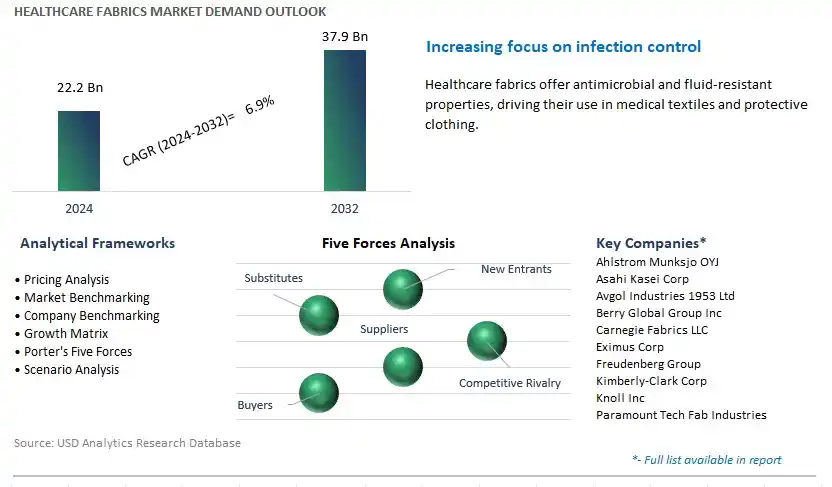
Global Healthcare Fabrics Market Size is valued at $22.2 Billion in 2024 and is forecast to register a growth rate (CAGR) of 6.9% to reach $37.9 Billion by 2032.
The global Healthcare Fabrics Market Study analyzes and forecasts the market size across 6 regions and 24 countries for diverse segments -By Raw Material (Polypropylene, Cotton, Polyester, Viscose, Polyamide, Others), By Fabric (Non-woven, Woven, Knitted, Others), By Application (Hygiene Products, Dressing Products, Clothing, Blanket & Bedding, Others).
An Introduction to Healthcare Fabrics Market in 2024
Healthcare fabrics play a crucial role in medical and healthcare settings for patient apparel, bedding, surgical drapes, and upholstery, providing comfort, protection, and infection control. In 2024, the market for healthcare fabrics is witnessing steady growth driven by increasing demand for high-performance textiles, advancements in fabric technology, and evolving healthcare regulations and standards. These fabrics, engineered with antimicrobial finishes, moisture-wicking properties, and barrier functionalities, offer advantages such as durability, breathability, and ease of care in clinical environments. Further, advancements in healthcare fabric formulations and manufacturing processes, including antimicrobial fibers, nanocoatings, and recyclable materials, address emerging challenges such as infection prevention, sustainability, and cost-effectiveness. As healthcare facilities and patients seek reliable and comfortable textile solutions, the demand for healthcare fabrics is expected to remain strong, supporting d innovation and market expansion.
Healthcare Fabrics Market Competitive Landscape
The market report analyses the leading companies in the industry including Ahlstrom Munksjo OYJ, Asahi Kasei Corp, Avgol Industries 1953 Ltd, Berry Global Group Inc, Carnegie Fabrics LLC, Eximus Corp, Freudenberg Group, Kimberly-Clark Corp, Knoll Inc, Paramount Tech Fab Industries, and others.
Healthcare Fabrics Market Dynamics
Market Trend: Surge in Demand for Antimicrobial and Protective Fabrics
The healthcare fabrics market is witnessing a prominent trend characterized by a surge in demand for antimicrobial and protective fabrics. With the increasing prevalence of healthcare-associated infections (HAIs) and the emergence of antibiotic-resistant bacteria, there is a growing emphasis on infection prevention and control measures within healthcare facilities. As a result, there's a rising preference for fabrics treated with antimicrobial agents or engineered with inherent antimicrobial properties to minimize the risk of cross-contamination and transmission of pathogens. Additionally, the demand for protective fabrics, such as barrier fabrics and fluid-resistant textiles, is on the rise to enhance healthcare worker safety and patient care standards, thus driving the adoption of specialized healthcare fabrics in hospitals, clinics, and other healthcare settings.
Market Driver: Stringent Regulatory Standards and Guidelines
A significant driver propelling the healthcare fabrics market is the enforcement of stringent regulatory standards and guidelines governing healthcare-associated textiles. Regulatory bodies and healthcare organizations worldwide are mandating compliance with rigorous standards and protocols for infection prevention and control, including the use of antimicrobial fabrics and protective textiles in healthcare settings. Compliance with these standards not only ensures patient safety and quality of care but also mitigates the risk of healthcare-associated infections and associated liabilities for healthcare facilities. Consequently, manufacturers of healthcare fabrics are compelled to adhere to regulatory requirements and invest in research and development to innovate fabrics that meet or exceed these stringent standards, thereby driving market growth and differentiation based on regulatory compliance and product performance.
Market Opportunity: Expansion in Telemedicine and Remote Patient Monitoring
An emerging opportunity lies in the expansion of healthcare fabrics into the telemedicine and remote patient monitoring segments. With the increasing adoption of telehealth solutions and remote monitoring technologies, there's a growing need for wearable fabrics and textiles integrated with sensors and monitoring devices to facilitate continuous patient monitoring and data collection outside traditional healthcare settings. Healthcare fabrics engineered for comfort, breathability, and skin compatibility can play a crucial role in the development of wearable medical devices, smart garments, and remote patient monitoring systems, enabling real-time health monitoring, disease management, and early intervention. By capitalizing on this opportunity through collaborations with technology providers and healthcare stakeholders, manufacturers can tap into the growing market for telemedicine and remote patient monitoring solutions and drive innovation in healthcare fabrics tailored for wearable and connected health applications.
Healthcare Fabrics Market Share Analysis: Polyester segment generated the highest revenue in 2024
The polyester segment stands as the largest in the Healthcare Fabrics Market. In particular, polyester fabrics offer a combination of desirable properties that make them well-suited for healthcare applications. Polyester is known for its strength, durability, and resistance to stretching, tearing, and abrasion, making it ideal for use in medical textiles that require long-term performance and reliability. Additionally, polyester fabrics are inherently hydrophobic, meaning they repel moisture and are quick-drying, which is essential in healthcare settings where cleanliness and infection control are paramount. Moreover, polyester fabrics are easy to clean, resistant to stains and odors, and can withstand repeated washing and sterilization cycles without losing their shape or functionality. Furthermore, polyester fabrics offer versatility in design and can be engineered to meet specific performance requirements, such as breathability, fluid resistance, and antimicrobial properties. As healthcare facilities continue to prioritize patient comfort, hygiene, and safety, the demand for polyester fabrics in medical textiles is expected to remain strong, solidifying the segment's position as the largest in the Healthcare Fabrics Market.
Healthcare Fabrics Market Share Analysis: Non-woven is poised to register the fastest CAGR over the forecast period
The non-woven segment is the fastest-growing segment in the Healthcare Fabrics Market. In particular, non-woven fabrics offer unique properties that make them increasingly preferred in healthcare applications. Non-woven fabrics are made by bonding fibers together using mechanical, chemical, or thermal processes, resulting in a fabric structure that is inherently porous, lightweight, and breathable. This porous structure allows for air and moisture vapor transmission, promoting a dry and comfortable environment for patients, especially in wound care and hygiene products. Additionally, non-woven fabrics can be engineered to provide specific characteristics such as fluid resistance, antimicrobial properties, and softness, making them suitable for a wide range of medical textiles. Moreover, non-woven fabrics offer advantages such as cost-effectiveness, ease of customization, and scalability in manufacturing, allowing for efficient production of medical products in large volumes. Furthermore, advancements in non-woven technology have led to the development of innovative products with enhanced performance characteristics, such as biodegradability, recyclability, and sustainability, aligning with the growing demand for eco-friendly and green materials in healthcare settings. As healthcare facilities continue to seek efficient, cost-effective, and high-performance solutions for patient care, the demand for non-woven fabrics in medical textiles is expected to grow rapidly, making it the fastest-growing segment in the Healthcare Fabrics Market.
Healthcare Fabrics Market Share Analysis: Hygiene Products segment generated the highest revenue in 2024
The hygiene products segment stands as the largest in the Healthcare Fabrics Market. In particular, hygiene products, such as diapers, sanitary napkins, and incontinence pads, are essential for maintaining personal hygiene and preventing infections in both healthcare and non-healthcare settings. These products require fabrics that offer excellent moisture management, softness, and comfort to the wearer, while also providing effective fluid absorption and containment. Fabrics used in hygiene products must be breathable to reduce the risk of skin irritation and promote airflow, preventing moisture build-up and maintaining skin health. Additionally, hygiene products often require fabrics with antimicrobial or odor-control properties to enhance product performance and user comfort. Moreover, the increasing prevalence of chronic conditions, aging populations, and awareness of hygiene practices drive the demand for hygiene products globally, further fuelling the demand for healthcare fabrics in this segment. Furthermore, advancements in fabric technology have led to the development of innovative materials that offer enhanced absorbency, durability, and sustainability, meeting the evolving needs of consumers and regulatory standards. As hygiene remains a top priority for individuals and healthcare providers, the demand for fabrics used in hygiene products is expected to remain strong, solidifying the segment's position as the largest in the Healthcare Fabrics Market.
Healthcare Fabrics Market
By Raw Material
Polypropylene
Cotton
Polyester
Viscose
Polyamide
Others
By Fabric
Non-woven
Woven
Knitted
Others
By Application
Hygiene Products
Dressing Products
Clothing
Blanket & Bedding
Others
Countries Analyzed
North America (US, Canada, Mexico)
Europe (Germany, UK, France, Spain, Italy, Russia, Rest of Europe)
Asia Pacific (China, India, Japan, South Korea, Australia, South East Asia, Rest of Asia)
South America (Brazil, Argentina, Rest of South America)
Middle East and Africa (Saudi Arabia, UAE, Rest of Middle East, South Africa, Egypt, Rest of Africa)
Healthcare Fabrics Companies Profiled in the Study
Ahlstrom Munksjo OYJ
Asahi Kasei Corp
Avgol Industries 1953 Ltd
Berry Global Group Inc
Carnegie Fabrics LLC
Eximus Corp
Freudenberg Group
Kimberly-Clark Corp
Knoll Inc
Paramount Tech Fab Industries
*- List Not Exhaustive
TABLE OF CONTENTS
1 Introduction to 2024 Healthcare Fabrics Market
1.1 Market Overview
1.2 Quick Facts
1.3 Scope/Objective of the Study
1.4 Market Definition
1.5 Countries and Regions Covered
1.6 Units, Currency, and Conversions
1.7 Industry Value Chain
2 Research Methodology
2.1 Market Size Estimation
2.2 Sources and Research Methodology
2.3 Data Triangulation
2.4 Assumptions and Limitations
3 Executive Summary
3.1 Global Healthcare Fabrics Market Size Outlook, $ Million, 2021 to 2032
3.2 Healthcare Fabrics Market Outlook by Type, $ Million, 2021 to 2032
3.3 Healthcare Fabrics Market Outlook by Product, $ Million, 2021 to 2032
3.4 Healthcare Fabrics Market Outlook by Application, $ Million, 2021 to 2032
3.5 Healthcare Fabrics Market Outlook by Key Countries, $ Million, 2021 to 2032
4 Market Dynamics
4.1 Key Driving Forces of Healthcare Fabrics Industry
4.2 Key Market Trends in Healthcare Fabrics Industry
4.3 Potential Opportunities in Healthcare Fabrics Industry
4.4 Key Challenges in Healthcare Fabrics Industry
5 Market Factor Analysis
5.1 Value Chain Analysis
5.2 Competitive Landscape
5.2.1 Global Healthcare Fabrics Market Share by Company (%), 2023
5.2.2 Product Offerings by Company
5.3 Porter’s Five Forces Analysis
5.4 Pricing Analysis and Outlook
6 Growth Outlook Across Scenarios
6.1 Growth Analysis-Case Scenario Definitions
6.2 Low Growth Scenario Forecasts
6.3 Reference Growth Scenario Forecasts
6.4 High Growth Scenario Forecasts
7 Global Healthcare Fabrics Market Outlook by Segments
7.1 Healthcare Fabrics Market Outlook by Segments, $ Million, 2021- 2032
By Raw Material
Polypropylene
Cotton
Polyester
Viscose
Polyamide
Others
By Fabric
Non-woven
Woven
Knitted
Others
By Application
Hygiene Products
Dressing Products
Clothing
Blanket & Bedding
Others
8 North America Healthcare Fabrics Market Analysis and Outlook To 2032
8.1 Introduction to North America Healthcare Fabrics Markets in 2024
8.2 North America Healthcare Fabrics Market Size Outlook by Country, 2021-2032
8.2.1 United States
8.2.2 Canada
8.2.3 Mexico
8.3 North America Healthcare Fabrics Market size Outlook by Segments, 2021-2032
By Raw Material
Polypropylene
Cotton
Polyester
Viscose
Polyamide
Others
By Fabric
Non-woven
Woven
Knitted
Others
By Application
Hygiene Products
Dressing Products
Clothing
Blanket & Bedding
Others
9 Europe Healthcare Fabrics Market Analysis and Outlook To 2032
9.1 Introduction to Europe Healthcare Fabrics Markets in 2024
9.2 Europe Healthcare Fabrics Market Size Outlook by Country, 2021-2032
9.2.1 Germany
9.2.2 France
9.2.3 Spain
9.2.4 United Kingdom
9.2.4 Italy
9.2.5 Russia
9.2.6 Norway
9.2.7 Rest of Europe
9.3 Europe Healthcare Fabrics Market Size Outlook by Segments, 2021-2032
By Raw Material
Polypropylene
Cotton
Polyester
Viscose
Polyamide
Others
By Fabric
Non-woven
Woven
Knitted
Others
By Application
Hygiene Products
Dressing Products
Clothing
Blanket & Bedding
Others
10 Asia Pacific Healthcare Fabrics Market Analysis and Outlook To 2032
10.1 Introduction to Asia Pacific Healthcare Fabrics Markets in 2024
10.2 Asia Pacific Healthcare Fabrics Market Size Outlook by Country, 2021-2032
10.2.1 China
10.2.2 India
10.2.3 Japan
10.2.4 South Korea
10.2.5 Indonesia
10.2.6 Malaysia
10.2.7 Australia
10.2.8 Rest of Asia Pacific
10.3 Asia Pacific Healthcare Fabrics Market size Outlook by Segments, 2021-2032
By Raw Material
Polypropylene
Cotton
Polyester
Viscose
Polyamide
Others
By Fabric
Non-woven
Woven
Knitted
Others
By Application
Hygiene Products
Dressing Products
Clothing
Blanket & Bedding
Others
11 South America Healthcare Fabrics Market Analysis and Outlook To 2032
11.1 Introduction to South America Healthcare Fabrics Markets in 2024
11.2 South America Healthcare Fabrics Market Size Outlook by Country, 2021-2032
11.2.1 Brazil
11.2.2 Argentina
11.2.3 Rest of South America
11.3 South America Healthcare Fabrics Market size Outlook by Segments, 2021-2032
By Raw Material
Polypropylene
Cotton
Polyester
Viscose
Polyamide
Others
By Fabric
Non-woven
Woven
Knitted
Others
By Application
Hygiene Products
Dressing Products
Clothing
Blanket & Bedding
Others
12 Middle East and Africa Healthcare Fabrics Market Analysis and Outlook To 2032
12.1 Introduction to Middle East and Africa Healthcare Fabrics Markets in 2024
12.2 Middle East and Africa Healthcare Fabrics Market Size Outlook by Country, 2021-2032
12.2.1 Saudi Arabia
12.2.2 UAE
12.2.3 Oman
12.2.4 Rest of Middle East
12.2.5 Egypt
12.2.6 Nigeria
12.2.7 South Africa
12.2.8 Rest of Africa
12.3 Middle East and Africa Healthcare Fabrics Market size Outlook by Segments, 2021-2032
By Raw Material
Polypropylene
Cotton
Polyester
Viscose
Polyamide
Others
By Fabric
Non-woven
Woven
Knitted
Others
By Application
Hygiene Products
Dressing Products
Clothing
Blanket & Bedding
Others
13 Company Profiles
13.1 Company Snapshot
13.2 SWOT Profiles
13.3 Products and Services
13.4 Recent Developments
13.5 Financial Profile
Ahlstrom Munksjo OYJ
Asahi Kasei Corp
Avgol Industries 1953 Ltd
Berry Global Group Inc
Carnegie Fabrics LLC
Eximus Corp
Freudenberg Group
Kimberly-Clark Corp
Knoll Inc
Paramount Tech Fab Industries
14 Appendix
14.1 Customization Offerings
14.2 Subscription Services
14.3 Related Reports
14.4 Publisher Expertise
By Raw Material
Polypropylene
Cotton
Polyester
Viscose
Polyamide
Others
By Fabric
Non-woven
Woven
Knitted
Others
By Application
Hygiene Products
Dressing Products
Clothing
Blanket & Bedding
Others
Countries Analyzed
North America (US, Canada, Mexico)
Europe (Germany, UK, France, Spain, Italy, Russia, Rest of Europe)
Asia Pacific (China, India, Japan, South Korea, Australia, South East Asia, Rest of Asia)
South America (Brazil, Argentina, Rest of South America)
Middle East and Africa (Saudi Arabia, UAE, Rest of Middle East, South Africa, Egypt, Rest of Africa)
