The global Hydrophilic Coatings Market is poised to register a 6.2% CAGR from $17.9 Billion in 2024 to $25.7 Billion in 2030.
The global Hydrophilic Coatings Market Study analyzes and forecasts the market size across 6 regions and 24 countries for diverse segments -By Substrate (Polymers, Glass/Ceramics, Metals, Nanoparticles, Others), By End-User (Medical Devices, Optics, Automotive, Aerospace, Marine, Others).
An Introduction to Global Hydrophilic Coatings Market in 2024
Hydrophilic coatings are thin films applied to various surfaces to improve their wettability and reduce friction, making them useful in medical devices, optical lenses, and consumer products. One key trend shaping the future of hydrophilic coatings is the development of advanced coating formulations and application techniques to enhance performance, durability, and biocompatibility while meeting regulatory requirements. Coating manufacturers are innovating new hydrophilic polymers, crosslinking agents, and surface modification methods to improve coating adhesion, lubricity, and resistance to wear and degradation, ensuring long-term functionality and reliability in medical and industrial applications. Additionally, advancements in coating deposition techniques such as plasma spraying, chemical vapor deposition (CVD), and electrospinning are enabling precise control over coating thickness, morphology, and surface roughness, optimizing hydrophilic properties and biointegration for implantable medical devices and drug delivery systems. Moreover, the integration of antimicrobial agents, drug-eluting nanoparticles, and stimuli-responsive polymers into hydrophilic coatings is adding multifunctionality and therapeutic capabilities, addressing emerging challenges such as infection prevention and localized drug delivery in healthcare settings. As industries seek innovative solutions for surface modification and performance enhancement, the hydrophilic coatings industry is poised for innovation and growth, with opportunities for collaboration, technology transfer, and market expansion to meet the evolving needs of manufacturers, healthcare providers, and end-users.
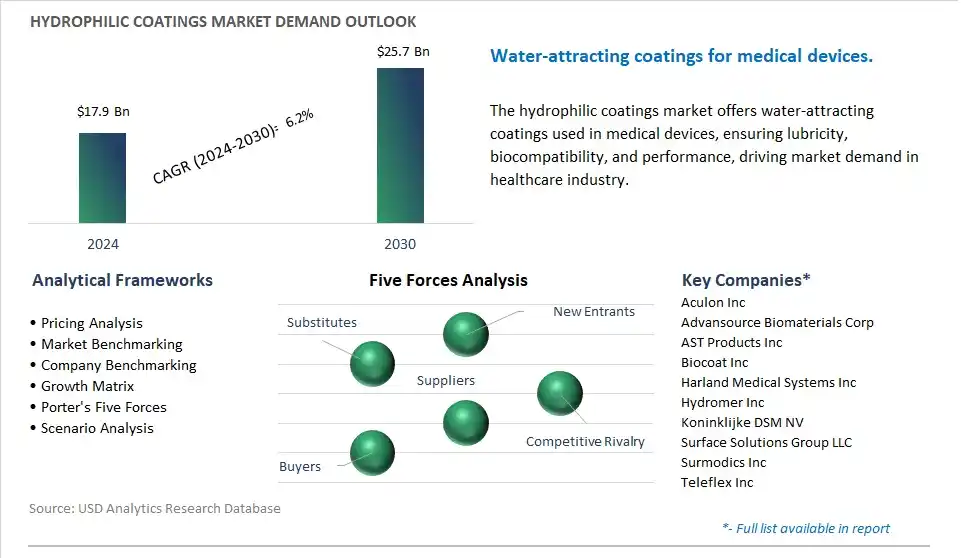
Hydrophilic Coatings Market Competitive Landscape
The market report analyses the leading companies in the industry including Aculon Inc, Advansource Biomaterials Corp, AST Products Inc, Biocoat Inc, Harland Medical Systems Inc, Hydromer Inc, Koninklijke DSM NV, Surface Solutions Group LLC, Surmodics Inc, Teleflex Inc.
Hydrophilic Coatings Market Dynamics
Hydrophilic Coatings Market Trend: Increasing Demand for Medical Devices and Implants with Enhanced Biocompatibility
A prominent trend in the market for Hydrophilic Coatings is the increasing demand for medical devices and implants with enhanced biocompatibility in the healthcare industry. As the population ages and the prevalence of chronic diseases rises, there is a growing need for medical devices and implants that minimize the risk of adverse reactions and improve patient outcomes. Hydrophilic coatings, which have the ability to attract and retain water molecules, enhance the lubricity and biocompatibility of medical devices such as catheters, guidewires, stents, and implants, reducing friction, tissue irritation, and thrombus formation during insertion and use. This is driven by advancements in medical technology, the growing importance of minimally invasive procedures, and regulatory requirements for safer and more effective medical devices, leading to increased adoption of hydrophilic coatings in medical applications worldwide.
Hydrophilic Coatings Market Driver: Surge in Minimally Invasive Surgeries and Endovascular Interventions
The market for Hydrophilic Coatings is being driven by the surge in minimally invasive surgeries and endovascular interventions, which require medical devices with superior lubricity and maneuverability to navigate through complex anatomical structures and vessels. With advancements in imaging technologies and surgical techniques, there is a growing preference for minimally invasive approaches that offer shorter recovery times, reduced postoperative complications, and improved patient comfort compared to traditional open surgeries. Hydrophilic coatings play a crucial role in facilitating the smooth insertion and advancement of catheters, guidewires, and other devices through blood vessels and body cavities, enabling precise positioning and delivery of therapeutic agents. Factors such as demographic shifts, increasing healthcare expenditure, and the expanding range of minimally invasive procedures drive the demand for hydrophilic-coated medical devices, fueling market growth and adoption in the healthcare sector.
Hydrophilic Coatings Market Opportunity: Expansion into Drug Delivery Systems and Implantable Devices
An exciting opportunity within the market for Hydrophilic Coatings lies in the expansion into drug delivery systems and implantable devices, where there is a growing demand for coatings that can improve device performance, biocompatibility, and patient outcomes. Companies can explore opportunities to develop hydrophilic coatings for drug-eluting stents, implantable sensors, and other implantable devices that require controlled release of therapeutic agents or sustained drug delivery. Additionally, there is potential to innovate in coating technologies to enhance the stability and functionality of drug-loaded coatings, ensuring precise drug release kinetics and therapeutic efficacy over extended periods. By leveraging their expertise in materials science, surface chemistry, and biomedical engineering, companies can capitalize on the growing market for implantable medical devices and drug delivery systems and position themselves as leaders in providing innovative hydrophilic coating solutions that address unmet clinical needs, driving growth and differentiation in the hydrophilic coatings market.
Hydrophilic Coatings Market Ecosystem
The hydrophilic coatings market encompasses diverse key stages, with different companies contributing to its production and application. Chemical giants including BASF and Dow Chemical serve as raw material suppliers, providing chemicals essential for hydrophilic coating formulations. Additionally, nanomaterial suppliers including Nanoco Technologies and US Research Nanomaterials offer specialized nanoparticles to enhance coating properties. Specialty coating manufacturers including Evonik and Henkel are responsible for developing and manufacturing various hydrophilic coatings, leveraging their expertise to create formulations tailored to specific applications.
Coating applicators, including companies including Mankato Coating and Amada Weld Tech, specialize in applying hydrophilic coatings to different substrates using various techniques including spraying, dipping, or roll coating. coating manufacturers have in-house application facilities for specific products or customer projects. The end-users of hydrophilic coatings span multiple industries, including the medical device industry, where these coatings are applied to devices including catheters and stents to enhance biocompatibility and reduce friction. In the textile industry, hydrophilic coatings are used on fabrics for moisture management and antimicrobial properties, while in the packaging industry, they prevent fogging and improve product visibility on food packaging materials.
Hydrophilic Coatings Market Share Analysis: Polymers substrate held the dominant revenue share in 2024
The largest segment in the Hydrophilic Coatings Market is the Polymers substrate segment. This dominance is primarily due to diverse key factors. Polymers are widely used as substrates in various industries, including healthcare, automotive, electronics, and packaging, where hydrophilic coatings play a crucial role in improving surface properties and functionality. Additionally, polymers offer diverse advantages as substrates for hydrophilic coatings, including flexibility, lightweight, chemical resistance, and ease of processing and fabrication. These properties make polymers highly versatile and suitable for a wide range of applications requiring hydrophilic surfaces, such as medical devices, catheters, stents, contact lenses, and diagnostic equipment. In addition, the demand for hydrophilic coatings on polymer substrates is driven by the need to enhance biocompatibility, reduce friction, prevent biofouling, and improve performance in wet environments. Further, advancements in polymer chemistry, surface modification techniques, and coating technologies enable the development of customized hydrophilic coatings tailored to specific substrate materials and application requirements. Overall, the Polymers substrate segment holds the largest share in the Hydrophilic Coatings Market due to the widespread use of polymers in various industries, their favorable properties as coating substrates, and the increasing demand for hydrophilic surfaces in medical and industrial applications.
Hydrophilic Coatings Market Share Analysis: Medical Devices is the fastest growing market segment over the forecast period to 2030
The fastest-growing segment in the Hydrophilic Coatings Market is the Medical Devices end-user segment. This growth is primarily due to diverse key factors. Firstly, there is a rising demand for medical devices with enhanced biocompatibility and performance characteristics to improve patient outcomes and reduce healthcare-associated infections. Hydrophilic coatings play a crucial role in medical device applications by providing lubricity, low friction, and hemocompatibility, which are essential for devices such as catheters, guidewires, stents, and surgical instruments. Additionally, the increasing prevalence of minimally invasive procedures and advancements in medical technology drive the adoption of hydrophilic coatings to facilitate device insertion, maneuverability, and navigation within the body's natural pathways. In addition, stringent regulatory requirements and standards governing medical device safety and efficacy further propel the demand for high-quality hydrophilic coatings that meet biocompatibility and sterilization requirements. Further, demographic trends such as aging populations and the growing incidence of chronic diseases fuel the demand for medical devices and procedures, driving the need for advanced coatings to enhance device performance and patient comfort. Overall, the Medical Devices end-user segment is experiencing rapid growth in the Hydrophilic Coatings Market due to increasing healthcare expenditure, technological advancements, regulatory compliance, and the expanding application scope of hydrophilic coatings in medical devices.
Hydrophilic Coatings Market Report Scope-
By Substrate
Polymers
Glass/Ceramics
Metals
Nanoparticles
Others
By End-User
Medical Devices
Optics
Automotive
Aerospace
Marine
Others
Hydrophilic Coatings Market Companies Profiled
Aculon Inc
Advansource Biomaterials Corp
AST Products Inc
Biocoat Inc
Harland Medical Systems Inc
Hydromer Inc
Koninklijke DSM NV
Surface Solutions Group LLC
Surmodics Inc
Teleflex Inc
*- List Not Exhaustive
TABLE OF CONTENTS
1 Introduction to 2024 Hydrophilic Coatings Market
1.1 Market Overview
1.2 Quick Facts
1.3 Scope/Objective of the Study
1.4 Market Definition
1.5 Countries and Regions Covered
1.6 Units, Currency, and Conversions
1.7 Industry Value Chain
2 Research Methodology
2.1 Market Size Estimation
2.2 Sources and Research Methodology
2.3 Data Triangulation
2.4 Assumptions and Limitations
3 Executive Summary
3.1 Global Hydrophilic Coatings Market Size Outlook, $ Million, 2021 to 2030
3.2 Hydrophilic Coatings Market Outlook by Type, $ Million, 2021 to 2030
3.3 Hydrophilic Coatings Market Outlook by Product, $ Million, 2021 to 2030
3.4 Hydrophilic Coatings Market Outlook by Application, $ Million, 2021 to 2030
3.5 Hydrophilic Coatings Market Outlook by Key Countries, $ Million, 2021 to 2030
4 Market Dynamics
4.1 Key Driving Forces of Hydrophilic Coatings Industry
4.2 Key Market Trends in Hydrophilic Coatings Industry
4.3 Potential Opportunities in Hydrophilic Coatings Industry
4.4 Key Challenges in Hydrophilic Coatings Industry
5 Market Factor Analysis
5.1 Value Chain Analysis
5.2 Competitive Landscape
5.2.1 Global Hydrophilic Coatings Market Share by Company (%), 2023
5.2.2 Product Offerings by Company
5.3 Porter’s Five Forces Analysis
5.4 Pricing Analysis and Outlook
6 Growth Outlook Across Scenarios
6.1 Growth Analysis-Case Scenario Definitions
6.2 Low Growth Scenario Forecasts
6.3 Reference Growth Scenario Forecasts
6.4 High Growth Scenario Forecasts
7 Global Hydrophilic Coatings Market Outlook by Segments
7.1 Hydrophilic Coatings Market Outlook by Segments, $ Million, 2021- 2030
By Substrate
Polymers
Glass/Ceramics
Metals
Nanoparticles
Others
By End-User
Medical Devices
Optics
Automotive
Aerospace
Marine
Others
8 North America Hydrophilic Coatings Market Analysis and Outlook To 2030
8.1 Introduction to North America Hydrophilic Coatings Markets in 2024
8.2 North America Hydrophilic Coatings Market Size Outlook by Country, 2021-2030
8.2.1 United States
8.2.2 Canada
8.2.3 Mexico
8.3 North America Hydrophilic Coatings Market size Outlook by Segments, 2021-2030
By Substrate
Polymers
Glass/Ceramics
Metals
Nanoparticles
Others
By End-User
Medical Devices
Optics
Automotive
Aerospace
Marine
Others
9 Europe Hydrophilic Coatings Market Analysis and Outlook To 2030
9.1 Introduction to Europe Hydrophilic Coatings Markets in 2024
9.2 Europe Hydrophilic Coatings Market Size Outlook by Country, 2021-2030
9.2.1 Germany
9.2.2 France
9.2.3 Spain
9.2.4 United Kingdom
9.2.4 Italy
9.2.5 Russia
9.2.6 Norway
9.2.7 Rest of Europe
9.3 Europe Hydrophilic Coatings Market Size Outlook by Segments, 2021-2030
By Substrate
Polymers
Glass/Ceramics
Metals
Nanoparticles
Others
By End-User
Medical Devices
Optics
Automotive
Aerospace
Marine
Others
10 Asia Pacific Hydrophilic Coatings Market Analysis and Outlook To 2030
10.1 Introduction to Asia Pacific Hydrophilic Coatings Markets in 2024
10.2 Asia Pacific Hydrophilic Coatings Market Size Outlook by Country, 2021-2030
10.2.1 China
10.2.2 India
10.2.3 Japan
10.2.4 South Korea
10.2.5 Indonesia
10.2.6 Malaysia
10.2.7 Australia
10.2.8 Rest of Asia Pacific
10.3 Asia Pacific Hydrophilic Coatings Market size Outlook by Segments, 2021-2030
By Substrate
Polymers
Glass/Ceramics
Metals
Nanoparticles
Others
By End-User
Medical Devices
Optics
Automotive
Aerospace
Marine
Others
11 South America Hydrophilic Coatings Market Analysis and Outlook To 2030
11.1 Introduction to South America Hydrophilic Coatings Markets in 2024
11.2 South America Hydrophilic Coatings Market Size Outlook by Country, 2021-2030
11.2.1 Brazil
11.2.2 Argentina
11.2.3 Rest of South America
11.3 South America Hydrophilic Coatings Market size Outlook by Segments, 2021-2030
By Substrate
Polymers
Glass/Ceramics
Metals
Nanoparticles
Others
By End-User
Medical Devices
Optics
Automotive
Aerospace
Marine
Others
12 Middle East and Africa Hydrophilic Coatings Market Analysis and Outlook To 2030
12.1 Introduction to Middle East and Africa Hydrophilic Coatings Markets in 2024
12.2 Middle East and Africa Hydrophilic Coatings Market Size Outlook by Country, 2021-2030
12.2.1 Saudi Arabia
12.2.2 UAE
12.2.3 Oman
12.2.4 Rest of Middle East
12.2.5 Egypt
12.2.6 Nigeria
12.2.7 South Africa
12.2.8 Rest of Africa
12.3 Middle East and Africa Hydrophilic Coatings Market size Outlook by Segments, 2021-2030
By Substrate
Polymers
Glass/Ceramics
Metals
Nanoparticles
Others
By End-User
Medical Devices
Optics
Automotive
Aerospace
Marine
Others
13 Company Profiles
13.1 Company Snapshot
13.2 SWOT Profiles
13.3 Products and Services
13.4 Recent Developments
13.5 Financial Profile
Aculon Inc
Advansource Biomaterials Corp
AST Products Inc
Biocoat Inc
Harland Medical Systems Inc
Hydromer Inc
Koninklijke DSM NV
Surface Solutions Group LLC
Surmodics Inc
Teleflex Inc
14 Appendix
14.1 Customization Offerings
14.2 Subscription Services
14.3 Related Reports
14.4 Publisher Expertise
By Substrate
Polymers
Glass/Ceramics
Metals
Nanoparticles
Others
By End-User
Medical Devices
Optics
Automotive
Aerospace
Marine
Others
Countries Analyzed
North America (US, Canada, Mexico)
Europe (Germany, UK, France, Spain, Italy, Russia, Rest of Europe)
Asia Pacific (China, India, Japan, South Korea, Australia, South East Asia, Rest of Asia)
South America (Brazil, Argentina, Rest of South America)
Middle East and Africa (Saudi Arabia, UAE, Rest of Middle East, South Africa, Egypt, Rest of Africa)
