
The Implantable Defibrillators Market study analyzes and forecasts the market size across 6 regions and 24 countries for diverse segments- By Type (Singel Chambered, Dual Chambered, Biventricular (cardiac resynchronization therapy)), By Route of Administration (Transvenous/Traditional ICD, Subcutaneous (S-ICD)), By End-User (Hospitals, Specialty Clinics, Ambulatory Surgical Centers).
In 2024, the market for implantable defibrillators continues to be a cornerstone in the management of life-threatening cardiac arrhythmias, providing essential protection against sudden cardiac death and improving survival outcomes for individuals at risk. Implantable defibrillators, including implantable cardioverter-defibrillators (ICDs) and cardiac resynchronization therapy defibrillators (CRT-Ds), deliver electrical shocks or pacing therapies to restore normal heart rhythm and prevent fatal arrhythmias such as ventricular fibrillation and ventricular tachycardia. These devices are indicated for patients with a history of cardiac arrest, sustained ventricular arrhythmias, heart failure, or significant risk factors for sudden cardiac death. Technological advancements in implantable defibrillator design, battery longevity, and programming algorithms have enhanced device performance, reliability, and patient safety. Additionally, the integration of remote monitoring capabilities enables healthcare providers to remotely monitor device function and patient status, facilitating early detection of arrhythmias and timely intervention. With the growing prevalence of cardiovascular diseases and the expanding indications for implantable defibrillators, the market is poised for continued growth and innovation in cardiac arrhythmia management, ensuring better quality of life and improved outcomes for patients at risk of sudden cardiac death.
Implantable defibrillators market is witnessing a prominent trend towards miniaturization and technological advancements. As technology progresses, manufacturers are developing smaller and more sophisticated devices, leading to improved patient comfort, enhanced durability, and better overall performance. Miniaturization allows for easier implantation procedures, reduces the risk of complications, and promotes greater patient acceptance of these life-saving devices. Furthermore, advancements in technology such as enhanced sensing algorithms, remote monitoring capabilities, and integration with other cardiovascular devices are enhancing the effectiveness and efficiency of implantable defibrillators, driving market growth.
A key driver for the implantable defibrillators market is the escalating incidence of cardiovascular diseases globally. Factors such as sedentary lifestyles, unhealthy dietary habits, rising prevalence of obesity, and an aging population contribute to the increasing burden of cardiovascular disorders. Implantable defibrillators play a crucial role in managing life-threatening cardiac arrhythmias and sudden cardiac arrests, thereby significantly reducing mortality rates associated with these conditions. As the prevalence of cardiovascular diseases continues to rise, there is a growing demand for implantable defibrillators, driving market expansion.
An emerging opportunity in the implantable defibrillators market lies in the expansion of applications and penetration into emerging economies. While developed regions have been the primary markets for these devices, there is a significant untapped potential in emerging economies where healthcare infrastructure is rapidly improving, and awareness about cardiovascular diseases is increasing. Additionally, rising disposable incomes, expanding healthcare budgets, and a growing emphasis on preventive care present favorable conditions for market penetration. Manufacturers can capitalize on this opportunity by strategically expanding their presence in emerging markets, offering affordable solutions, and investing in awareness campaigns to educate both healthcare professionals and patients about the benefits of implantable defibrillators. This expansion not only addresses unmet medical needs but also fuels market growth in regions with substantial market potential.
In the Implantable Defibrillators Market, the segment experiencing the fastest growth is the Subcutaneous Implantable Cardioverter Defibrillator (S-ICD). S-ICDs represent a newer generation of implantable defibrillator technology designed to deliver therapy for ventricular arrhythmias while avoiding intravascular leads and the need for transvenous access to the heart. This approach reduces the risk of complications associated with traditional transvenous implantable cardioverter defibrillators (TV-ICDs), such as lead fractures, infections, and venous thrombosis. Additionally, S-ICDs offer potential advantages in terms of implantation technique, patient comfort, and long-term management. As healthcare providers and patients seek alternatives to traditional ICDs, the demand for S-ICDs is growing rapidly. Hospitals, specialty clinics, and ambulatory surgical centers are key end-users involved in the implantation and management of S-ICD devices. With ongoing advancements in S-ICD technology, expanding indications, and positive clinical outcomes, the S-ICD segment is poised for significant growth in the implantable defibrillators market.
The market research study provides in-depth insights into leading companies including the SWOT analyses, product profile, financial details, and recent developments acrossAbbott Laboratories, Biotronik SE & Co. KG, Boston Scientific Corp, LivaNova PLC, Medtronic plc, MicroPort Scientific Corp
By Type
Singel Chambered
Dual Chambered
Biventricular (cardiac resynchronization therapy)
By Route of Administration
Transvenous/Traditional ICD
Subcutaneous (S-ICD)
By End-User
Hospitals
Specialty Clinics
Ambulatory Surgical Centers
Geographical Analysis
North America (United States, Canada, Mexico)
Europe (Germany, France, United Kingdom, Spain, Italy, Rest of Europe)
Asia Pacific (China, India, Japan, South Korea, Rest of Asia Pacific)
South America (Brazil, Argentina, Rest of South America)
Middle East and Africa (Saudi Arabia, UAE, Rest of Middle East, South Africa, Egypt, Rest of Africa)
Abbott Laboratories
Biotronik SE & Co. KG
Boston Scientific Corp
LivaNova PLC
Medtronic plc
MicroPort Scientific Corp
• Deepen your industry insights and navigate uncertainties for strategy formulation, CAPEX, and Operational decisions
• Gain access to detailed insights on the Implantable Defibrillators Market, encompassing current market size, growth trends, and forecasts till 2030.
• Access detailed competitor analysis, enabling competitive advantage through a thorough understanding of market players, strategies, and potential differentiation opportunities
• Stay ahead of the curve with insights on technological advancements, innovations, and upcoming trends
• Identify lucrative investment avenues and expansion opportunities within the Implantable Defibrillators Market industry, guided by robust, data-backed analysis.
• Understand regional and global markets through country-wise analysis, regional market potential, regulatory nuances, and dynamics
• Execute strategies with confidence and speed through information, analytics, and insights on the industry value chain
• Corporate leaders, strategists, financial experts, shareholders, asset managers, and governmental representatives can make long-term planning scenarios and build an integrated and timely understanding of market dynamics
• Benefit from tailored solutions and expert consultation based on report insights, providing personalized strategies aligned with specific business needs.
TABLE OF CONTENTS
1 Introduction to 2024 Implantable Defibrillators Market
1.1 Market Overview
1.2 Quick Facts
1.3 Scope/Objective of the Study
1.4 Market Definition
1.5 Countries and Regions Covered
1.6 Units, Currency, and Conversions
1.7 Industry Value Chain
2 Research Methodology
2.1 Market Size Estimation
2.2 Sources and Research Methodology
2.3 Data Triangulation
2.4 Assumptions and Limitations
3 Executive Summary
3.1 Global Implantable Defibrillators Market Size Outlook, $ Million, 2021 to 2030
3.2 Implantable Defibrillators Market Outlook by Type, $ Million, 2021 to 2030
3.3 Implantable Defibrillators Market Outlook by Product, $ Million, 2021 to 2030
3.4 Implantable Defibrillators Market Outlook by Application, $ Million, 2021 to 2030
3.5 Implantable Defibrillators Market Outlook by Key Countries, $ Million, 2021 to 2030
4 Market Dynamics
4.1 Key Driving Forces of Implantable Defibrillators Industry
4.2 Key Market Trends in Implantable Defibrillators Industry
4.3 Potential Opportunities in Implantable Defibrillators Industry
4.4 Key Challenges in Implantable Defibrillators Industry
5 Market Factor Analysis
5.1 Value Chain Analysis
5.2 Competitive Landscape
5.2.1 Global Implantable Defibrillators Market Share by Company (%), 2023
5.2.2 Product Offerings by Company
5.3 Porter’s Five Forces Analysis
5.4 Pricing Analysis and Outlook
6 Growth Outlook Across Scenarios
6.1 Growth Analysis-Case Scenario Definitions
6.2 Low Growth Scenario Forecasts
6.3 Reference Growth Scenario Forecasts
6.4 High Growth Scenario Forecasts
7 Global Implantable Defibrillators Market Outlook by Segments
7.1 Implantable Defibrillators Market Outlook by Segments, $ Million, 2021- 2030
By Type
Singel Chambered
Dual Chambered
Biventricular (cardiac resynchronization therapy)
By Route of Administration
Transvenous/Traditional ICD
Subcutaneous (S-ICD)
By End-User
Hospitals
Specialty Clinics
Ambulatory Surgical Centers
8 North America Implantable Defibrillators Market Analysis and Outlook To 2030
8.1 Introduction to North America Implantable Defibrillators Markets in 2024
8.2 North America Implantable Defibrillators Market Size Outlook by Country, 2021-2030
8.2.1 United States
8.2.2 Canada
8.2.3 Mexico
8.3 North America Implantable Defibrillators Market size Outlook by Segments, 2021-2030
By Type
Singel Chambered
Dual Chambered
Biventricular (cardiac resynchronization therapy)
By Route of Administration
Transvenous/Traditional ICD
Subcutaneous (S-ICD)
By End-User
Hospitals
Specialty Clinics
Ambulatory Surgical Centers
9 Europe Implantable Defibrillators Market Analysis and Outlook To 2030
9.1 Introduction to Europe Implantable Defibrillators Markets in 2024
9.2 Europe Implantable Defibrillators Market Size Outlook by Country, 2021-2030
9.2.1 Germany
9.2.2 France
9.2.3 Spain
9.2.4 United Kingdom
9.2.4 Italy
9.2.5 Russia
9.2.6 Norway
9.2.7 Rest of Europe
9.3 Europe Implantable Defibrillators Market Size Outlook by Segments, 2021-2030
By Type
Singel Chambered
Dual Chambered
Biventricular (cardiac resynchronization therapy)
By Route of Administration
Transvenous/Traditional ICD
Subcutaneous (S-ICD)
By End-User
Hospitals
Specialty Clinics
Ambulatory Surgical Centers
10 Asia Pacific Implantable Defibrillators Market Analysis and Outlook To 2030
10.1 Introduction to Asia Pacific Implantable Defibrillators Markets in 2024
10.2 Asia Pacific Implantable Defibrillators Market Size Outlook by Country, 2021-2030
10.2.1 China
10.2.2 India
10.2.3 Japan
10.2.4 South Korea
10.2.5 Indonesia
10.2.6 Malaysia
10.2.7 Australia
10.2.8 Rest of Asia Pacific
10.3 Asia Pacific Implantable Defibrillators Market size Outlook by Segments, 2021-2030
By Type
Singel Chambered
Dual Chambered
Biventricular (cardiac resynchronization therapy)
By Route of Administration
Transvenous/Traditional ICD
Subcutaneous (S-ICD)
By End-User
Hospitals
Specialty Clinics
Ambulatory Surgical Centers
11 South America Implantable Defibrillators Market Analysis and Outlook To 2030
11.1 Introduction to South America Implantable Defibrillators Markets in 2024
11.2 South America Implantable Defibrillators Market Size Outlook by Country, 2021-2030
11.2.1 Brazil
11.2.2 Argentina
11.2.3 Rest of South America
11.3 South America Implantable Defibrillators Market size Outlook by Segments, 2021-2030
By Type
Singel Chambered
Dual Chambered
Biventricular (cardiac resynchronization therapy)
By Route of Administration
Transvenous/Traditional ICD
Subcutaneous (S-ICD)
By End-User
Hospitals
Specialty Clinics
Ambulatory Surgical Centers
12 Middle East and Africa Implantable Defibrillators Market Analysis and Outlook To 2030
12.1 Introduction to Middle East and Africa Implantable Defibrillators Markets in 2024
12.2 Middle East and Africa Implantable Defibrillators Market Size Outlook by Country, 2021-2030
12.2.1 Saudi Arabia
12.2.2 UAE
12.2.3 Oman
12.2.4 Rest of Middle East
12.2.5 Egypt
12.2.6 Nigeria
12.2.7 South Africa
12.2.8 Rest of Africa
12.3 Middle East and Africa Implantable Defibrillators Market size Outlook by Segments, 2021-2030
By Type
Singel Chambered
Dual Chambered
Biventricular (cardiac resynchronization therapy)
By Route of Administration
Transvenous/Traditional ICD
Subcutaneous (S-ICD)
By End-User
Hospitals
Specialty Clinics
Ambulatory Surgical Centers
13 Company Profiles
13.1 Company Snapshot
13.2 SWOT Profiles
13.3 Products and Services
13.4 Recent Developments
13.5 Financial Profile
List of Companies
Abbott Laboratories
Biotronik SE & Co. KG
Boston Scientific Corp
LivaNova PLC
Medtronic plc
MicroPort Scientific Corp
14 Appendix
14.1 Customization Offerings
14.2 Subscription Services
14.3 Related Reports
14.4 Publisher Expertise
By Type
Singel Chambered
Dual Chambered
Biventricular (cardiac resynchronization therapy)
By Route of Administration
Transvenous/Traditional ICD
Subcutaneous (S-ICD)
By End-User
Hospitals
Specialty Clinics
Ambulatory Surgical Centers
Countries Analyzed
North America (United States, Canada, Mexico)
Europe (Germany, France, United Kingdom, Spain, Italy, Rest of Europe)
Asia Pacific (China, India, Japan, South Korea, Rest of Asia Pacific)
South America (Brazil, Argentina, Rest of South America)
Middle East and Africa (Saudi Arabia, UAE, Rest of Middle East, South Africa, Egypt, Rest of Africa)
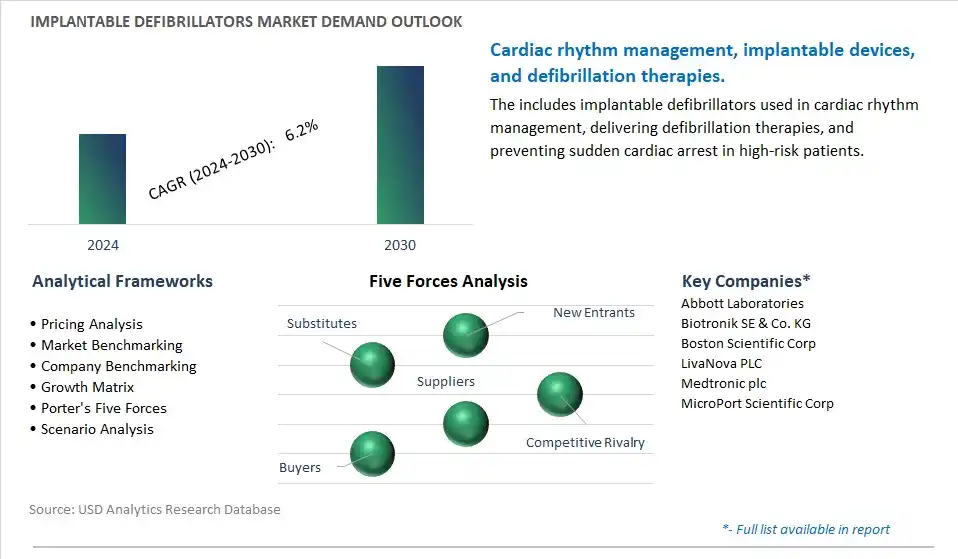
The global Implantable Defibrillators Market is one of the lucrative growth markets, poised to register a 6.2% growth (CAGR) between 2024 and 2030.
Emerging Markets across Asia Pacific, Europe, and Americas present robust growth prospects.
Abbott Laboratories, Biotronik SE & Co. KG, Boston Scientific Corp, LivaNova PLC, Medtronic plc, MicroPort Scientific Corp
Base Year- 2023; Estimated Year- 2024; Historic Period- 2018-2023; Forecast period- 2024 to 2030; Currency: USD; Volume